Children in Cameroon’s Diocese of Maroua-Mokolo, which has faced threats from Boko Haram. Credit: Aid to the Church in Need.
CNA Staff, Mar 19, 2021 / 02:01 pm (CNA).- Catholics in the US are showing more awareness of the problems of Christian persecution worldwide, the pastoral charity Aid to the Church in Need has said.
“It is heartening that, compared to a year ago, significantly more U.S. Catholics say that Christian persecution around the world is very grave and that the issue has become a matter of concern to more faithful. They also want both their Church and their government to step up efforts to do more to combat the issue,” George Marlin, chairman of Aid to the Church in Need-USA said March 17.
57% of U.S. Catholics said they think Christian persecution is “very severe” globally, an increase from 41% last year. About 67% said they are “very concerned” about Christian persecution.
Close to 50% of U.S. Catholics said that half or more of religiously-based attacks in the world are directed at Christians. They identified China, North Korea, and Pakistan as countries where Christians face severe persecution.
Some 52% said Pope Francis is “very engaged” on Christian persecution issues, an increase from 47% last year. About 30% said they think their bishop is “very engaged” on this issue, and 28% say their parish is.
Aid to the Church in Need said there were still gaps in respondents’ awareness. Most respondents did not know that in Pakistan in 2020 some 2,000 mainly Christian girls were abducted and threatened with forcible conversion to Islam. They were unaware that in China Christians who go to Mass are digitally surveilled. Also not known was that in Nigeria last year about 3,500 Christians were killed for their faith. In North Korea, identifying as a Christian can be a capital offense.
Marlin said the poll shows “the great need to inform the public regarding specific instances of Christian persecution.”
He said the U.S, bishops and organizations like Aid to the Church in Need “must step up our educational and informational efforts.”
“It is my hope that leaders around the world embrace the fundamental human right of religious freedom, and promote a society that respects ethnic, cultural and especially religious diversity,” he added.
The survey came just days ahead of Pope Francis’ trip to Iraq, where the Christian population has dwindled through emigration after the chaos of the 2003 U.S. invasion, the rise and fall of the Islamic State, and other major problems.
Aid to the Church in Need-USA commissioned the survey by McLaughlin & Associates. The nationwide poll of 1,000 Catholic adults was conducted Feb. 19-26 and claims an accuracy of plus or minus 3.1%. It is the fourth annual survey on the topic.
The survey also inquired about the religious profile of respondents. It found that 48% self-describe as devout and 39% as somewhat devout. Another 38% said they attend Mass at least weekly, 17% attend monthly, 15% attend only on Christmas and Easter, while 30% never or rarely go. About 31% self-identified as liberal, 35% as moderate, and 34% as conservative.
If you value the news and views Catholic World Report provides, please consider donating to support our efforts. Your contribution will help us continue to make CWR available to all readers worldwide for free, without a subscription. Thank you for your generosity!
Click here for more information on donating to CWR. Click here to sign up for our newsletter.
London, England, Nov 21, 2017 / 03:01 am (CNA/EWTN News).- An English chemist charged with murder for the 2015 killing of his 85-year-old father, who wished to die, was freed on Friday by a judge who said, “Your acts of assistance were acts of pure compassion and mercy.”
Bipin Desai, 58, was also charged with assisted suicide and two counts of theft. Desai gave his father, Dhirajlal Desai, a smoothie laced with stolen morphine at his home in Surrey on Aug. 26, 2015. Desai soon after injected his father with insulin to speed the morphine’s fatal action.
The judge ruled Nov. 17 that because Dhirajlal Desai wished to die, there was no basis for a murder conviction.
Dr. Anthony McCarthy of the Society for the Protection of Unborn Children responded to the ruling asking, “Are we now to believe that the killing of an innocent and vulnerable human being who is ‘tired of life’ is not to be regarded as any serious crime?”
Bipin Desai pleaded guilty to assisted suicide and the theft of the morphine and insulin from his employer. He was given a suspended nine-month jail sentence, and allowed to go free.
The judge, Justice Green, said that to convict Desai of murder would be “perverse and irrational … Your father had a solid and firm wish to die. For him, being assisted to die would be fulfilling his wish of going to heaven to see his wife and being put out of his misery.”
Green said the evidence “provides no support for the prosecution case, to the contrary it unequivocally supports the defence position that this is assisted suicide but not murder,” and that Desai had been “wrongfully accused of murder.”
According to Desai, his father had been asking to end his life after the 2003 death of his wife and the 2010 death of his dog. Desai’s lawyer, Natasha Wong, said in court that “what we have is a man who wanted to die, not because he was terribly ill but, sadly, because he had just had enough of life.”
Though Desai also admitted to stealing the drugs used to kill his father, Green said that “the thefts are trivial and only form part of the fabric of the wider case. The owner of the pharmacy said in his evidence that you were an honest, respectful and decent man.”
“You are free to now go with your family and start the process of rebuilding your life,” he continued.
Assisted suicide and euthanasia are both criminal offenses in England and Wales under the Suicide Act 1961, and are punishable by imprisonment.
A representative of the assisted suicide advocacy group Dignity in Dying said the case showed the need for “safe and compassionate” laws which decriminalized assisted suicide and euthanasia.
Peter Saunders of Care Not Killing responded that “This case underlines the need for better support for those caring for elderly and disabled relatives but does not mean the law should change.”
The Suicide Act 1961 was challenged in High Court last month by a terminally ill man, Noel Conway, who wanted a doctor to be able to prescribe him a lethal dose. His case was dismissed.
In jurisdictions where assisted suicide or euthanasia are legal, the procedures usually require that the individual have a terminal illness and that the fatal drugs are prescribed by a doctor. In the handful of states in the U.S. which have legalized assisted suicide, the individual must have a terminal illness which would lead to death over the course of the next six months.
Anthony McCarthy of SPUC said, “It is shocking that a High Court Judge in this country should speak with such approval of an adult son who ‘sends his father to heaven’. Serious crimes can be ‘well-motivated’ and indeed, mentally ill parents who kill their healthy children sometimes also talk of ‘sending them to heaven’.”
“What now of any respect for laws and investigations which seek to protect the ineliminable value of all human lives, regardless of feelings of sadness and loss on the victim’s part which may perhaps respond to loving care and professional help?”
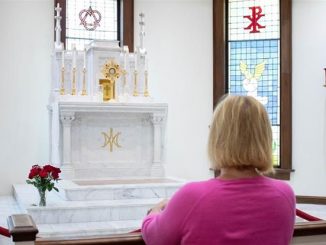
The Adoration Chapel at St. Peter’s Catholic Church in Beaufort, South Carolina. / Photo Credit: Aaron Miller, Miller Design & Marketing
Washington, D.C. Newsroom, Aug 20, 2023 / 05:00 am (CNA).
“Awesome. Awesome.”
That’s how Anna Sudomerski, the communications coordinator at St. Peter’s Catholic Church in Beaufort, South Carolina, describes the parish’s eucharistic adoration program.
St. Peter’s is among the parishes in the United States that are hosting perpetual eucharistic adoration with the Blessed Sacrament exposed 24 hours a day.
Since Church law dictates that exposition of the Blessed Sacrament requires at least one adorer present at all times, this means the parishes that opt for this extraordinary form of worship must coordinate a major year-round effort to ensure at least one volunteer is present before the Eucharist every hour of the day.
Eucharistic adoration, whether exposed or reserved in the tabernacle, is an ancient custom of the Church dating back to its earliest centuries. Yet its practice today occurs among flagging faith in the real presence of Christ in the Eucharist, with U.S. Catholics signaling a growing reluctance to believe that Jesus is truly present in the Blessed Sacrament.
Yet multiple parishes around the country in recent years have maintained vibrant adoration initiatives, including St. Peter’s, which began its perpetual adoration in the early 1990s.
Sudomerski said the St. Peter’s adoration program started at the parish’s original historic church in downtown Beaufort. With the construction of a new church building in 2006, adoration moved to a purpose-built chapel there.
For years, Sudomerski said, the adoration program was run by team captains who each supervised a specific stretch of hours within a given 24-hour period.
“They were in charge of certain times, like from midnight to 6 a.m., in case the adorer could not make it, so the captain would have to find a substitute or cover the hour themselves,” she told CNA. “We had four team captains covering midnight to 6, 6 to noon, noon to 6, and 6 to midnight.”
She said the church’s adoption of the sign-up software Adoration Pro “made it a lot easier for people to sign up.”
“From there, ever since, we’ve done several campaigns,” she said. “One to pass out interest forms to see who would be interested in what hour. We just finished another campaign because Father thought the Eucharist is the most important thing that we have. We’ve done callouts, mailings.”
Light of the World Catholic Church in Littleton, Colorado
Kathryn Nygaard, the communications director at Light of the World Catholic Church in Littleton, Colorado, outside of Denver, said the parish has maintained an adoration program since 2007.
“There are two parishioners who are the main adoration chapel coordinators and they do an incredible job,” she said. “In addition, there are 24 ‘hourly coordinators’ to assist with making sure substitutes fill in during open hours and communicating with the adorers in their specific hour.”
“There are approximately 270 people involved in adoration, as either regularly scheduled adorers or as substitutes,” she said. The church hosts two “renewal weekends” in February for adorers to re-up for the coming year; regular announcements are also made at weekend Masses to attract more interest.
Adorers at Light of the World use the church software Flocknote to communicate with one another, Nygaard said. “Most requests for substitutes are filled within 1-2 days,” she noted.
Bishops aim to ‘start a fire’ of eucharistic renewal
The U.S. bishops last year launched the National Eucharistic Revival, meant to “start a fire” of eucharistic devotion among Catholics in the United States. The initiative was first conceived following the 2019 Pew poll showing low numbers of Catholics with a belief in the Real Presence.
As part of the three-year program, parishes around the country have been encouraged to launch Eucharist-focused programs and events to draw parishioners into a deeper relationship with Jesus through the Blessed Sacrament.
Next year, the bishops will host a National Eucharistic Congress featuring multiple high-profile Catholic speakers along with what is expected to be a crowd of about 80,000 Catholics. Pope Francis in June called next year’s national congress “a significant moment in the life of the Church in the United States.”
St. Bonaventure Catholic Church in Columbus, Nebraska
At St. Bonaventure Catholic Church in Columbus, Nebraska, worshippers have been keeping perpetual adoration there for more than 62 years — since Feb. 14, 1961, according to a live clock on the parish’s website.
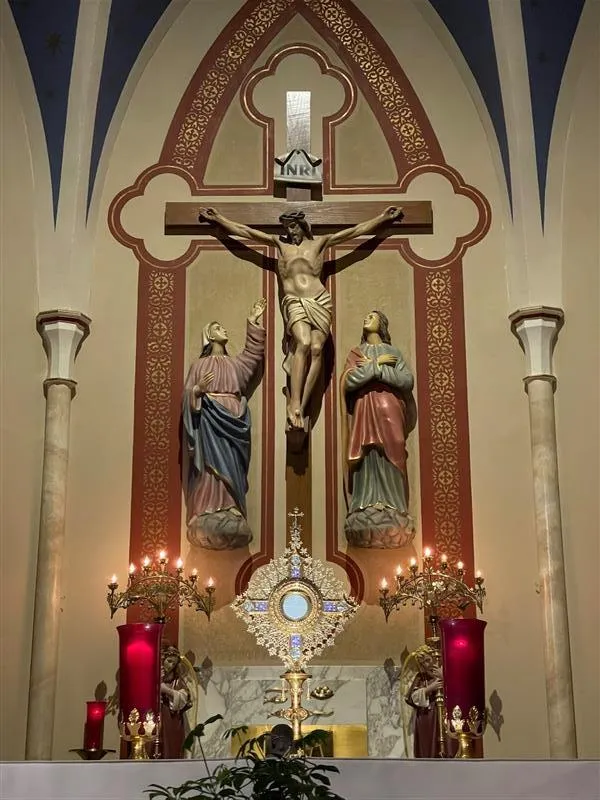
The exposed Blessed Sacrament at St. Bonaventure Catholic Church in Columbus, Nebraska. Credit: Tim Cumberland
The parish on its website says the roots of its adoration program go back to 1949 and expanded thereafter. The program now includes worshippers from other nearby parishes who come to participate in adoration.
Parishioner Tim Cumberland told CNA the church is “blessed to have about 550 people in the program.”
“A few years ago, we went to an automated process of managing our perpetual adoration program, using the Adoration Pro software,” Cumberland said. “This has greatly improved our ability for our adorers to find subs online when necessary. A request for a substitute is usually filled within minutes.”
Kim Waller said the 25-year-old adoration program at Holy Infant Catholic Church in Ballwin, Missouri, still uses a coordinator-led sign-up program instead of an online sign-up. Like many programs, Holy Infant breaks down management of the adoration schedule into hourly segments.
“The 24 hourly coordinators form the backbone of perpetual adoration,” she said. “They ensure that there is at least one adorer present in the chapel at all times. The hourly coordinator reviews the sign-up list weekly to ensure that their committed hourly adorer fulfills his/her commitment and contacts the adorer if she/he has not been to adoration as committed for two consecutive weeks.”
A new team of coordinators just took over in January, Waller said. “The last several years, the ministry was administered by a couple who since have passed within six months of each other,” she said.
St. Mary Help of Christians in Aiken, South Carolina
Donna Pierce told CNA she helped launch the 24/7 adoration program at St. Mary Help of Christians in Aiken, South Carolina, roughly 30 years ago.
“I think we have about 10-15 people who have maintained their Holy Hour since it began, and currently we have 318 weekly adorers and about 60 substitutes, not counting the many people that pop in the chapel when they can,” she said.
Pierce said a priest from a perpetual adoration apostolate helped the parish launch the program. “He told us that having perpetual adoration is actually much easier to run than a 40-hours or other time frame,” she said. “Adorers incorporate their hour into their schedule, so you don’t have to keep signing up from scratch.”
The exposed Blessed Sacrament in the St. Claire Chapel at St. Mary Help of Christians in Aiken, South Carolina. Credit: Lori Rainchuso
She said the parish maintains participation in the program by way of biannual talks at Masses (which Pierce described as “our fall and Lent blitzes”). These efforts usually result in upwards of a few dozen sign-ups.
On the website for the National Eucharistic Revival, the bishops say that the current year of the program is focused on “fostering eucharistic devotion at the parish level, strengthening our liturgical life through the faithful celebration of the Mass, eucharistic adoration, missions, resources, preaching, and organic movements of the Holy Spirit.”
Catholic evangelist Tim Glemkowski in a video for the revival urged parish leaders to “prioritize personal encounters with Jesus in the Eucharist” over the course of the year.
“The heart of this invitation … is to create space in our parish calendar this year for people to come and encounter Jesus in the Eucharist personally,” he said. “This could mean parishes that don’t have perpetual adoration start that opportunity, or opportunities for eucharistic processions, or different devotional experiences.”
Pierce said that starting the St. Mary program decades ago was a daunting prospect, but she went ahead with it by putting her trust in God.
“It was terrifying when Msgr. [Thomas] Evatt asked me to be head coordinator to start it so long ago — I was 30 years old with a toddler and working part time,” Pierce said. “So I made a deal with God. He would have to be responsible for sustaining it, and we would just be his instruments.”
“How many, many times he made it obvious he was running it!” she said.
Graces for eternity
St. Bonaventure’s website, meanwhile, predicts that the graces of perpetual adoration will redound not just in the present but for eternity.
“Someday far, far from now, there will be a magnificent heavenly banquet where all of the adorers in the St. Bonaventure adoration program will be reunited,” the parish’s website says.
“Won’t it be wonderful,” the website continues, “for all of us who have been in the program to share stories of how many of our lives, and the lives of those we touched as a result, were radically changed by this personal and enduring encounter with Our Lord!”








Leave a Reply