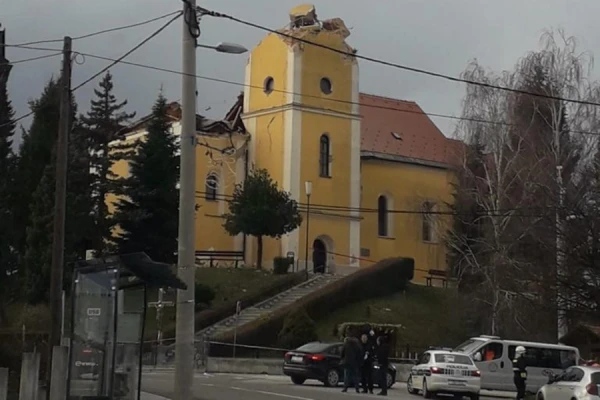
The earthquake-damaged Church of the Exaltation of the Holy Cross in Kravarsko, Croatia. Photo courtesy of Ksenija Abramović/Laudato TV.
CNA Staff, Dec 30, 2020 / 10:30 am (CNA).- A bishop asked Catholics to fast and pray for two days Wednesday after an earthquake struck Croatia.
Bishop Vlado Košić of Sisak issued the appeal to Catholics in his diocese and throughout the country after a magnitude 6.4 earthquake on Dec. 29 that killed at least seven people and injured 26 others.
His diocese includes the town of Petrinja, located close to the epicenter of the quake, which was felt in the neighboring countries of Slovenia, Bosnia and Herzegovina, Serbia, and Hungary, as well as Austria and Italy.
In a statement reported Dec. 30 by Croatia’s Catholic Information Agency, the bishop called for prayer and fasting Dec. 30-31 that residents would be spared further suffering.
He said that many people had been left homeless and feared aftershocks.
“We lost the cathedral and about a dozen other churches, not counting the chapels, which were destroyed by the earthquake, and many were severely damaged,” he said.
“We pray for the strength to endure all this faithfully and that in this tragedy we all remain brave and in solidarity.”
Among those killed in the earthquake was a 12-year-old girl. Another victim was discovered in the rubble at a church in the village of Žažina. Local media reported that the man was the church’s organist.
An estimated 86% of Croatia’s four million-strong population is Catholic.
Yesterday, an earthquake in Croatia caused victims and caused serious damage. I express my closeness to the wounded and to those who have been affected by the quake and I pray in particular for those who have lost their lives and for their families.
At Wednesday’s general audience, Pope Francis prayed for the victims of the earthquake.
He said: “Yesterday an earthquake caused casualties and extensive damage in Croatia. I express my closeness to the injured and to those affected by the earthquake, and I pray in particular for those who have lost their lives and for their families.”
“I hope that the authorities of the country, with the help of the international community, will soon be able to alleviate the suffering of the dear Croatian people.”
The Pastoral Directorate for Croats Abroad has urged members of the Croatian diaspora to send aid via Caritas Croatia.
If you value the news and views Catholic World Report provides, please consider donating to support our efforts. Your contribution will help us continue to make CWR available to all readers worldwide for free, without a subscription. Thank you for your generosity!
Click here for more information on donating to CWR. Click here to sign up for our newsletter.

The Holy Tunic of Christ on display in Argenteuil, France, in 2016. / Credit: Simon de l’Ouest, CC BY-SA 4.0, via Wikimedia Commons
Paris, France, Apr 24, 2025 / 11:00 am (CNA).
A rare exhibit of the Holy Tunic of Christ — believed to be the garment worn by Jesus during his passion — is drawing unprecedented crowds to the Basilica of Saint-Denis in Argenteuil, a suburb of Paris.
Open to the public from April 18 to May 11, the exhibit is galvanizing Catholic faithful across Europe. More than 400,000 pilgrims are expected during the 23-day event — more than double the attendance of the previous exhibit in 2016.
Argenteuil, a city that has seen significant Muslim immigration in recent decades, now finds itself at the heart of a surprising spiritual resurgence.
To accommodate the historic influx of visitors, the Diocese of Pontoise — which oversees the basilica — has launched a large-scale logistical effort. The monument will remain open daily from 9 a.m. to 10 p.m., with overnight access on the three Saturdays following Easter.
An educational and spiritual path accompanies pilgrims as they venerate the Holy Tunic, with several hundred trained volunteers assisting to guide the faithful and maintain a smooth flow of visitors.
The exhibit of the Holy Tunic opened on Good Friday, April 18, with a solemn Mass celebrated by Bishop Benoît Bertrand of Pontoise, followed by a public Stations of the Cross procession through the streets of Argenteuil. Secretary of State Cardinal Pietro Parolin was originally scheduled to preside over the closing Mass on May 11, but the recent death of Pope Francis on April 21 and the upcoming conclave may alter the Vatican delegation’s presence.
The Holy Tunic has only been publicly displayed twice in the 20th century — in 1934 and 1984 — drawing approximately 80,000 visitors each time.
In a statement, the Diocese of Pontoise emphasized that the purpose of the exhibit is to offer believers “an opportunity to meditate on the passion of Christ and the profound meaning of his sacrifice.”
Speaking to the Catholic weekly Famille Chrétienne, Father Guy-Emmanuel Cariot, rector of the basilica, underlined the spiritual dimension of the event. “Our task is to organize the encounter between people and the Holy Tunic — then the Lord does what he has to do,” he said.
For Cariot, the relic is “an open book of the Passion,” capable of moving modern hearts. “More than the relic itself, it is Jesus who draws people in,” he added, inviting every pilgrim to contemplate the mystery of redemption.
The Holy Tunic of Argenteuil is considered one of the most precious relics in Christendom. According to tradition, it was discovered in Jaffa in the fourth century by St. Helena, mother of Emperor Constantine, and later gifted by Empress Irene of Constantinople to Charlemagne in the year 800. It was then entrusted to the Benedictine nuns of the Argenteuil abbey. After disappearing during the French Revolution, it was rediscovered in the 19th century and has since undergone several restorations.
The Saint-Denis Basilica in Argenteuil, France. Credit: BastienM, CC BY-SA 3.0, via Wikimedia Commons
While scholars continue to debate its authenticity, the air of mystery surrounding the tunic has only deepened its veneration. For the faithful, it represents far more than a historical artifact: It is a tangible link to Christ’s passion — a sacred object that connects believers today with the redemptive suffering of Jesus.
Historian Jean-Christian Petitfils, author of “La sainte tunique d’Argenteuil: Authentique relique de la Passion du Christ”(“The Holy Tunic of Argenteuil: An Authentic Relic of Christ’s Passion”), argues that both scientific testing and historical indicators support the relic’s authenticity. Nonetheless, he acknowledges that gaps in documentation — and periods when the tunic vanished from the historical record — leave parts of its story shrouded in uncertainty.
This year’s exhibit takes place in a city that has experienced profound socio-religious shifts in recent decades. Argenteuil, home to nearly 110,000 residents — around a third of whom have at least one parent of immigrant origin — has witnessed a sharp and steady decline in Catholic practice, even as Islam has become more visibly present in the public sphere.
Against this backdrop, the display of the Holy Tunic carries significant symbolic weight. It represents a revival of Christian memory and a reaffirmation of the Church’s enduring presence in a society undergoing deep cultural and spiritual transformation. For many, it is a moment of awakening — a testament that the Catholic faith continues to resonate, even in a secularized and religiously diverse environment.
The pastoral programming reflects this ambition. Daily solemn Masses are celebrated by different Church leaders, including Cardinal Louis Raphaël Sako, patriarch of the Chaldeans in Iraq, and Cardinal Juan José Omella, archbishop of Barcelona. Special days are devoted to children, along with scouting vigils and catechesis sessions for families, youth, and spiritual seekers.
In the lead-up to the exhibit, the Holy Tunic toured several French cathedrals between 2024 and March 2025, preparing the public and cultivating a spirit of curiosity and reverence.
This display also coincides with the broader revitalization of the Basilica of Saint-Denis — a spiritual and historical landmark of the Île-de-France region and traditional burial place of French royalty. A major restoration project is underway to reconstruct its north tower and spire, dismantled in the 19th century after a storm.
Since 2022, archaeological excavations have unearthed Merovingian tombs and rare Romanesque elements, paving the way for a full restoration of the west façade, launched in 2023 and scheduled for completion in 2029. The initiative is not only architectural but also educational, featuring a craft village and immersive displays.
Like the exhibit in Argenteuil, it bears witness to a shared drive to revive France’s Christian roots through the transmission and enhancement of its sacred heritage.
Rome Newsroom, Dec 11, 2020 / 08:00 am (CNA).- The Catholic bishops of Spain called Friday for a day of fasting and prayer ahead of the expected approval of a bill to legalize euthanasia and assisted suicide in the country.
Poznan, Poland, Sep 18, 2018 / 06:00 pm (CNA).- Increasing the role of women in screening and training priests is among the steps that should be taken to prevent future sex abuse, said Cardinal Marc Ouellet, prefect of the Congregation for Bishops.
Prayer and fasting are humbling and empowering.
How can we send financial aid to Catholics impacted by the earthquake?