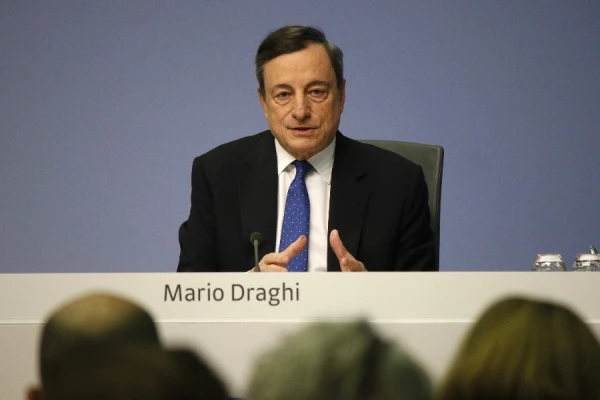
Vatican City, Jul 10, 2020 / 06:45 am (CNA).- Pope Francis appointed the former president of the European Central Bank to the Pontifical Academy of Social Sciences Friday.
The pope named Mario Draghi July 10 as one of three new members of the pontifical academy founded in 1994 by Pope John Paul II to promote the study of social sciences.
Draghi, 72, is an Italian economist best known for serving as president of the European Central Bank (ECB) from 2011 to 2019.
When he took over the helm of the ECB, he was faced with the European sovereign debt crisis. There were fears that mounting debt problems could force countries such as Italy, Spain and Greece to exit the eurozone.
In a 2012 speech, Draghi famously said that the ECB would do “whatever it takes” to preserve the euro during the crisis. The phrase is credited with helping to save the currency. As a result of his interventions, he earned the nickname “Super Mario.”
He will serve as an “ordinary member” of the pontifical academy, along with the Chilean sociologist Pedro Morandé Court and Kokunre Adetokunbo Agbontaen Eghafona, a sociology and anthropology professor at the University of Benin, Nigeria, who were also appointed July 10.
The Pontifical Academy of Social Sciences is one of 10 pontifical academies in Vatican City. Its headquarters is the Casina Pio IV, a villa in the Vatican Gardens, and its current president is another Italian economist, Stefano Zamagni.
If you value the news and views Catholic World Report provides, please consider donating to support our efforts. Your contribution will help us continue to make CWR available to all readers worldwide for free, without a subscription. Thank you for your generosity!
Click here for more information on donating to CWR. Click here to sign up for our newsletter.

Pope Leo XIV speaks from a window of the Apostolic Palace overlooking St. Peter’s Square during the Sunday Angelus on Aug. 24, 2025. / Credit: Vatican Media.
Vatican City, Aug 31, 2025 / 07:10 am (CNA).
Pope Leo XIV on Sunday prayed for the victims of a shooting at a Catholic church in Minneapolis, and deplored a worldwide “pandemic of arms” which has left many children dead or injured.
“Our prayers for the victims of the tragic shooting during a school Mass in the American state of Minnesota,” the pontiff said in English on Aug. 31, after leading the weekly Angelus prayer from a window overlooking St. Peter’s Square.
“We include in our prayers,” he added, “the countless children killed and injured every day around the world. Let us plead to God to stop the pandemic of arms, large and small, which infects our world.”
An Aug. 27 shooting at a school Mass at Annunciation Catholic Church in Minneapolis left two children dead and 17 others wounded.
Leo turned to Mary, the Queen of Peace, to ask for her intercession “to fulfill the prophecy of Isaiah: ‘They shall beat their swords into plowshares and their spears into pruning hooks.’”
A large crowd gathers in and outside of St. Peter’s Square to listen to Pope Leo XIV’s message during the Sunday Angelus on Aug. 31, 2025. Credit: Vatican Media.
In his other appeals after the Angelus, delivered in Italian, Pope Leo repeated his calls for an immediate ceasefire and “a serious commitment to dialogue” in the Middle East, and for prayer and concrete gestures for the victims of the ongoing war in Ukraine.
“The voice of arms must be silenced, while the voice of brotherhood and justice must be raised,” he said.
The pope said his heart is also wounded for those who have died or are missing after a boat carrying migrants from Africa to the Canary Islands capsized off the coast of Mauritania. According to the BBC, at least 69 people have died and many others are missing.
“This mortal tragedy repeats every day everywhere in the world,” Leo said. “Let us pray that the Lord teaches us, as individuals and as a society, to put fully into practice his word: ‘I was a stranger and you welcomed me.’”
“We entrust all our missing, injured, and dead everywhere to our Savior’s loving embrace,” the pontiff said both in English and in Italian.
In his spiritual message before the Angelus prayer, Pope Leo spoke about encounter, which requires openness of heart and humility.
Pope Leo XIV waves to the large crowds in a sunny St. Peter’s Square after delivering a message and leading the Angelus prayer on Aug. 31, 2025. Credit: Vatican Media.
“Humility is really freedom from ourselves,” he emphasized. “It is born when the Kingdom of God and its righteousness become our real concern and we allow ourselves to lift up our eyes and look ahead: not down at our feet, but at what lies ahead!”
Leo said people who put themselves before others, tend to think they are more interesting than anything else, “yet deep down, they are quite insecure.”
“Whereas,” he continued, “those who know that they are precious in God’s eyes, who know they are God’s children, have greater things to be worried about; they possess a sublime dignity all their own.”
The pope reflected on Jesus’ example of how to be a good guest, as described in the day’s Gospel reading; Jesus “acts with respect and sincerity, avoiding merely polite formalities that preclude authentic encounter,” Leo explained.
To extend an invitation to another person, also shows “a sign of openness of heart,” he added.
The pontiff encouraged everyone to invite Jesus to be their guest at Mass, so that he can tell them how it is he sees them.
“It is very important that we see ourselves through his eyes: to see how frequently we reduce life to a competition, how anxious we become to obtain some sort of recognition, and how pointlessly we compare ourselves to others,” he said.
We experience the freedom Jesus wants for us, he added, when we stop to reflect and let ourselves “be taken aback by a word that challenges our hearts’ priorities.”
Vatican City, Jan 30, 2019 / 04:12 am (CNA/EWTN News).- Everyone should pray the Stations of the Cross, Pope Francis said Wednesday, revealing that he always has with him a pocket-size book of “Via Crucis” meditations to pray with when he h… […]
Vatican City, Jan 11, 2019 / 03:53 am (CNA/EWTN News).- The Vatican confirmed Friday that Pope Francis will travel to Romania to the cities of Bucharest, Iaşi, and Blaj, and to a Marian shrine in eastern Transylvania, at the end of May and beginning of June.
The trip is set for May 31 to June 2 and will include a stop at a Marian shrine located in the Șumuleu Ciuc neighborhood of the city of Miercurea Ciuc, which is in a Hungarian ethno-cultural region of Romania.
CNA reported in November that Pope Francis had told the Romanian bishops during their ad limina meeting Nov. 9 that he would be visiting their country this year, though the precise date was not confirmed at the time.
Francis’ visit to the country follows exactly 20 years after Pope St. John Paul II was the first pope to go to Romania in 1999.
The motto of the visit is “Let’s Walk Together.” The trip’s logo, in blue and gold, depicts a group of Romanian people walking beneath an image of Our Lady, which according to a statement from the Holy See Press Office, evokes the Virgin Mary’s care and protection of the Romanian people.
The press office also noted that Romania has often been called “the garden of the Mother of God,” which is a phrase also used by Pope St. John Paul II during his visit to the country.
“The visit of Pope Francis takes up this Marian accent, inviting everyone to join forces under the protective mantle of the Madonna,” the statement continued.
As of 2011, the Catholics in Romania numbered 870,774; making up 4.3 percent of the population. The Catholic Church is the second largest denomination after the Romanian Orthodox Church.
The Romanian bishops’ conference is composed of 17 bishops, including both bishops of Roman Catholic dioceses and Greek Catholic dioceses, that is, dioceses of the Byzantine rite.
The pope will be in Romania just one week before the Feast of Pentecost, which is for many Romanian and Hungarian people an important day of pilgrimage to the Șumuleu Ciuc neighborhood.
The pilgrimage is made in commemoration of the Catholic Szekely population’s resistance to pressure from the Hungarian King John II Sigismund Zapolya to convert to Protestantantism. The group refused to abandon the Catholic faith and emerged victorious in a battle which took place on the Saturday before Pentecost in 1567.
Leave a Reply