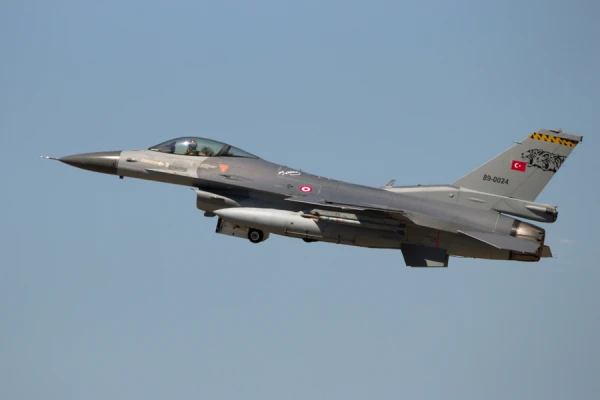
CNA Staff, Jun 22, 2020 / 12:00 pm (CNA).- The United States Commission on International Religious Freedom issued a statement on Friday, calling on the Turkish military to halt airstrikes in northern Iraq, and urged Turkish President Recep Tayyip Erdoğan to stop the military actions.
“USCIRF calls on Turkey to immediately cease its brutal airstrikes in Sinjar, Iraq and to withdraw any ground troops—who represent a dangerous escalation of violence in an already-fragile area,” said the statement from USCIRF Chair Gayle Manchin.
Manchin stated that the airstrikes are “particularly threatening to hundreds of traumatized Yazidi families attempting to return to Sinjar and to other civilians in northern Iraq—none of whom deserve to be placed in harm’s way by a NATO ally.”
The U.S. State Department declared in 2016 that Yazidis, along with the Christian and Shia Muslim religious minorities, were victims of a genocide perpetrated by the Islamic State in the region.
On June 15, Turkey began moving troops into the region. The operations are called “Operation Claw-Eagle” and “Operation Claw-Tiger.” “Claw-Eagle” refers to the airstrike campaign, and “Claw-Tiger” is the ground operations.
Turkey claims that the operations are targeting Kurdish rebels in the area–specifically members of the Kurdistan Workers Party–but the USCIRF disagrees with this claim. The airstrikes occurred just over six months after 200 refugee families arrived in Sinjar after spending six years in a refugee camp following displacement by the Islamic State, and the operations occurred near Yazidi towns.
“Turkey’s operations in Iraq and northeastern Syria make it clear that regional ambitions—not domestic security—are driving its actions today, and it cannot be allowed to do so with impunity,” Tony Perkins, vice chair of the USCIRF stated on Friday.
“We call upon the administration to utilize all diplomatic and economic leverage to protect vulnerable religious minorities in northern Iraq—as well as neighboring northeastern Syria—from Turkey’s indiscriminate military operations,” he added.
Turkey has been engaged in on-again/off-again war with the Kurdistan Workers Party, an organization that the United States has listed as a terrorist group, since 1984. The Kurdistan Workers Party advocates for a separate independent Kurdistan.
However, the USCIRF stated that there was no evidence that the Kurdistan Workers Party was actively planning any sort of action against Turkey at this time.
“In this massive campaign, Turkey has claimed to strike over 500 militants in areas where there is no indication of attacks planned or occurring against Turkey,” said the USCIRF.
“Once again, Turkey is showing their disregard for vulnerable religious and ethnic minorities who live in, or have been displaced to, those same areas.”
If you value the news and views Catholic World Report provides, please consider donating to support our efforts. Your contribution will help us continue to make CWR available to all readers worldwide for free, without a subscription. Thank you for your generosity!
Click here for more information on donating to CWR. Click here to sign up for our newsletter.

CNA Staff, Jul 20, 2020 / 07:00 am (CNA).- A Catholic cathedral that was repeatedly struck by missiles amid the Syrian civil war was due to reopen Monday following its restoration.
The Maronite Cathedral of St. Elijah in Aleppo was bombarded wit… […]
Ryiadh, Saudi Arabia, Oct 26, 2017 / 05:00 pm (CNA/EWTN News).- Saudi Arabia’s crown prince Mohammed bin Salman has suggested a turn towards moderate Islam, especially among younger Saudis who want to “destroy” extremist thoughts, but one expert suggests religious freedom is the best path for Saudi Arabia.
“As a general matter, no government can ‘destroy extremist thoughts,’ including the government of Saudi Arabia,” Georgetown University professor Thomas F. Farr told CNA. “Even when U.S. forces ‘destroy’ ISIS militarily, the problem of extremist interpretations of Islam will remain.”
Farr, who directs the Religious Freedom Research Project at Georgetown’s Berkley Center for Religion, Peace & World Affairs, advocated religious freedom as the best approach in Saudi Arabia.
His remarks follow comments from Prince Mohammed, the new heir apparent to the Kingdom of Saudi Arabia, who recently spoke to the U.K. newspaper The Guardian.
“We are simply reverting to what we [once] followed – a moderate Islam open to the world and all religions. Seventy percent of the Saudis are younger than 30, honestly we won’t waste 30 years of our life combating extremist thoughts, we will destroy them now and immediately.”
“After the Iranian revolution in 1979, people wanted to copy this model in different countries, one of them is Saudi Arabia,” Prince Mohammed continued. “We didn’t know how to deal with it. And the problem spread all over the world. Now is the time to get rid of it.”
Farr welcomed the encouragement of more moderate interpretations of Islam, but cautioned: “their success in that endeavor will have less to do with the use of force than it will the government’s willingness to move toward true religious freedom, defined in this context as the freedom of all religions in the kingdom openly to challenge Saudi Wahhabism, the ideological source of much violent Islamist extremism.”
“In short, what governments can do to undermine violent extremism is to protect religious freedom,” he said.
Saudi Arabia’s religious freedom record has come under criticism.
In its 2017 report, the U.S. Commission on International Religious Freedom recommended that Saudi Arabia be designated a tier one “Country of Particular Concern.”
“Saudi courts continue to prosecute and imprison individuals for dissent, apostasy, and blasphemy, and a law classifying blasphemy and the promotion of atheism as terrorism has been used to target human rights defenders, among others,” the report said. The government also privileges its interpretation of Sunni Islam over other interpretations and bans non-Muslim public places of worship.
The commission’s report also cited the Saudi government’s Vision 2030 program, focused on economic and cultural transformation, as a reason for improved religious freedom conditions. There was a “significant decrease” in the power of the country’s Commission for the Promotion of Virtue and Prevention of Vice, a continued government commitment to reform textbooks and curricula, and increased efforts to counter domestic and international extremism.
Prince Mohammed’s remarks expanded on comments he had made at an investment conference announcing a $500 billion planned independent economic zone across Saudi Arabia, Jordan and Egypt, The Guardian reports.
“Changing Saudi Arabia for the better means helping the region and changing the world,” the prince said. “So this is what we are trying to do here. And we hope we get support from everyone.”
The Sisters of St. Joseph of the Apparition cover the altar, just dedicated by the cardinal. The covering of the altar signifies that it is both the place of the Eucharistic sacrifice and the Lord’s table. / Credit: Photo courtesy of the Latin Patriarchate of Jerusalem
Jerusalem, Sep 12, 2024 / 07:00 am (CNA).
On Aug. 31, exactly 100 years after its dedication, the Church of Our Lady of the Ark of the Covenant was reopened for worship on the hill of Kiryat Yearim, nine miles from Jerusalem.
The church, which was closed for four years for restoration work, stands atop the hill overlooking the (Muslim) village of Abu Gosh. From the top, visitors can see Jerusalem.
A view from the hill of Kiryat Yearim, where the Church of Our Lady of the Ark of the Covenant stands. At the foot of the hill lies the Muslim village of Abu Gosh, with Jerusalem visible in the background, a little more than nine miles away. The place, mentioned in the Bible as “Kiriath-Jearim,” held an important role in the history of the Jewish people, as it was here that the Ark of the Covenant rested for about 20 years until King David brought it to Jerusalem. Credit: Marinella Bandini
The place, mentioned in the Bible as “Kiriath-Jearim,” has held an important role in the history of the Jewish people as it was here that the Ark of the Covenant rested after being recovered from the Philistines (see 1 Samuel 6).
The ark contained the two stone tablets on which the Ten Commandments — God’s covenant with the Jewish people — were inscribed and was the sign of God’s presence among his people.
According to the Bible, it was hosted in the house of Abinadab, where it remained for about 20 years (see 1 Samuel 7:1-2) until King David brought it to Jerusalem.
For this reason, even today, the site is visited by many groups of Jews.
A Byzantine basilica was built on the top hill around the fifth century. The current church, the foundation stone of which was laid in 1920, stands on the remains of that building. It was consecrated in 1924 by the then-Latin patriarch of Jerusalem, Luigi Barlassina, and dedicated to Our Lady of the Ark of the Covenant.
The Church of Our Lady of the Ark of the Covenant in Kiryat Yearim (exterior). The church is dedicated to the Virgin Mary, whom Christians also honor with the title of “Ark of the Covenant.” “The covenant of God with his people finds its fulfillment in Jesus Christ, who is no longer just the sign of God’s presence but God himself among us. Mary is the new Ark of the Covenant because she carried Christ himself in her womb,” said Cardinal Pierbattista Pizzaballa, the Latin patriarch of Jerusalem, in his homily. Credit: Marinella Bandini
Cardinal Pierbattista Pizzaballa, the current Latin patriarch of Jerusalem, recently came to the basilica to dedicate its new altar on the occasion of the reopening of the church.
“This reopening is a moment of trust in the future, a desire to start anew, and this is what we need most at this time, when everything around us speaks of death and endings,” he told CNA after the celebration on Aug. 31.
The opening of the doors of the Church of Our Lady of the Ark of the Covenant in Kiryat Yearim on Aug. 31, 2024, for the solemn celebration with the rite of dedication of the altar, presided over by Cardinal Pierbattista Pizzaballa, the Latin patriarch of Jerusalem. Credit: Photo courtesy of the Latin Patriarchate of Jerusalem
“Climbing this mountain, blessed by the presence of the Lord,” he added, “invites us to have a broad and farsighted perspective on events and not to close ourselves off in the dramatic present moment.”
Hosting the event were the Sisters of St. Joseph of the Apparition, a French congregation founded in 1832 by Mother Emilie De Vialar, which owns and operates the church and surrounding property.
The complete details of how the land came to be acquired by the sisters are lost to history, but it centers on one of the order’s sisters who died in 1927. Sister Josephine Rumèbe, who is buried in the church, was reportedly endowed with special mystical gifts and managed to acquire the land on behalf of the sisters. The story goes that she had 5,000 francs at her disposal and sought the help of a clergyman for the purchase. To prevent a competing buyer from acquiring it, the cleric secured the entire hill for 20,372 francs. Miraculously, when Sister Josephine counted the gold coins hidden in her room, the amount matched exactly what she needed.
Cardinal Pierbattista Pizzaballa, the Latin patriarch of Jerusalem, pours the chrism oil on the new altar of the Church of Our Lady of the Ark of the Covenant in Kiryat Yearim. On Aug. 31, 2024, he presided over the solemn Mass with the rite of dedication of the altar, marking the reopening of the church after four years of restoration and maintenance work. Credit: Marinella Bandini
The dedication of the new altar in the basilica took place after the recitation of the creed and chanting of the litanies. The cardinal placed relics in the altar, including that of Mother Emilie De Vialar, who was canonized a saint in 1951. This was followed by the anointing of the altar with chrism oil, the incensing of the altar, the covering of the altar, and the lighting of the altar.
The relics placed inside the new altar of the Church of Our Lady of the Ark of the Covenant in Kiryat Yearim, which was dedicated by Cardinal Pierbattista Pizzaballa, the Latin patriarch of Jerusalem, on Aug. 31, 2024. Among the relics are those of Mother Emilie De Vialar, founder of the Sisters of St. Joseph of the Apparition, the order who owns the church and surrounding property. Credit: Marinella Bandini
“The covenant of God with his people finds its fulfillment in Jesus Christ, who is no longer just the sign of God’s presence but God himself among us. Mary is the new Ark of the Covenant because she carried Christ himself in her womb,” said the cardinal in his homily, inviting the faithful, following the example of the Virgin Mary, to renew their trust in God as the Lord of history and active within history.
Upon entering the church — whose iconographic elements were created by artists from the Ave Center of the Focolare Movement — the eye is drawn to the golden flame emanating from the center of the apse.
Cardinal Pierbattista Pizzaballa, the Latin patriarch of Jerusalem, celebrates the Eucharistic liturgy on the altar he dedicated in the Church of Our Lady of the Ark of the Covenant in Kiryat Yearim on Aug. 31, 2024. Credit: Marinella Bandini
A special decoration that, on one hand, evokes the biblical significance of fire, symbolizing the presence of God, and on the other, is connected to the history of this place and particularly to Sister Josephine’s vision of a “mountain of fire,” holds significance here.
When she was still a young postulant in France, during Eucharistic adoration, Sister Josephine had a vision of flames forming a mountain with Jesus above them instead of the host. The vision then vanished, and only 50 years later, at the time of laying the foundation stone of the church, it was revealed to her that the “mountain of fire” was indeed Kiryat Yearim, which she used to call “the Holy Mountain.”
Sister Valentina Sala, the current provincial of the congregation for the Holy Land, immediately felt a strong connection to this place. She recounted to CNA: “The first time I came here for a few weeks, a sister took me to Kiryat Yearim. I knelt at Sister Josephine’s tomb and prayed to return if that was God’s will.”
Sister Valentina Sala, the current provincial of the congregation of the Sisters of St. Joseph of the Apparition for the Holy Land, prays at the tomb of Sister Josephine Rumèbe, founder of the convent and the church in Kiryat Yearim. “The first time I came here for a few weeks, a sister took me to Kiryat Yearim. I knelt at Sister Josephine’s tomb and prayed to return if that was God’s will,” she recounted to CNA. Credit: Marinella Bandini
On the centenary of the church’s dedication, Sister Valentina also emphasized the significance of this place for her congregation, whose charism is to serve the needs of people through works of charity.
“What is charity work? What people need today is not just health care or education; there is a hunger and thirst for God. We must be able to recognize this need, helping those who come here to listen to his voice. We need places where people can pause and rest with God,” she said.
When the construction of the church was nearly complete, Sister Josephine had a vision of the Virgin Mary, at the top of the church, facing Jerusalem with outstretched arms in a gesture of dispensing grace. A statue now stands above the church to recall that vision, facing away from those entering and directed toward Jerusalem.
“This place, which evokes the covenant, invites us to realign ourselves with God and to be under this blessing,” Sister Valentina concluded.
This is also the meaning of the words she addressed to those present — the vast majority of local faithful from Jerusalem as well as from Galilee — at the end of the Mass.
Hundreds of local faithful from Jerusalem and Galilee attend the solemn Mass with the rite of dedication of the altar, marking the reopening of the Church of Our Lady of the Ark of the Covenant in Kiryat Yearim, on Aug. 31, 2024. A hundred years ago, Sister Josephine Rumèbe of the Sisters of St. Joseph of the Apparition wrote about having seen a vision of “a crowd rushing toward the basilica. I saw priests, sisters of our order, and then men and women of the world who were even more pleasing to God than all the others, holy souls shining like stars.” Credit: Marinella Bandini
“Sister Josephine had already seen you in various visions: ‘I saw a crowd rushing toward the basilica. I saw priests, sisters of our order, and then men and women of the world who were even more pleasing to God than all the others, holy souls shining like stars.’”
She continued: “And what if we are that vision? What if we are that future? Of course, we are! From now on, you will be the ones to bring life to this hill, to this covenant between God and his people. Come, rush, stay, feel at home. There is not only a newly renovated church to see but a Presence to discover: Take the time to dwell with the Lord. What could be more beautiful… Many graces await to be dispensed from here!”
Leave a Reply