No Picture
News Briefs

In Chad, Jesuit Refugee Service teachers aim to keep school going amid pandemic lockdown

May 14, 2020 CNA Daily News 0

CNA Staff, May 14, 2020 / 08:00 pm (CNA).- As schools in Chad remain closed due to coronavirus pandemic restrictions, teachers from the Jesuit Refugee Service are conveying safety measures to prevent the spread of the virus in local communities.

¨We came together to raise awareness among the community. Our students are part of it, so it is important for us to spread the message,¨ Ibrahim Isaakh, a science teacher in Djabal, southeastern Chad told JRS May 11.

For her part, Fatimé Ali Rifa, a teacher in the Touloum refugee camp, Iriba, located in the east of the country, has been recommending frequent handwashing and avoidance of crowds as precautionary measures to the prevent the spread of the coronavirus.

More than 450,000 refugees live in Chad, who have fled from conflicts in Sudan, the Central African Republic, and Nigeria, among other countries. Refugees live in camps afflicted by the same poverty and food insecurity faced by most residents of Chad. In addition to refugees, there are more than 150,000 internally displaced people in Chad.

Eighty percent of people in Chad live below the poverty line, and most experience chronic food insecurity.

Schools in the landlocked country, Africa’s fifth largest nation, have been closed since March 19, a move that has brought new challenges to the more than 102,000 refugee students across the country.

“Their academic engagement is at risk of great delay as many refugees lack a TV or radio to be able to follow the telematic classes offered by the government,” the JRS explained in a May 11 release.

For Abdelhamid Ibrahim Radjab, a teacher at Amnabak refugee camp in Iriba, every time he meets the parent of a child in his school area, he reminds them to ask their child to “review the materials they have already learnt at school in order to be ready for their [upcoming] exam.”

As schools in Chad’s refugee camps often serve as points of safety, reconciliation, and community awareness, their closure means that “children are more vulnerable to domestic, sexual and gender-based violence, as well as exploitation,” according to the JRS.

“For the students, the closure of the schools affects their schedules, as they won’t be able to finish the programme,” Abdallah Ahmat, a math teacher at Djabal refugee camp said.

“The community is worried; it is not sure what will happen with the future of our children. The question is when is this all going to finish?”

As the Jesuit agency monitors the situation in the semi-desert country, leaders are developing strategies to continue the school calendar.

As a precautionary measure to prevent the spread of the disease among students, leaders are considering arranging for each class to include no more than 10 students.

Students may also study from home in groups of three or four;  teachers go from home to home to check what the students are doing and offering them guidance on the curriculum.

The leadership of JRS has expressed confidence in the teachers in its school programs noting, “Throughout all the uncertainties, one thing is clear: the commitment of our teachers has never wavered.”

“We hope that the situation gets better soon to allow the teachers and students to walk back to school. For the moment, and until the end of the pandemic, we will continue supporting our students with home-based learning,” Makka Abdallah Dehie, a primary teacher at Mile refugee camp, Guereda, told JRS.

With programs across 56 countries across the world, JRS runs seven refugee camps in Chad.

Founded in 1980, the mission of JRS is “to accompany, serve, and advocate on behalf of refugees and other forcibly displaced persons, that they may heal, learn, and determine their own future.”


A version of this story was first published by ACI Africa, CNA’s African news partner. It has been adapted by CNA.

[…]

No Picture
News Briefs

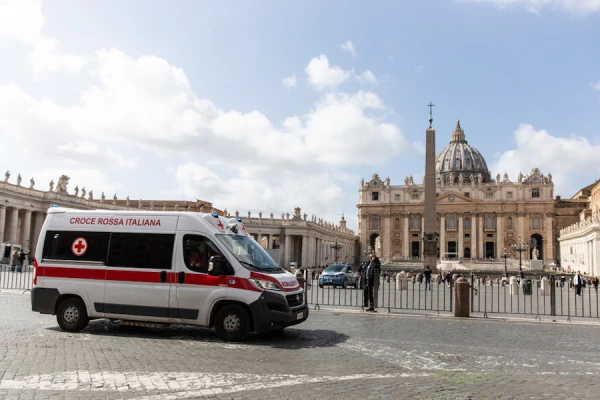
St. Peter’s Basilica considers temperature checks when public Masses resume

May 14, 2020 CNA Daily News 0

CNA Staff, May 14, 2020 / 03:30 pm (CNA).- Papal basilicas are considering checking visitors’ temperatures as a precaution against the spread of coronavirus when public Masses resume, the Holy See press office said Thursday.

Representatives of the four major Roman basilicas — St. Peter’s, St. Mary Major, St. John Lateran and St. Paul Outside the Walls — met May 14 under the auspices of the Vatican Secretariat of State, the press office said.

They discussed which protocols to adopt in light of the “second phase” of Italy’s lockdown, when public liturgies will be permitted again from May 18 under strict conditions.

Churches in Italy will be required to limit the number of people present – ensuring a one-meter (three feet) distance – and congregants must wear face masks. The church must also be cleaned and disinfected between celebrations.

While St. Peter’s is situated in Vatican City, the three other major basilicas are located within Italy but have extraterritorial status under the terms of the Lateran Treaty of 1929, which means they are properties of the Holy See, itself a sovereign body in international law.

The press office statement said that officials talked about “the need to adopt the most appropriate measures to guarantee the safety of the faithful”, including taking the temperatures of visitors, at least during Sunday Masses and on other holy days of obligation.

Holy See Press Office Director Matteo Bruni told CNA that each basilica would adopt measures that reflected their “specific characteristics.”

He said: “For St. Peter’s Basilica, in particular, the Vatican Gendarmerie will provide for access restrictions in close collaboration with the Inspectorate for Public Security and will facilitate safe entry with the assistance of volunteers from the Sovereign Military Order of Malta.”


[…]

No Picture
News Briefs

For Catholics, wearing masks can be an act of charity for neighbor

May 14, 2020 CNA Daily News 4

Denver Newsroom, May 14, 2020 / 03:09 pm (CNA).- Although some people have raised objections to wearing masks as the U.S. continues to battle the coronavirus pandemic, doing so can be an act of charity for one’s neighbor, a Catholic doctor said.

“The simple reason [to wear a mask] is primarily to protect others, the secondary reason is to protect oneself. Masks are a barrier to the airborne droplets that can carry the virus and infect anyone who breathes them in,” said Dr. Barbara Golder, a physician, lawyer and bioethicist with a background in pathology.

Golder told CNA that wearing a mask while in public is “a small thing to do, and it may well save lives.”

The United States has seen more than 1.3 million confirmed cases of the novel coronavirus, with more than 82,000 deaths, according to the Johns Hopkins Coronavirus Resource Center. Most people who contract the highly contagious virus show mild or no symptoms, but in some cases, it can result in severe complications or death, particularly for those who are elderly or have underlying health conditions.

With much of the country under quarantine restrictions in recent weeks to slow the spread of the virus, the question of when and how to reopen continues to be a source of controversy.

Public health officials have advised wearing masks in public, in order to reduce the risk of unknowingly transmitting the virus through droplets emitted from one’s mouth when speaking, coughing or sneezing. Many individuals who are infected with the virus do not develop symptoms, meaning that even people who do not feel sick could spread the virus to others.

Based on this federal guidance, many local authorities have issued regulations recommending or requiring that people wear masks in public settings.

These regulations have received a mixed response. Some critics argue that the mandatory regulations – and the fines and other punishments that accompany them – in some states are too harsh, infringing upon essential freedoms. Others worry that the use of masks may be ineffective or even harmful, claims which public health experts dispute.

Others have criticized the wearing of masks as a sign of weakness.

R. R. Reno, editor of the Catholic journal First Things, has been outspoken in his criticism of quarantine measures enacted in New York and other parts of the country. In a series of tweets this week – which were later deleted – Reno encouraged people to eschew masks, which he described as caving to a culture of fear.

“Masks=enforced cowardice,” Reno said in one tweet.

“The mask culture if (sic) fear driven,” he said in another, adding, “It’s a regime dominate (sic) by fear of infection and fear of causing of infection. Both are species of cowardice.”

However, Dr. Golder objected to the claim that following the guidance of public health officials is succumbing to fear or weakness.

“It isn’t fear to exercise prudent care for ourselves and others,” she told CNA. “This is a serious situation…When 60% of the population falls into a risk group because of age or an underlying medical condition such as obesity, diabetes, heart disease, or lung disease, it’s prudent to try to avoid infection.”

Golder acknowledged that conflicting advice early in the pandemic may be confusing, but explained that federal guidance has changed as scientists have learned more about the new virus and how it is spread.

“We now know that it is communicable by aerosol droplets that are expelled by coughing, sneezing, and even, to a certain extent, by breathing,” she said. “We also know that this happens even in patients who are infected and shedding virus but who do not have symptoms.”

For this reason, masks – along with social distancing – are an important tool in fighting the spread of the disease, she said.

“Wearing a mask limits the possibility of dispersing infective particles in the air, as well as reducing the risk of inhaling them,” she said.

Golder noted that small children, those who have breathing difficulties, and those who are physically unable to put on a mask need not wear one, but added that they may want to significantly limit contact with others.

But for most Americans, she said, “wearing a mask is a way of exercising our care for the other, who could be harmed if we do not.”

Leah Libresco Sargeant, author of “Building the Benedict Option,” echoed the idea that wearing a mask is a way of showing love for one’s neighbors.

“It’s much more a question of care than of fear,” she told CNA.

While masks may be somewhat uncomfortable, they are a small inconvenience that can be embraced out of charity for others, Sargeant suggested.

“Mask wearing is a small, humdrum discipline. It’s harder to romanticize than a big gesture,” she said.

“Think about the difference between going on a big pilgrimage and keeping up a habit of daily prayer, including in times of spiritual dryness. We have to do it out of love—there’s no other way to sustain the dull parts of caring for others.”

Dr. Golder acknowledged there are legitimate concerns about government overreach with some of the mandates surrounding masks and other pandemic limitations.

“[I]t’s absolutely true that there has been some overreach of government officials in imposing restrictions in various places,” she said.

“There is a real possibility of infringement of our constitutional rights and those charged with protecting our rights are hard at work to prevent that,” she added, pointing to court rulings blocking some of these regulations as signs that the American system is working.

But ultimately, Golder said, Catholics may want to consider the question of public health not solely from a perspective of rights, but from the viewpoint of service and friendship to which Christ calls us.

“God as man never once asserted his many ‘rights’ against us, maintaining to the last his role as servant and friend,” she said. “I think that might be the model here—How do I as friend and servant act in the presence of others? Wearing a mask might be a good start these days.”


[…]