

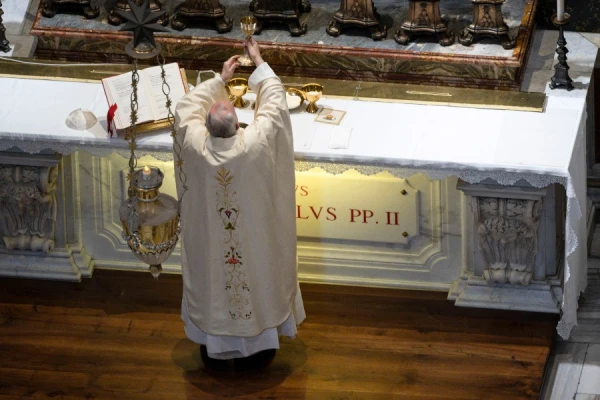
Vatican City, May 18, 2020 / 04:15 am (CNA).- St. John Paul II was a man of prayer who was close to the people and loved justice, Pope Francis said at his morning Mass Monday.
Celebrating Mass at the saint’s tomb in St. Peter’s Basilica, the pope noted that May 18 is the 100th anniversary of John Paul II’s birth.
Quoting from the day’s responsorial psalm, which declares that “The Lord loves his people” (Psalm 149:4), he said: “And today we can say here: 100 years ago the Lord visited his people, sent a man, prepared him to be a bishop and lead the Church. In memory of St. John Paul II, we take this up again: ‘The Lord loves his people,’ the Lord visited his people, he sent a pastor.”
In his homily, Francis focused on three qualities of St. John Paul II, who was pope from 1978 to 2005: prayer, closeness to the people, and love for justice.
He said that despite the demands on his time, the Polish pope always made prayer his first priority.
“The first task of a bishop is to pray, and he knew it. He did it,” he said.
“And he taught us that when a bishop makes an examination of conscience in the evening he must ask himself: how many hours have I prayed today?”
Francis said that John Paul II, who made 104 foreign trips during his 27-year pontificate, traveled the world “looking for his people.”
“A shepherd is close to the people. On the contrary, if he is not a shepherd, he is a hierarch, an administrator — perhaps a good one, but he is not a shepherd. … And St. John Paul II gave us the example of this closeness: close to the great and the small, to the near and the far, always close,” he said.
He observed that the Polish pope was “a man who wanted justice, social justice, the justice of peoples, justice that drives out wars.” But he was also a man of mercy, because mercy and justice cannot be separated.
Pope Francis recalled that John Paul II championed the message of St. Faustina Kowalska, the Polish nun who promoted the Divine Mercy devotion.
“He felt that God’s justice had this face of mercy, this attitude of mercy. And this is a gift that he left us: justice-mercy and just mercy,” he said.
Francis, who canonized John Paul II in 2014, concluded: “Let us pray to him today that he may give all of us, especially the pastors of the Church but to everyone, the grace of prayer, the grace of closeness and the grace of just mercy.”
The Mass was concelebrated by Cardinal Angelo Comastri, the archpriest of St. Peter’s Basilica, Cardinal Konrad Krajewski, the papal almoner, and Archbishop Jan Romeo Pawłowski, head of the third section of the Vatican Secretariat of State, which oversees the Holy See’s diplomatic corps.
Pope Francis has livestreamed his daily Masses since March 9, when public liturgies were suspended throughout Italy. Today was the last papal daily Mass to be livestreamed as public Masses resume throughout the country.
If you value the news and views Catholic World Report provides, please consider donating to support our efforts. Your contribution will help us continue to make CWR available to all readers worldwide for free, without a subscription. Thank you for your generosity!
Click here for more information on donating to CWR. Click here to sign up for our newsletter.

Although a welcome tribute to John Paul II by Francis it should be said that there is no moral correspondence between the two pontiffs on the vital Church doctrine of communion for divorced and remarried. Amoris Laetitia despite the Argentine Papal letters entered in the Acta Apostolicae Sedis, the response by Pope Francis is oblique and unsatisfactory. Not direct and definitive as required on the matter of sexual relations outside sacramental marriage [see proposition two Doctrinal Commentary to Ad Tuendam Fidem]. Veritatis Splendor is definitive upholding all essential moral doctrine inclusive of marriage, which as explained by John Paul there and elsewhere is never subject to abrogation in favor of a proportional good. We remain bound to follow Apostolic Tradition and the Deposit of Faith regarding marriage and what defines adultery. Furthermore, discernment as argued in Amoris of a legitimately unfeasible ability to practice chastity is a personal value judgment, not an objective irrefutable fact. God will confer sufficient grace needed to practice chastity. Our requirement in all life’s difficulties, which most experience is trust, and the willingness to decide in favor of God’s goodness.
I grew up with the Baltimore Catechism and Amoris Laetitia follows it precisely and most beautifully. God bless you
Also there is a wonderful continuity between Popes John Paul II, Pope Emeritus XVI and Pope Francis
We read that: “In his homily, [Pope]Francis focused on three qualities of St. John Paul II, who was pope from 1978 to 2005: prayer, closeness to the people, and love for justice.”
Other messages, omitted again for purposes of focus. . . had to do with the family, sexual morality, and particularly the orientation (today a doubly apropos word) of the John Paul II Institute on Marriage and the Family (1982-).
https://www.crisismagazine.com/2020/john-paul-the-forgotten
Prayer and justice were powerful weapons in the armory of Prophets Isaiah, Jeremiah, Mica, Hosea, Amos, John the Baptist, and of course Jesus of Nazareth. Long live the memory of the contributions of St JP II in the realm of prayer and justice.