Vatican City, May 16, 2020 / 04:34 am (CNA).- The only cure for worldliness is faith in Jesus Christ and in his death and resurrection, Pope Francis said at his morning Mass Saturday.
“There is one thing that does not tolerate worldliness: the scandal of the cross. It does not tolerate it,” the pope said May 16. “And the only medicine against the spirit of worldliness is Christ who died and rose for us, scandal and foolishness.”
At Mass in the chapel of the Casa Santa Marta, his Vatican residence, Pope Francis urged Catholics in the last two weeks of Easter, to “ask the Holy Spirit for the grace to discern what worldliness is and what the Gospel is and not to be deceived.”
In his homily, the pope reflected on the day’s Gospel reading from St. John, when Jesus told his disciples: “If the world hates you, realize that it hated me first. If you belonged to the world, the world would love its own; but because you do not belong to the world, and I have chosen you out of the world, the world hates you.”
Some people think worldliness just means partying, Francis said. “Worldliness may be this, but it is not fundamentally this,” he said.
“Worldliness is a culture,” according to the pope. The world “has superficial values” and “no fidelity because it changes according to the circumstances.”
He warned that Christians, too, are not immune to this spirit of the world, and quoted from the Letter of St. Paul to the Galatians: “You were slaves to the world, to worldliness.”
This, he said, makes him recall the end of the book, Meditation on the Church, by Henri de Lubac, which calls spiritual worldliness “the worst of the evils that can happen to the Church,” Francis stated.
“And Jesus insists on defending us from this and prays for the Father to defend us from this culture of worldliness,” he said.
The pope pointed to the apostle Paul’s preaching of the Gospel in Athens. When St. Paul spoke about the cross and resurrection, some of the people “were scandalized and went away,” according to Francis.
The apostle John, he said, also spoke about worldliness when he wrote that “the victory that conquers the world is our faith.”
“The only one: faith in Jesus Christ, dead and risen.” The pope said “that doesn’t mean being fanatics. This does not mean neglecting to have dialogue with all people, no: but with the conviction of faith, the scandal of the cross, the foolishness of Christ and also the victory of Christ.”
Pope Francis’ intention for the Mass was for those burying the dead during the coronavirus pandemic.
“It is one of the works of mercy to bury the dead and it is not a pleasant thing of course. We pray for those who risk their lives and catching the infection,” he said.
After Mass, the pope concluded with Eucharistic adoration and benediction. He also led congregants and those following the Mass via livestream in making a spiritual communion.
If you value the news and views Catholic World Report provides, please consider donating to support our efforts. Your contribution will help us continue to make CWR available to all readers worldwide for free, without a subscription. Thank you for your generosity!
Click here for more information on donating to CWR. Click here to sign up for our newsletter.
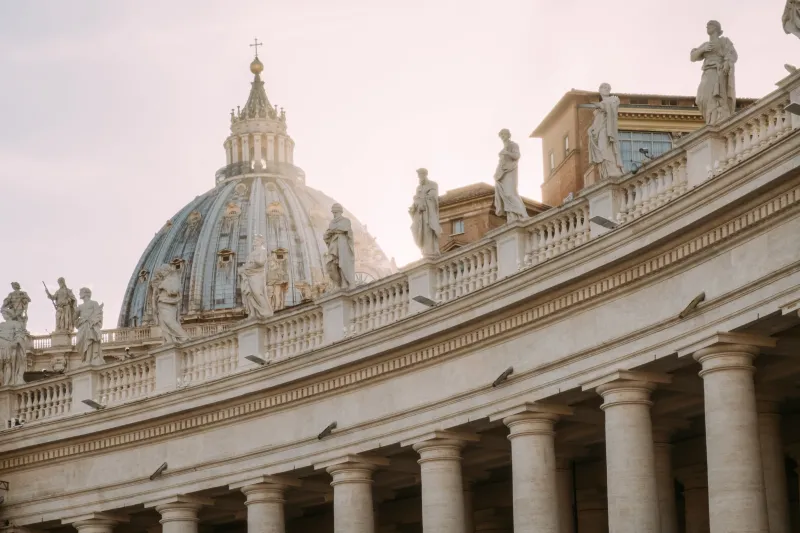
St. Peter’s Basilica / Simone Savoldi / Unsplash (CC0)
Rome Newsroom, Oct 2, 2022 / 03:00 am (CNA).
The world’s newest bishops gathered in Rome last month to learn more about what it means to be a Catholic bishop.
While the week’s presentations spanned a range of topics, three U.S. bishops who attended told CNA that synodality emerged as a key theme.
The Vatican’s annual formation course, sometimes known by the nickname “baby bishop school,” was canceled for two years because of the COVID-19 pandemic — making the 2022 edition the largest yet, with approximately 330 participating bishops across two sessions.
“People kind of picture baby bishop school as nuts and bolts, like ‘how to be a bishop.’ It’s not that at all,” Bishop Erik Pohlmeier of the Diocese of St. Augustine, Florida, told CNA at the end of the course.
“It’s kind of whatever the Church is talking about at that time, bringing that to the bishops that are coming on board,” he said. “The synodal process has been … a hallmark of conversation for the last couple of years, so now as we’re new bishops … the reflections revolved around that.”
The seminar’s first session was primarily attended by bishops consecrated in 2019 and 2020, while the second session was mostly those who joined the ranks in 2021 and the first part of 2022.
Thirty-nine U.S. bishops and auxiliary bishops attended, divided between the two weeks.
Pohlmeier was the freshest U.S. bishop to join. He was ordained a bishop on July 22 — just two days after his 51st birthday and seven weeks before arriving in Rome for the Sept. 12–19 course.
Speaking to CNA in Rome on Sept. 19, Pohlmeier said that as a new bishop, there are many things you do not know, but that’s where one’s fellow bishops come in.
“Every bishop knows other bishops,” he explained, like the bishop of the diocese where they served as a priest. “And they’re always, I mean to a person, helpful.”
Bishop Gregory Gordon, the first-ever auxiliary bishop of Las Vegas, Nevada, told CNA on Sept. 19 that the U.S. bishops’ conference also organizes meetings between bishops of the same ordination year, or “class,” as a way to build fraternity and create a network of support.
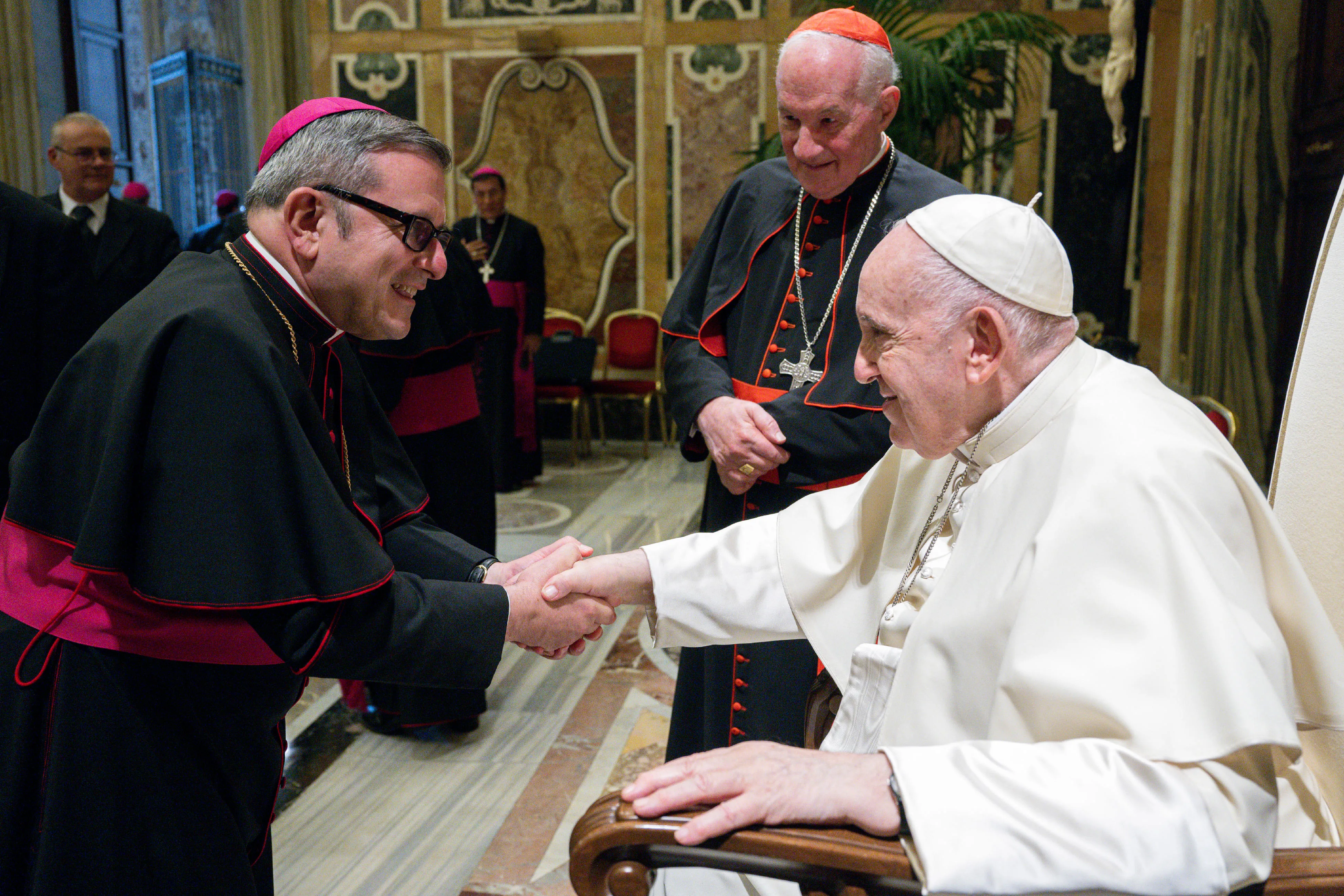
Bishop Gregory Gordon greets Pope Francis at the end of the course Sept. 19, 2022. Vatican Media
While the formal theme of this year’s seminar was how to announce the Gospel in changing times, Pohlmeier, Gordon, and Bishop Louis Tylka of Peoria, Illinois, said the unofficial topic of the week was synodality.
What they talked about
“We’re in the midst of the synod,” Tylka, who attended the seminar Sept. 1–8, told CNA by phone from his diocese. So the course, he added, focused on questions such as: “What does it mean to be a synodal Church? What is the ministry of the bishop in relation to that?”
Care for the planet and one’s neighbor, themes important to Pope Francis’ pontificate, were also a major part of the seminar, Tylka said.
The week’s presentations also covered child protection and the sexual abuse crisis.
“That’s one of those things that I think we will take home, saying we will be very, very careful not to neglect,” Gordon said.
Some talks, Pohlmeier noted, were directly about synodality and what it means. At the same time, those of a more practical nature, such as canon law for bishops, “would always include some comment on the synodal approach.”
“You’re going to get different articulations of what that means depending on who you talk to, but in general, my understanding is that it is more of a listening posture,” the St. Augustine bishop said.
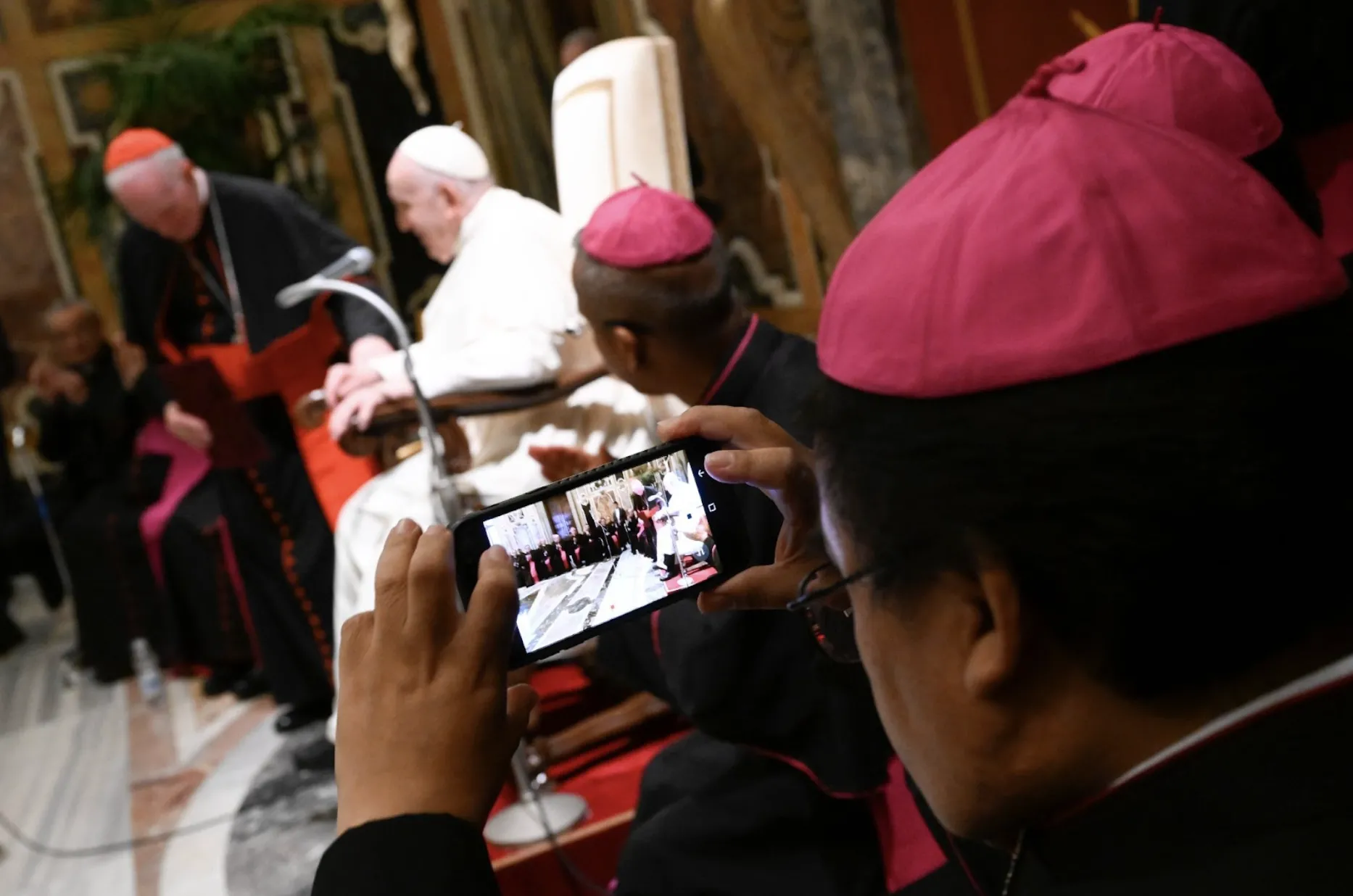
A bishop takes a photo of Pope Francis during their encounter on Sept. 19, 2022. Vatican Media
Bishop Gordon said Pope Francis himself modeled this listening attitude in their meeting with him on the final day of formation.
In the nearly two-hour meeting, he said most of the time was spent with the pope answering the bishops’ questions. “So you finished the course, [the pope] said. You’ve heard a lot already… Now I want to hear from you.”
This was Gordon’s big takeaway from the week: “It has to go back to the Holy Father’s words to us as he was answering our own questions, you know, asking us to exercise that episcopal closeness.”
The week also included time for communal prayer, Mass, adoration, and confession.
Bishop Tylka of Peoria said his personal opinion is that “a big part of synodality is the willingness and openness to create space for people to share their stories, to share their own encounters with Christ, to share their own experiences of how life is going.”
“So I think the role of the bishop clearly is to model that openness and that willingness to engage in dialogue,” he said.
This was my small group for discussion on Synodality! What an amazing group of bishops from around the world. Such a rich discussion on the Church! pic.twitter.com/fIOPLXwnfo
But there is also a lighter side to being a new bishop, as Pohlmeier evidenced with an amusing scene from the end of the week.
“Here we are, brand new and so … we got instructions on what we’re supposed to wear to meet the pope,” Pohlmeier said.
He explained that bishops in the Latin Church have two main styles of a full-length garment called a cassock. The new bishops were told to meet the pope. They should wear a black cassock with red trim, a purple fascia, and a purple zucchetto. (There is also a purple cassock with red trim for special liturgical events.)
Pohlmeier said it was funny to watch the bishops get ready for Mass in St. Peter’s Basilica and, afterward, the meeting with Pope Francis. Many of them were helping each other figure out where each piece of the complicated attire went — including the tall headpiece, called a mitre, which bishops wear to denote their office.
Today I joined the celebration in St Peter’s for the beatification of Blessed John Paul I. The rain did not dampen the joy of lifting up the ‘Smiling Pope.’ Humbled to be with the universal Church for such a celebration. pic.twitter.com/08AtzMUlMd
“Guys are literally opening up bags that haven’t been opened with miters from right there, from Euroclero,” Pohlmeier said, pointing over his shoulder in the direction of a clerical supply store next to St. Peter’s Square.
“You could see everybody that bought one this morning because they all matched,” he chuckled. “There were several people that were literally opening it up and pulling it out of the package and trying to get it on straight, and get things attached right, and not sure what clips go where and what’s right.”
“Those kinds of things are funny,” Pohlmeier said, “but nobody just tells you, ‘OK, buy this stuff, here’s what you need.’”
Vatican City, Nov 28, 2018 / 04:42 am (CNA/EWTN News).- By reflecting on the Ten Commandments, Christians can examine their hearts to see where disordered attachments and desires have made them in need of Christ’s healing, Pope Francis said Wedne… […]
Bishops process into St. Peter’s Basilica for the closing Mass of the first assembly of the Synod on Synodality on Oct. 29, 2023. / Vatican Media
Rome Newsroom, Jul 9, 2024 / 06:00 am (CNA).
The guiding document for the final part of the Synod on Synodality, published Tuesday, focuses on how to implement certain of the synod’s aims, while laying aside some of the more controversial topics from last year’s gathering, like women’s admission to the diaconate.
“Without tangible changes, the vision of a synodal Church will not be credible,” the Instrumentum Laboris, or “working tool,” says.
The six sections of the roughly 30-page document will be the subject of prayer, conversation, and discernment by participants in the second session of the 16th Ordinary General Assembly of the Synod of Bishops, to be held throughout the month of October in Rome.
Instead of focusing on questions and “convergences,” as in last year’s Instrumentum Laboris, “it is now necessary that … a consensus can be reached,” said a FAQ page from synod organizers, also released July 9, answering a question about why the structure was different from last year’s Instrumentum Laboris.
The guiding document for the first session of the Synod on Synodality in 2023 covered such hot-button topics as women deacons, priestly celibacy, and LGBTQ outreach.
By contrast, this year’s text mostly avoids these subjects, while offering concrete proposals for instituting a listening and accompaniment ministry, greater lay involvement in parish economics and finances, and more powerful parish councils.
“It is difficult to imagine a more effective way to promote a synodal Church than the participation of all in decision-making and taking processes,” it states.
The working tool also refers to the 10 study groups formed late last year to tackle different themes deemed “matters of great relevance” by the Synod’s first session in October 2023. These groups will continue to meet through June 2025 but will provide an update on their progress at the second session in October.
The possibility of the admission of women to the diaconate will not be a topic during the upcoming assembly, the Instrumentum Laboris said.
The new document was presented at a July 9 press conference by Cardinals Mario Grech and Jean-Claude Hollerich, together with the special secretaries of the synodal assembly: Jesuit Father Giacomo Costa and Father Riccardo Battocchio.
“The Synod is already changing our way of being and living the Church regardless of the October assembly,” Hollerich said, pointing to testimonies shared in the most recent reports sent by bishops’ conferences.
The Oct. 2-27 gathering of the Synod on Synodality will mark the end of the discernment phase of the Church’s synodal process, which Pope Francis opened in 2021.
Participants in the fall meeting, including Catholic bishops, priests, religious, and laypeople from around the world, will use the Instrumentum Laboris as a guide for their “conversations in the Spirit,” the method of discussion introduced at the 2023 assembly. They will also prepare and vote on the Synod on Synodality’s advisory final document, which will then be given to the pope, who decides the Church’s next steps and if he wishes to adopt the text as a papal document or to write his own.
The third phase of the synod — after “the consultation of the people of God” and “the discernment of the pastors” — will be “implementation,” according to organizers.
Prominent topics
The 2024 Instrumentum Laboris also addresses the need for transparency to restore the Church’s credibility in the face of sexual abuse of adults and minors and financial scandals.
“If the synodal Church wants to be welcoming,” the document reads, “then accountability and transparency must be at the core of its action at all levels, not only at the level of authority.”
It recommends effective lay involvement in pastoral and economic planning, the publication of annual financial statements certified by external auditors, annual summaries of safeguarding initiatives, the promotion of women to positions of authority, and periodic performance evaluations on those exercising a ministry or holding a position in the Church.
“These are points of great importance and urgency for the credibility of the synodal process and its implementation,” the document says.
The greater participation of women in all levels of the Church, a reform of the education of priests, and greater formation for all Catholics are also included in the text.
Bishops’ conferences, it says, noticed an untapped potential for women’s participation in many areas of Church life. “They also call for further exploration of ministerial and pastoral modalities that better express the charisms and gifts the Spirit pours out on women in response to the pastoral needs of our time,” the document states.
Formation in listening is identified as “an essential initial requirement” for Catholics, as well as how to engage in the practice of “conversation in the Spirit,” which was employed in the first session of the Synod on Synodality.
Pope Francis and delegates at the Synod on Synodality at the conclusion of the assembly on Oct. 28, 2023. Credit: Vatican Media
The document says the need for formation has been one of the most universal and strong themes throughout the synodal process. Interreligious dialogue also is identified as an important aspect of the synodal journey.
On the topic of the liturgy, the Instrumentum Laboris says there was “a call for adequately trained lay men and women to contribute to preaching the Word of God, including during the celebration of the Eucharist.”
“It is necessary that the pastoral proposals and liturgical practices preserve and make ever more evident the link between the journey of Christian initiation and the synodal and missionary life of the Church,” the document says. “The appropriate pastoral and liturgical arrangements must be developed in the plurality of situations and cultures in which the local Churches are immersed …”
How it was drafted
Dubbed the “Instrumentum Laboris 2,” the document released Tuesday has been in preparation since early June when approximately 20 experts in theology, ecclesiology, and canon law held a closed-door meeting to analyze around 200 synod reports from bishops’ conferences and religious communities responding to what the Instrumentum Laboris called “the guiding question” of the next stage of the Synod on Synodality: “How to be a synodal Church in mission?”
After the 10-day gathering, “an initial version” of the text was drafted based on those reports and sent to around 70 people — priests, religious, and laypeople — “from all over the world, of various ecclesial sensitivities and from different theological ‘schools,’” for consultation, according to the synod website.
The XVI Ordinary Council of the General Secretariat of the Synod, together with consultants of the synod secretariat, finalized the document.
According to the working tool, soliciting new reports and feedback after the consultation phase ended is “consistent with the circularity characterizing the whole synodal process.”
“In preparation for the Second Session, and during its work, we continue to address this question: how can the identity of the synodal People of God in mission take concrete form in the relationships, paths and places where the everyday life of the Church takes place?” it says.
The document says “other questions that emerged during the journey are the subject of work that continues in other ways, at the level of the local Churches as well as in the ten Study Groups.”
Expectations for final session
According to the guiding document, the second session of the Synod on Synodality can “expect a further deepening of the shared understanding of synodality, a better focus on the practices of a synodal Church, and the proposal of some changes in canon law (there may be yet more significant and profound developments as the basic proposal is further assimilated and lived.)”
“Nonetheless,” it continues, “we cannot expect the answer to every question. In addition, other proposals will emerge along the way, on the path of conversion and reform that the Second Session will invite the whole Church to undertake.”
The Instrumentum Laboris says, “Synodality is not an end in itself … If the Second Session is to focus on certain aspects of synodal life, it does so with a view to greater effectiveness in mission.”
In its brief conclusion, the text states: “The questions that the Instrumentum Laboris asks are: how to be a synodal Church in mission; how to engage in deep listening and dialogue; how to be co-responsible in the light of the dynamism of our personal and communal baptismal vocation; how to transform structures and processes so that all may participate and share the charisms that the Spirit pours out on each for the common good; how to exercise power and authority as service. Each of these questions is a service to the Church and, through its action, to the possibility of healing the deepest wounds of our time.”
Sages say, falling a victim to worldliness is a form of slavery. Time and again we are told, slavery in all forms needs to be banished from the face of the earth.






Sages say, falling a victim to worldliness is a form of slavery. Time and again we are told, slavery in all forms needs to be banished from the face of the earth.