CNA Staff, May 1, 2020 / 09:00 am (CNA).- In a statement marking the beginning of the Muslim holy month of Ramadan, the Vatican has condemned an increasing spate of attacks on churches, synagogues and mosques around the world.
Cardinal Miguel Ángel Ayuso Guixot, M.C.C.J., president of the Pontifical Council for Interreligious Dialogue said in the council’s “message for the month of Ramadan” on May 1 that “the context of recent attacks on churches, mosques and synagogues by wicked persons who seem to perceive the places of worship as a privileged target for their blind and senseless violence.”
He cited the 2019 joint statement of Pope Francis and the Grand Imam of Al-Azhar on human fraternity, which stated that such attacks are “a deviation from the teachings of religions as well as a clear violation of international law”.
Religious freedom advocates, including the U.S. Commission on International Religious Freedom (USCIRF) have drawn attention to an increasing number of attacks on churches, synagogues, mosques, and other houses of worship in recent years.
USCIRF released a fact-sheet in October of 2019 that called on states to protect places of worship, emphasizing their “protected status during armed conflict” and saying that “an intentional attack” on a church, synagogue, or mosque “may be considered a war crime.”
The commission’s 2020 annual report noted an increase in attacks on houses of worship around the world in 2019.
In 2019, Easter Sunday bombings in Sri Lanka targeted three churches as well as hotel resorts, killing more than 250 people. Shootings at mosques in Christchurch, New Zealand, during Muslim Friday prayer, killed 51 people in March, 2019. Shootings at synagogues in the U.S. in October of 2018 and again in April of 2019 killed 12, and roughly 80 gravestones at a Jewish cemetery in France were vandalized with Nazi and anti-Semitic symbols.
Ramadan is a month in the Islamic calendar of fasting, prayer, and acts of service; it began on April 23.
“The month of Ramadan is so central in your religion and therefore dear to you at personal, familial and social levels. lt is a time for spiritual healing and growth, of sharing with the poor, of strengthening bonds with relatives and friends,” the Vatican’s statement read.
After extending good wishes, the Vatican stated that “[t]he thoughts we like to share with you this year following our cherished tradition are about the protection of the places of worship.”
Churches, synagogues, and mosques have historically been places of hospitality, the statement noted.
“While appreciating the efforts done by the international community at different levels for the protection of the places of worship worldwide, it is our hope that our mutual esteem, respect and cooperation will help strengthen the bonds of sincere friendship, and enable our communities to safeguard the places of worship to assure for coming generations the fundamental freedom to profess one’s own beliefs,” the statement said.
If you value the news and views Catholic World Report provides, please consider donating to support our efforts. Your contribution will help us continue to make CWR available to all readers worldwide for free, without a subscription. Thank you for your generosity!
Click here for more information on donating to CWR. Click here to sign up for our newsletter.
Cardinal Pietro Parolin. / Claude Truong-Ngoc via Wikimedia Commons (CC BY-SA 4.0).
Washington, D.C. Newsroom, Jun 27, 2022 / 12:57 pm (CNA).
After reluctantly bowing out of his own scheduled trip to Africa in July, Pope Francis has decided to … […]
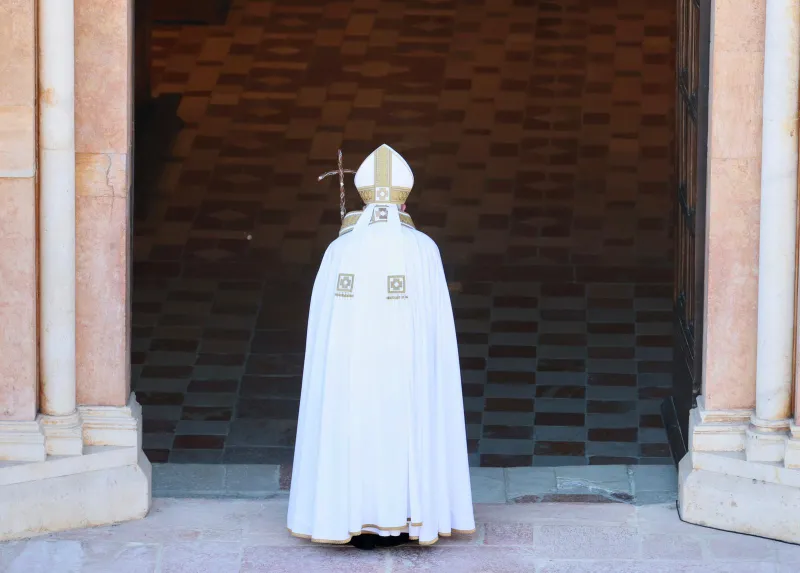
Pope Francis opens the Holy Door in L’Aquila, Italy on Aug. 28, 2022. / Daniel Ibanez/CNA
Rome Newsroom, Aug 28, 2022 / 04:15 am (CNA).
Pope Francis became the first pope in 728 years to open the Holy Door of a 13th-century basilica in L’Aquila, Italy on Sunday.
During a visit to the Italian city located about 70 miles northeast of Rome on Aug. 28, the pope participated in a centuries-old tradition, the Celestinian Forgiveness, known in Italian as the Perdonanza Celestiniana.
The opening of the Holy Door marked a key moment in the annual celebration established by Pope Celestine V in 1294.
“For centuries L’Aquila has kept alive the gift that Pope Celestine V left it. It is the privilege of reminding everyone that with mercy, and only with it, the life of every man and woman can be lived with joy,” Pope Francis said in his homily during Mass at L’Aquila’s Basilica of Santa Maria di Collemaggio.
“To be forgiven is to experience here and now what comes closest to the resurrection. Forgiveness is passing from death to life, from the experience of anguish and guilt to that of freedom and joy. May this church always be a place where we can be reconciled, and experience that grace that puts us back on our feet and gives us another chance,” he said.
Pope Francis began the day trip at 7:50 a.m. traveling by helicopter from the Vatican to L’Aquila. He visited the city’s cathedral, which is still being rebuilt after it was badly damaged during a 2019 earthquake in which more than 300 people died.
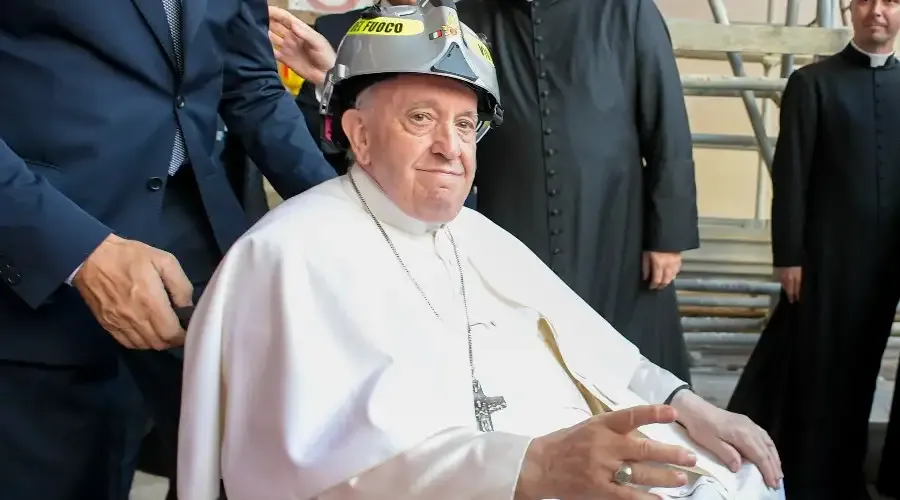
The pope wore a hard hat while touring the reconstruction area of the damaged church. He spoke to family members of earthquake victims in the town square in front of the cathedral, where local prisoners were also present in the crowd. People cheered and waved Vatican flags as Pope Francis greeted them from a wheelchair.
Pope Francis wore a hard hat while visiting the L’Aquila cathedral, which was damaged by a 2019 earthquake. Vatican Media
Pope Francis said: “First of all I thank you for your witness of faith: despite the pain and loss, which belong to our faith as pilgrims, you have fixed your gaze on Christ, crucified and risen, who with his love redeemed the nonsense of pain and death.”
“And Jesus has placed you back in the arms of the Father, who does not let a tear fall in vain, not even one, but gathers them all in his merciful heart,” he added.
After speaking to the families of the victims, Pope Francis traveled in the popemobile to L’Aquila’s Basilica of Santa Maria di Collemaggio, where he celebrated an outdoor Mass, recited the Angelus, and opened the Holy Door.
In his brief Angelus message, the pope offered a prayer for the people of Pakistan, where flash floods have killed more than 1,000 people and displaced thousands more.
Pope Francis also asked for the intercession of the Virgin Mary to obtain “forgiveness and peace for the whole world,” mentioning Ukraine and all other places suffering from war.
Pope Francis prayed for peace in his Angelus address following Mass in L’Aquila, Italy. Pope Francis prayed for peace in his Angelus address following Mass in L’Aquila, Italy.
During his visit to L’Aquila, the pope said that he wanted the central Italian city to become a “capital of forgiveness, peace, and reconciliation.”
“This is how peace is built through forgiveness received and given,” he said.
L’Aquila is the burial place of Pope Celestine V, who led the Catholic Church for just five months before his resignation on Dec. 13, 1294. The pope, who was canonized in 1313, is buried in L’Aquila’s Basilica of Santa Maria di Collemaggio.
In the spring, the Vatican’s announcement that Pope Francis would visit L’Aquila prompted unsourced speculation that the trip could be the prelude to the 85-year-old pope’s resignation.
When Benedict XVI became the first pope to resign in almost 600 years in 2013, Vatican-watchers recalled that he had visited the tomb of Celestine V years earlier. During his trip on April 28, 2009, he left his pallium — the white wool vestment given to metropolitan archbishops — on the tomb. In hindsight, commentators suggested that Benedict was indicating his intention to resign.
In his homily in L’Aquila, Pope Francis praised Pope Celestine V for his humility and courage.
Mentioning Dante Alighieri’s description of Celestine as the man of “the great refusal,” Pope Francis underlined that Celestine should not be remembered as a man of “no” — for resigning the papacy — but as a man of “yes.”
Pope Francis said: “Indeed, there is no other way to accomplish God’s will than by assuming the strength of the humble, there is no other way. Precisely because they are so, the humble appear weak and losers in the eyes of men, but in reality they are the true winners, for they are the only ones who trust completely in the Lord and know his will.”
At the end of the Mass, the crowd prayed the Litany of Saints and watched as Pope Francis made history when he opened the basilica’s Holy Door. According to Cardinal Giuseppe Petrocchi of L’Aquila, Pope Francis is the first pope to open the Holy Door in 728 years.
Visiting cardinals have opened the Holy Door for the Celestinian Forgiveness in past years, after a reading of the bull of forgiveness by the local mayor. Celestine donated the papal bull to L’Aquila, where it is kept in an armored chapel in the tower of the town hall.
The bull of forgiveness drawn up by Celestine V offered a plenary indulgence to all who, having confessed and repented of their sins, go to the Basilica of Santa Maria di Collemaggio from Vespers on Aug. 28 to sunset on Aug. 29. A plenary indulgence is a grace granted by the Catholic Church through the merits of Jesus Christ, Mary, and all the saints to remove the temporal punishment due to sin.
Celestine’s indulgence was exceptional at the time, given it was available to anyone, regardless of status or wealth, and cost nothing except personal repentance at a time when indulgences were often tied to almsgiving.
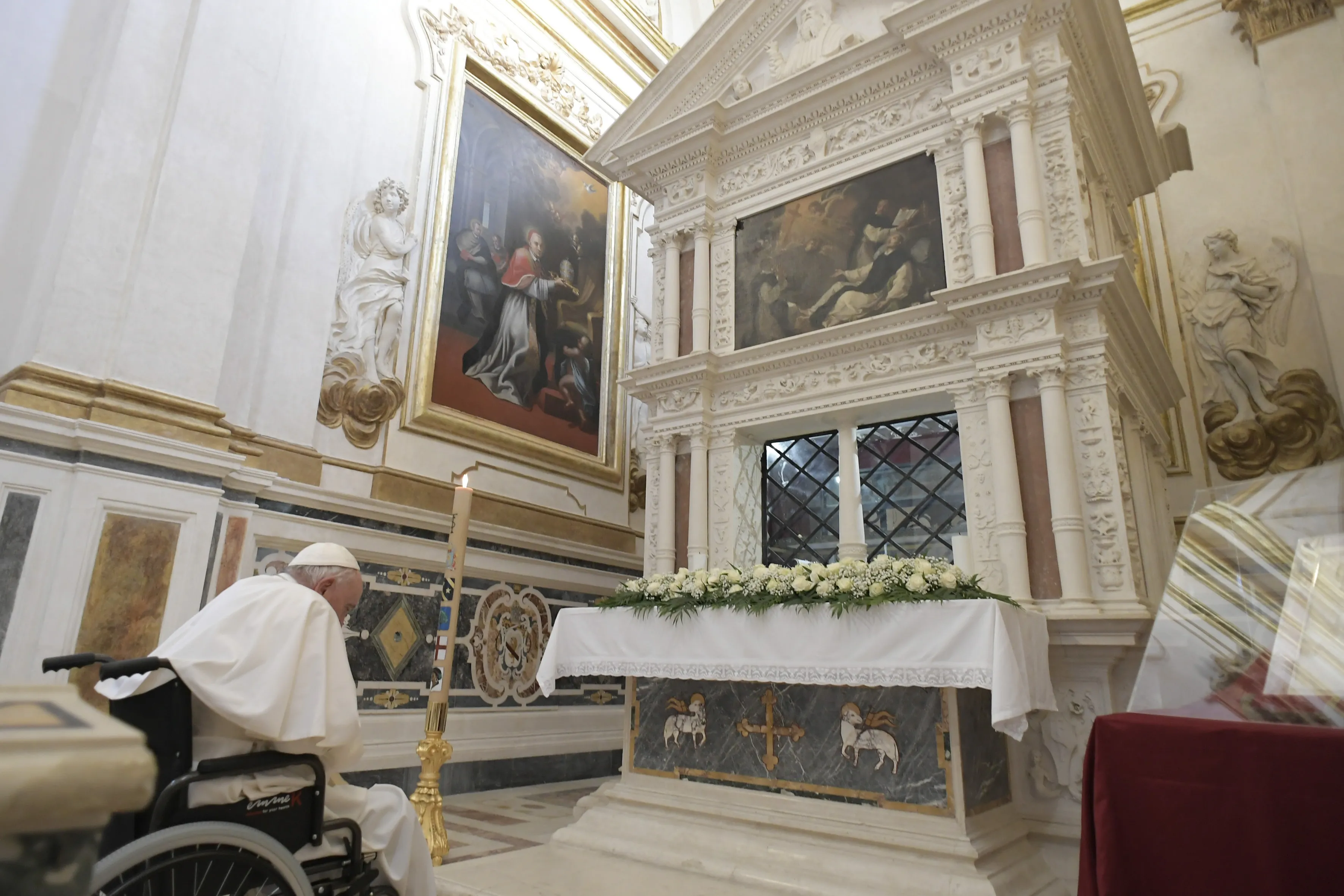
Pope Francis prays at the tomb of Pope Celestine V in L’Aquila, Italy. Vatican Media
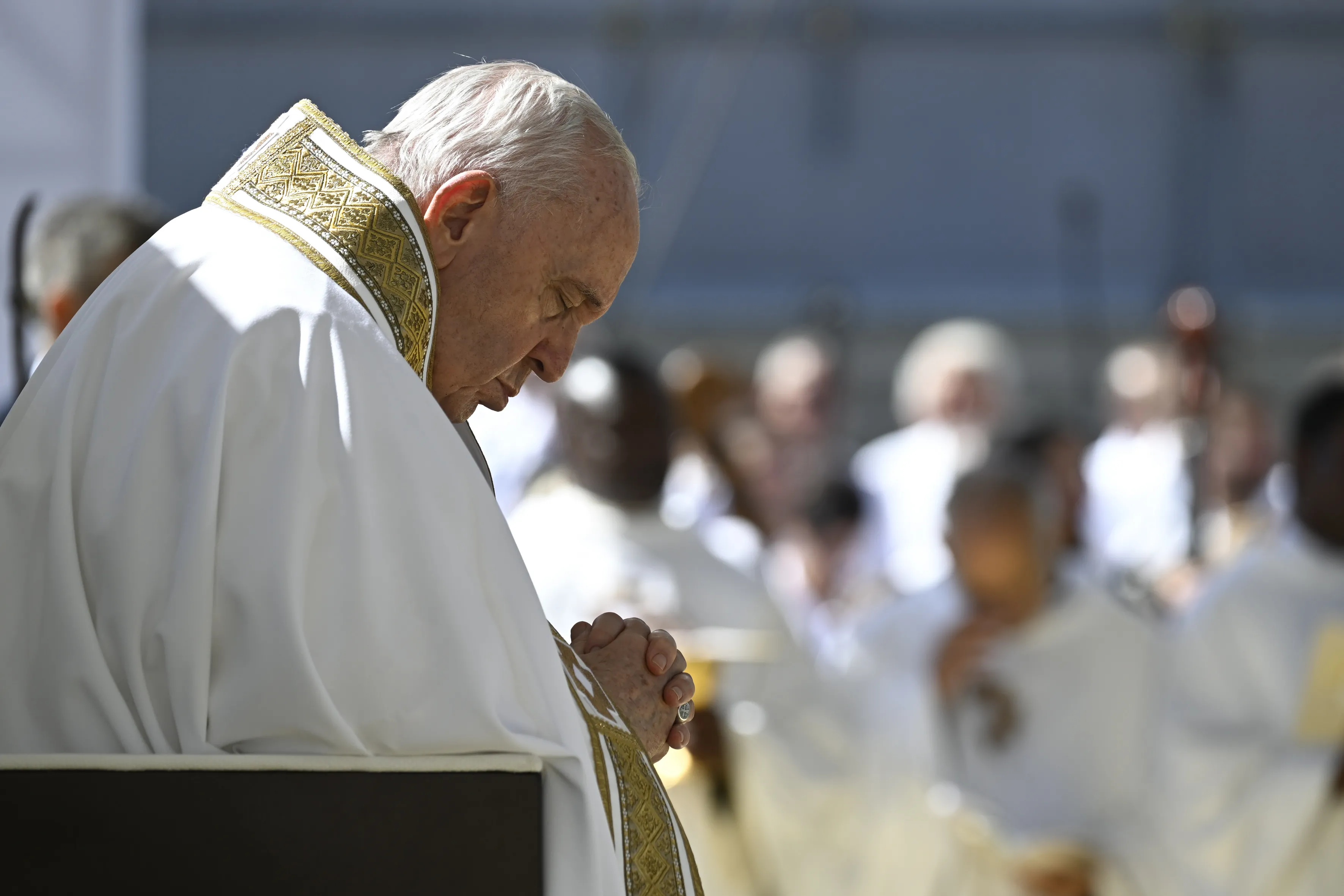
After opening the Holy Door, Pope Francis was wheeled through the basilica to the tomb of Pope Celestine V, where he spent a moment in silent prayer before the relics of his papal predecessor who was declared a saint in 1313.
“In the spirit of the world, which is dominated by pride, today’s Word of God invites us to be humble and meek. Humility does not consist in the devaluation of self, but rather in that healthy realism that makes us recognize our potential and also our miseries,” Pope Francis said.
“Starting precisely from our miseries, humility causes us to look away from ourselves and turn our gaze to God, the One who can do everything and also obtains for us what we cannot have on our own. ‘Everything is possible for those who believe (Mark 9:23).'”
Vatican City, Mar 30, 2018 / 10:06 am (CNA/EWTN News).- Papal preacher Fr. Raniero Cantalamessa dedicated his Good Friday homily to young people, comparing them to the apostle John and urging them to have the courage to go in the opposite direction of the selfishness of the world, running instead toward the sacrificial love of Jesus on the cross.
In his March 30 homily, Cantalamessa said modern society has come “under the dominion of Satan and sin,” and has been taken over by what St. Paul in his Letter to the Ephesians called the “spirit of the air.”
Cantalamessa said the phrase takes on a literal meaning today, because this spirit “spreads itself in infinite ways electronically through airwaves,” and plays a major role in shaping public opinion.
“To act, think or speak against this spirit is regarded as non-sensical or even as wrong and criminal,” he said, adding that the best way to ensure that one has not conformed to this world is by going in the opposite direction, walking toward suffering, and toward “the poor and those at the lowest level of society,” rather than away from them.
“Blending in with this world of suffering and marginalization is, paradoxically, the best way of ‘separating’ ourselves from the world because it means going in the direction from which the world flees as much as it can. It means separating ourselves from the very principle that rules the world, self-centeredness,” he said.
To drive his point home, Cantalamessa quoted British poet T.S. Eliot, saying “in a world of fugitives / The person taking the opposite direction / Will appear to run away.”
“Dear young Christians, if you will allow an old man like John to address you directly, I would exhort you: be those who take the opposite direction! Have the courage to go against the stream,” he said, adding that “the opposite direction for us is not a place but a person; it is Jesus, our friend and redeemer.”
Fr. Cantalamessa is the official papal preacher. He offers meditations to the pope and members of the Curia on Fridays during Advent and Lent, and he preaches the homily for the Good Friday veneration liturgy.
After the chanting of the Gospel during the liturgy for the Lord’s Passion in St. Peter’s Basilica, presided over by Pope Francis, Cantalamessa in his homily reflected on why the Church places such a strong emphasis on the cross of Christ.
He said that according to one theory, it could be because God reveals himself “sub contraria specie,” meaning in a form contrary to what he actually is: “he reveals his power in weakness, his wisdom in foolishness, his riches in poverty.”
However, this logic does not apply to the cross, he said, because on the cross God reveals himself “as he really is, in his most intimate and truest reality.” And this reality, he said, is that “God is love…oblative love, a love that consists in self-giving, and only on the cross does God’s infinite capacity for self-gift manifest the length to which it will go.”
With a Synod of Bishops dedicated to youth on the schedule for this October, Cantalamessa said the presence of St. John with Jesus on Calvary holds special significance, since it is believed that the evangelist joined Jesus when he was still a young man.
Noting how John is often referred to in scripture as “the disciple whom Jesus loved,” the papal preacher said this was a real and personal experience of “falling in love” with the Lord that can be seen from the fact that the whole of John’s Gospel focuses on the person of Jesus, rather than his works and teaching.
Cantalamessa said St. John was almost certainly one of the two disciples of John the Baptist who, when Jesus passed them on the beach, followed him and spent the day with him. He noted how when they asked Jesus where he was staying, “it was about the tenth hour.”
“That hour decided the course of John’s life, and he never forgot it,” Cantalamessa said, and stressed the importance of helping young people today understand not only what God and the Church expect of them and what they can offer to the Church and to society, but also to help youth understand what Jesus himself can offer to them.
He pointed to how John described his experience with Jesus as the “fullness of joy” and an “abundant life,” and urged members of the Church to accept Francis’ invitation in Evangelii Gaudium to “a renewed personal encounter with Jesus Christ, or at least an openness to letting him encounter them.”
“I ask all of you to do this unfailingly each day. No one should think that this invitation is not meant for him or her, since no one is excluded from the joy brought by the Lord,” he said, continuing to quote Francis.
Cantalamessa said it is possible to encounter Christ today because He is risen and alive, and that after this personal encounter takes place, “everything is possible.”
Speaking directly to youth, the papal preacher said they have a special mission “to rescue human love from the tragic drift in which it had ended up: love that is no longer a gift of self but only the possession – often violent and tyrannical – of another.”
Pointing to the self-sacrificial “agape” love shown by Jesus on the cross and the desiring, “eros” love that “welcomes, that pursues, that desires, and that finds joy in being loved in return,” Cantalamessa said these two types of love are linked, and cannot be separated from each other.
God both desires man and exercises charity toward him, he said, explaining that learning how to love like God “is not a question of renouncing the joys of love, attraction, and ‘eros,’ but of knowing how to unite ‘eros’ and ‘agape’ in the desire for another, the ability to give oneself to the other.”
Learning how to do this will not happen “in one day,” he said, and told youth to start preparing themselves now to give themselves either to another person in marriage, or to God in a consecrated vocation.
This preparation, he said, can begin now with something as simple as a smile or a gift of one’s time or service in one’s family, parish or volunteer work, which “so many of you are already quietly doing.”
Thus wrote Mahatma Gandhi: “Non-violence is the greatest force at the disposal of mankind. It is mightier than the mightiest weapon of destruction devised by the ingenuity of man. Non-violence is the means of realizing Him.”



Thus wrote Mahatma Gandhi: “Non-violence is the greatest force at the disposal of mankind. It is mightier than the mightiest weapon of destruction devised by the ingenuity of man. Non-violence is the means of realizing Him.”
Another scandalous pronouncement from the Roman Curia.