

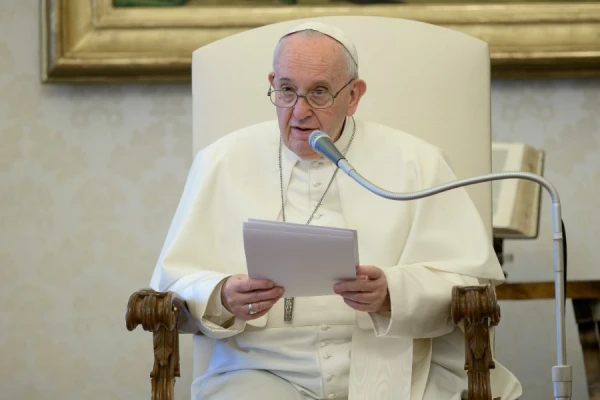
Vatican City, Apr 22, 2020 / 06:30 am (CNA).- Commenting on the celebration of Earth Day during his general audience Wednesday, Pope Francis urged people to show solidarity with the weak and vulnerable and to protect humanity’s common home.
According to Pope Francis, Earth Day “is an occasion for renewing our commitment to love and care for our common home and for the weaker members of our human family.”
“As the tragic coronavirus pandemic has taught us, we can overcome global challenges only by showing solidarity with one another and embracing the most vulnerable in our midst,” the pope said April 22.
He called for a renewed sense “of sacred respect for the earth, for it is not just our home but also God’s home,” adding that “this should make us all the more aware that we stand on holy ground.”
“In this Easter season of renewal, let us pledge to love and esteem the beautiful gift of the earth, our common home, and to care for all members of our human family,” Francis urged.
“Like the brothers and sisters that we are, let us together implore our heavenly Father: ‘Send forth your Spirit, O Lord, and renew the face of the earth.’”
Pope Francis delivered his weekly catechesis via livestream from the Vatican’s apostolic library, saying selfishness had led people to fail in their responsibility “to be guardians and stewards of the earth.”
“We have sinned against the earth, against our neighbours, and ultimately against the Creator, the benevolent Father who provides for everyone, and desires us to live in communion and flourish together,” he stated.
Being made in the image of God, he said, means “we are called to have care and respect for all creatures, and to offer love and compassion to our brothers and sisters, especially the most vulnerable among us, in imitation of God’s love for us, manifested in his Son Jesus, who made Himself man to share this situation with us and to save us.”
Francis said there was a Spanish saying that “God forgives always; we men forgive sometimes; the earth never forgives.”
“The earth never forgives: if we have despoiled the earth, the response will be very bad,” the pope commented.
Pope Francis also noted his appreciation for national and local environmental movements which “appeal to our consciences,” though he said it will still “be necessary for our children to take to the streets to teach us the obvious: we have no future if we destroy the very environment that sustains us.”
“We can each contribute in our own small way,” he encouraged.
The pope also urged awareness and cooperation on the international level, calling on leaders to guide preparations for the upcoming conferences COP15 on Biodiversity in Kunming, China, and COP26 on Climate Change in Glasgow, Scotland.
“These two meetings are very important,” he said.
If you value the news and views Catholic World Report provides, please consider donating to support our efforts. Your contribution will help us continue to make CWR available to all readers worldwide for free, without a subscription. Thank you for your generosity!
Click here for more information on donating to CWR. Click here to sign up for our newsletter.

Francis said there was a Spanish saying that “God forgives always; we men forgive sometimes; the earth never forgives.”
********
I’ve always heard that as “Nature” never forgives. And that doesn’t portray nature as a loving mother but rather as something affected by the results of a fallen world: disease, famine, natural disasters, etc.
We suffer the natural consequences of some of our poor choices.
To be clear, the virus sent to the rest of the world by the Communist government of China is not nature’s punishment for the “sin” of “climate change.” Some of the statements coming from the Holy Father beggar belief. Interestingly, the government of China, with which this papacy has such amiable relations, has not come in for any criticism from the Vatican during this crisis. On the other hand, Francis has not been able to restrain himself from taking veiled swipes at Trump. Pretty telling, I’d say.
In his urgent and strategic efforts to beckon very disparate and fragmented “movements” toward a more moral commonwealth, the Holy Father makes very good points–but from time to time is he perhaps too ambiguous(?).
Do we really “sin” against the earth? And do we really engage only when “our children take to the streets to teach us the obvious”? Did St. John Paul II make the same points–also in an evangelizing and well-grounded way (and less earthy, shall we say), when he wrote:
“Man remains above all a being who seeks the truth and strives to live in the truth, deepening his understanding through dialogue which involves past and future [both!] generations” (Centesimus Annus, 1191, n.49). And, without seemingly conflating the two spheres by poetic license, he too drew urgent attention to both the endangered “natural ecology” and the related but also distinct—-and sinned against—-members of the “human ecology” (nn. 37-40).
“We have sinned against the earth” implies a living person. We can sin against a brother who has a soul created in God’s image. Figuratively. We actually sin against God when we sin against our brother. As the Pope acknowledges. As an afterthought and nuance of ambiguity. Yes we should care for our common home. If we misuse the planet, dump our garbage, old vehicle down a ravine we sin against God not the planet. Nevertheless love for our common home as couched clashes with Christ’s admonition against [an excessive] love of this world. The Earth Day prayer has that connotation when viewed in context. Goddess of the Andes veneration cannot be dismissed. Earth Day “is an occasion for renewing our commitment to love and care for our common home and for the weaker members of our human family.” Nothing is said here, very little is said elsewhere about the millions upon millions of infants murdered in the womb. Jeffrey Sachs is chosen as a Vatican consultant on the Family. Obviously not in an effort to care for those who are actually the most weak and vulnerable. There’s an exaggerated emphasis on ecological concern that makes “love and care for our common home” suggest a competitive love with the divinity. Is such exaggerated ecological concern, though not necessarily intentional albeit idolatry in disguise? If so then this must be addressed and set right.
https://www.abc.net.au/news/2018-06-27/china-ghost-cities-show-growth-driven-by-debt/9912186
It is, indeed, ironic to hold a conference on biodiversity in China. Perhaps, it is to prove a point of the destruction the country made over the decades when building massive cities that NO ONE lives in. Just think of the swats of land cleared for all those projects!
We are privileged to be living on God’s Holy Ground.