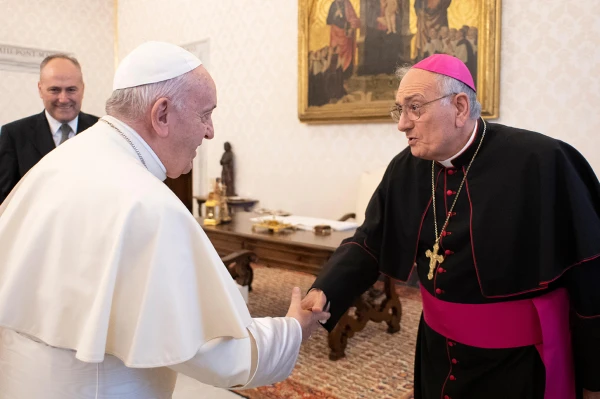
Vatican City, Apr 14, 2020 / 06:19 pm (CNA).- Pope Francis phoned Cardinal Timothy Dolan of New York Tuesday to express his concern for the people of New York during the coronavirus pandemic. More than 10,000 deaths in the city are being attributed to infection by the virus.
Cardinal Dolan said April 14 that Pope Francis had called him that afternoon “to express his love, concern, and closeness to all the people of New York, especially those who are sick, during the coronavirus outbreak.”
“He mentioned in a special way Bishop Nicholas DiMarzio and the people of the Diocese of Brooklyn and Queens, and I happily shared the Holy Father’s words with Bishop DiMarzio immediately thereafter,” the cardinal added.
Two priests of the Diocese of Brooklyn, Fathers Jorge Ortiz-Garay and Gioacchino Basile, have died due to coronavirus, on March 27 and April 4, respectively. The Brooklyn diocese covers the New York City boroughs of Brooklyn and Queens.
Bishop Nicholas DiMarzio of Queens commented that “On behalf of the Diocese of Brooklyn, I am humbled to have received prayers and condolences from our Holy Father, Pope Francis, on the deaths of two of our priests who have been lost to coronavirus. As we continue to mourn the loss of Father Ortiz-Garay and Father Basile, it is comforting to know Pope Francis joins with us in solidarity. We are one church, and together the people of God will get through these most difficult times.”
Cardinal Dolan wrote that Pope Francis “said that New Yorkers were in his prayers in a special way at this time. He asked me to relay his prayerful best wishes to the sick, the doctors, nurses, EMT’s, [sic] medical professionals, and caregivers who are tending to them, our civic leaders, as well as our priests, religious, and lay people.”
He added that “I thanked the Pope for the leadership he has displayed during this global pandemic, and assured him of the love and prayers of the people of New York for him and his ministry.”
New York City’s health department said April 14 that it has counted more than 10,000 deaths due to coronavirus after deciding it is “now including people who had never tested positive for the virus but were presumed to have died because of it,” the New York Times reported.
If you value the news and views Catholic World Report provides, please consider donating to support our efforts. Your contribution will help us continue to make CWR available to all readers worldwide for free, without a subscription. Thank you for your generosity!
Click here for more information on donating to CWR. Click here to sign up for our newsletter.
Vatican City, Feb 12, 2020 / 12:49 pm (CNA).- During his General Audience on Wednesday, Pope Francis discussed the second beatitude, Blessed are those who mourn for they shall be comforted, emphasizing the value of compunction.
Mourning “is an attitude that became central to Christian spirituality,” the pope said Feb. 12 at the Vatican’s Paul VI Hall.
The desert fathers calld this “an inner pain that opens up to a relationship with the Lord and with one’s neighbour; a renewed relationship with the Lord and with one’s neighbour,” he said.
Mourning can have two aspects, Pope Francis said: “for death or for the suffering of someone” and “tears shed over sin – for our own sin, when the heart bleeds for the pain of having offended God and one’s neighbour.”
He said that it is “a question of loving the other in such a way that we are bound to him or her until we share his or her pain … it is important that others make a breach in our hearts.”
“I have often spoken about the gift of tears, and how precious it is,” he said.
“Can one love in a cold way? Can one love by function, by duty? Certainly not. There are the afflicted to console, but sometimes there are also the consoled to afflict, to awaken, who have a heart of stone and have forgotten how to weep. It is also necessary to reawaken people who do not know how to be moved by the pain of others.”
While bitter, mourning can “open one’s eyes to life and to the sacred and irreplaceable value of each person, and at that moment one realizes how short time is,” the pope reflected.
Turning to weeping over sin, Francis said that it is not anger at having made a mistake, which he called pride.
“Instead there are those who mourn the evil done, the good omitted, the betrayal of the relationship with God. This is mourning for not having loved, which springs from having the life of others at heart. Here one weeps because one does not correspond to the Lord Who loves us so much, and we are saddened by the thought of the good not done; this is the meaning of sin. They say, ‘I have wounded the one I love’, and it pains them to tears. God be blessed if these tears come!”
He said it is “difficult but vital” to face one’s own errors.
“Let us think of the weeping of Saint Peter, which leads him to a new and far truer love: they are tears which purify, which renew. Peter looked to Jesus and wept: his heart was renewed.”
Pope Francis contrasted St. Peter with Judas, “who did not accept that he had made a mistake and, poor man, took his own life.”
“Understanding sin is a gift from God, it is the work of the Holy Spirit. We, by ourselves, are unable to understand sin. It is a grace we must ask for … This is a very great gift and after we have understood this, there comes the grief of repentance.”
The pope referred to St. Ephrem the Syrian’s saying that “a face washed with tears is unspeakably beautiful.”
“The beauty of penitence, the beauty of tears, the beauty of contrition,” the pope exclaimed.
“Christian life finds its best expression in mercy. Wise and blessed is he who welcomes the pain linked to love, because he will receive the consolation of the Holy Spirit which God always forgives, even the worst sins, always is the tenderness of God Who forgives and corrects.”
He added that “God always forgives: let us never forget this.. The problem is in us, that we tire of asking for forgiveness, we become wrapped up in ourselves and we do not ask for forgiveness. This is the problem; but He is there to forgive.”
Pope Francis meets with the Order of Malta’s Fra’ Marco Luzzago on June 25, 2021. / Vatican Media
Vatican City, Mar 7, 2022 / 09:35 am (CNA).
The Order of Malta’s future is in Pope Francis’ hands. After a meeting with senior members on Feb. 26, the pope will take time to ponder the proposals for renewal and eventually decide on a path of reform.
Cardinal Silvano Maria Tomasi, the papal delegate to the organization, reported on the meeting in a letter to confreres of the order.
Tomasi stressed that “we explained to the Holy Father that the reform under study keeps and better frames the order as a lay religious order and at the same time consents to the continuation of its charitable, diplomatic and humanitarian action for ‘our lords the sick’ and at the service of the Church.”
The Italian cardinal added that the pope had “decided to keep listening to us, and granted us another hearing. After the meetings, the pope will rule about the projects presented to him.”
Also present at the papal meeting were Fra’ Marco Luzzago, Lieutenant of the Grand Master, members of Tomasi’s working group for the reform, and a delegation representing the order’s members.
In a Feb. 27 press release, the 1,000-year-old institution stressed that “the focus of the meeting was the Order of Malta’s reform.”
It said that “in a letter sent to the Order of Malta’s leaders worldwide, Marwan Sehnaoui, chairman of the steering committee for the constitutional reform process, expressed his gratitude to ‘His Holiness for having dedicated two hours of his valuable time to the Order of Malta.’”
Sehnaoui said: “The Holy Father began and ended the audience by stating that he had taken himself the final decision-making of the critical issues regarding the order’s constitutional reform.”
“Pope Francis listened carefully to the presentations and interventions of both sides. After exchanging views, the Holy Father said there is no urgency in making a final decision. His Holiness also said that he wishes to gather and review more information and that he would probably convene another audience.”
These statements require a close reading. First, by explaining that the order’s diplomatic and humanitarian work will not be affected by the reform, Tomasi implicitly addressed a criticism raised after the circulation of a draft reform text, which described the Order of Malta as “subject to the Holy See.” This triggered concern that the new statutes would dilute the order’s sovereignty.
Cardinal Silvano Maria Tomasi. Martin Micallef/Maltese Association Order of Malta via Flickr.
Although it possesses no real territory, the order has the hallmarks of sovereignty, such as its own official currency, postage stamps, and vehicle registration plates. It has diplomatic relations with more than 100 states and permanent observer status at the United Nations. It also oversees a flourishing humanitarian network that is currently delivering aid to refugees fleeing Ukraine.
Speaking with the National Catholic Register on Jan, 23, Tomasi stressed that in a subsequent draft, the order was no longer described as subject to the Holy See.
“We didn’t keep that expression,” he said, “and it’s not going to be in the text of the constitution that we’re going to circulate.”
He continued: “In a letter to the order, I said that, when we would be finished with the work under the constitution, government, and working group of the special delegate, we would send the text to the ‘fras’ — the religious — to the presidents of the associations, to the sovereign council and the members of the government so that we have everybody’s input and objections — if there were aspects of the constitution or the text that weren’t acceptable or considered objectionable.”
The most important reform is, in the end, that of fras, who are known as first-class knights. Only first-class knights who descend from a family of four quarters of nobility are eligible to be elected as the Grand Master, the order’s religious superior and sovereign. This provision means that fewer than 40 people in the order are able to be considered for the role.
Pope Francis took over the reform process after a fierce debate within the order.
The working group entrusted to draft the new statutes was composed of the canon law expert Father Gianfranco Ghirlanda, Msgr. Brian Ferme, secretary of the Vatican’s Council for the Economy, Maurizio Tagliaferri, Federico Marti, and Gualtiero Ventura.
Albrecht von Boeselager. Daniel Ibáñez/CNA.
The group was later enlarged with the addition of a few senior members of the order, including the Grand Chancellor Albrecht von Boeselager. But Boeselager announced in January that he was stepping down from the expanded group. Sehnaoui, president of the order’s Lebanese association, was appointed to take Boeselager’s place, assisted by Péter Szabadhegÿ.
Tomasi refused to recognize the Sehnaoui appointment, and so he could not attend the two-day meeting to discuss the draft text.
It is particularly significant, then, that Sehnaoui was included in the group that met with the pope on Feb. 26. Sehnaoui’s presence might be considered a gesture of detente.
Tomasi sent a letter to the knights after a private meeting with the pope on Jan 29, after the two-day reform meeting, held on Jan. 25-26.
The cardinal said that “the pope has decided that he wants to meet the mixed working group with some members representing the professed, the government of the order, the procurators of the priories and the presidents of the associations, to present to him concrete reform projects.”
So, Tomasi wrote, “the Holy Father, therefore, decided to suspend all other activities until this meeting is taking place, following which he will make a final decision.”
“Therefore, the meeting of the mixed working group of Feb. 22-23 is suspended, and the meetings of the steering committee chaired by President Marwan Sehnaoui are also suspended.”
The Magistral Villa of the Sovereign Military Order of Malta in Rome. Lalupa via Wikimedia (CC BY-SA 3.0).
Tomasi stressed that “any other activity before the meeting with the pope will be considered an act of disobedience to the Holy Father.”
It was a notably harsh statement which indicated that the pope would be taking responsibility for the process.
Knights who took part in the papal meeting told CNA that “they had a positive feeling” and that the pope “listened carefully to their issues.”
Members of the order must now wait to see what the pope decides. It will eventually become clear whether he has chosen to treat the order principally as a religious order or will also consider the vast humanitarian network overseen by this sovereign entity with no territory.
Life is a precious gift.