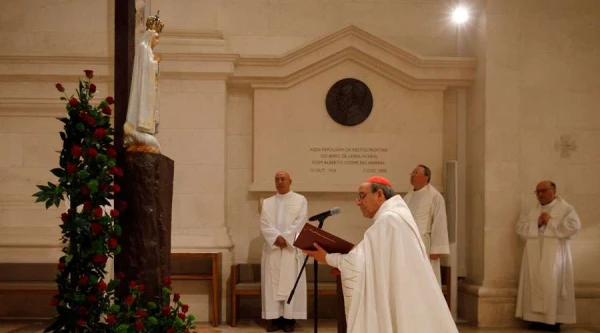
CNA Staff, Mar 25, 2020 / 05:25 pm (CNA).- Twenty-four countries on Wednesday were consecrated to the Sacred Heart of Jesus and the Immaculate Heart of Mary at the Shrine of Our Lady of Fatima in Fatima, Portugal.
In a March 25 ceremony that included the recitation of the rosary and a litany asking the Blessed Virgin Mary to pray for the afflicted, Fatima’s bishop, Cardinal Antonio Marto, renewed the consecration of Portugal and Spain to Jesus and Mary, and added the names of twenty-four other countries.
In response to the global coronavirus pandemic, the Portuguese bishops’ conference announced last week they would reconsecrate Portugal to Christ and Mary on the evening of March 25. Shortly after the announcement, the Spanish bishops’ conference requested that their country also be consecrated in the same liturgy.
The Portuguese bishops subsequently invited the heads of other national bishops’ conferences to request that their nations be added as well.
In addition to Spain and Portugal, the other 22 countries consecrated at the request of their respective episcopal conferences are: Albania, Bolivia, Colombia, Costa Rica, Cuba, Slovakia, Guatemala, Hungary, India, Mexico, Moldova, Nicaragua, Panama, Paraguay, Peru, Poland, Kenya, the Dominican Republic, Romania, Tanzania, East Timor and Zimbabwe.
The cardinal also prayed for “children, the elderly and the most vulnerable,” asking the Blessed Virgin Mary to “comfort doctors, nurses, healthcare professionals, and volunteer caregivers. Strengthen families and reinforce us in citizenship and solidarity.”
During his remarks, the cardinal recalled that Saints Francisco and Jacinto Marto, shepherd children to whom the Blessed Virgin Mary appeared in 1916 and 1917, both died amid the victims of the Spanish flu pandemic.
Cardinal Marto prayed that the saints would intercede for “"so many sick people who, these days and in a profound way, experience the solitude of isolation to which they are subject."
In a statement, the bishops’ conference of Portugal noted that on 36 years ago, on March 25, 1984, Pope St. John Paul II consecrated the entire world to the Immaculate Heart of Mary.
In Spain, more than 3,600 people have died of the coronavirus, while in Portugal, nearly 3000 are infected and almost 50 have died. More than 21,000 people have died around the world as a result of the novel coronavrius.
If you value the news and views Catholic World Report provides, please consider donating to support our efforts. Your contribution will help us continue to make CWR available to all readers worldwide for free, without a subscription. Thank you for your generosity!
Click here for more information on donating to CWR. Click here to sign up for our newsletter.
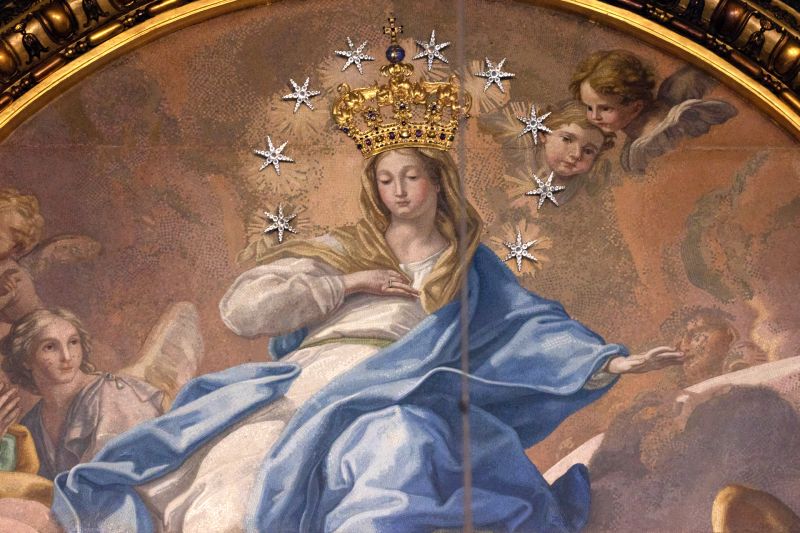
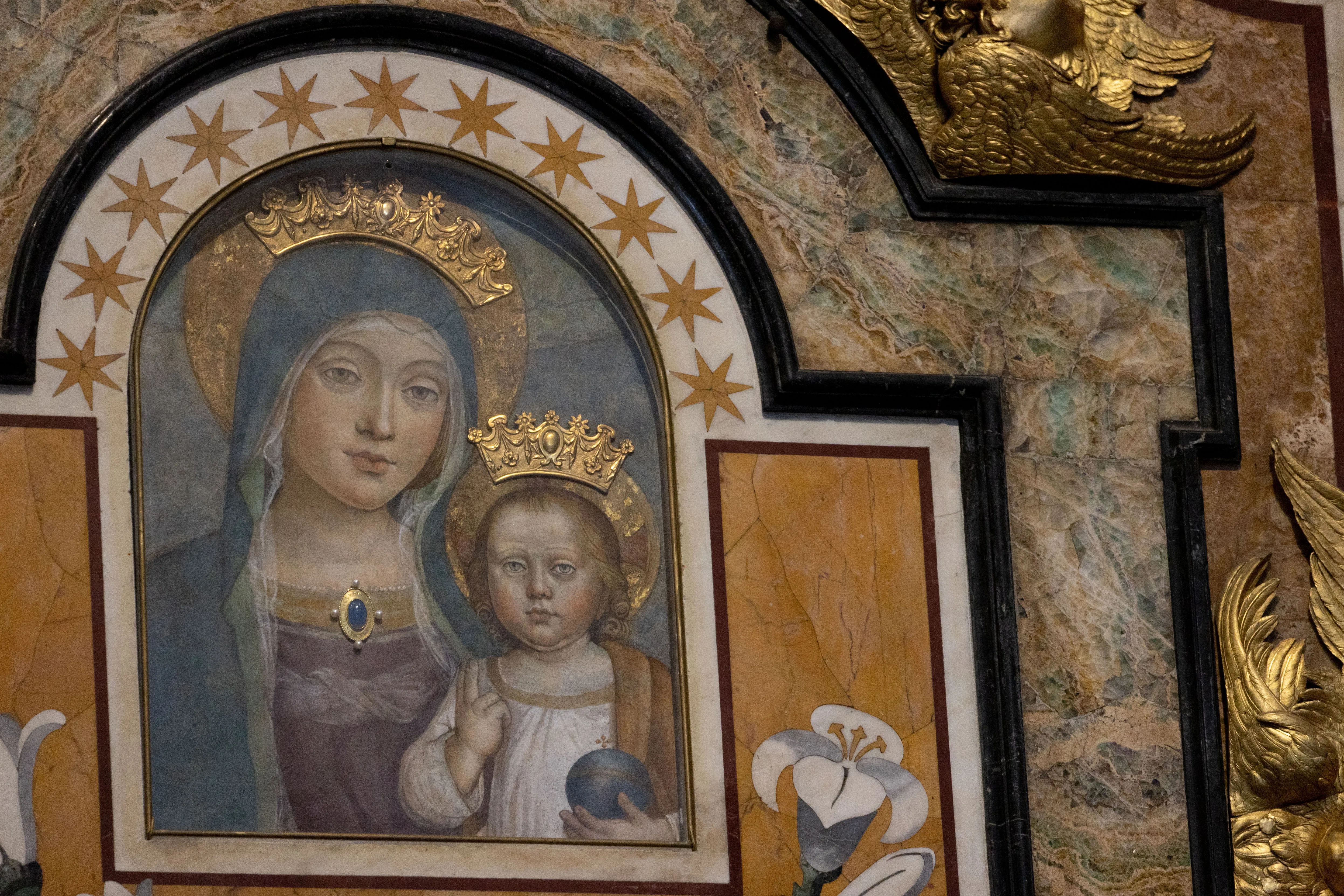
When Pope Pius IX declared the doctrine of the Immaculate Conception of the Virgin Mary on December 8, 1854, he had a golden crown added to the mosaic of Mary, Virgin Immaculate, in the Chapel of the Choir in St. Peter’s Basilica. / Daniel Ibañez/CNA
Vatican City, May 29, 2023 / 10:30 am (CNA).
To honor the Blessed Virgin Mary, the Vatican offers a special Marian pilgrimage within St. Peter’s Basilica each Saturday afternoon during the month of May.
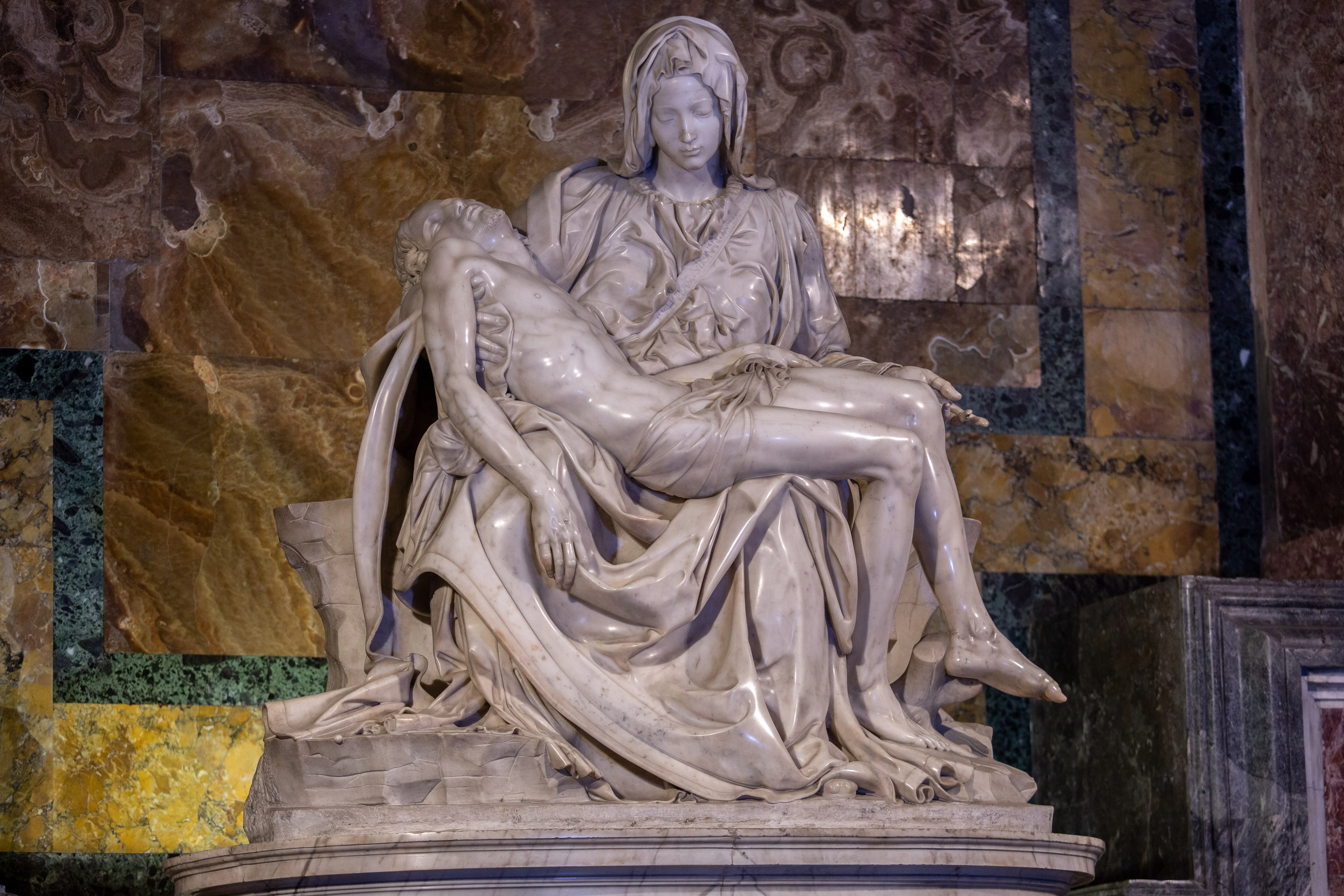
The Marian itinerary brings pilgrims from Michelangelo’s marble sculpture of the Pieta to Our Lady of Perpetual Help, a 12th-century painting brought into the basilica in 1578 in a solemn procession.
For those unable to travel to the Eternal City, CNA is providing the following “virtual tour” with photos by Daniel Ibañez of eight beautiful images of Our Lady in St. Peter’s Basilica for the feast of Mary, Mother of the Church.
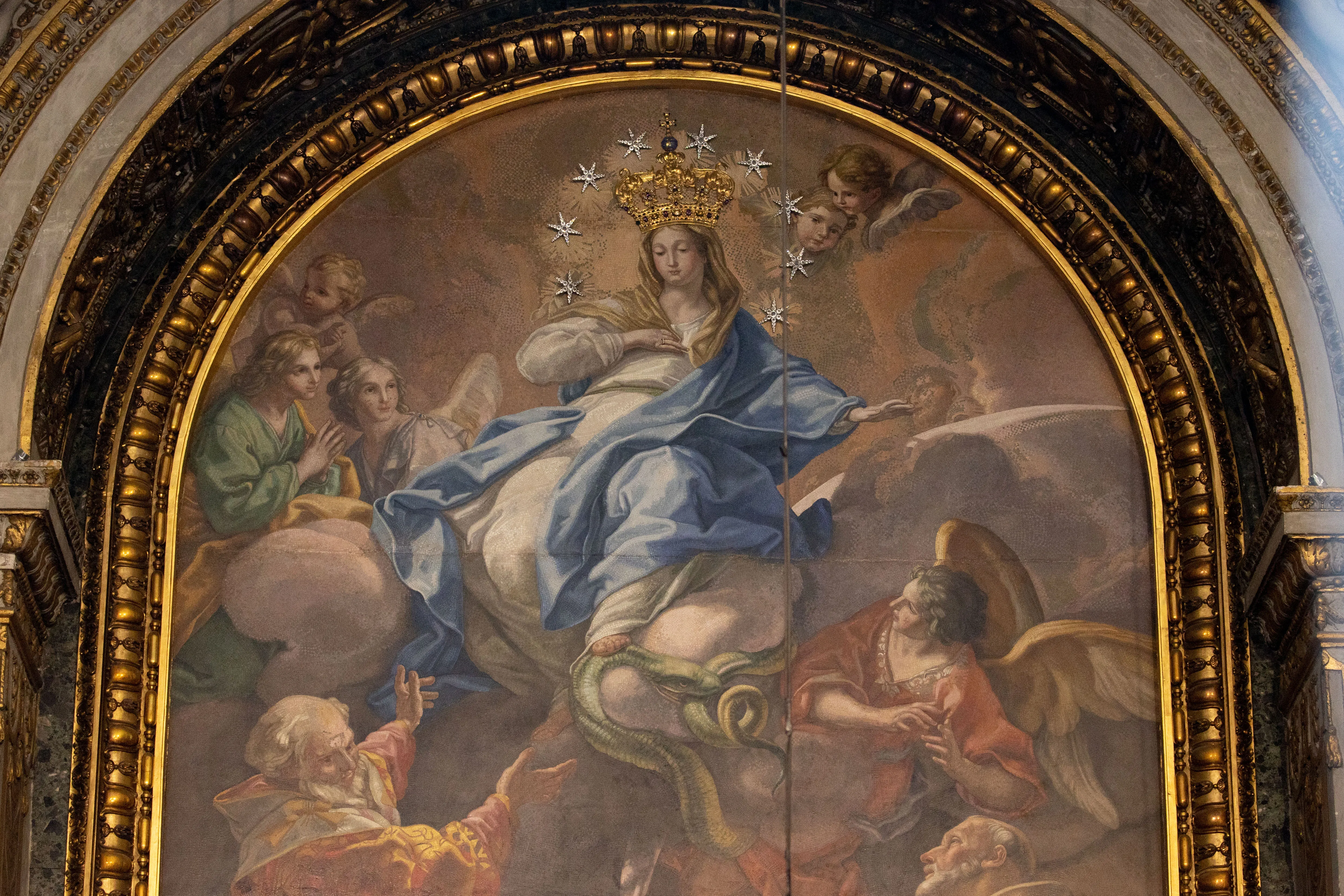
In St. Peter’s Basilica’s Chapel of the Choir, a large mosaic based on painting by Italian artist Pietro Bianchi depicts Mary, Virgin Immaculate, in the glory of heaven being venerated by St. John Chrysostom (left) and other saints. Daniel Ibañez/CNA
Virgin Immaculate
In the basilica’s Chapel of the Choir, a large altarpiece reveals Mary, Virgin Immaculate, in the glory of heaven above angels and saints. The mosaic based on an 18th-century painting by Italian artist Pietro Bianchi depicts St. John Chrysostom St. Francis of Assisi, and St. Anthony of Padua venerating the Blessed Virgin Mary.
The chapel is located on the left side of the basilica behind an iron gate designed by Gian Lorenzo Bernini. St. John Chrysostom is buried beneath the altar, which also contains relics of St. Francis and St. Anthony.
When Pope Pius IX declared the doctrine of the Immaculate Conception of the Virgin Mary on December 8, 1854, he had a golden crown added to the mosaic of Mary. Pope Pius X later added a larger diamond crown to mark the 50th anniversary of the declaration in 1904.
The original painting by Bianchi can be found in Rome’s Basilica di Santa Maria degli Angeli e dei Martiri.
Mother of the Church
St. Peter’s Basilica contains an icon of the Virgin Mary titled “Mater Ecclesiae,” which means “Mother of the Church.”. Daniel Ibañez/CNA
The basilica contains an icon of the Virgin Mary titled “Mater Ecclesiae,” which means “Mother of the Church.”
The original image of the Virgin Mary and the Christ Child was painted on a column in old St. Peter’s Basilica, built by Emperor Constantine in the fourth century. It was later transferred to the 16th-century St. Peter’s Basilica. Paul VI honored the icon with the title “Mater Ecclesiae” after the Second Vatican Council.
A mosaic of the Virgin Mary overlooking St. Peter’s Square was inspired by the original Mater Ecclesiae image. The mosaic was installed after the assassination attempt against St. John Paul II in 1981.
When he blessed the mosaic, John Paul II prayed “that all those who will come to this St. Peter’s Square will lift up their gaze towards you [Mary], to direct, with feelings of filial trust, their greetings and their prayers.”
In 2018, Pope Francis added the memorial of “Mary, Mother of the Church” to the liturgical calendar for the Monday after Pentecost.
Mother of Pilgrims
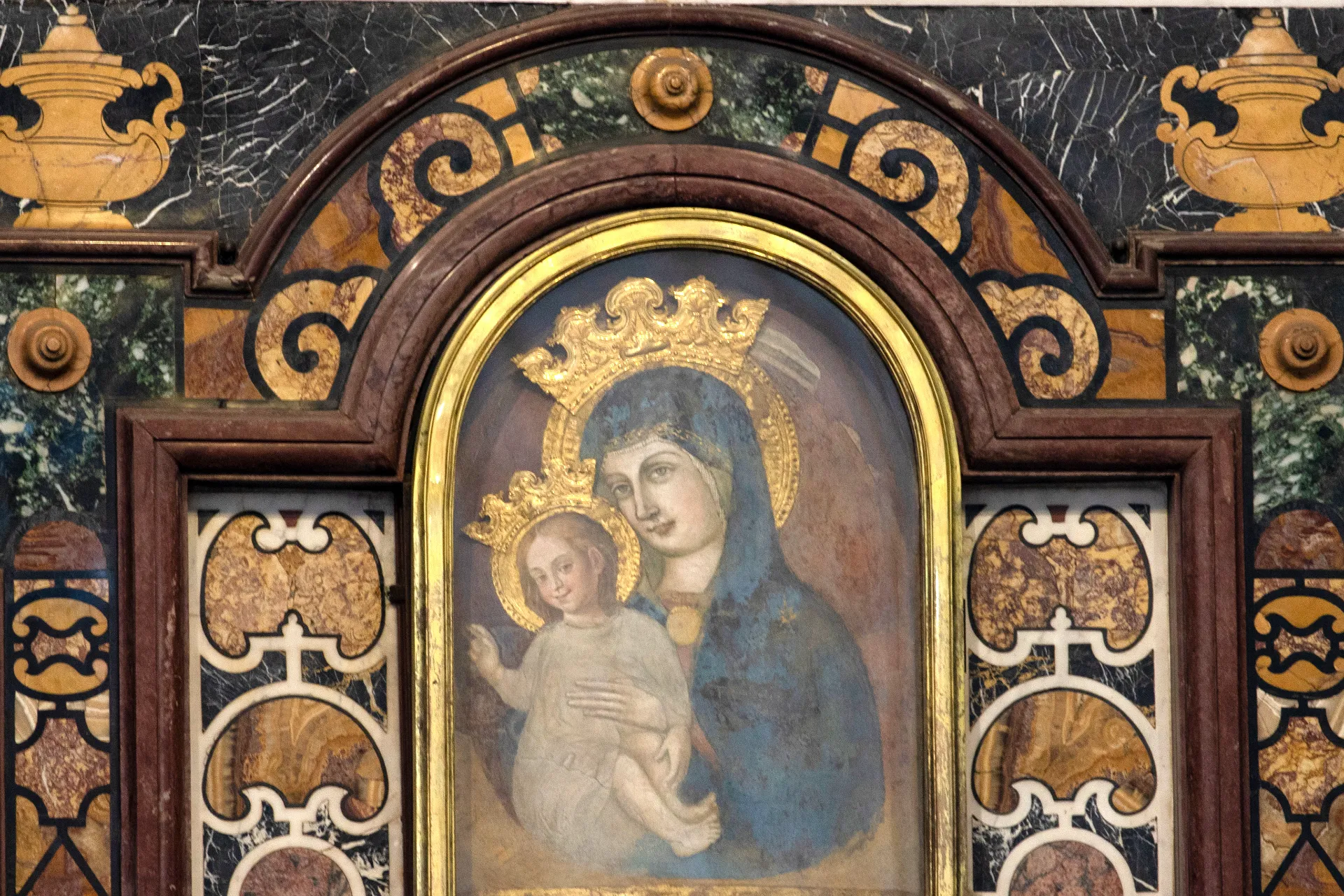
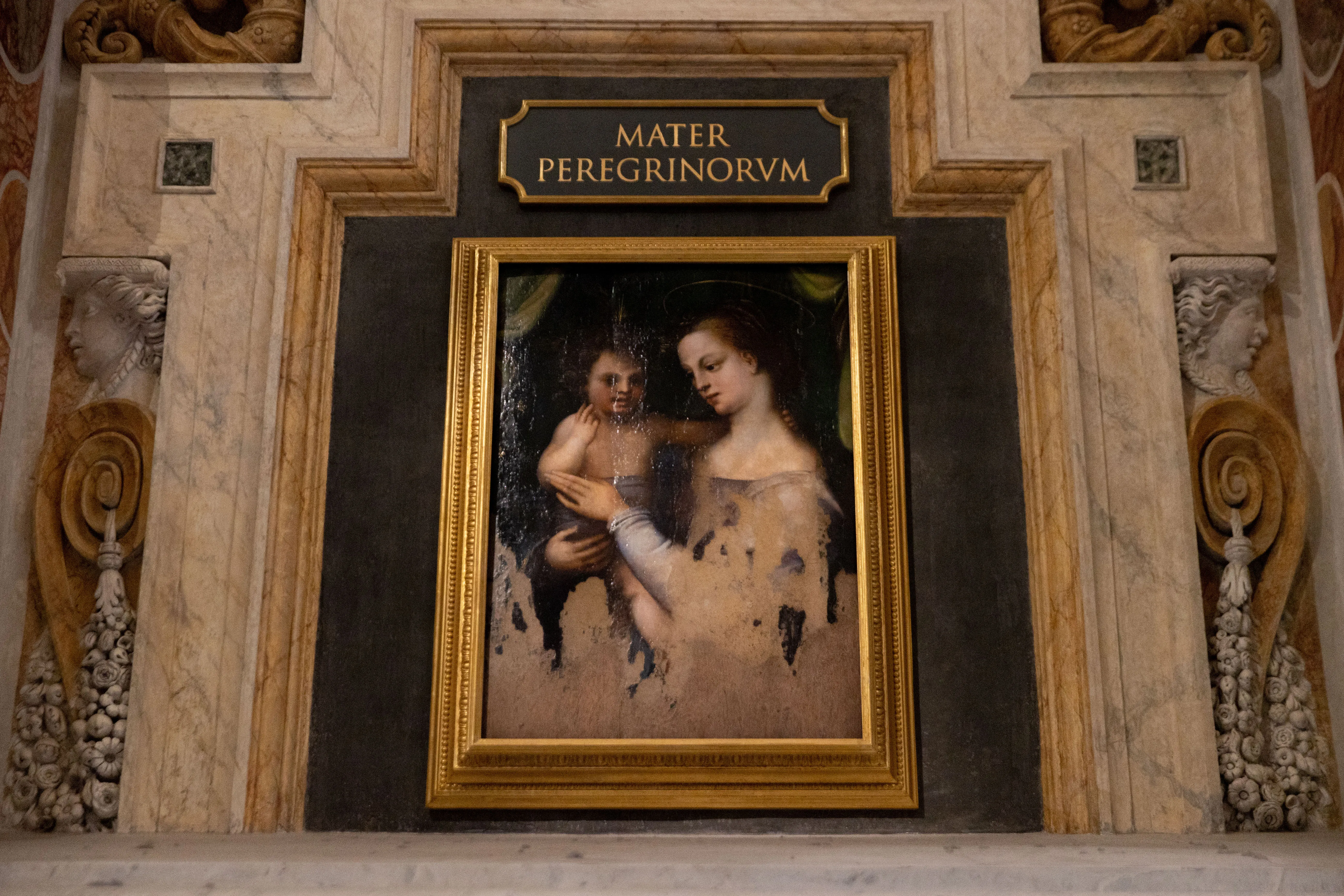
A restored 16th-century painting of Our Lady holding her Son can be found in St. Peter’s Basilica above the sarcophagus of Pope Gregory XIV under the title “Mother of Pilgrims.”. Daniel Ibañez/CNA
A restored 16th-century painting of Our Lady holding her son can be found in St. Peter’s Basilica above the sarcophagus of Pope Gregory XIV.
The image is titled “Mater Peregrinorum” or Mother of Pilgrims. The original artist is not known, but Italians also refer to the painting as the “Madonna di Scossacavalli” because it came from Rome’s Church of San Giacomo Scossacavalli, which was demolished in 1937 to create the current Via della Conciliazione leading to St. Peter’s Basilica.
Our Lady of Perpetual Help
A 12th-century painting on wood titled Our Lady of Perpetual Help in the Gregorian Chapel of St. Peter’s Basilica. Daniel Ibañez/CNA
A 12th-century painting on wood titled Our Lady of Perpetual Help, also known as Our Lady of Succor, was transferred to an altar in St. Peter’s Gregorian Chapel on February 12, 1578 with a solemn procession.
The painting was the first artistic restoration completed under Pope Francis’ pontificate during the Year of Faith, according to a book published by the Knights of Columbus.
The remains of the Doctor of the Church St. Gregory of Nazianzus (d. 390) are preserved in an urn beneath the Altar of Our Lady of Succor in the Gregorian Chapel, found on the right side of the basilica.
Ark of the Covenant
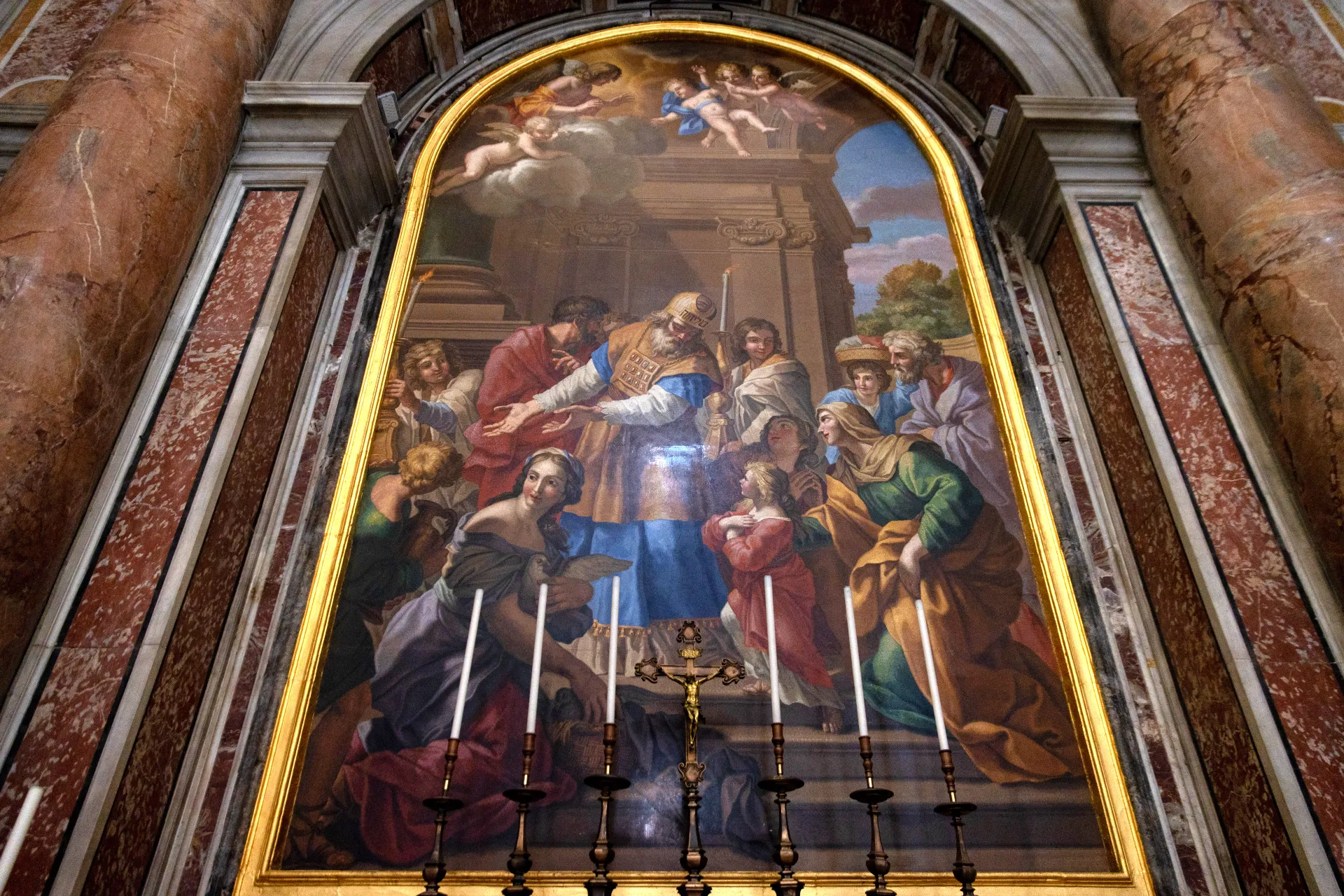
A mosaic altarpiece of the Presentation of the Virgin Mary in the Temple can be found above the tomb of Pope St. Pius X near the left-front entrance of the basilica. Daniel Ibañez/CNA
A colorful mosaic altarpiece of the Presentation of the Virgin Mary in the Temple brightens the wall above the tomb of Pope St. Pius X (d. 1914) in the Presentation Chapel near the left-front entrance of the basilica.
A young Mary is depicted on the steps of the Temple with her parents, Sts. Anne and Joachim, the grandparents of Jesus.
The mosaic completed by Pietro Paolo Cristofari in 1728 is based on a painting by 17th-century artist Giovanni Francesco Romaneli, the original of which can be found in Rome’s Basilica di Santa Maria degli Angeli e dei Martiri.
Gate of Heaven
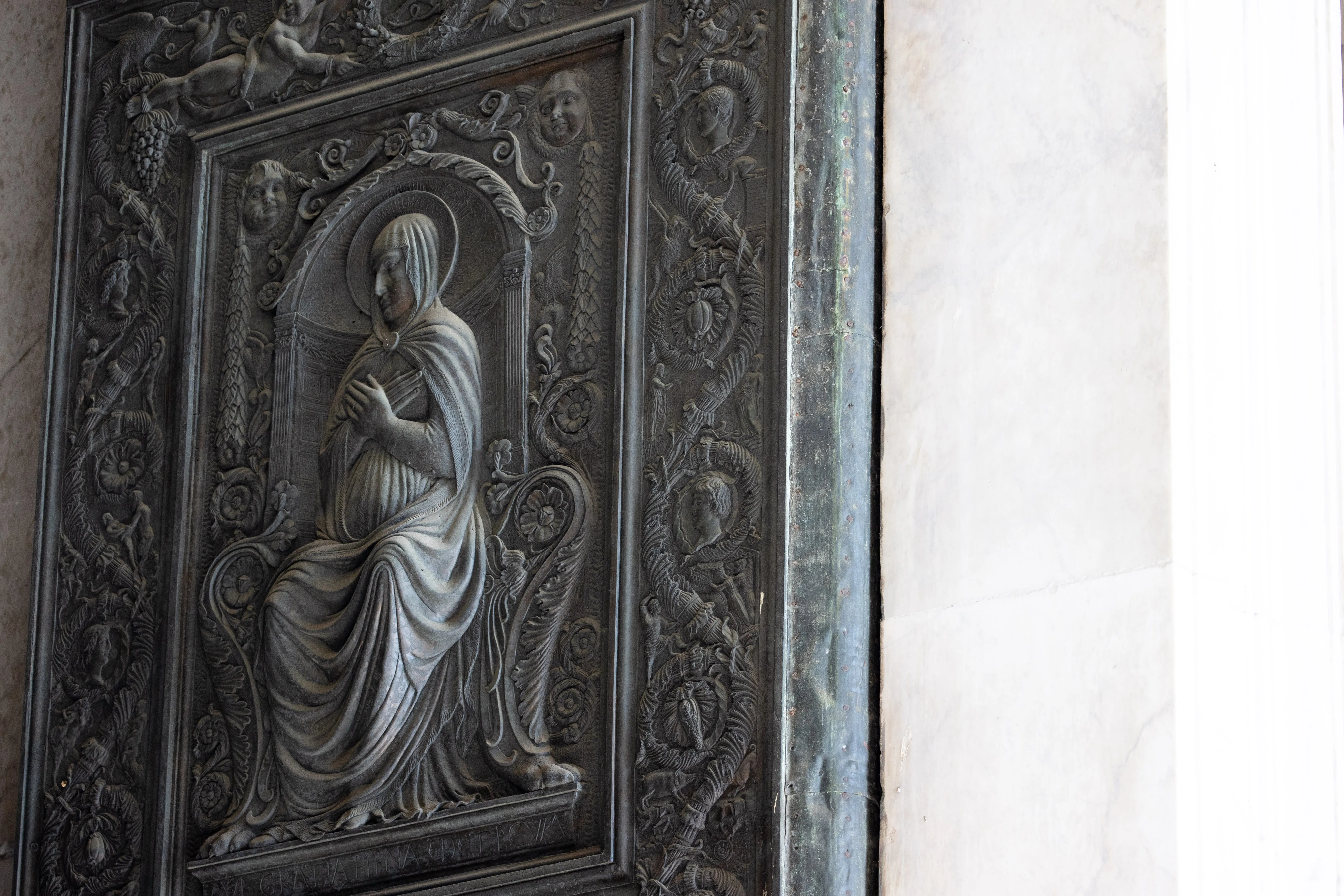
According to Father Agnello Stoia, the pastor of the parish of St. Peter’s Basilica, the 15th-century image of Mary on the oldest door of St. Peter’s Basilica is a reminder of Mary’s title, “Gate of Heaven.”. Daniel Ibañez/CNA
The central door leading to basilica was retained from the old St. Peter’s Basilica and is known as the Filarete Door. Created by a Florentine artist in 1455, the door depicts Christ, the Virgin Mary, and the apostles Sts. Peter and Paul.
According to Father Agnello Stoia, the pastor of the parish of St. Peter’s Basilica, the 15th-century image of Mary on the door is a reminder of Mary’s title, “Gate of Heaven.”
Queen Assumed into Heaven
The mosaics decorating the interior dome of St. Peter’s Basilica depict the Blessed Virgin Mary next to Christ the Redeemer and the Apostles. Daniel Ibañez/CNA
Looking up at the soaring cupola, or dome, of St. Peter’s Basilica, one sees mosaics depicting the Blessed Virgin Mary next to Christ the Redeemer, along with St. John the Baptist and the apostles.
The mosaic of the Virgin Mary on the Great Dome, completed in 1610 by Orazio Gentileschi, is based on drawings by Italian Mannerist painter Giuseppe Cesari.
Mother of the Redeemer
Michelangelo’s Pieta conveys the faith and emotion of the Blessed Virgin Mary as she cradles in her arms the dead body of her only son after witnessing him crucified. Daniel Ibañez/CNA
Michelangelo Buonarroti carved the Pieta from a single slab of Carrara marble when he was 24-years old. The sculpture was unveiled in St. Peter’s Basilica for the Jubilee of 1500.
The moving sculpture conveys the faith and emotion of the Blessed Virgin Mary as she cradles in her arms the dead body of her only son after witnessing him crucified.
The sculpture sits above a side-altar near the front entrance of St. Peter’s Basilica, where Mass was sometimes offered before recent restrictions. Visitors to the basilica can only see the Pieta behind bulletproof glass after a man attacked the sculpture with a hammer in May 1972.
The Pieta was the only work of art that Michelangelo ever signed.
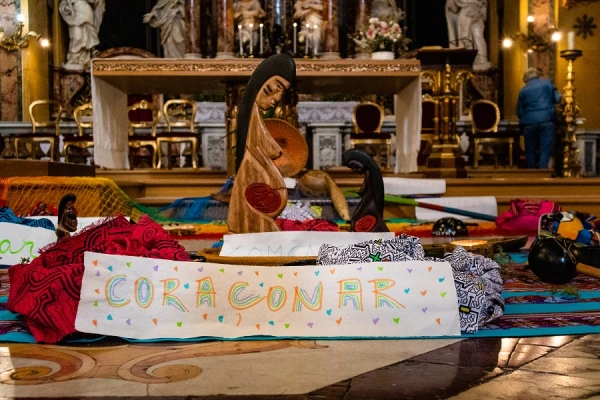
Vatican City, Oct 16, 2019 / 07:18 am (CNA).- Fr. Giacomo Costa, a communications official for the Amazon synod, said Wednesday a wooden figure of a nude pregnant woman, which has been present at events related to the synod, is not the Virgin Mary, but is instead a female figure representing life.
“It is not the Virgin Mary, who said it is the Virgin Mary?” Costa said Oct. 16 at a press conference for the Amazon synod, a meeting taking place in the Vatican Oct. 6-27 on the ministry of the Church in the region.
The wooden figure of a pregnant woman has been described as both a Marian image and as a traditional indigenous religious symbol of the goddess Pachamama, or Mother Earth.
When told “many people have said” the woman is a figure of the Virgin Mary, Costa added “‘many have said,’ okay, as you like, but I have never heard that.”
“There is nothing to know. It is an indigenous woman who represents life,” he stated, adding that his information commission will look for more information about it, but “it is a feminine figure” and is “neither pagan nor sacred.”
Paolo Ruffini, prefect of the Vatican communications dicastery, said Wednesday he sees the figure as “representing life.”
“Fundamentally, it represents life. And enough. I believe to try and see pagan symbols or to see… evil, it is not,” he said, adding that “it represents life through a woman.” He equated the image to that of a tree, saying “a tree is a sacred symbol.”
Ruffini said that interpretation is his personal opinion, and he was not speaking as the head of Vatican communications or synod communications.
He added that “We know that some things in history have many interpretations” and he would look for more information about the image and inform journalists about what he finds out.
Cristiane Murray, vice director of the Holy See press office, added that more information about the wooden figure should be sought from REPAM or the organizers of the events where the image has been present.
Mauricio Lopez, REPAM’s executive secretary, told CNA after the press conference that he could not comment on the press conference, directing CNA to Costa’s remarks, as the “official spokesperson” of the Synod.
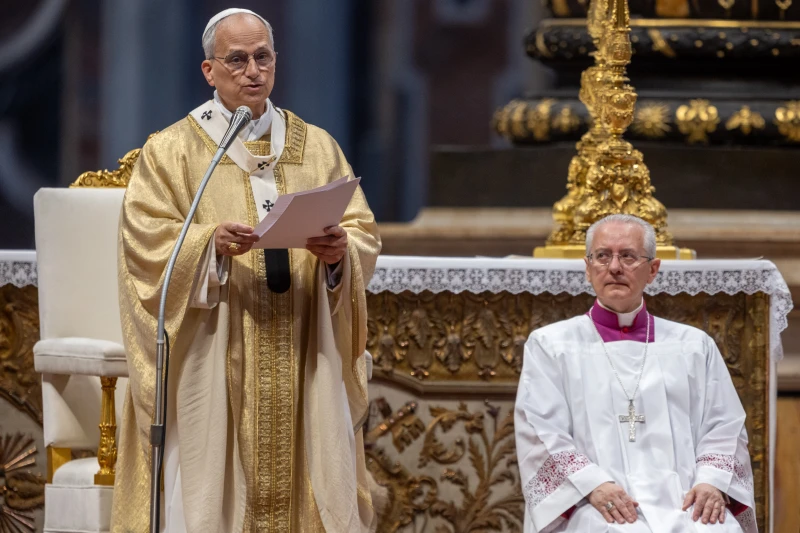
Pope Leo XIV delivers his homily during the ordination of 11 new priests for the Diocese of Rome at St. Peter’s Basilica on May 31, 2025. / Credit: Daniel Ibáñez/CNA
CNA Newsroom, May 31, 2025 / 09:30 am (CNA).
Pope Leo XIV ordained 11 new priests for the Diocese of Rome on Saturday during a Mass at St. Peter’s Basilica, urging them to live lives that are “transparent, visible, credible” in service to God’s people.
The ordination Mass brought together seminarians from both the Pontifical Roman Major Seminary and the Redemptoris Mater Seminary.
The pope described it as a moment of “great joy for the Church” and a sign that “God has not grown tired of gathering His children.”
Pope Leo XIV lays hands on one of 11 men during priestly ordinations at St. Peter’s Basilica on May 31, 2025. Credit: Daniel Ibáñez/CNA
Pope Leo XIV: Priests must be credible witnesses
In his homily, Pope Leo reflected on St. Paul’s words to the community in Ephesus: “You know how I lived the whole time I was with you,” pointing to the necessity of credibility in priestly life.
“We live among the people of God so that we may stand before them with a credible witness,” the pope said. “Together, we rebuild the credibility of a wounded Church, sent to a wounded humanity, within a wounded creation.”
The pope cautioned the ordinands against clerical self-isolation or entitlement.
“Pope Francis has warned us many times about this, because self-referentiality extinguishes the fire of mission.”
A newly ordained priest prays during the ordination Mass celebrated by Pope Leo XIV at St. Peter’s Basilica on May 31, 2025. Credit: Daniel Ibáñez/CNA
Leo emphasized that the priesthood is not about authority but stewardship: “Not masters, but guardians,” he said. “The mission belongs to Jesus. He is risen, and He goes before us. None of us is called to replace Him.”
The pope concluded his homily by reflecting on the Church’s mission of reconciliation in a broken world. “Together, then, we will rebuild the credibility of a wounded Church, sent to a wounded humanity, within a wounded creation,” he said.
“It does not matter to be perfect, but it is necessary to be credible.” Drawing on the image of the Risen Christ showing his wounds, Pope Leo XIV emphasized that even signs of rejection become sources of forgiveness and hope, making priests “ministers of hope” who view everything “under the sign of reconciliation.”
In his final words, the pontiff spoke of priestly service as participation in Christ’s love for the world. “The love of Christ indeed possesses us,” he said, describing this as “a possession that liberates and enables us not to possess anyone.”
Leo thanked the newly ordained for dedicating their lives to serve “a wholly priestly people” and invoked the intercession of Mary, whom he called “Our Lady of Trust and Mother of Hope,” asking her to pray for the Church’s mission to “unite heaven and earth.”
It breaks my heart that the USCCB didn’t request this consecration. Well, here and now, I entrust our United States of America to the Sacred Heart of Jesus and the Immaculate Heart of Mary.
Question: Why are multiple re-consecrations necessary since it seems these countries, including Portugal, do not consider the first to have done anything? Another question: What good does it do to re-consecrate your countries when on a day-to-day level they tolerate or even support divorce, contraception, homosexuality, and abortion, or are the Sacred Heart of Jesus and Immaculate Heart of Mary just supposed to overlook all of that as long as they make the virus disappear?







Can’t believe that the USCCB did not ask that the USA be included in this.
Ditto. It shows the depth of their apostasy and secularization.
You can’t believe it? I can. (No sarc intended)
It breaks my heart that the USCCB didn’t request this consecration. Well, here and now, I entrust our United States of America to the Sacred Heart of Jesus and the Immaculate Heart of Mary.
Saint Francisco de Jesus Marto and Saint Jacinta de Jesus Marto – Pray for us.
Amen!
Question: Why are multiple re-consecrations necessary since it seems these countries, including Portugal, do not consider the first to have done anything? Another question: What good does it do to re-consecrate your countries when on a day-to-day level they tolerate or even support divorce, contraception, homosexuality, and abortion, or are the Sacred Heart of Jesus and Immaculate Heart of Mary just supposed to overlook all of that as long as they make the virus disappear?