Sanaa, Yemen, Feb 19, 2020 / 11:19 am (CNA).- Nearly 24 million people in Yemen are in dire need of humanitarian assistance, according to a Center of Strategic and International Studies report.
Speaking Jan. 9 to diplomats accredited to the Holy See, Pope Francis called the current situation in Yemen “one of the most serious humanitarian crises of recent history.”
The Yemeni Civil War between a Saudi Arabian-led coalition and Iranian-backed Houthi rebels has left more than 100,000 dead since 2015, and millions more in need of basic food and medical necessities. Between Saudi air strikes on hospitals and schools and Houthi forces holding aid hostage, both sides of the conflict have violated international humanitarian law.
In his speech to diplomats last month the pope decried the “general indifference on the part of the international community” to the human suffering in Yemen.
The United Nations was $1.2 billion short of meeting its $4.2 billion goal for international donations to address the situation in Yemen in 2019. However, the greater challenge has been getting the existing food and medical aid to the millions of Yemeni people who need it.
Severe movement constraints on humanitarian organizations, aerial bombardments, and restrictions on importation has left 80% of Yemen’s population in need of food, fuel, and medicine, the CSIS Task Force on Humanitarian Access reported.
On Feb. 19, the Associated Press reported that half of the United Nations’ aid delivery programs had been blocked by the Houthi rebels. The rebels had requested that 2% of the entire aid budget be given to them, heightening concerns that the rebels have been diverting humanitarian aid to fund the war.
“To implement a tax on humanitarian assistance are unacceptable and directly contradict international humanitarian principles,” a USAID spokesperson told the AP.
Because the UN and other donors refused to pay the 2% demand, more than 300,000 pregnant and nursing mothers and children under 5 did not receive nutritional supplements for six months, a U.N. official said.
Saudi-led coalition airstrikes have attacked Yemeni hospitals, a breach of international humanitarian law. On Feb. 10, the UN reported that two more hospitals north of Marib City had been hit.
More than 19.7 million people in Yemen are in need of basic health care after the conflict severely damaged vital health care facilities.
A cholera outbreak in Yemen has affected tens of thousands of people, but cases of cholera have significantly declined since September 2019 when the World Health Organization reported 86,000 cases. In January 2020, WHO reported 35,000 suspected cholera cases in Yemen.
A UN spokesman reported Feb. 18 that aid staff have not heard reports of “famine-like conditions” in 2020 as they had in 2018. However, 7 million people in Yemen remain malnourished as the country relies on imports for 90% of its grain and other food supplies.
In early months of 2020, the conflict has displaced 26,800 people in northern Yemen, according to the UN.
In January 2020, a representative of the Permanent Observer Mission of the Holy See to the UN spoke during an open debate at the UN Security Council.
Pope Francis is concerned about the continued “silence and indifference” on the situation in Yemen and concerned that the lack of international attention could allow further suffering and loss of life, Vatican diplomat Monsignor Fredrik Hansen told the Security Council.
The pope has often asked for prayers for the Yemeni people in his public audiences in recent years.
“Pray hard, because there are children who are hungry, who are thirsty, who have no medicine, and are in danger of death,” Pope Francis said during an Angelus prayer in February 2019.
If you value the news and views Catholic World Report provides, please consider donating to support our efforts. Your contribution will help us continue to make CWR available to all readers worldwide for free, without a subscription. Thank you for your generosity!
Click here for more information on donating to CWR. Click here to sign up for our newsletter.
Seminarians at Good Shepherd Major Seminary in Nigeria’s Kaduna state where four students were kidnapped and one, Michael Nnadi, was killed in 2020. / Credit: Good Shepherd Major Seminary Kaduna/ Facebook
ACI Africa, Jan 26, 2024 / 11:40 am (CNA).
Last year, 2023, was a difficult year for Brother Peter Olarewaju, a postulant at the Benedictine monastery in Nigeria’s Ilorin Diocese who was kidnapped alongside two others at the monastery. Olarewaju underwent different kinds of torture and witnessed the murder of his companion, Brother Godwin Eze.
After his release, Olarewaju said his kidnapping was a blessing, as it had strengthened his faith. He even said that he is now prepared to die for his faith.
“I am prepared to die a martyr in this dangerous country. I am ready any moment to die for Jesus. I feel this very strongly,” Olarewaju said in an interview with ACI Africa, CNA’s news partner in Africa, on Nov. 26, 2023, days after he was set free by suspected Fulani kidnappers.
The late Brother Godwin Eze who was kidnapped from the Benedictine monastery in Nigeria’s Ilorin Diocese and murdered by his kidnappers in October 2023. Credit: Benedictine monastery, Eruku
The monk’s testimony is not an isolated case in Nigeria, where kidnapping from seminaries, monasteries, and other places of religious formation has been on the rise. While some victims of the kidnappings have been killed, those who survived the ordeal have shared that they have come back stronger — and ready to die for their faith.
Seminarian Melchior Maharini, a Tanzanian who was kidnapped alongside a priest from the Missionaries of Africa community in the Diocese of Minna in August 2023, said the suffering he endured during the three weeks he was held captive strengthened his faith. “I felt my faith grow stronger. I accepted my situation and surrendered everything to God,” he told ACI Africa on Sept. 1, 2023.
Father Paul Sanogo (left) and Seminarian Melchior Maharini (right) were kidnapped from their community of Missionaries of Africa in Nigeria’s Diocese of Minna. Credit: Vatican Media
Many other seminarians in Nigeria have been kidnapped by Boko Haram militants, Fulani herdsmen, and other bandit groups operating in Africa’s most populous nation.
In August 2023, seminarian David Igba told ACI Africa that he stared death in the face when a car in which he was traveling on his way to the market in Makurdi was sprayed with bullets by Fulani herdsmen.
Seminarian Na’aman Danlami died when the Fulanis attacked St. Raphael Fadan Kamantan Parish on the night of Sept. 7, 2023. Credit: Photo courtesy of Aid to the Church in Need
In September 2023, seminarian Na’aman Danlami was burned alive in a botched kidnapping incident in the Diocese of Kafanchan. A few days earlier, another seminarian, Ezekiel Nuhu, from the Archdiocese of Abuja, who had gone to spend his holidays in Southern Kaduna, was kidnapped.
Two years prior, in October 2021, Christ the King Major Seminary of Kafanchan Diocese was attacked and three seminarians were kidnapped.
Seminarian David Igba during a pastoral visit at Scared Heart Udei of the Catholic Diocese of Makurdi. Credit: David Igba
In one attack that attracted global condemnation in 2020, seminarian Michael Nnadi was brutally murdered after he was kidnapped alongside three others from Good Shepherd Major Seminary in the Diocese of Kaduna. Those behind the kidnapping confessed that they killed Nnadi because he would not stop preaching to them, fearlessly calling them to conversion.
After Nnadi’s murder, his companions who survived the kidnapping proceeded to St. Augustine Major Seminary in Jos in Nigeria’s Plateau state, where they courageously continued with their formation.
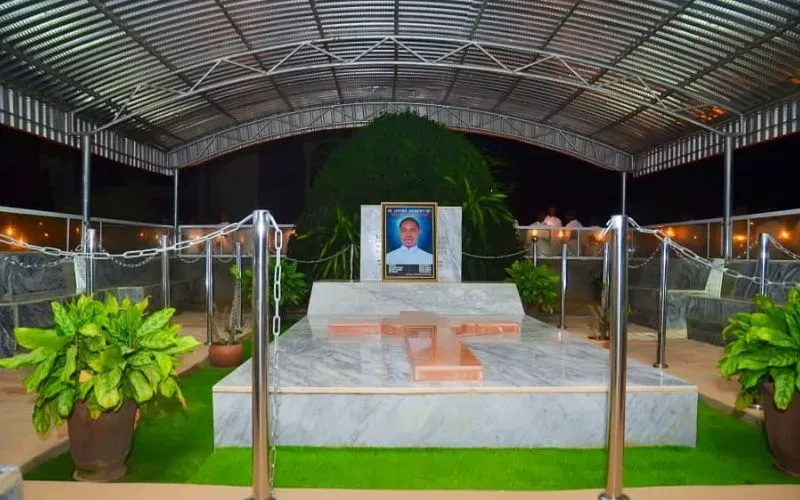
The tomb of seminarian Michael Nnadi, who was brutally murdered after he was kidnapped alongside three others from the Good Shepherd Major Seminary in the Catholic Diocese of Kaduna in 2020. Credit: Father Samuel Kanta Sakaba, rector of a Good Shepherd Major Seminary in Kaduna
As Christian persecution rages in Nigeria, seminary instructors in the country have shared with ACI Africa that there is an emerging spirituality in Nigerian seminaries that many may find difficult to grasp: the spirituality of martyrdom.
They say that in Nigeria, those who embark on priestly formation are continuously being made to understand that their calling now entails being ready to defend the faith to the point of death. More than ever before, the seminarians are being reminded that they should be ready to face persecution, including the possibility of being kidnapped and even killed.
Father Peter Hassan, rector of St. Augustine Major Seminary in the Archdiocese of Jos, Plateau state, said that seminaries, just like the wider Nigerian society, have come to terms with “the imminence of death” for being Christian.
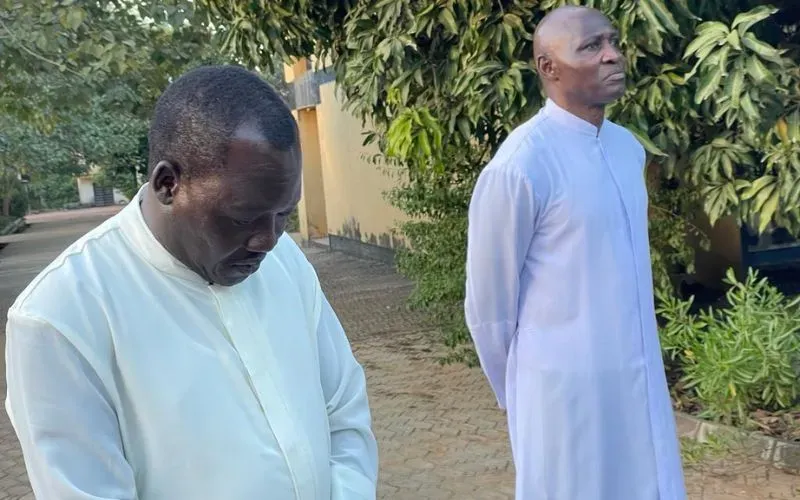
Father Peter Hassan, rector of St. Augustine Major Seminary in Jos, Nigeria, walks with an unnamed companion. Credit: Father Peter Hassan
“Nigerian Christians have been victims of violence of apocalyptic proportions for nearly half a century. I can say that we have learned to accept the reality of imminent death,” Hassan said in a Jan. 12 interview with ACI Africa.
He added: “Nevertheless, it is quite inspiring and comforting to see the many young men who are still ready to embrace a life that will certainly turn them into critically endangered species. Yet these same young men are willing to preach the gospel of peace and embrace the culture of dialogue for peaceful coexistence.”
Shortly after Nnadi’s kidnapping and killing, St. Augustine Major Seminary opened its doors to the three seminarians who survived the kidnapping.
Hassan told ACI Africa that the presence of the three former students of Good Shepherd Major Seminary was “a blessing” to the community of St. Augustine Major Seminary.
“Their presence in our seminary was a blessing to our seminarians, a wake-up call to the grim reality that not even the very young are spared by those mindless murderers,” Hassan said.
Back at Good Shepherd, seminarians have remained resilient, enrolling in large numbers even after the 2020 kidnapping and Nnadi’s murder.
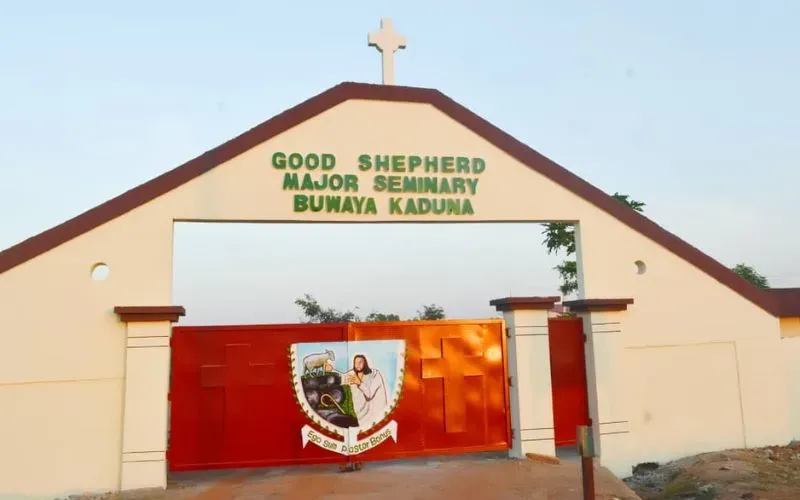
Good Shepherd Major Seminary in Kaduna, Nigeria. Credit: Father Samuel Kanta Sakaba, rector of a Good Shepherd Major Seminary in Kaduna
In an interview with ACI Africa, Father Samuel Kanta Sakaba, the rector of Good Shepherd Major Seminary, said that instructors at the Catholic institution, which has a current enrollment of 265 seminarians, make it clear that being a priest in Nigeria presents the seminarians with the danger of being kidnapped or killed.
ACI Africa asked Sakaba whether or not the instructors discuss with the seminarians the risks they face, including that of being kidnapped, or even killed, to which the priest responded: “Yes, as formators, we have the duty to take our seminarians through practical experiences — both academic, spiritual, and physical experiences. We share this reality of persecution with them, but for them to understand, we connect the reality of Christian persecution in Nigeria to the experiences of Jesus. This way, we feel that it would be easier for them to not only have the strength to face what they are facing but to also see meaning in their suffering.”
“Suffering is only meaningful if it is linked with the pain of Jesus,” the priest said. “The prophet Isaiah reminds us that ‘by his wounds, we are healed.’ Jesus also teaches us that unless the grain of wheat falls on the ground and dies, it will remain a single grain, but that it is only when it falls and dies that it yields a rich harvest. Teachings such as these are the ones that deepen our resilience in the face of persecution.”
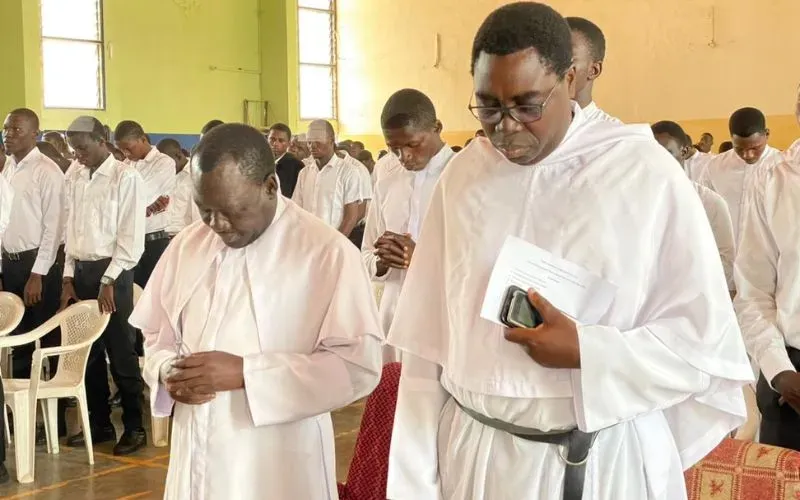
Seminarians and their instructors at St. Augustine Major Seminary in Jos, Nigeria. Credit: Father Peter Hassan
Sakaba spoke of the joy of those who look forward to “going back to God in a holy way.”
“Whatever happens, we will all go back to God. How joyful it is to go back to God in a holy way, in a way of sacrifice.” he said. “This holiness is accepting this cross, this pain. Jesus accepted the pain of Calvary, and that led him to his resurrection. Persecution purifies the individual for them to become the finished product for God. I believe that these attacks are God’s project, and no human being can stop God’s work.”
However, the rector clarified that those who enroll at the seminary do not go out seeking danger.
“People here don’t go out putting themselves in situations of risk,” he said. “But when situations such as these happen, the teachings of Jesus and his persecution give us courage to face whatever may come our way.”
Sakaba said that although priestly formation in Nigeria is embracing the “spirituality of martyrdom,” persecution in the West African country presents “a difficult reality.”
“It is difficult to get used to pain. It is difficult to get used to the issues of death … to get familiar with death,” he said. “No one chooses to go into danger just because other people are suffering; it is not part of our nature. But in a situation where you seem not to have an alternative, the grace of God kicks in to strengthen you to face the particular situation.”
Sakaba said that since the 2020 attack at Good Shepherd Major Seminary, the institution has had an air of uncertainty. He said that some of the kidnappers who were arrested in the incident have been released, a situation he said has plunged the major seminary into “fear of the unknown.”
“It hasn’t been easy for us since the release,” Sabaka told ACI Africa. “The community was thrown into confusion because of the unknown. We don’t know what will happen next. We don’t know when they will come next or what they will do to us. We don’t know who will be taken next.”
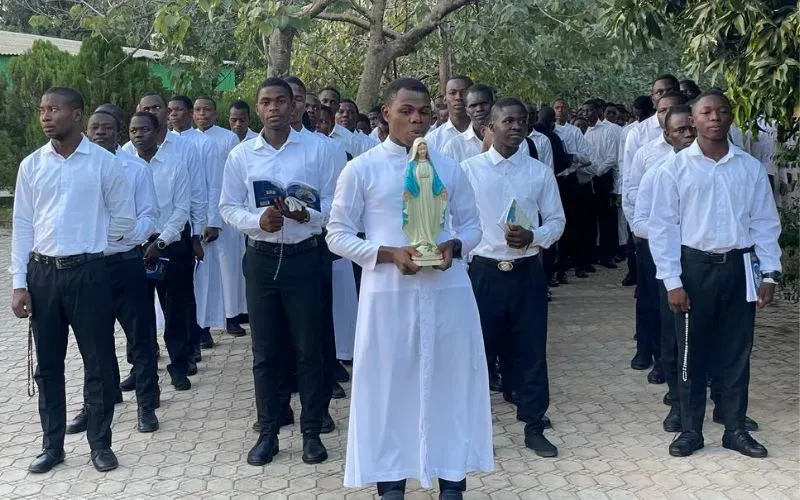
Seminarians at St. Augustine Major Seminary in Jos, Plateau state, Nigeria, during a Marian procession. Credit: Father Peter Hassan
In the face of that, however, Sabaka said the resilience of the seminary community has been admirable. “God has been supporting, encouraging, and leading us. His grace assisted us to continue to practice our faith,” he said.
The jihadist attacks, which continue unabated in communities surrounding the seminary, do not make the situation easier.
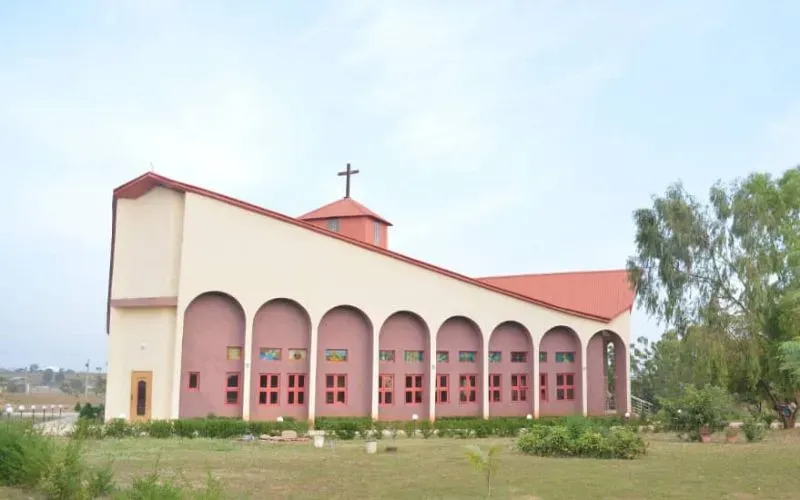
Church at the Good Shepherd Major Seminary in Kaduna, Nigeria. Credit: Father Samuel Kanta Sakaba, rector of Good Shepherd Major Seminary in Kaduna
“Every attack that happens outside our community reminds us of our own 2020 experience. We are shocked, and although we remain deeply wounded, we believe that God has been leading us,” he said.
This story was first published by ACI Africa, CNA’s news partner in Africa, and has been adapted by CNA.






Leave a Reply