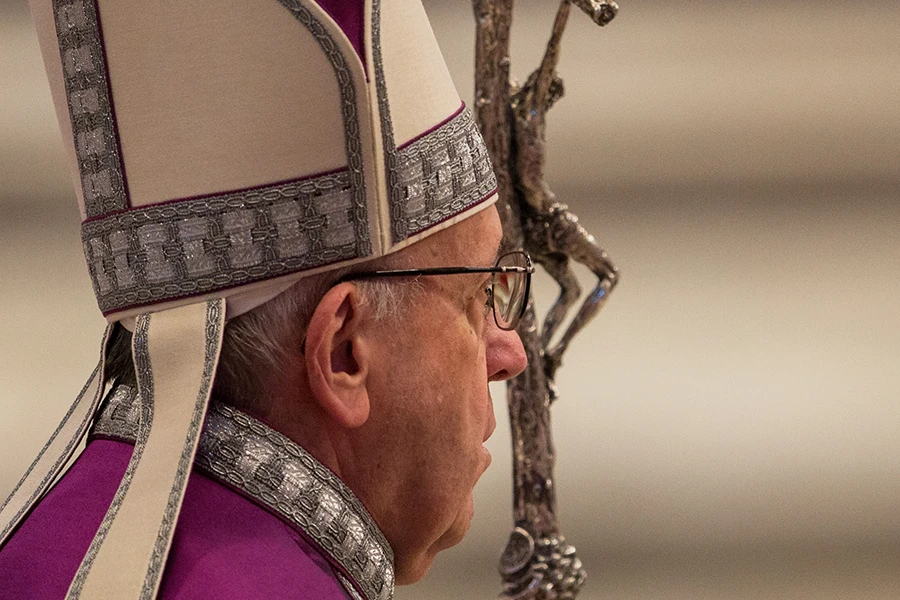
Vatican City, Mar 9, 2018 / 12:09 pm (CNA/EWTN News).- At his annual Lenten penitential service on Friday, Pope Francis said that it is not God who abandons us when we sin, but we who separate ourselves from him by choosing to sin, and that no matter what we do, God never stops loving us.
“We know that the state of sin distances us from God. But in fact, sin is the way that we distance ourselves from him. Yet that does not mean that God distances himself from us,” the Pope said March 9.
“The state of weakness and confusion that results from sin is one more reason for God to remain close to us,” he continued. “The certainty of this should accompany us throughout our lives.”
Pope Francis gave a brief homily during an annual Lenten penitential service in St. Peter’s Basilica. He reflected on a passage from the first letter of John, which speaks about God’s love for his children.
God’s love is greater than anything we can imagine, reaching beyond even the worst sins we find within us, he said.
“His is an infinite love, one that knows no bounds,” he reflected. “The words of the Apostle are a reassuring confirmation that our hearts should trust, always and unhesitatingly, in the Father’s love: ‘No matter what our hearts may charge us with, God is greater than our hearts’ (1 Jn. 3:20).”
Following the homily, Pope Francis led a silent examination of conscience. Then, as in other years, the Pope was the first to go and make his confession to a fellow priest before hearing the confessions of several others.
Other priests were also available throughout the basilica to hear individual confessions.
The penitential service also marked the beginning of the “24 Hours for the Lord” initiative held yearly on the fourth Friday and Saturday of Lent.
Led by Pope Francis, “24 Hours for the Lord” is a worldwide initiative that points to confession as a primary way to experience God’s merciful embrace. It was launched in 2014 under the auspices of the Pontifical Council for the Promotion of the New Evangelization.
The event gives Catholics an opportunity to go to confession and take part in Eucharistic adoration at participating churches. This year’s theme is “With you is forgiveness” taken from Psalm 130.
Earlier on March 9, Pope Francis spoke to participants in the Apostolic Penitentiary’s annual course on the internal forum, which is attended primarily by young priests, seminarians, and penitentiary priests specifically appointed to hear confessions and administer penance.
This year, ahead of the Synod of Bishops on youth, the course focused on the relationship between sacramental confession and vocational discernment.
In his speech, Francis noted how young priests have an “advantage – so-to-speak” when it comes to hearing the confessions of other young people, a proximity of age “favors even sacramental dialogue.”
On the other hand, there are limitations and challenges to being at the beginning of their ministry and therefore lacking in the experience of an older confessor, he said.
With these thoughts in mind, he asked, how do we go about listening to sacramental confessions, especially of the young, when it comes to vocational discernment?
“First of all, I would say that it is always necessary to rediscover, as St Thomas Aquinas says, the instrumental dimension of our ministry,” he said. “The priest confessor is not the source of Mercy or of Grace; he is certainly the indispensable tool, but always just an instrument!”
Being intentionally aware of this can help keep priests from becoming what Francis called “masters of consciences” instead of humbly listening to the Holy Spirit. He emphasized that seeing oneself as an instrument is not a lessening of the priest’s role in confession, but “the full realization of [the ministry].”
The Pope also stressed that confessors should listen carefully to any questions before offering answers, and when these two elements come together in sacramental dialogue, it can help to open up the journey of prayer and prudence that is vocational discernment.
Concluding, he encouraged the present and future confessors to be “witnesses of mercy, humble hearers of young people and God’s will for them, always respectful of the conscience and freedom of those who approach the confessional.”
He reminded them to entrust penitents to Mary, “who is the Refuge of sinners and Mother of mercy.”
 […]
[…]



It was good of him to apologize, but I can’t fault him for smacking her hand. She nearly pulled him off his feet, it looks like, and wasn’t letting go. It must have felt like he was being attacked.
One learns about a person through his/her spontaneous acts. In this case, what one sees is what he is.
More telling even than the slap on the hand is the look on his face as he turns away— no fear or shock evident, just deep anger. If looks could kill, that woman would be with the angels.
And this is the “mercy” and “accompaniment” that Francis extends to faithful believing Catholics. Never in the history of the Catholic Church has a Shepherd treated his own flock with such utter contempt and derision.
The pope is an old man grabbed from behind and nearly yanked off his feet. In English law, what the woman did qualifies as a criminal offence called Common Assault. For sure as Christians we are called to turn the other cheek, and the Pope is right to apologise, but he has always readily admitted that he is not perfect. I doubt I would do better.
The Pope should have apologized for slapping this woman, an act of physical violence in response to what seems like an act of physical aggression by this same woman that potentially could have hurt him. He does only have one lung and is in his 80’s.
Yes, he became angry, an emotional response of which patience is the antidote at an emotional level so this is “half of the truth” he has agreed to apologize for. The “whole truth” is the Pope responded physically to her attempt to physically control him with an action of physical violence. He just need to name his actions correctly, not his emotional state that lead to the actions in order to tell the “whole truth” and to fully take responsibility for his actions and behaviors.
He could have yelled at her in anger, but he chose to slap her instead. Anger is one of the deadly spiritual sins that leads to violent behavior.
The woman was wrong to have physically grabbed him, and tried to control him, a demonic attack on the Pope. His response was physical as well as emotional. He slapped her. The demon of anger he kept and took with him as was evident on his face when he turned away from her.
Such an opposite response when Jesus was grabbed by the woman who was bleeding, and his response was healing her the moment she touched him – a total non-violent response to violence. But, the Pope is not Jesus, just a poor sinner like the rest of us.
More prayers and fasting in the Name of Jesus Christ to rid the Vatican and the Catholic Church of the demons that the Pope has invited into the Church.
Kudos to CRW for not to descending to the depths of deceit and depravity heaped upon Pope Francis by others in the far-right Roman Catholic echo chamber.
After watching the complete video a couple of times, only persons of ill-intent would criticize the Holy Father for his response. I’m only 62. Had someone yanked my arm the way that the woman yanked Pope Francis’ hand and arm (He at 82 years of age, missing a lung, and wracked with arthritis), I would have knocked her down without a moment of thought or later regret. Her actions and shouting clearly indicate someone with an agenda.
Let us also recall that in the last year, both Russia and China have assassinated people using lethal poisons delivered on doorknobs, tabletops, newspapers, and during a handshake. Every faithful Roman Catholic worthy of the name should be alarmed and outraged at the thought that this could have been a fatal encounter.
If they have not already done so, heads need to roll in the Vatican security bureaucracy, and the people of ill-will criticizing Pope Francis should worry about the beam in their own eye.