No Picture
News Briefs

Saginaw diocese buries the forgotten dead on All Souls’ Day

November 7, 2019 CNA Daily News 0

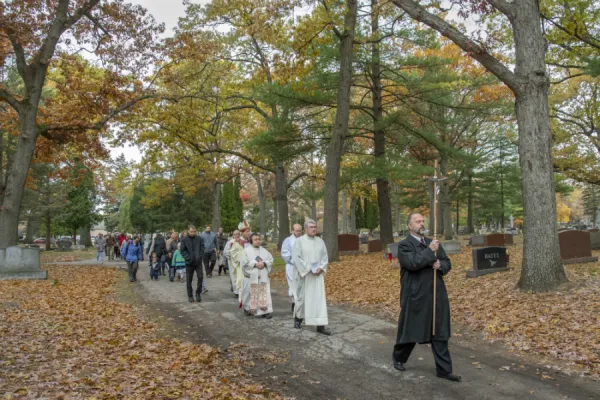
Saginaw, Mich., Nov 7, 2019 / 03:01 pm (CNA).- On Saturday Bishop Robert Gruss of Saginaw said a Mass of All Souls’ Day for 175 people whose mortal frames had been unclaimed, and which were then buried at one of the diocese’s cemeteries.

“The Church invites us to pray in a very special way, give alms and do works of penance for all the deceased, for our loved ones and friends, but also for all those who have died whom we have never known. There are many who have no one to pray for them,” Bishop Gruss preached during the Nov. 2 Mass at Calvary Cemetery in Kawkawlin, Mich., about 20 miles north of Saginaw.

“This is why we gather today in this special way for this memorial service for these unclaimed cremains. These individuals have no one to pray for them. They have not received a burial proper to their human dignity. But we will doing this today, giving these men, women and children a proper burial.”

The cremated bodies of 175 people were entombed in a crypt at the cemetery. Their remains had been in a county medical examiner’s office or funeral homes, and while some of the people had died quite recently, the oldest remains were of someone who died in 1972. Among those whose remains were entombed were 13 veterans, and military honors were presented by the Bay County Veterans Council Honor Guard.

“These individuals, these children of God, we know very little about. We know their names, but we know very little about them. But we do know that their lives have value; in the eyes of God and in our eyes, they belong to Him,” Bishop Gruss reflected.

“We are here today to show our love and care and concern for our brothers and sisters by upholding their God given dignity and providing them a final resting place where they will be remembered.”

The bishop noted that those who were being buried after the Mass “have all been part of a family. Why their cremains have been left behind is unknown to me. Though their lives remain a mystery to all of us, every aspect of their lives, every experience of their lives is known [to] God … And in the mystery of Christ’s love, they too have been offered salvation because it is God’s will that all people will be saved.”

Bishop Gruss began his homily saying, “the Church has always promoted the praying for our deceased loved ones and teaches the value of this practice. Oftentimes people make the assumption that their loved one is automatically going to heaven. We can never presume anything such as this.Yes, it is God’s will that all people are saved, but the ultimate judgment belongs to God and not to us. We can only live in hope that heaven becomes a reality for our loved onesand for us by the way we live our lives. If heaven were automatic, why would the Church need to pray for their deceased loved ones?”

He added that “we gather here today to pray for all of our loved ones who have gone before us. We gather here today to pray for these men, women and children whom we will lay rest.”

Alice Lefevre, Cemeteries Director for the Diocese of Saginaw, noted ahead of the interment that “Our Lord instructs us to bury the dead. It is a corporal work of mercy.”

The diocese reported that the students of St. Brigid of Kildare Catholic School in Midland held a “penn war” to raise money for expenses associated with the burials, raising more than $500, which was used for memorial flowers, among other things.

According to MLive, the diocese reached an agreement with Saginaw County in August that it will inter any cremated remains accumulated by the county.

The county controller, Robert Belleman, says he contacted the diocese to see if they could assist with proper burial of the cremated remains of 47 people which were held at the county medical examiner’s office.

“We really appreciate that willingness by the Diocese of Saginaw to agree to properly bury these 47 cremains,” Belleman told MLive.

[…]

The Dispatch

The Dangerous Hart of Universalism

November 6, 2019 Don Johnson 50

For the past few months my youngest daughter has been studying modern history. As part of the curriculum, she has had to memorize a timeline of important events. Many of these, of course, involve immense […]

No Picture
News Briefs

Survey says: Most Catholics in US reject Church teaching on cohabitation

November 6, 2019 CNA Daily News 12

Washington D.C., Nov 6, 2019 / 06:18 pm (CNA).- Nearly three quarters of Catholics in the United States are not opposed to couples cohabiting before marriage, despite the Church’s moral teaching.

A new survey by the Pew Research Center, released Nov. 6, reports that Americans as a whole are very accepting of unmarried couples living together, even if they have no plans to marry. Additionally, Pew found that a shrinking percentage of adults are getting married, and an increasing number of adults have decided to cohabit.

Only 14% of adults surveyed said they did not believe that it was ever acceptable for two unmarried adults in a romantic relationship to live together. An additional 16% said that they agreed with cohabitation only if there were plans for the couple to one day get married.

Of the people surveyed, 69% said they believed it was acceptable for an unmarried couple to live together, without any plans to eventually wed.

In 2002, the National Survey of Family Growth found that while 54% of adults between the ages of 18 and 44 had ever cohabited with a romantic partner, 60% had ever been married. By 2017, the number of adults who had ever been married dropped to 50%, while the number of adults who had cohabitated rose to 54%.

Pew found that race and religion played a role in whether or not a person was approving of the ideal of cohabitation. A total of 72% of white respondents said that cohabitation without a plan to get married was acceptable, with an additional 13% saying they approved of cohabitation without a plan to get married. Of black survey respondents, 23%, the largest of any ethnic group, said that they did not thing cohabitation was ever acceptable. Only 55% of black respondents said they approved of cohabitation without planning on getting married.

For Hispanics, only 10% of respondents said it was never acceptable to cohabitate. Slightly over one-fifth of Hispanic respondents – 21% – said they found cohabitation acceptable as long as there were wedding bells in the future.

Religion was a factor as well. Catholics and white mainline Protestants had nearly identical rates of approval of cohabitation–the survey found that 74% of Catholics and 76% of white Protestants who do not claim to be born-again or evangelical were okay with an unmarried couple cohabitating. Conversely, this figure dropped to 47% for blacked Protestants and 35% for white evangelical Protestants.

A full 90% of religiously unaffiliated people approved of cohabitation, and fewer than a third of this group said they believed society would be better off if more couples who cohabited got married.

White evangelical Christians were more likely than any other group to say that they believed increased marriage rates were better for society.

The survey also showed that married adults are more satisfied with their relationship than are those who cohabit, and they are more trustful of their partners.

The data for this survey came from the American Trends Panel, which was taken June 25- July 8. A total of 9,834 people were surveyed. Pew said the margin of error was about 1.5 points.

During the Fall 2013 USCCB General Assembly, Cardinal Sean O’Malley spoke to CNA about the reasons why couples are increasingly turning to cohabit. O’Malley cited financial instability–particularly student loans–as well as cultural norms as for why this was the case.

“Concerns about marriage – people not getting married, falloff in Mass attendance, (and the) challenge of catechizing the young Catholics” are some of the more troubling trends facing Catholicism in the U.S., the Archbishop of Boston said to CNA Nov. 11, during the general assembly of the national bishops’ conference in Baltimore.

The cardinal noted that “the whole notion of family is so undercut by the cohabitation mentality,” and that these social trends are having a tremendous impact on the working-class communities “who were once the backbone of the Church.”

“Half of the children born to that demographic are born out of wedlock,” a statistic that Cardinal O’Malley said would have been “inconceivable” a few decades ago.

[…]