Dublin, Ireland, Dec 5, 2019 / 07:00 pm (CNA).- After the demolition of a Dublin building, archaeologists have discovered the foundations a 300-year-old church that was used during times of Catholic persecution.
The church was uncovered by a team of archeologists during a dig taking place before the development of a 10-story office building planned for the site.
Excavation of the church will likely take place until December.
“We have to dig here very carefully because the church is a recorded monument,” archeologist Franc Myles told The Irish Times.
The church, St. Andrew’s Parish in central Dublin, was built in 1709, when British penal laws outlawed the practice of Catholicism.
“There was probably a building used as a chapel from the foundation of St Andrew’s Parish in 1709 and it is depicted on John Rocque’s map [of Dublin] of 1756,” a developer’s archeological report explains about the site.
Despite the prohibitions on Catholicism, the parish grew in its first hundred years. In fact, the archaeological report adds that, after significant growth in the parish, “it was decided that the chapel would have to be reconstructed” in 1811.
Father Daniel Murray, who later wasArchbishop of Dublin from 1823 to 1852, laid down the foundation stone in 1814 for a new chapel. By 1831, significant progress had been made on the Church’s reconstruction, but a new parish priest decided to move the church to a different location.
Construction on the office building will likely continue after the archaeological process has been completed and recorded.
Myles had hope that the archeologists would have found on the site timber structures dating back to the 1670s. He said none of those have been found, and speculated they had been demolished by construction in the 1960s.
If you value the news and views Catholic World Report provides, please consider donating to support our efforts. Your contribution will help us continue to make CWR available to all readers worldwide for free, without a subscription. Thank you for your generosity!
Click here for more information on donating to CWR. Click here to sign up for our newsletter.
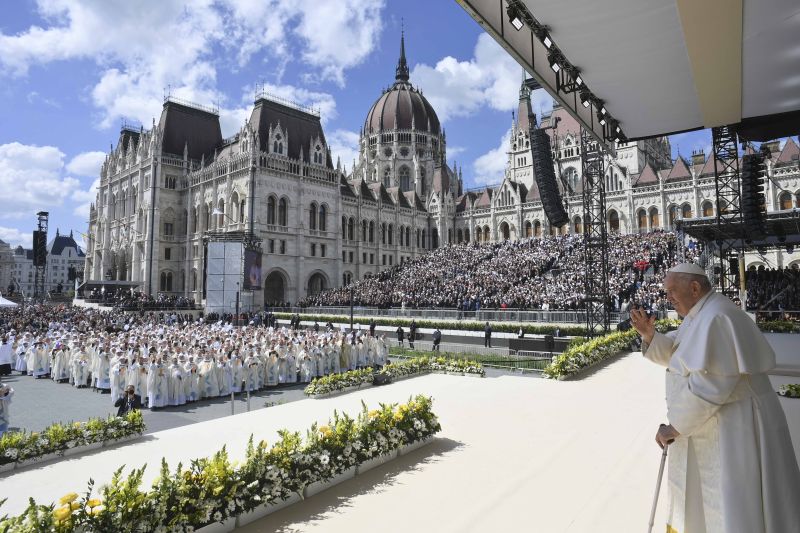
Pope Francis stands on an altar erected outside the Parliament Building in Budapest’s Kossuth Lajos’ Square during a public outdoor Mass on April 30, 2023. / Vatican Media
CNA Staff, Apr 30, 2023 / 05:47 am (CNA).
During an outdoor Mass in Budapest on Good Shepherd Sunday, Pope Francis called on Hungarians to be “open and inclusive,” reflecting on how Jesus wants his flock to share the abundant life they’ve received from him.
“Though we are diverse and come from different communities, the Lord has brought us together, so that his immense love can enfold us in one embrace,” the pope said in his April 30 homily, speaking in bright sunshine to more than 50,000 people gathered in and around the Hungarian capital’s picturesque Kossuth Lajos Square.
“[A]ll of us are called to cultivate relationships of fraternity and cooperation, avoiding divisions,” he said, “not retreating into our own community, not concerned to stake out our individual territory, but rather opening our hearts to mutual love.”
Prior to Mass, held outside the city’s majestic neo-Gothic Parliament building, the pope was transported in his wheelchair to a specially constructed altar platform flanked by banners in the colors of the Vatican and Hungarian flags and simply adorned with a towering wooden crucifix.
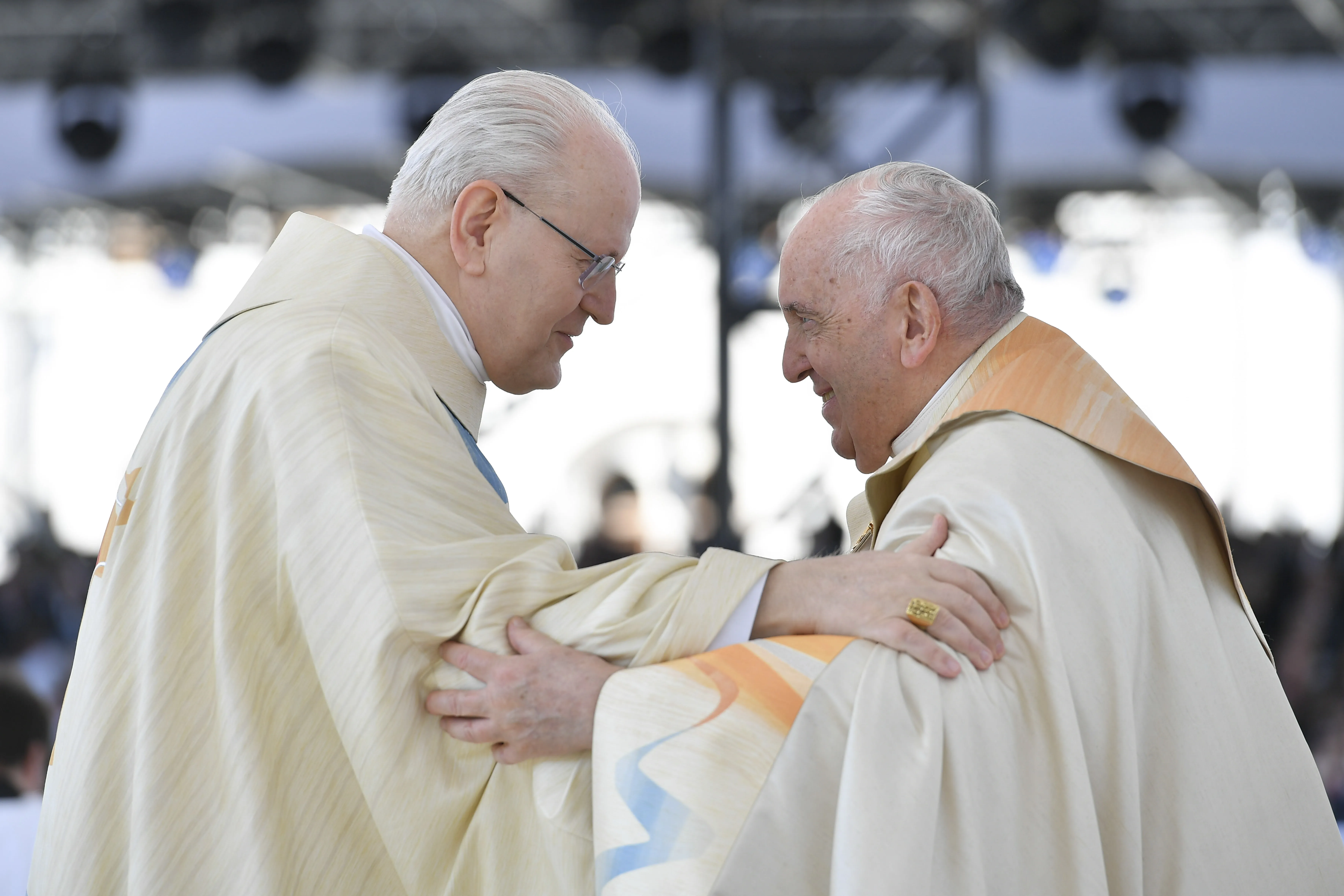
Pope Francis and Cardinal Peter Erdő, the archbishop of Budapest (left) are shown at the outdoor Mass held in Budapest, Hungary, on April 30, 2023. Erdő was the principal celebrant of the Mass; since the pope’s knee injury has impeded his mobility, he has called on cardinals to take his place at the altar. Vatican Media
Cardinal Peter Erdő, the archbishop of Budapest, was the principal celebrant of the Mass; since the pope’s knee injury has impeded his mobility, he has called on cardinals to take his place at the altar.
In his homily, Francis zeroed in on “two specific things that, according to the Gospel, [the Good Shepherd] does for the sheep. He calls them by name, and then he leads them out.”
“The history of salvation does not begin with us, with our merits, our abilities, and our structures. It begins with the call of God,” the pope said.
“[T]his morning, in this place, we sense the joy of our being God’s holy people. All of us were born of his call.”
Pope Francis said he spoke especially “to myself and to my brother bishops and priests: to those of us who are shepherds.” He called on the faithful to be “increasingly open doors: ‘facilitators’ — that’s the word — of God’s grace, masters of closeness; let us be ready to offer our lives, even as Christ … teaches us with open arms from the throne of the cross and shows us daily as the living Bread broken for us on the altar.”
Seeing closed doors is “sad and painful,” the pope said. He referred specifically to the “closed doors of our selfishness with regard to others; the closed doors of our individualism amid a society of growing isolation; the closed doors of our indifference towards the underprivileged and those who suffer; the doors we close towards those who are foreign or unlike us, towards migrants or the poor.”
The pope’s plea was, “Please, let us open those doors! Let us try to be — in our words, deeds, and daily activities — like Jesus, an open door.”
As open doors, the Lord of life can enter our hearts, Pope Francis assured, with “words of consolation and healing.”
Pope Francis speaks during a public outdoor Mass in Kossuth Lajos Square in Budapest, Hungary, on April 30, 2023. Vatican Media
Speaking to his Hungarian hosts, he urged them to be “open and inclusive” and “in this way, help Hungary to grow in fraternity, which is the path of peace,” an apparent reference to the country’s contested migration policies.
While the pope has praised the country for being a leader in assisting persecuted Christians in other countries and welcoming more than a million war refugees from neighboring Ukraine, Prime Minister Viktor Orbán’s curbing of migrants from the Middle East and Africa is generally seen as being at odds with the pope’s call to openness. During the migrant crisis of 2015, Orbán sealed Hungary’s southern border with Serbia, closing off the main land route into Europe.
Pope Francis ended his homily with a reminder that Jesus “calls us by name and cares for us with infinitely tender love. He is the door, and all who enter through him have eternal life. He is our future, a future of ‘life in abundance.’
“Let us never be discouraged,” the pope said. “Let us never be robbed of the joy and peace he has given us. Let us never withdraw into our own problems or turn away from others in apathy. May the Good Shepherd accompany us always: with him, our lives, our families, our Christian communities and all of Hungary will flourish with new and abundant life!”
In his Regina Caeli reflection after the Mass, the pope referenced the ongoing fighting in Ukraine.
“Blessed Virgin, watch over the peoples who suffer so greatly. In a special way, watch over the neighboring, beleaguered Ukrainian people and the Russian people, both consecrated to you,” he said.
“You, who are the Queen of Peace, instill in the hearts of peoples and their leaders the desire to build peace and to give the younger generations a future of hope, not war, a future full of cradles not tombs, a world of brothers and sisters, not walls and barricades.”
Ending his three-day visit to Budapest, the pope is scheduled to deliver a speech on culture and academics Sunday afternoon at the Péter Pázmány Catholic University. He then will have a farewell ceremony at 5:30 p.m. local time before departing on his return flight to Rome.
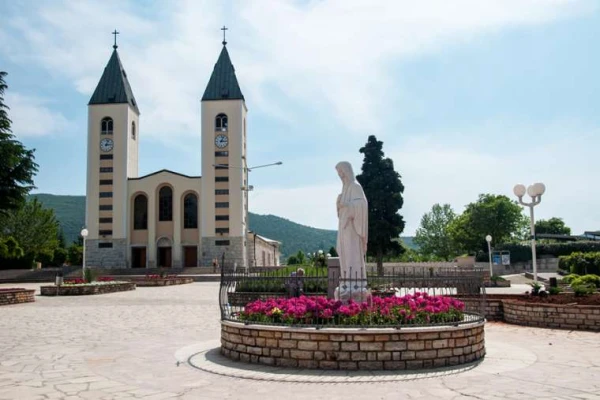
Medjugorje, Bosnia and Herzegovina, May 12, 2019 / 07:46 am (CNA).- Pope Francis has given the green light for Catholics to organize pilgrimages to Medjugorje, a site of alleged Marian apparitions, though the Church has not yet given a verdict on the apparitions’ authenticity.
The pope’s authorization of pilgrimages to the site is not to be understood as an “authentication” of the alleged apparitions, “which still require an examination by the Church,” papal spokesman Alessandro Gisotti said in a statement May 12.
He added that anyone leading pilgrimages to the site should avoid creating “confusion or ambiguity under the doctrinal aspect,” including priests who intend to celebrate Mass there.
The provision was made as an acknowledgment of the “abundant fruits of grace” that have come from Medjugorje and to promote those “good fruits.” It is also part of the “particular pastoral attention” of Pope Francis to the place, Gisotti said.
The announcement of the papal authorization was made May 12 by the Vatican’s apostolic visitor to the site, Archbishop Henryk Hoser, and Archbishop Luigi Pezzuto, apostolic nuncio to Bosnia and Herzegovina.
Hoser, retired archbishop of Warsaw-Prague, was appointed apostolic visitor to Medjugorje by Pope Francis in May 2018. His directive, which is of an undetermined length, is to oversee the pastoral needs at the site of the alleged Marian apparitions.
Hoser’s appointment as apostolic visitor followed his service as papal envoy to the site in 2017.
In January 2014, a Vatican commission concluded a nearly four-year-long investigation on the doctrinal and disciplinary aspects of the Medjugorje apparitions, and submitted a document to the Congregation for the Doctrine of the Faith.
When the congregation has analyzed the commission’s findings, it will finalize a document on the site, which will be submitted to the pope, who will make a final decision.
The alleged apparitions began June 24, 1981, when six children in Medjugorje, a town in what is now Bosnia and Herzegovina, began to experience phenomena which they have claimed to be apparitions of the Blessed Virgin Mary.
According to these six “seers,” the apparitions contained a message of peace for the world, a call to conversion, prayer and fasting, as well as certain secrets surrounding events to be fulfilled in the future.
These apparitions are said to have continued almost daily since their first occurrence, with three of the original six children – who are now young adults – continuing to receive apparitions every afternoon because not all the “secrets” intended for them have been revealed.
Since their beginning, the alleged apparitions have been a source of both controversy and conversion, with many flocking to the city for pilgrimage and prayer, and some claiming to have experienced miracles at the site, while many others claim the visions are non-credible.
Pope Francis visited Bosnia and Herzegovina in June 2015 but declined to stop in Medjugorje during his trip. During his return flight to Rome, he indicated that the process of investigation in the apparitions was nearly complete.
On the return flight from a visit to the Marian shrine of Fatima in May 2017, the pope spoke about the final document of the Medjugorje commission, sometimes referred to as the “Ruini report,” after the head of the commission, Cardinal Camillo Ruini, calling it “very, very good,” and noting a distinction between the first Marian apparitions at Medjugorje and the later ones.
“The first apparitions, which were to children, the report more or less says that these need to continue being studied,” he said, but as for “presumed current apparitions, the report has its doubts,” the pope said.
On multiple occasions, the pope has said he is suspicious of the ongoing apparitions, “I prefer the Madonna as Mother, our Mother, and not a woman who’s the head of an office, who every day sends a message at a certain hour. This is not the Mother of Jesus.”
"Without God, nothing in life has meaning," says Spanish national soccer team coach Luis de la Fuente Castillo. / Credit: Junta de Andalucía (CC BY-SA 2.0)
ACI Prensa Staff, Jul 12, 2024 / 06:00 am (CNA).
The coach of the Spanish nati… […]




Leave a Reply