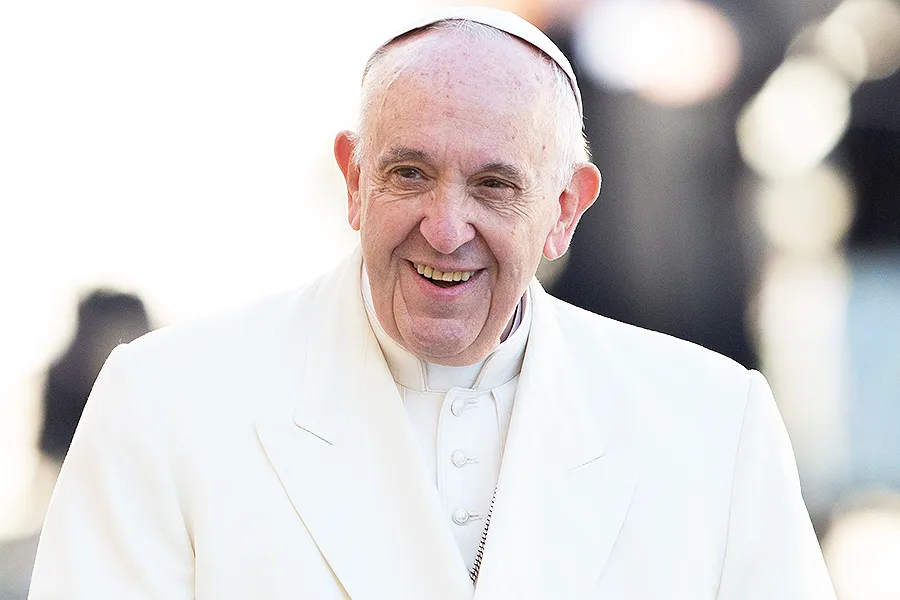
Vatican City, Dec 5, 2017 / 05:19 pm (CNA).- Despite the recent inclusion of Pope Francis’ 2016 letter to the Buenos Aires bishops on Amoris laetitia in the Holy See’s official text of record, neither the Church’s discipline nor its doctrine have changed.
The move is the latest in the debate over the admission of the divorced-and-remarried to Communion. The Second Vatican Council, St. John Paul II, and Benedict XVI – as well as the Congregation for the Doctrine of the Faith and the Pontifical Council for Legislative Texts under them – all firmly opposed proposals to admit to eucharistic communion the divorced-and-remarried who do not observe continence.
The debate has received renewed impetus under Pope Francis. His 2016 apostolic exhortation on love in the family, Amoris laetitia, has been met with varied reception and interpretation within the Church. Its eighth chapter, entitled “Accompanying, Discerning, and Integrating Weakness,” deals with, among other things, the pastoral care of the divorced-and-remarried, those who may not be admitted to Communion unless they have committed to living in continence, eschewing the acts proper to married couples.
Yet, for many Church leaders and theologians, ambiguous language in that chapter has led to uncertainties about this practice, and about the nature and status of the apostolic exhortation itself. Some have maintained that it is incompatible with Church teaching, and others that it has not changed the Church’s discipline. Still others read Amoris laetitia as opening the way to a new pastoral practice, or even as a development in continuity with St. John Paul II.
Some Church leaders have noted that Amoris laetitia has led to the disorientation and great confusion of many of the faithful, and at least one respected theologian has argued that Francis’ pontificate has fostered confusion, diminished the importance of doctrine in the Church’s life, and cause faithful Catholics to lose confidence in the papacy.
Pope Francis has been understood to encourage those who interpret Amoris laetitia as opening the way to a new pastoral practice – as he seemed to do in a letter to the bishops of the Buenos Aires region, which is the subject of the latest furor.
His letter approves those bishops’ pastoral response to the divorced-and-remarried, based on Amoris laetitia. The response had said that ministry to the divorced-and-remarried must never create confusion about Church teaching and the indissolubility of marriage, but may also allow access to the sacraments under specific limits. These might include specific situations when a penitent in an irregular union is under attenuated culpability, as when leaving such a union could cause harm to his children, although the circumstances envisioned are not precisely delineated, which, some theologians say, has contributed to the confusion.
The Pope’s Sept. 5, 2016 letter addressed to Bishop Sergio Alfredo Fenoy of San Miguel said, “The text is very good and makes fully explicit the meaning of the eighth chapter of ‘Amoris Laetitia’. There are no other interpretations. And I am sure it will do a lot of good. May the Lord reward you for this effort of pastoral charity.”
It was reported this weekend that Pope Francis’ letter, as well as the pastoral response of the Buenos Aires bishops, were promulgated in the October 2016 issue of the Acta Apostolicae Sedis, a Vatican publication in which official documents of the Pope and the Roman Curia are published, and through which universal ecclesiastical laws are promulgated.
Dr. Edward Peters, a professor of canon law at Sacred Heart Major Seminary in Detroit, wrote Dec. 4 that the Buenos Aires document contains assertions “running the gamut from obviously true, through true-but-oddly-or-incompletely phrased, to a few that, while capable of being understood in an orthodox sense, are formulated in ways that lend themselves to heterodox understandings.”
He noted that what prevents the admission of the divorced-and-remarried to eucharistic communion is canon 915 “and the universal, unanimous interpretation which that legislative text, rooted as it is in divine law, has always received.” The canon states that those “obstinately persevering in manifest grave sin are not to be admitted to holy communion.”
In an August 2017 post anticipating the possible publication in AAS of the Buenos Aires letter or the Pope’s commendation of it, Peters had written that “many, nay most, papal documents appearing in the Acta carry no canonical or disciplinary force.”
He wrote that “Unless canon 915 itself is directly revoked, gutted, or neutered, it binds ministers of holy Communion to withhold that most august sacrament from, among others, divorced-and-remarried Catholics except where such couples live as brother-sister and without scandal to the community.”
“Nothing I have seen to date, including the appearance of the pope’s and Argentine bishops’ letters in the Acta Apostolicae Sedis, makes me think that Canon 915 has suffered such a fate.”
He added: “Neither the pope’s letter to the Argentines, nor the Argentine bishops’ document, nor even Amoris laetitia so much as mentions Canon 915, let alone do these documents abrogate, obrogate, or authentically interpret this norm out of the Code of Canon Law.”
While the Pope’s letter and the Buenos Aires bishops’ pastoral response do contain ambiguous “disciplinary assertions”, they are insufficient “to revoke, modify, or otherwise obviate” canon 915, Peters wrote.
Aside from the canonical problems with the admission of the divorced-and-remarried to eucharistic communion is the question of what it means that the Buenos Aires document and the Pope’s letter in support of it are intended to be a part of the Church’s Magisterium.
A rescript from Cardinal Pietro Parolin, Vatican Secretary of State, in the AAS notes that their promulgation was intended “as authentic Magisterium.”
The Magisterium is a part of teaching office of bishops, by which they are charged with interpreting and preserving the deposit of faith. In its 1990 declaration Donum veritatis, the Congregation for the Doctrine of the Faith noted that the Magisterium “has the task of discerning, by means of judgments normative for the consciences of believers, those acts which in themselves conform to the demands of faith and foster their expression in life and those which, on the contrary, because intrinsically evil, are incompatible with such demands.”
Catholics are bound to assent to divinely revealed teachings with faith; to firmly embrace and retain those things which are required to safeguard reverently and to expound faithfully the deposit of faith; and to give religious submission of intellect and will to doctrines on faith or morals given through the authentic Magisterium.
The critical question regarding Amoris laetitia is what, precisely, it teaches with regard to faith and morals, and what it doesn’t, or even, can’t, teach. On the latter question, especially, the Church’s existent doctrine is helpful.
Even while some bishops, such as those of the Buenos Aires region and those of Malta, have interpreted the apostolic exhortation as allowing a new pastoral practice, many others have maintained that it changes nothing of doctrine or discipline.
For example, while prefect of the Congregation for the Doctrine of the Faith, Cardinal Gerhard Müller said that Amoris laetitia has not eliminated Church discipline on marriage, nor has it has permitted in some cases the divorced-and-remarried “to receive the Eucharist without the need to change their way of life.”
“This is a matter of a consolidated magisterial teaching, supported by scripture and founded on a doctrinal reason: the salvific harmony of the sacrament, the heart of the ‘culture of the bond’ that the Church lives.”
The prefect of the CDF said that if Pope Francis’ exhortation “had wanted to eliminate such a deeply rooted and significant discipline, it would have said so clearly and presented supporting reasons.”
“There is however no affirmation in this sense; nor does the Pope bring into question, at any time, the arguments presented by his predecessors, which are not based on the subjective culpability of our brothers, but rather on their visible, objective way of life, contrary to the words of Christ,” Cardinal Müller stated.
It has been the constant teaching of the Church that marriage is indissoluble, that people not married to each other may not legitimately engage in acts of sexual intimacy, that the Eucharist may not be received by those conscious of grave sin, and that absolution requires the purpose of amending one’s life, even with a diminished or limited capacity to exercise the will.
And the Catechism of the Catholic Church teaches that “If the divorced are remarried civilly, they find themselves in a situation that objectively contravenes God’s law. Consequently, they cannot receive Eucharistic communion as long as this situation persists … Reconciliation through the sacrament of Penance can be granted only to those who have repented for having violated the sign of the covenant and of fidelity to Christ, and who are committed to living in complete continence.”
St. John Paul II promulgated the Catechism in 1992 by the apostolic constitution Fidei depositum, in which he wrote that it “is a statement of the Church’s faith and of Catholic doctrine, attested to or illumined by Sacred Scripture, Apostolic Tradition and the Church’s Magisterium. I declare it to be a valid and legitimate instrument for ecclesial communion and a sure norm for teaching the faith.”
“The approval and publication of the Catechism of the Catholic Church represents a service which the Successor of Peter wishes to offer to the Holy Catholic Church … of supporting and confirming the faith of all the Lord Jesus’ disciples, as well as of strengthening the bonds of unity in the same apostolic faith. Therefore, I ask the Church’s Pastors and the Christian faithful to receive this catechism in a spirit of communion and to use it assiduously in fulfilling their mission of proclaiming the faith and calling people to the Gospel life. This catechism is given to them that it may be a sure and authentic reference text for teaching Catholic doctrine.”
Critical to understanding the character of the Church’s teaching on these issues is a declaration the Pontifical Council for Legislative Texts wrote in 2000 that canon 915’s prohibition on admitting to Holy Communion those who obstinately persist in manifest grave sin is applicable to the divorced-and-remarried.
“Any interpretation of can. 915 that would set itself against the canon’s substantial content, as declared uninterruptedly by the Magisterium and by the discipline of the Church throughout the centuries, is clearly misleading,” it said.
This prohibition, the pontifical council continued, is “by its nature derived from divine law and transcends the domain of positive ecclesiastical laws: the latter cannot introduce legislative changes which would oppose the doctrine of the Church.”
This declaration defines a kind of a limit on how the Magisterium can develop; by invoking divine law, the council says that no pastoral approach can transgress the norms of Sacred Scripture and Sacred Tradition. While considering questions of subjective culpability do not exceed those norms, the council’s directive explains that the Church can not, and will not, redefine the deposit of faith.
The deposit of faith has not been changed, and nor has canon law. Despite a great deal of anxiety and media attention, truth remains unchanged, and unchanging.
While some find the Pope’s writing to be ambiguous, truth is not. Amoris laetitia must be interpreted in a way that does not contravene truth.
Even when such an interpretation is not readily apparent.
 […]
[…]






We are all so proud of all of this, are we not?
Is the Vatican the most corrupt organization on Earth? Likely not, but I wouldn’t bet on it.
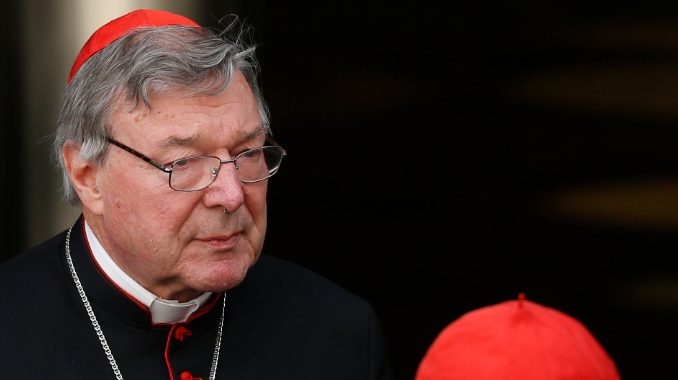
Makes one wonder about what really happened to Pell. May the truth be exposed by the light of our beloved Savior and Head of the Church.
Nov. 22nd: Why hasn’t Pope Francis helped Cdl. Pell the way he helped other Bishops and Cardinals who were credibly accused of abuse??? Why did he say nothing to help Cdl. Pell? There seems to be corruption and evil even in the highest places. Pray for Cdl. Pell that he may be freed soon and that the truth…the whole truth, be revealed for all the world to see.
I wonder how much of that missing money when to Pell’s accuser….
I am not familiar with all the ins and outs of this case, but I think it is worth noting what one official said: “Sometimes the Church must be able to help without being seen to be helping.” What many normal people fail to realize is that there are lots of people living in countries where everything possible is being done to destroy and handicap the Church and Christianity in general. The financial aid of the Church is needed at times, and at such times it has to be given in ways that are not open to snooping by hostile governments who are up to no good for their own citizens.
I had the same thought as I read it but I also had the thought that in light of recent revelations it was also cover for something more nefarious
And all of this happening as Bergoglio helps usher in One World Religion to welcome the Antichrist:
https://www.lifesitenews.com/news/abp-vigano-decries-pope-approved-plan-to-build-abrahamic-religious-site-with-muslims-jews
Truly scandalous.
The fraud at the Vatican Bank explains the obviously false allegations against Cardinal Pell.
The Vatican Secretariat of State is the tap-root of evil in the Catholic Church.
What’s so notable about the “raids” by Vatican police is that we never hear the purpose of the raids. But these raids, which seem to be primarily aimed at confiscating evidence, can be done to stop anyone, a good guy or a bad guy. In fact, people in the investigation business, as police are, are sometimes hired to do things that appear to be legitimate, but are being controlled from above by people with conflicting, conflicted and sometimes illegitimate aims. I have experienced this first-hand as an investigator in a major financial case, involving what turned out to be longstanding deception by senior personnel inside the organization.
It is patently obvious that The Vatican Secretary of State, and it’s characters like Becciu and Parolin, consider themselves “above the law,” and are brazen about it.
These men are determined to prevent good Bishops like Cardinal Pell, and good Catholic laymen like Mr. Odendall and his colleagues, from disclosing some very rotten behavior in the Secretary of State, which the Pontiff Francis has given an iron grip over everyone in the Curia, with his recent “reorganization” that creates the Secretary of State Cardinal Parolin as a super tyrant who can intervene in each and every office in the Vatican.
These men like Parolin and Becciu are tyrants and outlaws. They helped arrange the phony abuse allegation against Pell, in network with their shady pals in the financial fraud underworld, which extends and connects from Rome to Victoria, and to cities around the world.
Now, with being kicked out of the Egmont Group, even the secular banking world doesn’t trust them…and that is an ENORMOUSLY BAD indicator. It doesn’t get any worse…
A whole lot of these men in the Secretariat of State and APSA and the Vatican Bank are probably frauds.
Its not just Bergoglio that has given the Secretariat of State near tyrannical authority, it was after the Second Vatican Council that this happened. Under Pius XII and John XXIII, the Prefect of the Holy Office was always viewed as “second in command”, with the Secretariat of State far below. As the Council wanted the Church to be more worldly, and involved in political issues, the Secretariat become more important.
Aaron – You are exactly right, and I have written previously that I believe that Pope Paul VI’s demotion of the Sacred Congregation for the Faith and the elevation of the Secretariat of State is a horrible sign of personal priorities held by Pope Paul VI, and so may others in the Church.
Pell is the victim of Masonic influence. There are many good, faithful Catholics who don’t want to believe this …….Freemasonry is at the root of all these issues….
It’s a pity we can’t have as Secretary of State the Venerable Rafael Cardinal Merry del Val.
Not only are the Vatican agencies and ultimately, the “Holy” Father implicated, also the Australian judicial system is. The charges against Cardinal Pell are absurd, as the first jury concluded. But the mafia has a long arm: In light of the impossibility of the charge, one has to suppose that the second jury, which convicted him, and with one courageous exception, the state-level panel of top judges have also been threatened or bribed. It’s a good thing that the CNA news is now becoming public, not long before the Australian Supreme Court hears the case definitively. Or maybe they too will capitulate.
For all of the above read ‘Masonic influence’. Call it. Mafia if you will, or threats or bribery, but don’t discount the reach of Freemasonry ….. whether in government or church or legal circles. The issues we as a Church face today are not the sum of coincidences. We are under attack from within….at the highest levels…from some whose message is at odds with the Gospel, and whose loyalties lie with a Master…other than Jesus Christ.
What you say is certainly possible.
All the comments, which refer to the Holy Father seem to me to be inflammatory, personal attacks.
Here are continuing problems, heaped on top of the October 2019 act of idolatry.
https://www.catholicculture.org/commentary/one-more-damaging-blow-to-popes-credibility/
Historically the Secretary of State presumed function as primary communicator within the curia, and diplomatically representing the Pontiff and Church affairs. Although Paul VI enlarged that office – historically the Secretary of State presumed under Paul VI essentially the same function as primary within the curia, and diplomatically representing the Pontiff and Church affairs. For example.
Although Paul VI enlarged the office placing the Secretary over all the curia departments he did not mitigate the function of the CDF as the primary and exclusive defender of the faith within the Curia dicasteries. That arrangement likely was made out of naivete by Paul VI not foreseeing a future Pontiff Francis who would place Propaganda Fides as the primary dicastery and voice of what Catholicism is in practice. The fault line was the enhancement of the Secretariat the earthquake Pope Francis’ policy of diminishing the CDF autocratically dismissing Cardinal Gerhard Muller’s better personnel on apparent grounds of their strictness in adhering to ‘Rules’ that conflicted with the new gospel Amoris Laetitia. Sex and money is an age old corrupter Cardinal Pell the likely victim of Vatican and world wide machinations to silence a true man of the cloth. As documented by Chris in Maryland whatever his sources they add up. The marked difference in corruption within our Church at this moment, its mimic of age old corruption in the secular is that it’s not simply a general presumption of a corrupt Church. Rather it is the catalyst Pope Francis. He relegated CDF to innocuousness and he did zero to step in to expose the sexually disturbed players money laundering, and taking in monetary support from an obliging German Hierarchy. A kind of quid pro quo in order to advance a radical agenda. Where does it leave the faithful Catholic. Borderline despair affects many though like Paul the Apostle we recover because of Christ’s strengthening presence within us and continue to resist. Like Michael Matt The Remnant a continuance of an historically deeply Catholic family with roots in Germany “We Resist You” directed at the fallacies of our Pontiff not the Chair of Peter or the Church instituted by Christ. Faithful Catholics are not ‘children’ as portrayed by Pope Francis in response to the removed from office Cardinal Muller. His voice is ridiculed and in the case of of Archbishop Carlo Vigano his voice is perjured. We have not legal recourse regarding the Pontiff’s authority. We have infinitely more authority within the Church instituted by Jesus Christ because we stand with Him and the Gospel he revealed.