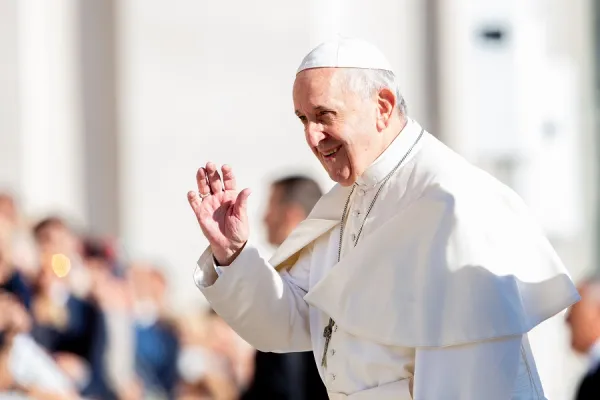
Vatican City, Oct 27, 2019 / 04:55 am (CNA).- Pope Francis denounced exploitation and “predatory models of development” that plunder the poor and wound “sister earth” in the Amazon Synod closing Mass Sunday.
“In this Synod we have had the grace of listening to the voices of the poor and reflecting on the precariousness of their lives, threatened by predatory models of development,” Pope Francis said in his homily Oct. 27.
“The mistakes of the past were not enough to stop the plundering of other persons and the inflicting of wounds on our brothers and sisters and on our sister earth: we have seen it in the scarred face of the Amazon region,” he said in St. Peter’s Basilica.
Pope Francis said that throughout history people who have considered themselves superior to others have “made other people feel rejected” by “considering them backward and of little worth.”
“They despise their traditions, erase their history, occupy their lands, and usurp their goods,” he said.
“How much alleged superiority, transformed into oppression and exploitation, exists even today,” he added. “We have seen this in our discussions at the synod.”
The Mass in St. Peter’s Basilica served as the official close of the Synod of Bishops on the Pan-Amazonian region, which took place at the Vatican Oct. 6-27. The synod final document approved by the 181 voting bishops Oct. 26 calls for the ordination of married men in the Amazon region, and an ecological conversion for the entire Church.
“How many times, even in the Church, have the voices of the poor not been heard and perhaps scoffed at or silenced because they are inconvenient,” the pope said.
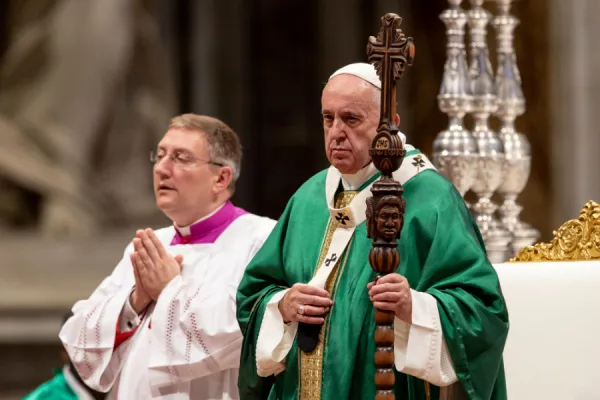
Pope Francis’ crosier for the closing Mass was a gift from members of the Synod of Bishops for the Amazon. A woman carried a plant in the opening procession as the choir sang St. Francis’ Canticle, “Laudato Si.” She later presented the plant to Pope Francis during the presentation of the gifts.
The controversial statues “symbolizing life” that the pope said might be displayed in the basilica for the closing Mass were not present.
Pope Francis reflected on the Gospel from Luke in which a Pharisee’s prayer is “I thank you God that I am not like the rest of humanity,” while a tax collector prays for the mercy of God.
“The root of every spiritual error, as the ancient monks taught, is believing ourselves to be righteous,” Francis warned.
The pope said that the pharisee was “brimming with self-assurance about his own ability to keep the commandments” and was focused only on himself, forgetting to love God and his neighbor.
“He stands in the temple of God, but the one he worships is himself,” Pope Francis said.
“There are many Catholic groups who do the same,” he added in a departure from his prepared remarks.
“Worship of self carries on hypocritically with its rites and ‘prayers,’ forgetting the true worship of God, and many of these have been Catholics, Catholics who have forgotten to express love to one’s neighbor. Even Christians who pray and go to Mass on Sunday are subject to this religion of the self,” he added.
Pope Francis said that the prayer of those who presume themselves righteous remains earthly, “crushed by the gravitational force of egoism,” while the prayer of the poor person rises directly to God.
“Let us pray for the grace not to consider ourselves superior, not to believe that we are alright, not to become cynical and scornful. Let us ask Jesus to heal us of speaking ill and complaining about others, of despising this or that person: these things are displeasing to God,” he said.
Catholic indigneous people from the Amazon were special guests at the Mass, as were members from the L’Arche community, an initiative that supports people with intellectual disabilities.
“Let us pray for the grace to be able to listen to the cry of the poor: this is the cry of hope of the Church. When we make their cry our own, our prayer too will reach to the clouds,” Pope Francis said.
If you value the news and views Catholic World Report provides, please consider donating to support our efforts. Your contribution will help us continue to make CWR available to all readers worldwide for free, without a subscription. Thank you for your generosity!
Click here for more information on donating to CWR. Click here to sign up for our newsletter.

Vatican City, Jun 8, 2020 / 11:30 am (CNA).- The Institute for the Works of Religion (IOR), commonly called the Vatican Bank, said it had made a net profit of 38 million euros in 2019 as it released its annual report Monday.
Pope Benedict XVI announced his intention to resign the papacy during a meeting of cardinals Feb. 11, 2013. The surprise announcement, which he made in Latin, took place in the Hall of the Consistory in the Vatican’s apostolic palace. / Vatican Media
Washington, D.C. Newsroom, Jan 2, 2023 / 06:00 am (CNA).
On Feb. 11, 2013, before a gathering of cardinals who had come to the Vatican expecting to hear the announcement of upcoming canonizations, Pope Benedict XVI dropped a bombshell.
After a few announcements about Church business at the conclusion of the meeting, the pope took out two sheets of paper and read a prepared statement in Latin.
“I have convoked you to this Consistory, not only for the three canonizations, but also to communicate to you a decision of great importance for the life of the Church. After having repeatedly examined my conscience before God, I have come to the certainty that my strengths, due to an advanced age, are no longer suited to an adequate exercise of the Petrine ministry,” the then 85-year-old pontiff told the gathering of the Catholic Church’s highest-ranking clergymen.
Because he spoke in Latin, the language used for official Vatican proclamations, reporters present did not at first realize that the pope had just stepped down.
‘Total surprise, total shock’
The assembled cardinals, on the other hand, who knew their Latin, reacted with stunned silence.
American Cardinal James Stafford later told CNA that the pope’s statement was received with “total surprise, total shock.”
“A cardinal who was sitting next to me said, ‘Did he resign?’ I said, ‘Yes, that’s what he did. He resigned.’ And we just all stood at our places.”
Cardinals react to Pope Benedict XVI’s announcement of his intention to resign the papacy Feb. 11, 2013. The surprise announcement, which Benedict made in Latin, took place in the Hall of the Consistory in the Vatican’s apostolic palace. Vatican Media
Nigeria’s Cardinal Francis Arinze, who was present that morning, said the announcement was a “surprise, like thunder that gives no notice that it’s coming,” reported The Catholic Telegraph.
In renouncing the papacy, Benedict became only the second pope in almost 600 years to voluntarily step down. In 1294, Pietro da Morrone, an elderly hermit, was crowned Pope Celestine V, but finding the demands of the job too much for him, he resigned after only five months.
In 1415, Pope Gregory XII also resigned, but under very different circumstances — he stepped down in order to end a crisis within the Church known as the Great Western Schism.
Title, white clothes, and papal coat of arms
What happened next with Benedict XVI was no less surprising to those who expected him to live as a retired cardinal.
In his last official statement as pope, before a general audience on Feb. 27, 2013, Pope Benedict assured the tens of thousands of people gathered to hear him speak as pope for the last time that even though he was stepping back from official duties, he would remain, in essence, pope.
“The ‘always’ is also a ‘forever’ — there can no longer be a return to the private sphere. My decision to resign the active exercise of the ministry does not revoke this,” Benedict said.
“I do not return to private life, to a life of travel, meetings, receptions, conferences, and so on. I am not abandoning the cross, but remaining in a new way at the side of the crucified Lord,” he told the crowd.
A day earlier, on Feb. 26, 2013, the director of the Vatican Press Office, Father Federico Lombardi, had silenced speculation over what Benedict would be called and what he would wear. He would, Lombardi said, retain the trappings of the papacy — most significantly, his title and dress.
“He will still be called His Holiness Benedict XVI,” Lombardi said. “But he will also be called Pope Emeritus or Roman Pontiff Emeritus.”
Lombardi said Benedict would continue to wear a white cassock but without the mozzetta, the short cape that covers the shoulders. The pope’s fisherman’s ring would be replaced by a ring from his time as cardinal. The red shoes would go as well, Lombardi said, and be replaced by a pair of brown ones.
“The city of León is known for beautiful shoes, and very comfortable shoes. And when the pope was asked what he wanted to wear he said, ‘I want the shoes from León in Mexico,’” Lombardi said at the press conference.
On May 2, the cardinal who designed Benedict’s coat of arms in 2005 told CNA that he had written the pope emeritus suggesting that his coat of arms would need to be redesigned to reflect his new status. Cardinal Andrea Cordero Lanza di Montezemolo proposed making the keys of St. Peter smaller and less prominent.
“That shows that he had a historic possession but not a current jurisdiction,” said the cardinal at the time.
Benedict, however, it seems, politely declined a new coat of arms. La Stampa reported the following year that the Vatican Publishing House’s manual of ecclesiastical heraldry in the Catholic Church contained the following note:
“Expressing deep appreciation and heartfelt gratitude to the author for the interesting study sent to him, [Benedict] made it known that he prefers not to adopt an expressive heraldic emblem of the new situation created with his renouncing of the Petrine Ministry.”
By his decision to continue to dress in white like the pope, retain the title of pope, and keep the coat of arms of his papacy, Benedict revealed that in giving up the “active exercise of the ministry,” he was not forsaking the role of pope altogether.
Pope Francis and Pope Emeritus Benedict XVI pray together at the papal residence in Castel Gandolfo March 23, 2013, their first meeting after Francis’ election. Vatican Media
An expanded Petrine ministry
In his 2013 announcement, Benedict clearly expressed his intention to step aside, even determining the date and time of his official departure. Nonetheless, his decision to keep the title of pope and maintain the ceremonial protocol that goes along with the papacy led some to speculate whether there were not actually “two popes.”
Benedict’s personal secretary and closest confidante, Archbishop Georg Gänswein, sought to clear up any confusion in 2016.
In a speech at the Pontifical Gregorian University in Rome on May 20, 2016, Gänswein said that Pope Francis and Benedict are not two popes “in competition” with one another but represent one “expanded” Petrine office with “an active member” and a “contemplative.”
Parsing Benedict’s speech, Gänswein explained that in stepping down, Benedict was not giving up his ministry.
“The key word in that statement is ‘munus petrinum,’ translated — as happens most of the time — with ‘Petrine ministry.’ And yet, ‘munus,’ in Latin, has a multiplicity of meanings: It can mean service, duty, guide, or gift, even prodigy. Before and after his resignation, Benedict understood and understands his task as participation in such a ‘Petrine ministry [munus],’” Gänswein said.
“He left the papal throne and yet, with the step he took on Feb. 11, 2013, he has not abandoned this ministry,” Gänswein explained, saying the latter scenario was something “quite impossible after his irrevocable acceptance of the office in April 2005.”
Benedict himself later made clear in an interview with his biographer Peter Seewald that he saw himself as continuing in his ministry. He said that a pope who steps down is like a father whose role changes, but always remains a father.
“Of course a father does not stop being father, but he is relieved of concrete responsibility. He remains a father in a deep, inward sense, in a particular relationship which has responsibility, but not with day-to-day tasks as such. It was also this way for bishops,” Benedict said.
“I think it is also clear that the pope is no superman and his mere existence is not sufficient to conduct his role, rather he likewise exercises a function.
“If he steps down, he remains in an inner sense within the responsibility he took on, but not in the function. In this respect one comes to understand that the office of the pope has lost none of its greatness, even if the humanity of the office is perhaps becoming more clearly evident,” Benedict said.
Benedict’s decision “not to abandon his ministry” inspired a cottage industry of conspiracy theories, with some questioning whether the pope emeritus truly stepped down because of his age and frailty.
George Weigel, author of the definitive biography of St. John Paul II, “Witness to Hope,” dismissed such speculation in an interview with CNA.
“I have no reason to think that there was anything more to Pope Benedict’s resignation than what he said was its cause: his conviction that he no longer had the strength, physical and intellectual, to give the Church what it needed from a pope,” he said.
“Everything else written about this is sheer speculation. Let’s take Benedict at his word,” Weigel said.
A life of prayer
In retiring to live in the Mater Ecclesiae Monastery in the Vatican Gardens, Benedict did not completely withdraw from the world. He attended public events in his new capacity as pope emeritus, received visitors, and pursued a life of fruitful study, writing, and prayer.
Pope Francis visits Pope Emeritus Benedict XVI at the Mater Ecclesiae monastery in Vatican City to exchange Christmas greetings Dec. 23, 2013. Vatican Media
Matthew Bunson, Catholic historian, author, and executive editor of EWTN News, told CNA that Benedict was determined not to exercise authority in his new role.
“He really embraced what it means to be pope emeritus, and refrained from making public comments, to instead live a life of prayer and reflection,” Bunson said.
“Benedict really was on retreat, and in prayer,” he said, “and that means we have his prayer for us as a Church.”
While becoming increasingly frail, Benedict continued to celebrate Mass daily with the other residents of the monastery and was known to enjoy spending time in the Vatican Gardens praying his daily rosary.
In the fall of 2021, more than eight years after Benedict stepped down, his private secretary, Gänswein, told Domradio in Cologne, Germany, that Benedict was “stable in his frailty.”
He described the pope emeritus as very weak physically but still clear in mind. Gänswein said he had not lost his “typical Bavarian humor.”
The meaning of Benedict’s renunciation for future popes
In 2013, after Benedict announced that he would step down as pope, Father Gianfranco Ghirlanda, a Jesuit theologian and canonist chosen by Pope Francis to be a cardinal, wrote an essay on what should happen when a pope steps down.
In the article, published in Civiltà Cattolica, Ghirlanda suggested the retiring Benedict take the title bishop emeritus of Rome.
“It is evident that the pope who has resigned is no longer pope; therefore he no longer has any power in the Church and cannot interfere in any government affair. One may wonder what title Benedict XVI will retain. We think that he should be given the title of bishop emeritus of Rome, like any other diocesan bishop who ceases,” he said.
In December 2021, at a congress on papal resignations, Ghirlanda took up the theme again.
“Having two people with the title of ‘pope,’ even if one added ’emeritus,’ it cannot be said that this might not generate confusion in public opinion,” he said.
To make clear that the pope who resigns is no longer pope, he said, he should perhaps be called “former Roman pontiff” or “former supreme pontiff.”
Pope Francis in July 2022 told reporters that if he were to retire from the papacy he would do things differently from his predecessor.
“The first experience went very well,” Pope Francis said, because Benedict XVI “is a holy and discreet man.”
In the future, however, “it would be better to define things or explain them better,” the pontiff added.
“I am the bishop of Rome. In that case I would be the bishop emeritus of Rome,” he said, and then suggested he would live in St. John Lateran Palace rather than at the Vatican.
Pope Francis delivers his Sunday Angelus message from a window of the Apostolic Palace overlooking St. Peter’s Square on Oct. 27, 2024. / Credit: Vatican Media
Vatican City, Oct 27, 2024 / 11:40 am (CNA).
In his Angelus address on Sunday, Pope … […]
8 Comments
How could any reasonable person say such a thing: ““The mistakes of the past were not enough to stop the plundering of other persons and the inflicting of wounds on our brothers and sisters and on our sister earth”. “Our sister earth”? Where in divine revelation is the earth considered our “sister”? Apparently PF has had some new divine revelation or maybe one of the demonic kind, or maybe, being charitable, he is suffering from dementia?
While I do not agree with everything Pope Francis says, his referring to the earth as our sister was used by St. Francis of Assisi. As Chesterton noted, Christians believe the Earth is our sister while Pagans believe it is our mother.
I get Chesterton’s point but when is the last time Sister Earth asked you over for dinner or sent you a Christmas card. I prefer St. Paul – the earth (creation) is groaning as it awaits its participation in the redemption of man. This is an attribution witout a personification.
I am thinking next year, as a result of the synod, he will urge all Catholics to buy a Pachamama image as sign of solidarity with the oppressed sister earth of the Amazon,…
and that the images be supplied from China so that religious prisoners there will know they are aiding the utopia which is just around the next corner.
Look at that enormous wooden staff in the Pope’s hand! What beautiful tree was mercilessly cut down to satisfy man’s ego? Did Sister Earth give her permission for this assault, or is this just another example of man’s presumption of superiority? Shame!
So it appears that the Pope says “Worship of self carries on hypocritically with its rites and ‘prayers,’ forgetting the true worship of God, and many of these have been Catholics” and then he says “Let us ask Jesus to heal us of speaking ill and complaining about others…” You just can’t get better comedy.
Seriously folks? You’re going to criticize the Pope for quoting Saint Francis? Why stop there? What about all that OTHER crazy stuff he said? Criticizing self-righteous Pharisees? Telling us to take the beam from our own eye before we poke the mote in our brother’s eye? Who does he think he’s talking to? Buddhists?!?
I really wish people would do a little more soul-searching before badmouthing our Pope. Some of the disrespect I see on line practically amounts to promoting schismatic thinking. And I know fifty people are going to jump in and tell me all the reasons that obedience doesn’t apply to THIS Pope. But really? Do you people ever step back and LISTEN to yourselves?
I get that many people who comment on these forums have gotten themselves so worked up that they’re convinced they really are more Catholic than the Pope. But you might want to give just a moment of thought to the fact that Bergoglie is not a long-haired hippy but a respected and erudite theologian whose teachings are heavily derived from Romano Guardini — the same theologian who inspired much of Pope Benedict XVI’s thinking. In addition, St. John Paul II and Benedict XVI both valued Bergoglio and tapped him for critical leadership positions — the kind of positions that potential future Cardinals and Popes get tapped for. In my opinion they did that for two reasons. One, because they saw him as having synthesized the best aspects of Liberation Theology with a coherent and morally compelling interpretation of the broad mainstream of 19th and 20th century Catholic theology. Second, they believed that his great personal piety and devotion to the poor embodied the spirit of the New Evangelization that the Church needed to meet the challenges of the 21st century.
Maybe both those Popes were wrong and you’re right. Maybe Francis really is the biggest disaster the Church has ever seen. But St. John Paul II and Benedict XVI were pretty smart guys. And I also happen to believe that they were led by the Holy Spirit. So how about we just calm down, take a deep breath, trust the Holy Spirit — and have a little faith in all the Popes and cardinals involved in promoting and electing this Pope. Don’t you think it’s even remotely possible that they knew more about the real needs of the world’s 1.3 billion Catholics than you do?
How could any reasonable person say such a thing: ““The mistakes of the past were not enough to stop the plundering of other persons and the inflicting of wounds on our brothers and sisters and on our sister earth”. “Our sister earth”? Where in divine revelation is the earth considered our “sister”? Apparently PF has had some new divine revelation or maybe one of the demonic kind, or maybe, being charitable, he is suffering from dementia?
While I do not agree with everything Pope Francis says, his referring to the earth as our sister was used by St. Francis of Assisi. As Chesterton noted, Christians believe the Earth is our sister while Pagans believe it is our mother.
True.
I get Chesterton’s point but when is the last time Sister Earth asked you over for dinner or sent you a Christmas card. I prefer St. Paul – the earth (creation) is groaning as it awaits its participation in the redemption of man. This is an attribution witout a personification.
I am thinking next year, as a result of the synod, he will urge all Catholics to buy a Pachamama image as sign of solidarity with the oppressed sister earth of the Amazon,…
and that the images be supplied from China so that religious prisoners there will know they are aiding the utopia which is just around the next corner.
Look at that enormous wooden staff in the Pope’s hand! What beautiful tree was mercilessly cut down to satisfy man’s ego? Did Sister Earth give her permission for this assault, or is this just another example of man’s presumption of superiority? Shame!
So it appears that the Pope says “Worship of self carries on hypocritically with its rites and ‘prayers,’ forgetting the true worship of God, and many of these have been Catholics” and then he says “Let us ask Jesus to heal us of speaking ill and complaining about others…” You just can’t get better comedy.
Seriously folks? You’re going to criticize the Pope for quoting Saint Francis? Why stop there? What about all that OTHER crazy stuff he said? Criticizing self-righteous Pharisees? Telling us to take the beam from our own eye before we poke the mote in our brother’s eye? Who does he think he’s talking to? Buddhists?!?
I really wish people would do a little more soul-searching before badmouthing our Pope. Some of the disrespect I see on line practically amounts to promoting schismatic thinking. And I know fifty people are going to jump in and tell me all the reasons that obedience doesn’t apply to THIS Pope. But really? Do you people ever step back and LISTEN to yourselves?
I get that many people who comment on these forums have gotten themselves so worked up that they’re convinced they really are more Catholic than the Pope. But you might want to give just a moment of thought to the fact that Bergoglie is not a long-haired hippy but a respected and erudite theologian whose teachings are heavily derived from Romano Guardini — the same theologian who inspired much of Pope Benedict XVI’s thinking. In addition, St. John Paul II and Benedict XVI both valued Bergoglio and tapped him for critical leadership positions — the kind of positions that potential future Cardinals and Popes get tapped for. In my opinion they did that for two reasons. One, because they saw him as having synthesized the best aspects of Liberation Theology with a coherent and morally compelling interpretation of the broad mainstream of 19th and 20th century Catholic theology. Second, they believed that his great personal piety and devotion to the poor embodied the spirit of the New Evangelization that the Church needed to meet the challenges of the 21st century.
Maybe both those Popes were wrong and you’re right. Maybe Francis really is the biggest disaster the Church has ever seen. But St. John Paul II and Benedict XVI were pretty smart guys. And I also happen to believe that they were led by the Holy Spirit. So how about we just calm down, take a deep breath, trust the Holy Spirit — and have a little faith in all the Popes and cardinals involved in promoting and electing this Pope. Don’t you think it’s even remotely possible that they knew more about the real needs of the world’s 1.3 billion Catholics than you do?