No Picture
News Briefs

Blood of St. Januarius liquefies on feast day
September 19, 2019 CNA Daily News 0

Naples, Italy, Sep 19, 2019 / 10:06 am (CNA).- The miracle of the liquefiction of the blood of early Church martyr St. Januarius took place Thursday in Naples.

The blood was shown to have liquefied shortly after 10 a.m. during Mass in the Naples’ Cathedral of the Assumption of Mary.

The Mass was celebrated by Cardinal Crescenzio Sepe, Archbishop of Naples, who in his homily, strongly criticized the violent crime of Neapolitan streets.

Despite the city’s recurring miracle, “the evil that the hateful and violent killers commit in Naples is limitless,” he said.” In effect they try to kill at birth just the possibility of making a future…”

This, he noted, generates fear and insecurity, and goes against the common good. 

“We must ask ourselves: does Naples still have a great and sincere heart? Us citizens of today’s Naples have to answer this question with truth, therefore, with realism, with honesty and courageously, without letting ourselves be taken by a false nostalgia of the times we once had,” he stated.

St. Januarius, or San Gennaro in Italian, the patron of Naples, was a bishop of the city in the third century, whose bones and blood are preserved in the cathedral as relics. He is believed to have been martyred during Diocletian persecution.

The reputed miracle is locally known and accepted, though has not been the subject of official Church recognition. The liquefaction reportedly happens at least three times a year: Sept. 19, the saint’s feast day, the Saturday before the first Sunday of May, and Dec. 16, the anniversary of the 1631 eruption of Mount Vesuvius.

During the miracle, the dried, red-colored mass confined to one side of the reliquary becomes blood that covers the entire glass. In local lore, the failure of the blood to liquefy signals war, famine, disease or other disaster.

The blood did not liquefy in December 2016, but Monsignor Vincenzo De Gregorio, abbot of the Chapel of the Treasure of San Gennaro, said it was a sign that Catholics should pray rather than worry about what the lack of miracle could mean.

“We must not think of disasters and calamities. We are men of faith and we must pray,” he said at the time.

The vial has sometimes changed upon the visit of a pope.

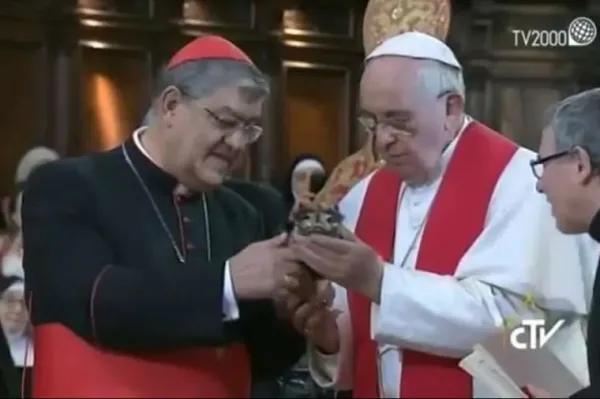
On March 21, 2015, Pope Francis met with priests, religious and seminarians at the cathedral and gave a blessing with the relic.

Sepe then received the vial back from the pope and noted that the blood had partially liquefied.

The last time blood liquefied in the presence of a pope was in 1848 when Bl. Pius IX visited. The phenomenon didn’t happen when St. John Paul II visited the city in October 1979, or when Benedict XVI visited in October 2007.


 

[…]

No Picture
News Briefs

A new book from a Vatican journalist, for Vatican journalists

September 18, 2019 CNA Daily News 1

Vatican City, Sep 19, 2019 / 12:00 am (CNA).- A book on papal communication aims to connect the history of the Vatican’s communications office with the theology of the Second Vatican Council.

“I welcomed this publication with great pleasure,” Alessandro Gisotti, deputy editorial director at Vatican Media, during a September launch event for “Anche i Papi comunicano,” – “The popes also communicate.”

 “I believe it is also a sign of gratitude to all the colleagues who accompanied me during the months in which I held the position of director of the Press Room. I was part of this story and now that it has been dedicated to Navarro Valls the Press Room is even more the home of journalists,” Gisotti added, according to a report from Vatican Media.

The book is authored by Veronica Giacometti, an editor at Italian news agency ACI Stampa and a former intern at Radio Vaticano. ACI Stampa is CNA’s Italian-language partner agency.

Gisotti said the book is important because it connects contemporary Catholic communicators to the Church’s tradition.

“Tradition means transmitting knowledge, it is important that Vatican experts know how popes have communicated in recent decades,” he said.

“Popes communicate first of all with their presence. A president, if he does not act, is thought not exist. But the pope exists and communicates as Peter’s successor, he is the message itself, therefore political categories cannot be applied to his communication,” Gisotti said.

Giacometti told Vatican Media that she wrote the book to be a resource to Vatican journalists.

This book can be a working tool. It contains basic information (for Vatican journalists.) For example, what is a bolletino, how is the press office structured,” among other questions, she said.

Giacometti said she aimed to put the traditions of Vatican journalists on paper.

Alan Holdren, director of EWTN’s Rome office, and long-time Vatican journalist, also spoke at the launch event.

“I think all of us feel this need to know where we have come from. I have been here for 10 years, my first days of journalism at the Vatican were right in the Vatican’s press room. I spent a year and a half there, every day of the week, to report the facts about the pope. The press room for us is a meeting point, a welcome point, a point of information that is essential to carry out our profession,” Holdren said.


[…]

No Picture
News Briefs

The unborn child is a person with the right to an identity, say bishops of Panama

September 18, 2019 CNA Daily News 0

Panama City, Panama, Sep 18, 2019 / 06:01 pm (CNA).- The Panamanian bishops expressed their support last week for a bill that would allow parents to register their children who were miscarried, as this would help “the parents alleviate the pain and make more bearable their mourning over the loss” of their baby.

The bishops made the statement in a Sept. 12 communiqué titled “The right to registration of identity of the child in the womb” regarding Bill 18 on “Identity of child who was miscarried,” proposed by Corina Cano, a legislator of the Nationalist Republican Liberal Movement, which is the junior partner in a governing coalition with the Democratic Revolutionary Party.

According to La Prensa, a Panama City daily, this law would create at the national level “a book of deceased persons who were conceived but not born” and would amend Article 60 of the Civil Registry to include “those that occur in the mother’s womb whatever the cause of death, gestational age, or weight that it had at the moment of death.”

The bill also says that the registration would be made within 72 hours of the death’s occurrence.

Panamanian media indicate the initiative has been criticized by some feminist groups who believe the bill violates the law, puts the Civil Code at risk, and confuses the tasks of the Civil Registry.

In their statement, the bishops recalled that “the Catholic Church has defended the rights a person has from the moment of conception until the person’s natural death.”

“In the Family Code this is recognized in Article 484, which regulates the rights and guarantees of the minor child by defining the minor as: ‘every human being from its conception to eighteen (18) years of age’”, the prelates stated.

They also stressed that “the unborn child is a person who has the right to have an identity. We can’t discard it as if it had never been conceived. It existed for its parents  and thus it ought to be recorded by giving it official recognition.”

In their statement the bishops also referred to the upcoming appointment of justices to the Supreme Court, a process that must be “independent of political, partisan and individual interests given the  weak shape of the institution and the low confidence the the citizenry has in the justice system.”

An open application period began Sept. 2 for the appointment of three chief magistrates and six alternates for the Supreme Court of Justice.

In the appointment of judges, the prelates said, “certain aspects ought to be considfered, such as: moral soundness and reputation; legal experience and academic preparation; service to society and scientific research; as well as citizen participation in solving the problems of justice.”

Therefore “the Church urges that in this process the profile of each aspirant be truly analyzed, so the citizenry can be informed  and give their opinion, so that the most suitable people are appointed  to these high positions in the Panamanian justice system.”

This, they concluded “is an historic opportunity to begin a process of strengthening as an institution one of the most strongly questioned bodies of the state, considering the legal norms and the ethical, moral, and spiritual values, on which this country has been built.”

[…]