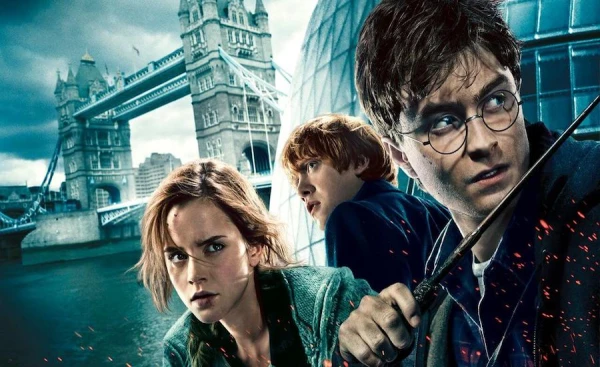
Washington D.C., Sep 3, 2019 / 03:05 pm (CNA).- A Catholic elementary school in Nashville has banned the seven books of the Harry Potter series due to concerns the books promote witchcraft and black magic. An exorcist and a Catholic author talked with CNA about the Harry Potter books and the Catholic faith.
“These books present magic as both good and evil, which is not true, but in fact a clever deception,” Fr. Dan Reehil, pastor at Saint Edward School in Nashville, said to parents in an Aug. 28 email.
“The curses and spells used in the books are actual curses and spells; which when read by a human being risk conjuring evil spirits into the presence of the person reading the text,” the priest added.
Reehil said that the books “glorify acts of divination; of conjuring the dead, of casting spells among other acts that are an offense to the virtue of religion — to the love and respect we owe to God alone. Many reading these books could be persuaded to believe these acts are perfectly fine, even good or spiritually healthy.”
Reehil told parents he made the decision to ban the books after consulting exorcists in both the United States and Rome.
Saint Edward teaches students from pre-K through eighth grade.
The Harry Potter books have been controversial since the first book was published in 1997. The American Library Association listed the Harry Potter series as its first-most challenged books in 2001 and 2002. The books were challenged due to claims of being “anti-family,” containing “occult/satanism” content, and violence.
Series author J.K. Rowling has rejected the idea that her books contain anti-Christian messages. In a 2007 interview, the author said that she believed there were parallels between the series’ title character, Harry Potter, and Jesus Christ.
Monsignor Charles Pope, a priest and exorcist of the Archdiocese of Washington, told CNA that “it’s always good to err on the side of caution in these matters,” adding that the decision to remove the books from the library was a “prudential judgment.”
“I think that in times like these we need to be extra cautious, and so as a general rule I’d support it, but I think every individual parent would have to work with their own kids on these matters,” Pope said.
Pope told CNA that he has not read the Harry Potter books nor seen the movies apart from “some excerpts,” and said with a laugh that the series is “way past (his) age.”
Rosamund Hodge, an author of young adult fantasy novels and a lay Dominican, told CNA she thinks concerns about the “magic” in Harry Potter are overblown.
“The magic in these books is about as ‘real’ as Cinderella’s fairy godmother singing ‘bibbidi- bobbidi-boo,’” she told CNA.
“While [Author J.K.] Rowling does occasionally draw from actual occult folklore for some of her world-building…the spells her characters use are usually just fake Latin describing what they’re supposed to do.”
Hodge does not believe there is a risk of children accidentally conjuring evil spirits through repeating the “spells” used in the books.
“Children are about as likely to summon demons by play-acting Harry Potter as they are to accidentally sell their souls by proclaiming ‘Abracadabra!’ while performing card tricks,” Hodge said.
Hodge said that while Rowling “does not write with a Catholic imagination,” she is not concerned with the allegations of “occult” content in the Harry Potter books.
The author told CNA that Catholic children might learn something from the books, even though the series characters do not possess a Catholic worldview.
“I think the proper response is not to ban the books, but to discuss them,” she said. “If children learn how to cope with Harry and his friends sometimes believing the wrong things, perhaps they’ll be prepared for the Thanksgiving dinner where their favorite uncle announces that euthanasia should be legal.”
Pope told CNA that, no matter their decision about Harry Potter, Catholics should guard against any sort of dabbling with the occult or witchcraft.
“Once you’re into actual witchcraft you are in the dark side, since there’s nothing of God in this. It’s a violation of the First Commandment,” he said.
“I mean, I’ve had to look this devil in the face,” the priest added. “He’s very real. He’s very pernicious. He’s also very sly. We need to be sober about his present action in the world.”
If you value the news and views Catholic World Report provides, please consider donating to support our efforts. Your contribution will help us continue to make CWR available to all readers worldwide for free, without a subscription. Thank you for your generosity!
Click here for more information on donating to CWR. Click here to sign up for our newsletter.

Pope Francis meets with the United States bishops at St. Matthew’s Cathedral in Washington, D.C., on Sept. 23, 2015. / Credit: L’Osservatore Romano
CNA Staff, Apr 22, 2025 / 07:00 am (CNA).
Pope Francis, who died on April 21 at the age of 88, visited the United States just once, nearly 10 years ago, in September 2015.
Despite the brevity of the visit, he accomplished a lot: Attracting hundreds of thousands of participants, he canonized a new saint (St. Junípero Serra), became the first pope to ever address a joint session of Congress, and galvanized the U.S. Catholic community with his presence and his speeches on the East Coast.
Washington, D.C.
Pope Francis began his tour of North America with several days in Cuba. Landing in Washington, D.C., on Sept. 22, 2015, Pope Francis met with President Barack Obama first thing the next morning. The meeting came amid a time of concerns for many American Catholics regarding politics, including the Obama administration’s contraceptive mandate and the recent legalization of same-sex marriage nationwide, via the June 2015 Supreme Court decision in Obergefell v. Hodges.
Pope Francis is greeted by President Barack Obama on Sept. 22, 2015. Credit: Somodevilla/Getty Images
During the presidential meeting, Francis praised Obama’s commitment to inclusivity and noted that American Catholics have contributed greatly to building a tolerant and inclusive society while also stressing that religious liberty “remains one of America’s most precious possessions.” He also encouraged commitment to addressing the “urgent” issue of climate change, building on his expansive 2015 encyclical on the environment, Laudato Si’.
Pope Francis says Mass for clergy and religious in Philadelphia’s Cathedral Basilica of Sts. Peter and Paul, Sept. 26, 2015. Credit: L’Osservatore Romano.
While in D.C., that same day, the pope addressed bishops and priests at the Cathedral of St. Matthew the Apostle and later celebrated Mass at the Basilica of the National Shrine of the Immaculate Conception. At the latter Mass, he celebrated the first canonization on American soil by declaring Junípero Serra, who founded missions along present-day California, a saint.
“He was the embodiment of ‘a Church which goes forth,’ a Church which sets out to bring everywhere the reconciling tenderness of God,” the pope said.
Crowds gather for the Mass canonizing St. Junipero Serra at the Basilica of the National Shrine of the Immaculate Conception in Washington, D.C., on Sept. 23, 2015. Credit: Alan Holdren/CNA
On the same day, Francis made an unscheduled stop to visit with the Little Sisters of the Poor in Washington, D.C., to support the sisters as they awaited word on whether or not the Supreme Court will hear their case against the federal contraception mandate. (The sisters are still fighting aspects of the mandate, even after more than 14 years in court.)
Pope Francis greets Sister Marie Mathilde, 102 years old, at the Jeanne Jugan Residence in Washington, D.C., Sept. 23, 2015. Credit: Photo courtesy of the Little Sisters of the Poor
Francis addressed a joint session of Congress the next day, Sept. 24, making him the first pope to ever to do so. During his lengthy speech, he condemned the arms trade and the death penalty — statements that reportedly made some lawmakers in the room squirm.
Francis went on to assert that the family was being threatened like never before and praised American figures, including Abraham Lincoln and Martin Luther King Jr., for their tireless efforts to defend freedom and moral values. He also touched on respect for human life and the environment in the well-received speech.
Pope Francis speaks to the U.S. Congress in Washington, D.C., on Sept. 24, 2015. Credit: L’Osservatore Romano
The pope also visited St. Patrick Parish and met with people experiencing homelessness at Catholic Charities, addressing people who minister to the poor. He offered St. Joseph as their patron and model, because, he said, St. Joseph grappled with injustice and suffering in his care for Mary and Jesus.
“The Son of God came into this world as a homeless person,” the pope said. “The Son of God knew what it was to start life without a roof over his head.”
“We can find no social or moral justification, no justification whatsoever, for lack of housing. There are many unjust situations, but we know that God is suffering with us, experiencing them at our side. He does not abandon us.”
Controversially, while in D.C. Pope Francis met with Kim Davis, a Kentucky county clerk who had become a cultural lightning rod for refusing to issue same-sex marriage licenses. The pope reportedly told her to “stay strong,” offering rosaries to Davis and her husband. The Vatican later clarified that Francis met with Davis and her husband as part of a large group invited by the nunciature, with the Vatican spokesperson adding that the pope “did not enter into the details” of her situation.
New York City
After flying to New York City the evening of Sept. 24 and praying vespers at St. Patrick’s Cathedral in Manhattan, Francis addressed the United Nations General Assembly the next day, Sept. 25, the fifth time a pope had addressed the body.
The pontiff issued a call to the countries of the world to reject what he called “ideological colonization” — the “imposition of anomalous models and lifestyles which are alien to people’s identity and, in the end, irresponsible.”
Pope Francis’ historic address to the U.N. in New York City on Sept. 25, 2015. Credit: Alan Holdren/CNA
Like his predecessor, Benedict XVI, Pope Francis made a solemn visit with other religious leaders to Ground Zero, the site of the 9/11 attacks, later on Sept. 25. He met with families of first responders, saying at the site museum that acts of destruction always have “a face, a concrete story, names.” He offered a “prayer of remembrance” for all those killed that day, along with a prayer for the survivors and those who are mourning the loss of their loved ones.
Pope Francis speaks during an interreligious prayer service at Ground Zero, Sept. 25, 2015. Credit: Addie Mena/CNA
Later that day, after visiting Our Lady, Queen of the Angels School in the Harlem neighborhood of New York City, Francis celebrated Mass at Madison Square Garden. He encouraged people to remember those in the city who are often forgotten, including “foreigners, the children who go without schooling, those deprived of medical insurance, the homeless, the forgotten elderly.”
Madison Square Garden prepares for the papal Mass, Sept. 25, 2015. Credit: Alan Holdren/CNA
“Knowing that Jesus still walks our streets, that he is part of the lives of his people, that he is involved with us in one vast history of salvation, fills us with hope. A hope which liberates us from the forces pushing us to isolation and lack of concern for the lives of others, for the life of our city,” the pope said.
“A hope which frees us from empty ‘connections,’ from abstract analyses, or sensationalist routines. A hope which is unafraid of involvement, which acts as a leaven wherever we happen to live and work. A hope which makes us see, even in the midst of smog, the presence of God as he continues to walk the streets of our city.”
Philadelphia
Pope Francis’ visit included an appearance at the 2015 World Meeting of Families (WMF) in Philadelphia, an event that focuses on celebrating the gift of the family.
Pope Francis at the World Meeting of Families in Philadelphia on Sept. 26, 2015. Credit: L’Osservatore Romano
After flying to the “City of Brotherly Love” the morning of Sept. 26, Pope Francis took part in a Mass for clergy and religious at Philadelphia’s Cathedral Basilica of Sts. Peter and Paul. In his homily address, the pope challenged the clergy and religious to inspire new vocations.
He called for women to take on a greater role in the Church, highlighting the example of St. Katharine Drexel — a Philadelphia native — and he reminded the priests and religious present of their role in ministering to families, couples preparing for marriage, and young people.
He later addressed a crowd of some 50,000 people at Independence Mall, the site of Independence Hall and the Liberty Bell, for a religious freedom rally with Hispanic and other immigrants.
Speaking to thousands of families gathered on the Benjamin Franklin Parkway in Philadelphia that night, a visibly moved Pope Francis ditched his prepared remarks and instead gave an impromptu reflection on the beauty and dire importance of family life. He voiced his thanks at “the presence of all of you — who are a real witness that it’s worth being a family!” A society “is strong, solid, and edified on beauty, goodness, and truth,” he added.
Pope Francis addresses the Festival of Families in Philadelphia on Sept. 26, 2015. Credit: EWTN
On Sept. 27, the next day, Francis had an unscripted meeting with five abuse survivors — three women and two men — all of whom had been abused in childhood either by members of the clergy, family members, or educators. He promised accountability for perpetrators and expressed sorrow for the victims’ suffering.
In the face of such heinous acts as sexual abuse, “God cries,” he said, adding that “the criminal sins of the abuse of minors can’t be kept in silence any longer … I promise, with the vigilance of the Church, to protect minors and I promise [that] all of those responsible will be held accountable.”
He told a gathering of international bishops afterward that the survivors’ stories of suffering “have aggravated my heart” and said that crimes of abuse must never be kept in silence.
Later that morning, Francis visited a Philadelphia correctional facility, saying at the meeting with a group of 100 inmates and their families that every person is marked and bruised by life, but Jesus washes away our sins and invites us to live a full life.
Pope Francis embraces a man at Curran-Fromhold Correction Facility in Philadelphia on Sept. 27, 2015. Credit: EWTN
Reflecting on the trip, the Holy Father said it was “particularly moving for me to canonize St. Junípero Serra, who reminds us all of our call to be missionary disciples.”
He added that he was touched “to stand with my brothers and sisters of other religions at Ground Zero, that place which speaks so powerfully of the mystery of evil. Yet we know with certainty that evil never has the last word, and that, in God’s merciful plan, love and peace triumph over all.”
Furthermore, he promised his prayers for the U.S. people, saying: “This land has been blessed with tremendous gifts and opportunities. I pray that you may all be good and generous stewards of the human and material resources entrusted to you.”
“I thank the Lord that I was able to witness the faith of God’s people in this country, as manifested in our moments of prayer together and evidenced in so many works of charity.”
Concluding, he asked those present: “Do not let your enthusiasm for Jesus, his Church, our families, and the broader family of society run dry.”
“May our days together bear fruit that will last, generosity and care for others that will endure!” he said. “Just as we have received so much from God — gifts freely given us, and not of our own making — so let us freely give to others in return.”
CNA Staff, Jun 10, 2020 / 12:34 am (CNA).- Catholics have a key part to play— in cooperation with God’s grace— in overcoming racism, the bishop of Phoenix said at the diocesan Mass for Forgiveness of the Sin of Racism this week.
“George Floyd did not die alone. Jesus was with him—praying with him and for him. At every time and every place, Jesus draws near to every person, especially in times of suffering and at the hour of death,” Bishop Thomas Olmsted of Phoenix said in the homily June 8.
As the Church gathers to pray for forgiveness for the sin of racism, Olmsted said, it is important to define what Catholics mean by the term.
The Catechism of the Catholic Church offers guidance, he said, defining it as “unjust discrimination on the basis of a person’s race.”
In Paragraph 1935 of the Catechism, it says “every form of social or cultural discrimination in fundamental personal rights on the grounds of sex, race, color, social conditions, language, or religion must be curbed and eradicated as incompatible with God’s design.”
Olmsted said he has seen racial discrimination manifest itself among some Catholics in Arizona. Nearly half of Phoenix’s pastors were born in other countries, he said, and sadly not all have been received well by Catholics in the diocese.
For example, “on the day that I installed one of our finest pastors, protestors came to the parking lot and distributed flyers on car windows denouncing the bishop for replacing their beloved former pastor with ‘these Africans,’” Olmsted said.
The Church provides, through the Sacrament of Confession, a means by which those who have perpetuated the sin of racism can seek God’s mercy.
“The rich mercy of God restores human dignity, even to the most hardened of sinners, if we have the humility to say six words: ‘I am sorry. Please forgive me,’” he said.
Jesus himself, and saints like Pope John Paul II, have modeled the kind of forgiveness that is necessary for healing from racism, Olmsted said.
“[Racism] is overcome by God, by His mercy. It is not our achievement. We have a key part to play, in cooperation with His grace, but only God can change minds and hearts. That’s why the Sacraments of Confession and the Eucharist play such vital roles in overcoming the sin of racism,” Olmsted said.
In responding to racism, Catholics— even if they are not themselves racist— must not allow their hearts to harden, frozen by indifference, and simply fail to respond altogether, Olmsted said.
“While racism is a sinful act that prejudice, injustice, and lack of respect for human dignity brings about, racism also hides itself behind indifference. Racists may not get caught because they are doing “nothing.” But, in Jesus’ description of the Last Judgment, found in Matthew 25:4, sin is depicted not as what people did but ‘what they failed to do,’” he said.
Olmsted recalled that during March 2000, Pope John Paul II led the whole Church in a Day of Pardon, in which he asked the entire Church to place itself “before Christ, who out of love, took our guilt upon Himself,” and to make a “profound examination of conscience,” and to “forgive and ask forgiveness.”
“Inspired by the example of St. John Paul II, let us beg the Lord Jesus, at this Mass, for the grace we need to overcome the evil of racism and to build a society of Jesus and solidarity,” Olmsted concluded.
Chicago, Ill., Jan 27, 2018 / 04:09 pm (CNA/EWTN News).- In a recent study, teenage girls were found to feel powerless when asked for a nude image of themselves from young men, most often saying they felt trapped, bombarded, coerced, and confused when … […]
7 Comments
I guess as a parent I’d be more concerned about the author’s stand on certain social issues and her comments concerning the sexual preferences of one of the characters.
But, yes the magic stuff in the books seems problematic too. Especially in our current culture.
Nobody should read those books. First and worst of all, they encourage children to feel powerful through witchcraft. There has been a huge uptick and interest in all things to do with witches, warlocks, spells and the like by people who are totally ignorant of how the spiritual world works. Why not make it sound like a fun adventure? And so people with no discernment think there’s no problem. And secondly, they are poorly written. If parents want their kids to have a fun spiritual adventure where good wins over evil, read the Narnia books.
What strikes me is the courage to make this decision to ban certain “pernicious” books, from a Catholic perspective.
I do believe that Fr. Reehill keep the welfare of those children in mind. Not to our surprise, some author will jump to tell us how importante it is to discuss, rather than “ban the books”. The question is: what to discuss? For an elementary school children there will be too many topics to discuss, on what we believe as Catholic. It doesn’t bother to read a huge series of 7 books just to share your opinions about witchcraft.
Oh boy, are we back in 2001? We better start talking about the dangers of Pokemon again, encouraging belief in evolution.
Notice how you never read stories of schools banning the Earthsea novels, or any number of other fantasy series that deal with magic?
Joe K.,
I don’t like paranoia or censorship either but have you observed the direction our culture has moved since 2001?
Perhaps this school has considered the prevailing culture & determined that certain materials may pose risks to their students. I’d leave that as a prudential decision based upon the particular situation the school administration finds itself in.
There’s been much more interest in the occult lately, perhaps due to falling church attendance & religious affiliation. It’s natural to want to fill that spiritual vacuum & as Christians, we don’t want to encourage children to fill that space with the wrong things.
I doubt children will be convinced to be better-practicing Catholics by having school libraries rid themselves of Harry Potter, as much as I doubt that they will be better-practicing Catholics by being force-fed LifeSiteNews articles.
“Don’t you see what the culture is like these days?” is always a weak argument. You’ll always think things are worse now than when you were younger. Children (and people) respond to LIVED Christian lives, not access (or lack thereof) materials which the internet and movie theaters already make readily available.
The ‘new’ interest in the occult and dropping in church attendance are both symptoms, not cause and effect, of that lack of actual, LIVED authentic spirituality in peoples’ lives, which itself is only part of a broader picture: increased economic uncertainty which leads to less stable families, more work to make ends meet means less leisure time to think about things like church and spirituality, less money to spend on private education, what you do spend money on is completely materialistic and consumptive (internet, tv), and so on. Food for thought.
Joe,
I agree that falling church attendance and increasing interest in the occult are symptoms of a deeper problem.
I’m a grandma and mother of 8 and I do believe that the culture is worse than when I was growing up. The 1960’s and 70s had setious troubles too but alternative lifestyles then were the exception. Now they’re mainstream.
I guess as a parent I’d be more concerned about the author’s stand on certain social issues and her comments concerning the sexual preferences of one of the characters.
But, yes the magic stuff in the books seems problematic too. Especially in our current culture.
Nobody should read those books. First and worst of all, they encourage children to feel powerful through witchcraft. There has been a huge uptick and interest in all things to do with witches, warlocks, spells and the like by people who are totally ignorant of how the spiritual world works. Why not make it sound like a fun adventure? And so people with no discernment think there’s no problem. And secondly, they are poorly written. If parents want their kids to have a fun spiritual adventure where good wins over evil, read the Narnia books.
What strikes me is the courage to make this decision to ban certain “pernicious” books, from a Catholic perspective.
I do believe that Fr. Reehill keep the welfare of those children in mind. Not to our surprise, some author will jump to tell us how importante it is to discuss, rather than “ban the books”. The question is: what to discuss? For an elementary school children there will be too many topics to discuss, on what we believe as Catholic. It doesn’t bother to read a huge series of 7 books just to share your opinions about witchcraft.
Oh boy, are we back in 2001? We better start talking about the dangers of Pokemon again, encouraging belief in evolution.
Notice how you never read stories of schools banning the Earthsea novels, or any number of other fantasy series that deal with magic?
Joe K.,
I don’t like paranoia or censorship either but have you observed the direction our culture has moved since 2001?
Perhaps this school has considered the prevailing culture & determined that certain materials may pose risks to their students. I’d leave that as a prudential decision based upon the particular situation the school administration finds itself in.
There’s been much more interest in the occult lately, perhaps due to falling church attendance & religious affiliation. It’s natural to want to fill that spiritual vacuum & as Christians, we don’t want to encourage children to fill that space with the wrong things.
I doubt children will be convinced to be better-practicing Catholics by having school libraries rid themselves of Harry Potter, as much as I doubt that they will be better-practicing Catholics by being force-fed LifeSiteNews articles.
“Don’t you see what the culture is like these days?” is always a weak argument. You’ll always think things are worse now than when you were younger. Children (and people) respond to LIVED Christian lives, not access (or lack thereof) materials which the internet and movie theaters already make readily available.
The ‘new’ interest in the occult and dropping in church attendance are both symptoms, not cause and effect, of that lack of actual, LIVED authentic spirituality in peoples’ lives, which itself is only part of a broader picture: increased economic uncertainty which leads to less stable families, more work to make ends meet means less leisure time to think about things like church and spirituality, less money to spend on private education, what you do spend money on is completely materialistic and consumptive (internet, tv), and so on. Food for thought.
Joe,
I agree that falling church attendance and increasing interest in the occult are symptoms of a deeper problem.
I’m a grandma and mother of 8 and I do believe that the culture is worse than when I was growing up. The 1960’s and 70s had setious troubles too but alternative lifestyles then were the exception. Now they’re mainstream.