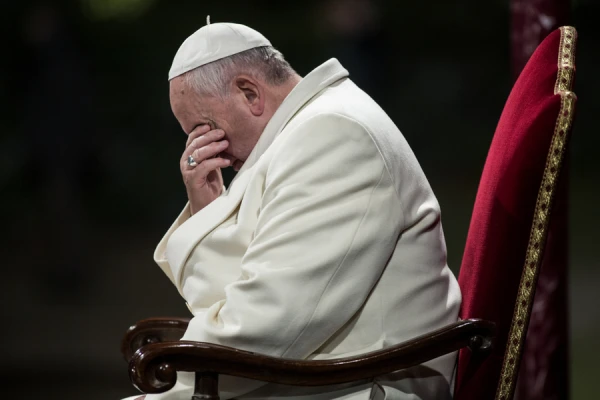
Vatican City, Jun 26, 2019 / 08:00 am (CNA).- Pope Francis expressed his “immense sadness” upon seeing the image of the migrant father and child who drowned in their attempt to cross the Rio Grande, a Vatican spokesman said Wednesday.
“The Pope is profoundly saddened by their deaths, and is praying for them and for all migrants who have lost their lives while seeking to flee war and misery,” Holy See Press Office interim director Alessandro Gissoti said June 26.
The graphic image of the bodies of Salvadoran migrant Oscar Alberto Martinez and his 23-month-old daughter, Valeria, floating along the Rio Grande riverbank circulated across the world after they were discovered on June 24.
Martinez and his daughter died while attempting to swim across the Rio Grande along the U.S.-Mexico border after they were unable to make an official request to U.S. authorities for asylum from El Salvador, the Mexican newspaper, La Jornada, reported.
At least 283 migrants died while attempting to cross the U.S.-Mexico border last year, according to U.S. border patrol.
President Donald Trump announced June 22 that he would delay scheduled immigration raids by two-weeks to allow Congress to modify U.S. asylum law.
The House of Representatives passed a bill June 4 that would provide a citizenship path for some brought to the U.S. illegally as children, as well as for qualified holders of Temporary Protected Status or Deferred Enforced Departure.
The bill, the American Dream and Promise Act of 2019, would grant qualifying childhood arrivals 10 years of legal residence, after which they could receive permanent legal residence with two years of higher education or military service, or three years of employment. Those with TPS or DED could apply for lawful permanent residence if they have been in the country for at least three years and have passed background checks. After five years of lawful permanent residence, they would apply for citizenship.
Earlier this month, Mexico agreed to take measures to reduce the number of migrants to the US, in order to avoid the imposition of tariffs.
Some 6,000 National Guard troops will be assigned to Mexico’s southern border with Guatemala, and some asylum seekers in the US will be sent to Mexico to wait while their claims are processed.
Pope Francis has been an outspoken advocate for countries to accept migrants and refugees in recent years.
“Before the challenges of contemporary movements of migration, the only reasonable response is one of solidarity and mercy,” Pope Francis said at a Mass commemorating migrants who died attempting to cross the Mediterranean Sea from Africa to Europe.
“How many of the poor are trampled on in our day! . . . Among them, I cannot fail to include the migrants and refugees who continue to knock at the door of nations that enjoy greater prosperity,” he said.
If you value the news and views Catholic World Report provides, please consider donating to support our efforts. Your contribution will help us continue to make CWR available to all readers worldwide for free, without a subscription. Thank you for your generosity!
Click here for more information on donating to CWR. Click here to sign up for our newsletter.
Pope Leo XIV appointed Archbishop James Checchio coadjutor archbishop of New Orleans in September 2025 to automatically succeed the 76-year-old Archbishop Gregory Aymond upon his retirement. […]
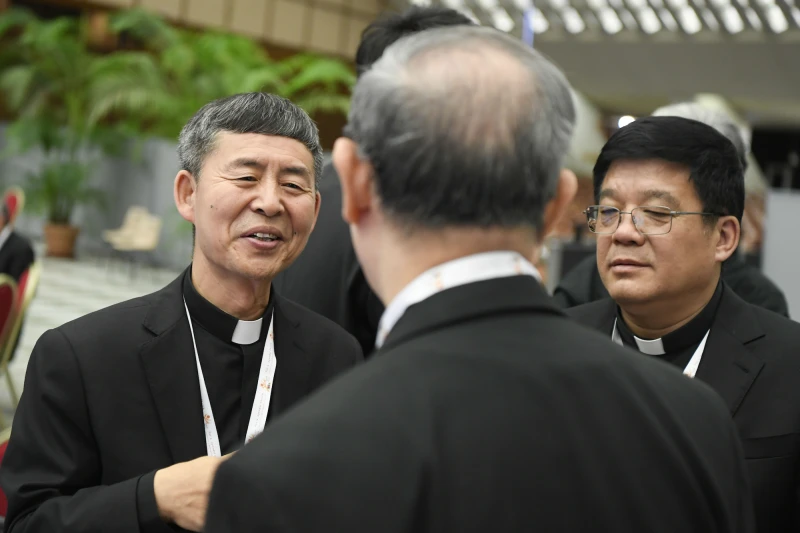
Bishop Yao Shun of Jining and Bishop Yang Yongqiang of Zhouchun (right) of the People’s Republic of China at the Synod on Synodality at the Vatican in October 2023. / Vatican Media
Vatican City, Oct 8, 2024 / 13:30 pm (CNA).
The Synod on Synodality, meant to be a moment of encounter and dialogue for the global Church, has provided a venue for Catholic bishops from mainland China and Taiwan to meet together.
Bishop Norbert Pu is the Catholic Church’s first bishop born in Taiwan. The 66-year-old bishop of Chiayi is a delegate in the nearly monthlong synod assembly as a representative of the Chinese Regional Bishops’ Conference of Taiwan.
In an interview with CNA, Pu said he is most looking forward to getting to know the different bishops, cardinals, and synod delegates from other parts of the world gathered at the Vatican for the second session of the 16th Ordinary General Assembly of Bishops.
Bishop Norbert Pu speaks to CNA at the Vatican, Tuesday, Oct. 8, 2024. Credit: EWTN News
Pu noted that he had already met with the two bishops from mainland China taking part in the synod and plans to meet with them again.
“It’s very important to dialogue with them, to respect each other. I think it’s good … not only for the Chinese, for the whole Church,” the Taiwanese bishop said.
Bishop Antonio Yao Shun of Jining, the first bishop consecrated in China under the terms of the Sino-Vatican agreement, represented the Church in China at the synod assembly in October 2023 along with Chinese Archbishop Joseph Yang Yongqiang before the two suddenly departed early without explanation.
Yao has said that many of the participants in last year’s synod assembly “showed interest in the development of the Church in China, eager to know more and to pray for us.”
The synod also provided an opportunity for the bishops from the People’s Republic of China to spend time with the bishop of Hong Kong, Cardinal Stephen Chow.
During last year’s synod assembly, the cardinal and the two bishops even took a brief trip together to Naples where they offered Mass at the Chiesa della Sacra Famiglia dei Cinesi (Church of the Holy Family of the Chinese), a church built in 1732 as part of an institute founded by Pope Clement XII to train Chinese seminarians and teach missionaries the Chinese language to help with the evangelization of China.
A new synod delegate from China
For this year’s assembly, Yao has been replaced by Chinese Bishop Vincent Zhan Silu of Mindong diocese in China’s southern Fujian province.
Zhan Silu, 63, was formerly excommunicated for having been ordained a bishop without a papal mandate in Beijing in 2000. His excommunication was lifted in 2018 when the Vatican signed a historic provisional agreement with the Chinese government on the appointment of bishops.
When Cardinal Jean-Claude Hollerich was asked why Yao had been replaced by Zhan Silu, the relator general of the synod replied: “The Secretariat of State communicated the names to us, but we have no other information on the matter,” according to Asia News.
Without Yao, Archbishop Yang, 54, is the synod veteran among the two Chinese bishops. Since participating in last year’s synod assembly, Yang has been transferred to the Archdiocese of Hangzhou, a move that took place “within the framework of dialogue” of the provisional agreement with China, according to the Vatican. The change elevated him to the rank of archbishop.
Yang was ordained a bishop with Vatican approval in 2010 and served as the bishop of Zhoucun in mainland China’s Shandong Province from 2013 to June 2024.
He participated in the 2023 National Committee of the Chinese People’s Political Consultative Conference, a political advisory body that is part of the Chinese Communist Party’s united front system, where it was decided that the Catholic Church should integrate its thought with the party and unite more closely to Xi Jinping, according to the official website of the Catholic Patriotic Association.
Zhan Silu and Yang are among the 368 voting delegates taking part in the second synod assembly at the Vatican Oct. 2–27.
The synod is taking place amid the ongoing dialogue between Beijing and Rome on the appointment of bishops. The Vatican has yet to announce if it renewed its provisional agreement with China, which is expected to have been renewed this fall for the third time since it was first signed in 2018.
Vatican-Taiwan relations
During the first week of the assembly, some synod delegates took a break from the day’s meetings to join in the celebration of Taiwan’s 113th National Day at a reception organized by the Embassy of the Republic of China to the Holy See just down the street from St. Peter’s Basilica.
Cardinals and others enjoy a celebration of Taiwan’s 113th National Day at a reception organized by the Embassy of the Republic of China to the Holy See in Vatican City, Wednesday, Oct. 2, 2024. Credit: Embassy of the Republic of China to the Holy See
Vatican City State is the only remaining country in Europe that recognizes Taiwan as a country.
The Holy See has had formal diplomatic relations with Taiwan, formally called the Republic of China (ROC), since 1922, while the Church has not had an official diplomatic presence on the mainland People’s Republic of China (PRC) since it was officially expelled by Beijing in 1951.
The island of Taiwan, fewer than 110 miles off the coast of China and home to a population of more than 23 million people, has maintained a vibrant democracy with robust civil liberties despite increased pressure from Beijing regarding the island’s status.
Unlike mainland China — where images of Christ and the Virgin Mary have been replaced with images of President Xi Jinping, according to a report released last week — Catholics in Taiwan enjoy religious freedom, which is enshrined in its constitution.
More than 10,000 people attended the National Eucharistic Congress in Taiwan last weekend, according to Taiwan’s Ministry of Foreign Affairs.
Pope Francis sent a message to the congress, writing that he hoped it would “arouse in the hearts of the Christian faithful a true worship and love of the Eucharist.” The congress in the Diocese of Kaohsiung was the fifth Eucharistic congress held in Taiwan since 2011.
Bishop Pu told CNA that the congress presented an opportunity to let more people in Taiwan know about the Eucharist and its central importance to the Catholic faith.
“We hope we can always maintain this formal and good relationship with the Vatican. Because for Taiwan, this is very important. We hope that the world will see this because Taiwan is a democratic and free country, respected by other nations,” Pu said.
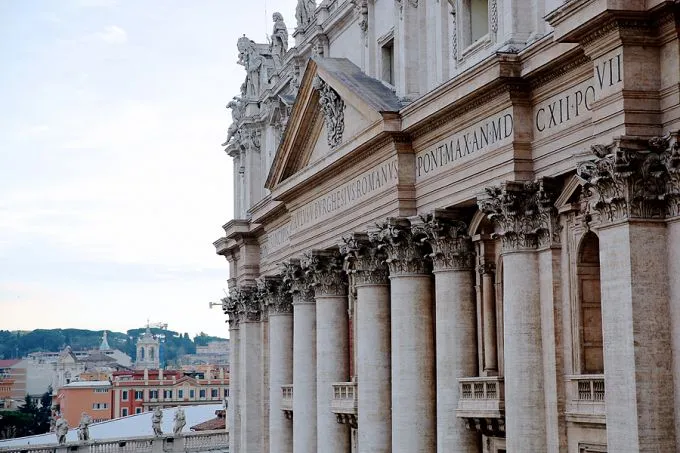
A view of the facade of St. Peter’s Basilica from the Vatican’s Apostolic Palace. / Lauren Cater/CNA.
CNA Newsroom, Jul 22, 2022 / 03:02 am (CNA).
The Holy See intervened in the German “Synodal Way” on July 21, 2022, warning of a “threat to the unity of the Church”.
Below is the full text of the statement in a working translation into English, provided by CNA:
“In order to safeguard the freedom of the People of God and the exercise of the episcopal ministry, it seems necessary to clarify that the ‘Synodal Way’ in Germany does not have the power to compel bishops and the faithful to adopt new forms of governance and new orientations of doctrine and morals.
It would not be lawful to initiate in the dioceses, prior to an agreed understanding at the level of the universal Church, new official structures or doctrines, which would constitute a violation of ecclesial communion and a threat to the unity of the Church. In this sense, the Holy Father called to mind in his letter to the pilgrim people of God in Germany: the universal Church lives in and of the particular Churches, just as the particular Churches live and flourish in and from the universal Church. If they find themselves separated from the entire ecclesial body, they weaken, rot and die. Hence the need always to ensure communion with the whole body of the Church.”[1] Therefore, it is desirable that the proposals made by the Particular Churches in Germany may be incorporated into the synodal process on which the universal Church is undertaking, in order to contribute to mutual enrichment and to bear witness to the unity with which the Body of the Church manifests its fidelity to Christ the Lord.”
Is his Holiness also “profoundly saddened” by the thousands of women and children in Europe who have been raped by so called “refugees”? Or for the victims of terrorist attacks like in Manchester two years ago?
“The House of Representatives passed a bill June 4 that would provide a citizenship path for some brought to the U.S. illegally as children, as well as for qualified holders of Temporary Protected Status or Deferred Enforced Departure.”
And every one of the representatives who voted for that pretty much shares in the guilt for anybody who dies trying to cross the border illegally, because they are essentially telling them, “Sure, go ahead, there won’t be any negative consequences and you’ll almost certainly get to stay and you’ll be treated as if you had actually followed the law.”
I am grateful to Francis for demonstrating the limits of papal infalibility as no one has before. Neither his nor the USCCB’s pronouncements on immigration have the slightest merit. They should not only be disregarded, but openly opposed by every faithful Catholic.





Is his Holiness also “profoundly saddened” by the thousands of women and children in Europe who have been raped by so called “refugees”? Or for the victims of terrorist attacks like in Manchester two years ago?
Papal virtue signalling is the worst.
“The House of Representatives passed a bill June 4 that would provide a citizenship path for some brought to the U.S. illegally as children, as well as for qualified holders of Temporary Protected Status or Deferred Enforced Departure.”
And every one of the representatives who voted for that pretty much shares in the guilt for anybody who dies trying to cross the border illegally, because they are essentially telling them, “Sure, go ahead, there won’t be any negative consequences and you’ll almost certainly get to stay and you’ll be treated as if you had actually followed the law.”
I am grateful to Francis for demonstrating the limits of papal infalibility as no one has before. Neither his nor the USCCB’s pronouncements on immigration have the slightest merit. They should not only be disregarded, but openly opposed by every faithful Catholic.