

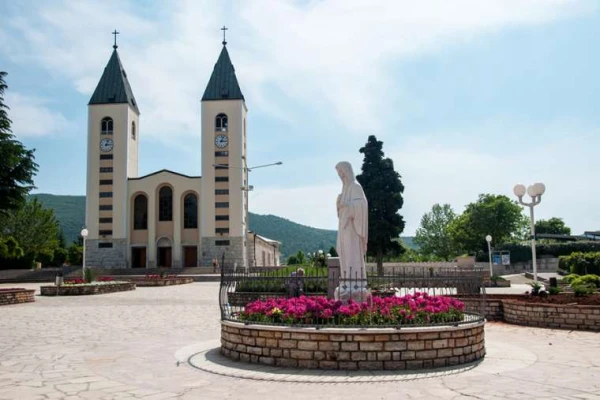
Medjugorje, Bosnia and Herzegovina, May 12, 2019 / 07:46 am (CNA).- Pope Francis has given the green light for Catholics to organize pilgrimages to Medjugorje, a site of alleged Marian apparitions, though the Church has not yet given a verdict on the apparitions’ authenticity.
The pope’s authorization of pilgrimages to the site is not to be understood as an “authentication” of the alleged apparitions, “which still require an examination by the Church,” papal spokesman Alessandro Gisotti said in a statement May 12.
He added that anyone leading pilgrimages to the site should avoid creating “confusion or ambiguity under the doctrinal aspect,” including priests who intend to celebrate Mass there.
The provision was made as an acknowledgment of the “abundant fruits of grace” that have come from Medjugorje and to promote those “good fruits.” It is also part of the “particular pastoral attention” of Pope Francis to the place, Gisotti said.
The announcement of the papal authorization was made May 12 by the Vatican’s apostolic visitor to the site, Archbishop Henryk Hoser, and Archbishop Luigi Pezzuto, apostolic nuncio to Bosnia and Herzegovina.
Hoser, retired archbishop of Warsaw-Prague, was appointed apostolic visitor to Medjugorje by Pope Francis in May 2018. His directive, which is of an undetermined length, is to oversee the pastoral needs at the site of the alleged Marian apparitions.
Hoser’s appointment as apostolic visitor followed his service as papal envoy to the site in 2017.
In January 2014, a Vatican commission concluded a nearly four-year-long investigation on the doctrinal and disciplinary aspects of the Medjugorje apparitions, and submitted a document to the Congregation for the Doctrine of the Faith.
When the congregation has analyzed the commission’s findings, it will finalize a document on the site, which will be submitted to the pope, who will make a final decision.
The alleged apparitions began June 24, 1981, when six children in Medjugorje, a town in what is now Bosnia and Herzegovina, began to experience phenomena which they have claimed to be apparitions of the Blessed Virgin Mary.
According to these six “seers,” the apparitions contained a message of peace for the world, a call to conversion, prayer and fasting, as well as certain secrets surrounding events to be fulfilled in the future.
These apparitions are said to have continued almost daily since their first occurrence, with three of the original six children – who are now young adults – continuing to receive apparitions every afternoon because not all the “secrets” intended for them have been revealed.
Since their beginning, the alleged apparitions have been a source of both controversy and conversion, with many flocking to the city for pilgrimage and prayer, and some claiming to have experienced miracles at the site, while many others claim the visions are non-credible.
Pope Francis visited Bosnia and Herzegovina in June 2015 but declined to stop in Medjugorje during his trip. During his return flight to Rome, he indicated that the process of investigation in the apparitions was nearly complete.
On the return flight from a visit to the Marian shrine of Fatima in May 2017, the pope spoke about the final document of the Medjugorje commission, sometimes referred to as the “Ruini report,” after the head of the commission, Cardinal Camillo Ruini, calling it “very, very good,” and noting a distinction between the first Marian apparitions at Medjugorje and the later ones.
“The first apparitions, which were to children, the report more or less says that these need to continue being studied,” he said, but as for “presumed current apparitions, the report has its doubts,” the pope said.
On multiple occasions, the pope has said he is suspicious of the ongoing apparitions, “I prefer the Madonna as Mother, our Mother, and not a woman who’s the head of an office, who every day sends a message at a certain hour. This is not the Mother of Jesus.”
If you value the news and views Catholic World Report provides, please consider donating to support our efforts. Your contribution will help us continue to make CWR available to all readers worldwide for free, without a subscription. Thank you for your generosity!
Click here for more information on donating to CWR. Click here to sign up for our newsletter.

It is a fraud, and the alleged “seers” are liars. Just as one example, the former Father Vego was expelled from his order and laicized. According to the “seers” Our Lady was telling them that he was innocent and should continue to administer the sacraments. Meanwhile, Vego and his mistress, a nun, conceived a child. So, either the “seers” are lying, or Our Lady is.
Try reading Ivo Sivric: The Hidden Side of Medjugorje: A Theologian’s Observations, Vol. 1
or
https://archive.org/stream/MedjugorjeAfter21YearsMichaelDavies/Medjugorje+After+21+years+Michael+Davies_djvu.txt
or
https://www.catholicstand.com/truth-medjugorje-donal-foley-part/
“The provision was made as an acknowledgment of the “abundant fruits of grace” that have come from Medjugorje”
Yeah, like the Legionaries of Christ had abundant fruits of grace; which was in spite of the fact that Marcial Maciel was evil. Or the “fruits of grace” of Garabandal, which ended up in schism.
All those “fruits of grace” of people who went to Medjugorje after the bishop had forbidden official pilgrimages are the result of disobedience – a hallmark of the alleged apparitions. Tell me, if the Vatican does end out saying the apparitions are false and forbidding pilgrimages, how many of Medjugorje’s devotees will defy authority – again.
Our Lady of Medjugorje – Pray for us.
Of the Pope’s approach, we read: “‘The first apparitions, which were to children, the report more or less says that these need to continue being studied,’ he said, but as for ‘presumed current apparitions, the report has its doubts,’ the pope said.”
About fifteen years ago, I think, I ran across a volume in a used book store, written by a secularist researcher who was simply curious about such things as apparitions (author and title forgotten). Near the end was a short interview piece with psychologist-priest Fr. Benedict Groeschel. Groeschel claimed no deep research into Medjugorje, but offered the possibility that the original apparition was, in fact, real but that the rest might be more like “echoes” coming from the seers rather than from Mary.
Apparition always come with the possibility that they are real, or not real, or real-and-misunderstood, or pious-but-not-real inventions or our complex minds.
It seems plausible that the seers are too vulnerable to the impact of their original “experiences” (an inadequate word) which were/are real. The eternal simply does not fit well within the temporal (von Balthasar refers to the singular Incarnation as an incomprehensible “collision” between the Creator and His creation; the Second Person of a mysterious Triune God wills to enter into His own creation. Say what?!! Hence the Nicene Creed, an act of Faith).
The idea of after-the-fact temporal ripples or echoes, probably mixed with wishful thinking and subjective editing, could explain a lot. (On the two occasions when I heard one seer and then the other, touring North America, the particular events were not very convincing.)
Peeling back these layers, the spiritual fruits and healings of Medjugorje do claim attention. And, also, as for the scandals at Medjugorje, the Father of Lies is probably active. One lesson from Scripture is that if Satan is not present (flushed out), then Christ might not be present either.
Recalling Fr. Groeschel, it might be that Pope Francis is getting this thing just about right.
Fascinating comment, Mr. Beaulieu. Thank you.
“Groeschel claimed no deep research into Medjugorje, but offered the possibility that the original apparition was…”
Yes. But may I interrupt. A good start to convincing others…an “expert” opinion to be offered during an interview to be couched in pious, humble yet “professional” terms. I like my doctors to diagnose without seeing all the lab results or radiological studies…and then offer understandings that are quasi-solutions.”
Exactly the kind of “thinking” we should take seriously…because it was Benedict Groeschel…or if that’s not enough by referencing von Balthazar? Why not reference St. John of the Cross who had more to say than von Balthazar about these topics and who is I believe a Doctor of the Church? Why reference the Trinity here? A summary/conclusion beyond criticism?
Groeschel had a fault, a habit of talking too much above and beyond his scope of practice really yet still enthusiastically with a kind of overconfidence, a stand up comic one moment then utterly humble “religious” quality, very NY, even playing to the audience at times…not just during that “declining” period before his retirement. I met him twice, in NY and NJ and heard him speak. But his books exhibit some of that same conflation between a description and a diagnosis where he provides the answer (in contrast to the “other” Franciscans still unreformed?…though his own reform group subdivided). He was inclined by nature to say more, to speculate (which is an illness within the practice of psychology itself)….as he did in that unfortunate interview in 2012 that was cited in a New York Times article…referencing seductive “youngsters” (14-18 years old, including even close to “canonical” ages) and asserting that he was “inclined to think” first offenders had “no intention of committing a crime” and should not be jailed (How about getting shuffled around the Archdiocese and country along with a prescription for Holy Hours?) This was blamed on the effects of aging, disease process and the effects of a car accident in 2004. But it sounds more like an excerpt from a chat in a conference room at the Chancery vs… his required apology for “lack of clarity.” His statement was perfectly clear. And his statement about Medjugorje? Yes indeed, “no deep research” claimed…sadly, through the many many good years and graced good works and homilies Groeschel never heard an “expert” say “I do not know and I cannot say now” or seemingly so.
2019. NOT the case with Medjugorje. Except…maybe if it can all be repackaged…
Yes, another chance for Bergoglio to “get it right” (for those who consider confusion and nonsense and “process” an accomplishment) and value “discernment” where there is NOTHING to “discern.”
Life without details.
The best part? Bergoglio reverses what Benedict did with regards to Medjugorje and figures it all out ahead of time in a nice politically repackaged with a bow on top basket! Nice!
How frequently a “simple” temptation itself starts out with a “good” (a positive, a pleasure) but somewhere in the middle or even only at the very end does it go off the rails and land you in Hell’s path…and it may or not be reveal that the “good” at the beginning came from the Evil One.
In some minds, the absence of demonic pattern/activity might indicate Christ is not present…but is this a comprehensive view, a reliable spiritual litmus test or simply another attempt to dress up “no deep research” as a positive takeaway and an insight on some allegedly higher level?
Wow! Is it really that complex? Nothing is impossible for God!