Vatican City, Feb 8, 2019 / 11:19 am (CNA/EWTN News).- In mid-nineteenth century Algeria, a French bishop sought to share the Gospel among the local Africans living in his diocese by forming a community that adopted the traditional dress in Algiers — a white cassock with a red fez.
One hundred and fifty years later, the Missionaries of Africa, commonly called the “White Fathers” for their distinctive attire, have grown to have more than 1,500 vocations in 22 African countries — 95 percent of which come from Africa.
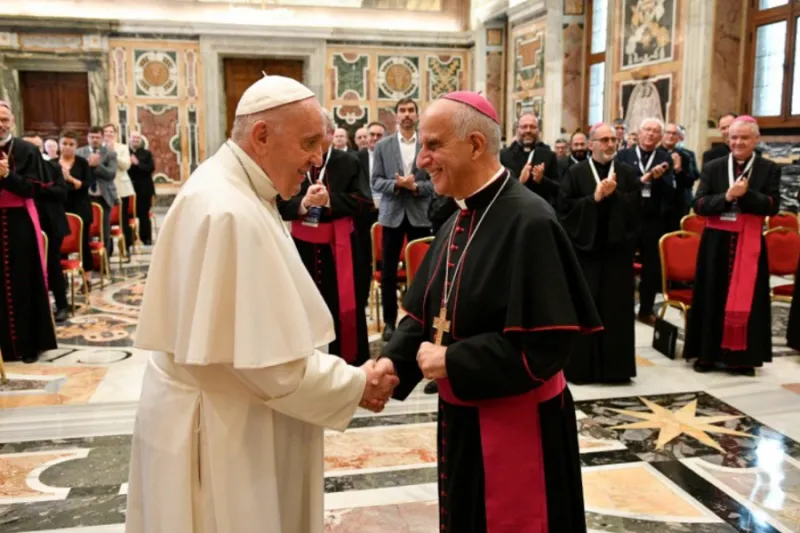
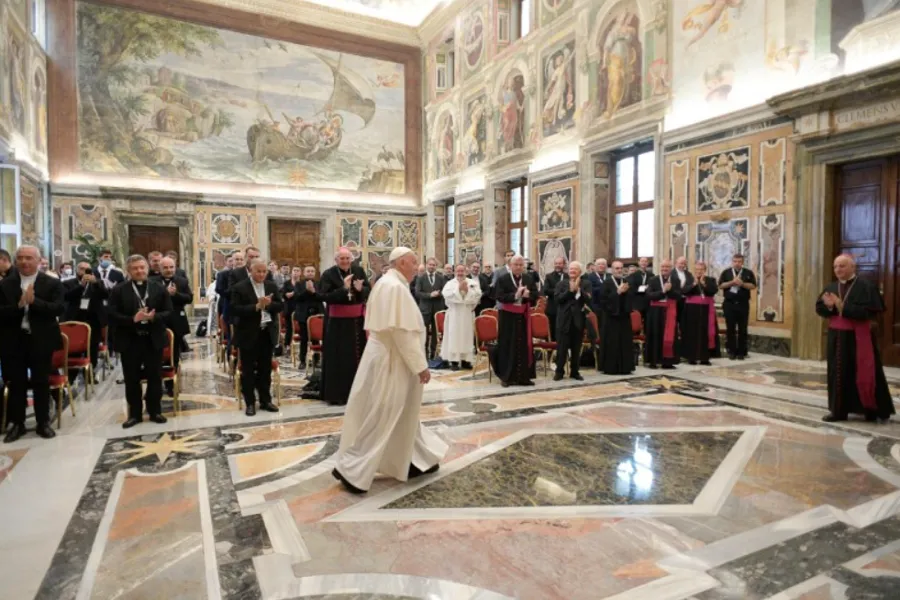
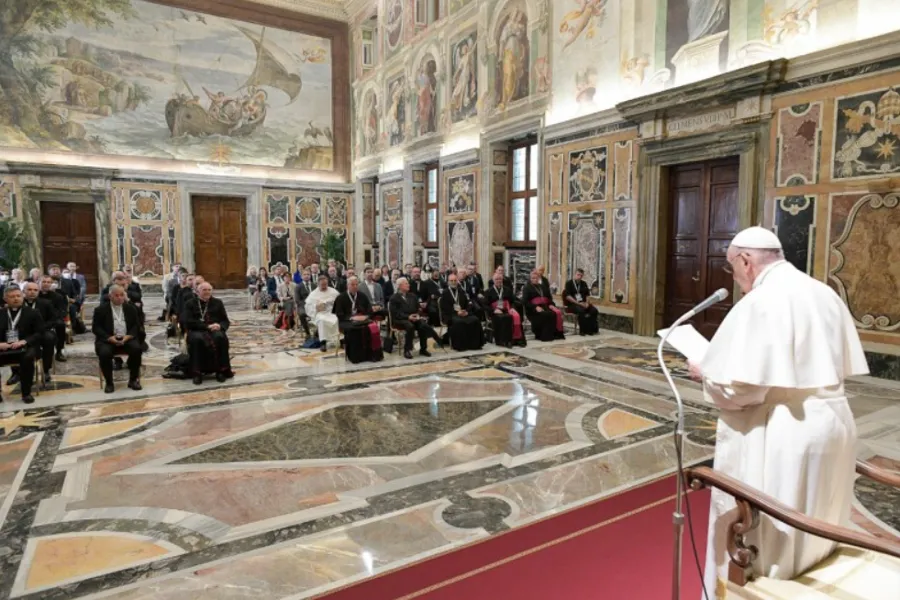
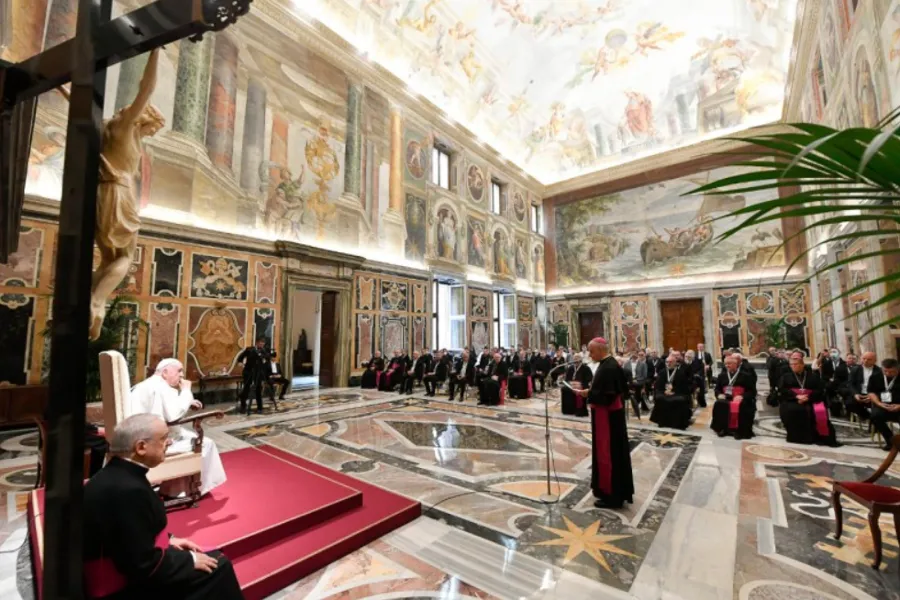
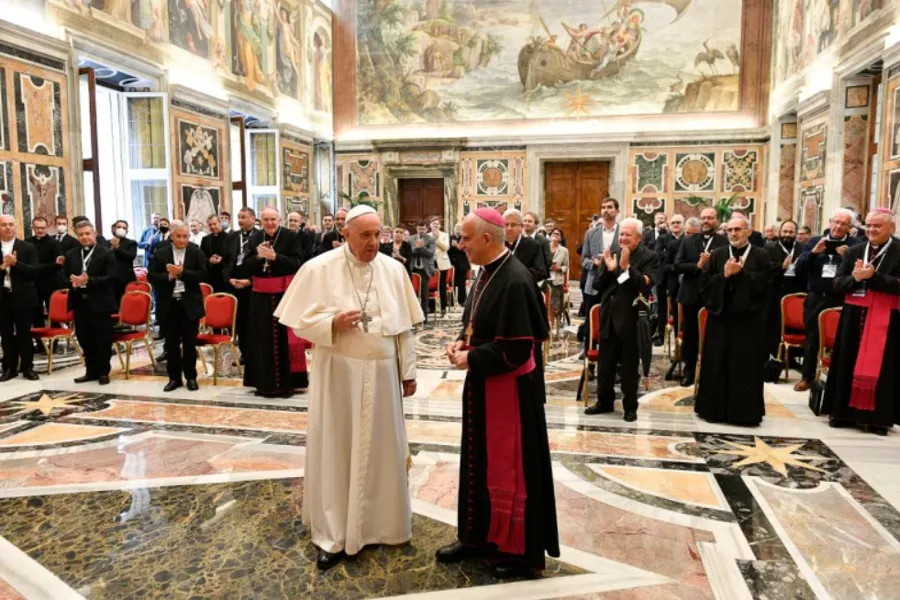
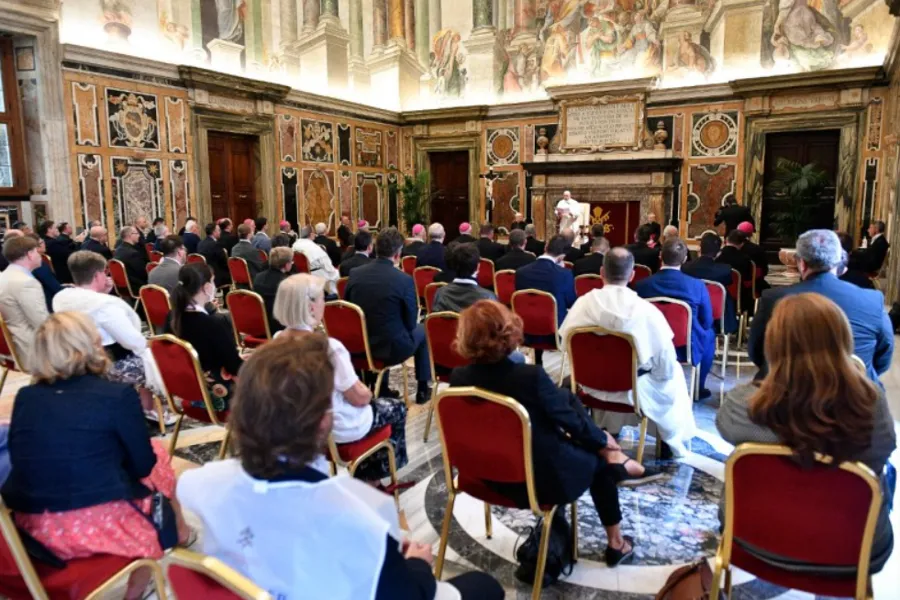
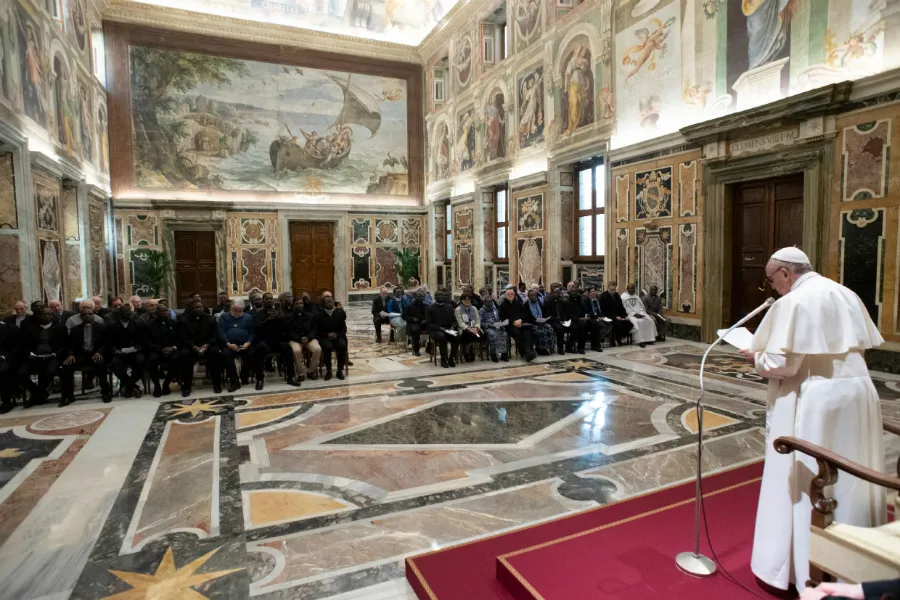
Pope Francis welcomed members of the Missionaries of Africa and Missionary Sisters of Our Lady of Africa to the Vatican’s Apostolic Palace Friday, and encouraged them to continue their mission on their 150th anniversary of their community’s founding.
“It is always for Him, with Him and in Him that the mission is lived. Therefore, I encourage you to keep your eyes fixed on Jesus Christ, so as never to forget that the true missionary is above all a disciple,” Pope Francis told the missionaries Feb. 8.
Founded by Cardinal Charles Lavigerie of Algiers in 1868, the White Fathers went on to evangelize in sub-Saharan Africa. Their priests notably brought Catholicism to Uganda, catechizing and baptizing St. Charles Lwanga and his 22 companion martyrs in the 1880s.
Today the White Fathers work to provide clean for orphanages in Tanzania, education for women in Burkina Faso, mental trauma aid for refugees in Burundi, and healing for victims of human trafficking in Kenya. They continue to be known for their dialogue with Muslim communities in Africa.
Pope Francis thanked the White Fathers and Sisters “in particular for the work you have already done in favor of dialogue with Islam, with our Muslim sisters and brothers.”
“May the Spirit make you builders of bridges among men. Where the Lord has sent you, may you help to grow a culture of encounter, be at the service of a dialogue that, while respecting differences, can draw wealth from the diversity of others,” he said.
The pope commented on the community founder’s zeal for abolishing slavery.
Called the “the apostle of the slaves of all Africa,” Cardinal Lavigerie was an outspoken opponent of the European slave trade in the 19th century. He traveled around Europe campaigning against the practice of slavery in Africa and elsewhere.
Today the White Fathers continue to fight slavery in the form of human trafficking with the establishment of the “Human Trafficking Rescue Center” in Ngong, Kenya.
“In the wake of Cardinal Lavigerie, you are called to sow hope, fighting against all today’s forms of slavery; making you close of the little ones and the poor, of those who wait, in the peripheries of our society, to be recognized in their dignity, to be welcomed, protected, raised, accompanied, promoted and integrated,” Pope Francis said.
“With this hope, I entrust you to the Lord, through the intercession of the Virgin Mary, Our Lady of Africa,” he added.
If you value the news and views Catholic World Report provides, please consider donating to support our efforts. Your contribution will help us continue to make CWR available to all readers worldwide for free, without a subscription. Thank you for your generosity!
Click here for more information on donating to CWR. Click here to sign up for our newsletter.

Banner calling for the consecration of Russia is displayed during Pope Francis’ Angelus in St. Peter’s Square on March 13, 2022. / Vatican Media
Denver Newsroom, Mar 13, 2022 / 07:19 am (CNA).
Pope Francis on Sunday called for an end to the “harrowing war” in Ukraine, condemning in particular the “barbarism” of Russia’s reported attacks last week on civilians— including pregnant women and children— in the eastern city of Mariupol.
“With an aching heart I add my voice to that of the common people, who implore the end of the war,” the pope said March 13, addressing the crowd gathered in St. Peter’s Square in Rome following the Angelus, a Marian prayer.
“In the name of God, listen to the cry of those who suffer, and put an end to the bombings and the attacks! Let there be real and decisive focus on the negotiations, and let the humanitarian corridors be effective and safe. In the name of God, I ask you: stop this massacre!”
Pope Francis waves to crowd gathered for the Angelus at St. Peter’s Square on March 13, 2022. Vatican Media
The pope’s words come following numerous reports last week of civilian casualties in Mariupol, amid Russia’s attempt to seize the strategically-located city as part of its ongoing invasion of Ukraine, which began on Feb. 24.
On Wednesday, March 9, a Russian strike on a maternity hospital in Mariupol killed at least three people and injured at least 17, according to local officials. Amid heavy loss of life in the city, there have been reports of civilians being buried in mass graves.
Pope Francis said that Mariupol, a city of 400,000 which was founded and named for the Virgin Mary, “has become a city martyred” amid the assault.
“Faced with the barbarism of the killing of children, and of innocent and defenseless citizens, there are no strategic reasons that hold up: the only thing to be done is to cease the unacceptable armed aggression before the city is reduced to a cemetery,” the pope said.
The pope’s words echoed those of a prominent Catholic leader in Ukraine, Major Archbishop Sviatoslav Shevchuk, who lamented March 10 what he described as the “mass murder” of Ukrainians following Russia’s full-scale invasion. The following day, March 11, Shevchuk said the assault is “becoming a war primarily against the civilian, peaceful population.”
As of Sunday, the United Nations Refugee Agency had estimated that 2.5 million people have fled Ukraine since the war began, many seeking refuge in Poland. Pope Francis urged the welcoming of refugees, “in whom Christ is present.”
He also asked all diocesan and religious communities to “increase their moments of prayer for peace.”
“God is only the God of peace, he is not the God of war, and those who support violence profane his name. Now let us pray in silence for those who suffer, and that God may convert hearts to a steadfast will for peace,” the pope concluded.
According to recent reports, a Russian rocket attack early Sunday on a military base near Lviv, a city near the Polish border, killed at least 35 people and injured 134.
Since the start of the invasion, Pope Francis has called for peace. He recently urged Catholics worldwide to pray and fast for Ukraine on Ash Wednesday, which marked the beginning of Lent on March 2. He also dispatched two Vatican Cardinals to Ukraine, where among other things they have met with refugees.
March 13, 2022 marked the ninth anniversary of Francis’ election as pope.
Pope Francis meets with the Order of Malta’s Fra’ Marco Luzzago on June 25, 2021. / Vatican Media
Vatican City, Mar 7, 2022 / 09:35 am (CNA).
The Order of Malta’s future is in Pope Francis’ hands. After a meeting with senior members on Feb. 26, the pope will take time to ponder the proposals for renewal and eventually decide on a path of reform.
Cardinal Silvano Maria Tomasi, the papal delegate to the organization, reported on the meeting in a letter to confreres of the order.
Tomasi stressed that “we explained to the Holy Father that the reform under study keeps and better frames the order as a lay religious order and at the same time consents to the continuation of its charitable, diplomatic and humanitarian action for ‘our lords the sick’ and at the service of the Church.”
The Italian cardinal added that the pope had “decided to keep listening to us, and granted us another hearing. After the meetings, the pope will rule about the projects presented to him.”
Also present at the papal meeting were Fra’ Marco Luzzago, Lieutenant of the Grand Master, members of Tomasi’s working group for the reform, and a delegation representing the order’s members.
In a Feb. 27 press release, the 1,000-year-old institution stressed that “the focus of the meeting was the Order of Malta’s reform.”
It said that “in a letter sent to the Order of Malta’s leaders worldwide, Marwan Sehnaoui, chairman of the steering committee for the constitutional reform process, expressed his gratitude to ‘His Holiness for having dedicated two hours of his valuable time to the Order of Malta.’”
Sehnaoui said: “The Holy Father began and ended the audience by stating that he had taken himself the final decision-making of the critical issues regarding the order’s constitutional reform.”
“Pope Francis listened carefully to the presentations and interventions of both sides. After exchanging views, the Holy Father said there is no urgency in making a final decision. His Holiness also said that he wishes to gather and review more information and that he would probably convene another audience.”
These statements require a close reading. First, by explaining that the order’s diplomatic and humanitarian work will not be affected by the reform, Tomasi implicitly addressed a criticism raised after the circulation of a draft reform text, which described the Order of Malta as “subject to the Holy See.” This triggered concern that the new statutes would dilute the order’s sovereignty.
Cardinal Silvano Maria Tomasi. Martin Micallef/Maltese Association Order of Malta via Flickr.
Although it possesses no real territory, the order has the hallmarks of sovereignty, such as its own official currency, postage stamps, and vehicle registration plates. It has diplomatic relations with more than 100 states and permanent observer status at the United Nations. It also oversees a flourishing humanitarian network that is currently delivering aid to refugees fleeing Ukraine.
Speaking with the National Catholic Register on Jan, 23, Tomasi stressed that in a subsequent draft, the order was no longer described as subject to the Holy See.
“We didn’t keep that expression,” he said, “and it’s not going to be in the text of the constitution that we’re going to circulate.”
He continued: “In a letter to the order, I said that, when we would be finished with the work under the constitution, government, and working group of the special delegate, we would send the text to the ‘fras’ — the religious — to the presidents of the associations, to the sovereign council and the members of the government so that we have everybody’s input and objections — if there were aspects of the constitution or the text that weren’t acceptable or considered objectionable.”
The most important reform is, in the end, that of fras, who are known as first-class knights. Only first-class knights who descend from a family of four quarters of nobility are eligible to be elected as the Grand Master, the order’s religious superior and sovereign. This provision means that fewer than 40 people in the order are able to be considered for the role.
Pope Francis took over the reform process after a fierce debate within the order.
The working group entrusted to draft the new statutes was composed of the canon law expert Father Gianfranco Ghirlanda, Msgr. Brian Ferme, secretary of the Vatican’s Council for the Economy, Maurizio Tagliaferri, Federico Marti, and Gualtiero Ventura.
Albrecht von Boeselager. Daniel Ibáñez/CNA.
The group was later enlarged with the addition of a few senior members of the order, including the Grand Chancellor Albrecht von Boeselager. But Boeselager announced in January that he was stepping down from the expanded group. Sehnaoui, president of the order’s Lebanese association, was appointed to take Boeselager’s place, assisted by Péter Szabadhegÿ.
Tomasi refused to recognize the Sehnaoui appointment, and so he could not attend the two-day meeting to discuss the draft text.
It is particularly significant, then, that Sehnaoui was included in the group that met with the pope on Feb. 26. Sehnaoui’s presence might be considered a gesture of detente.
Tomasi sent a letter to the knights after a private meeting with the pope on Jan 29, after the two-day reform meeting, held on Jan. 25-26.
The cardinal said that “the pope has decided that he wants to meet the mixed working group with some members representing the professed, the government of the order, the procurators of the priories and the presidents of the associations, to present to him concrete reform projects.”
So, Tomasi wrote, “the Holy Father, therefore, decided to suspend all other activities until this meeting is taking place, following which he will make a final decision.”
“Therefore, the meeting of the mixed working group of Feb. 22-23 is suspended, and the meetings of the steering committee chaired by President Marwan Sehnaoui are also suspended.”
The Magistral Villa of the Sovereign Military Order of Malta in Rome. Lalupa via Wikimedia (CC BY-SA 3.0).
Tomasi stressed that “any other activity before the meeting with the pope will be considered an act of disobedience to the Holy Father.”
It was a notably harsh statement which indicated that the pope would be taking responsibility for the process.
Knights who took part in the papal meeting told CNA that “they had a positive feeling” and that the pope “listened carefully to their issues.”
Members of the order must now wait to see what the pope decides. It will eventually become clear whether he has chosen to treat the order principally as a religious order or will also consider the vast humanitarian network overseen by this sovereign entity with no territory.
Vatican City, Jun 9, 2019 / 03:29 am (CNA).- Without the gifts of the Holy Spirit, Christians lack that which animates them and gives them internal life and harmony, Pope Francis said on Pentecost.
Leave a Reply