No Picture
News Briefs

Exorcism course to study link between porn and demonic influence

April 16, 2018 CNA Daily News 0

Vatican City, Apr 16, 2018 / 03:52 pm (CNA/EWTN News).- An annual exorcism course offered to priests in Rome aims to open the dialogue on what degree of demonic influence may exist in pornography use.

“Human sexuality in itself is a value, but when you use it poorly, you are creating harm for yourself and others, especially if it involves children,” Fr. Pedro Barrajon LC told journalists April 16.

Speaking of the widespread use of pornography in modern society, he said he believed organizers of the course wanted to discuss “this modern cultural phenomenon of an evil that harms people,” not to ignore the role of personal responsibility, but to explore whether there is demonic influence in pornography use, and to what extent.

The same goes for drug addiction, cultism and satanic worship, and it also goes for pedophilia and child pornography, which will both be addressed on the last full day of the course, he said.

“Does it come only from human causes – psychological, familial, social or cultural – or is there more?” he said, adding that the course aims to “open a space to see if there is a possibility to show influence from the devil.”

Barrajon spoke to journalists on the first day of the 13th annual course on exorcism and liberation prayer, offered by the Pontifical Regina Apostolorum University (APRA) and the Group of Socio-Religious Research and Information (GRIS).

Taking place April 16-21, the course will explore the topic of exorcism and prayers of liberation from different points of view, including theological, anthropological, canonical, liturgical, psychological, social and criminal perspectives.

Among other things, it will touch on magic, cults and satanic worship, and how to tell the difference between possession and psychological illness. This year’s course will also explore the rising practice of witchcraft in Africa, the increase of New Age beliefs in Spain, and the presence of cults throughout Latin America.

The course will also feature testimonies from exorcists and people who have been liberated from demonic possession. The last day will largely focus on the criminal aspects of exorcism and demonic activity, specifically pedophilia and pornography, as well as discernment and the writings of the Desert Fathers.

In his introduction speech, Fr. Jose Enrique Oyarzun, LC, a professor at the Regina Apostolorum University, said there is often “great confusion” regarding the devil, with many people believing that he does not exist.

This is a dangerous mistake, he warned, quoting Pope Francis’ new apostolic exhortation Gaudete et Exsultate, which says, “it is precisely the conviction that this malign power is present in our midst that enables us to understand how evil can at times have so much destructive force.”

Continuing to quote the document, Oyarzun said the devil “is present in the very first pages of the Scriptures, which end with God’s victory over the devil,” and is also present in the prayer of the Our Father, which ends with the phrase “deliver us from evil.”

“That final word does not refer to evil in the abstract; a more exact translation would be ‘the evil one.’ It indicates a personal being who assails us,” he said, and concluding the quote, said, “we should not think of the devil as a myth, a representation, a symbol, a figure of speech or an idea. This mistake would lead us to let down our guard, to grow careless and end up more vulnerable.”

In comments to journalists, Professor Giuseppe Ferrari, who moderated the opening panel of the course, lamented the fact that many Catholics, and even some priests, are among those who don’t believe in the devil. This is very problematic, he said, because when one stops believing in the devil, “one risks believing in anything, in the foolish things of this world.”

In his comments to journalists, Barrajon noted that there have been reports of an increased number of exorcisms in recent years, but cautioned against placing too much weight on these reports, because so far, “there is no serious statistical study on the practice of exorcism.”

Some countries, such as Italy, have had a higher number of exorcisms in part because bishops are appointing more exorcists, and also because communication about who the exorcists are and how to reach them has gotten better, he said.

He also stressed the importance of knowing how to discern whether someone is truly possessed, or whether they have some sort of psychiatric or psychological illness.

“For what I’ve seen, the experience of the exorcist counts a lot,” he said, explaining that many experienced exorcists can tell immediately if a person is experiencing demonic possession or a psychological problem.

Some indications of possession include negative reactions to religious objects or images, an unnaturally deep voice, and body contortions. The spitting out of nails, glass and knives that is seen in the movies can also happen during exorcisms, he said, and is a “physical manifestation of evil.”

In a keynote Q&A during the opening session, Albanian Cardinal Ernest Simoni, a leading exorcist in his diocese before his arrest by the communist regime in the 1960s, suggested that demonic possession is more common than many people realize.

The cardinal also cautioned that cultural mentalities such as materialism and consumerism “destroy life.” He said that to stay close to Christ and avoid the devil, one must “pray endlessly, pray without interruption.”

In addition to regular Mass attendance, he said, “we have to be chaste, we have to be faithful, we have to comply with the rules and guidelines of our tradition…unless you become like chaste, pure children, you won’t be able to access the reign of God.”

The ultimate answer “is not what I do or what I think,” he said, but “it is Jesus who lives in us…infinite love is what we need.”

“Whenever you are ready, whenever you are really, really ready to repent, you will be redeemed. It doesn’t matter if you say it 7 or 77 times in a day,” he said, but “you have to be convinced, you have to be united with your prayer.”



[…]

No Picture
News Briefs

Christian leaders in Guernsey: Provide care for the vulnerable, not assisted suicide

April 16, 2018 CNA Daily News 0

Saint Peter Port, Guernsey, Apr 16, 2018 / 02:58 pm (CNA/EWTN News).- Christian leaders on the Channel Island of Guernsey have united to author an open letter opposing assisted suicide legislation which will be debated in the coming months.

Signed by 53 pastoral ministers and 41 churches, the letter spelled out the dangers of introducing physician assisted suicide in the bailiwick, calling the measure dangerous for the community.

“We believe the proposal to introduce a legal provision for assisted dying to be misplaced and indeed a danger for us as a community, particularly for the most vulnerable in our island,” read the letter.

“We believe the States of Guernsey should focus on the care of vulnerable people, support the Les Bourgs Hospice, increase mental health provision and care well for those with age-related dementia. As a community we need to celebrate and support all of life and not actively seek to terminate life.”

“Every life is a gift that is precious and worthy of defense. Living life in all its fullness will include darker times, pain and sorrow. This is part of the rich diversity and tapestry of life that also provides opportunities for care, generosity, kindness and selfless love,” the letter continued.

One of the letter’s signatories, John Guille, is chairman at Les Bourgs Hospice. Other signatories of the letter included officials of the Catholic Church, the Church of England, and Methodism.

Debate on the whether to approve in assisted suicide legislation in principle will take place May 16 in the territory’s legislature, the States of Guernsey. Guernsey is a Crown dependency for which the U.K. is responsible, located off the coast of Normandy.

Current laws in Guernsey do not make allowances for physician assisted suicide and the island’s prominent hospice center, Les Bourgs, adheres to the World Health Organization’s ethos of hospice and palliative care, which upholds that end-of-life care may “neither hasten or postpone death,” according to the Guernsey Press.

“We are taking the exceptional step of writing to the people of Guernsey as Church leaders across a wide community of Christian witness,” the Christian ministers wrote.

In the letter, the church leaders cautioned against the popular push for “choice” when it comes to end-of-life care, saying that it should not be “the primary argument for life and death issues.”

“Deeper ethical and moral considerations should have much greater weight in matters of island policy and law,” they said, also noting that “individual ‘choice’ is not an isolated event,” but rather something that effects other people and society as a whole.

“Our decisions can also be influenced by profound life-changing events,” they continued, noting that an illness or a grim diagnosis would have a profound effect on a person’s ultimate end of life care.

The leaders also highlighted mental health conditions, such as depression, which could push an individual to pursue assisted suicide, instead of looking into other options. They encouraged the “support of those who love us,” during these challenging times, instead of pushing death.

The States’ consideration of the assisted dying measure would also hold a great weight for the vulnerable on the island, the church ministers noted, saying that individuals with disabilities, the elderly, and others with sicknesses will see the measure as “a threat.”

They also noted that the legislation would dramatically affect the relationship between doctors and patients, “threatening the trust that issuing life-ending prescriptions will bring.” The assisted suicide legislation could additionally open the doors to other measures, the leaders wrote, reaching beyond the conditions of those nearing their lives.

“Of the few other jurisdictions that have introduced assisted dying most have, over time, seen the initial safeguards eroded and criteria broadened to include other conditions beyond terminally ill people,” the letter said.

“To assist in the death of another is essentially to assist in their suicide,” the letter continued.

Ultimately, the Christian leaders on Guernsey urged citizens to discern deeply the potential impact of introducing physician assisted suicide, particularly on the community’s most vulnerable citizens.

“Our hope and prayer is that the requete is rejected by the States,” the letter said. “This is a life and death issue so please contact your deputies with your views, doing so with the care and compassion that sustains our island community.”

Bishop Philip Egan of Portsmouth, the diocese which encompasses Guernsey, had spoken out against the assisted suicide proposal in a letter last month to the Parish of Our Lady and the Saints of Guernsey. He urged Catholics to “mobilize” and to “speak out against this proposal.”

“Someone near the end of life needs emotional support, comfort and care, good pain control, respect and loving communication – not suicide on prescription,” Egan said.

If the upcoming legislation passes, Guernsey would be the first territory among the British Isles to legalize assisted suicide.

[…]

No Picture
News Briefs

The life of a hermit: A glimpse inside the little-known state of life

April 15, 2018 CNA Daily News 2

Portland, Maine, Apr 15, 2018 / 04:01 pm (CNA/EWTN News).- The word ‘hermit’ might conjure up some strange images, a la John the Baptist living reclusively in the desert, wearing a hair shirt and eating locusts and honey.

The word itself comes from the Greek ‘eremos’, meaning wilderness or an isolated place. The vocation of a hermit became most popular among early Christians, who, inspired by Old Testament saints such as Elijah and John the Baptist, desired to live a life set apart and therefore withdrew into the desert in order to live lives of prayer and penance.

But the vocation is still a recognized calling in the Church today, and is about so much more than seemingly-odd ascetic practices and isolation.

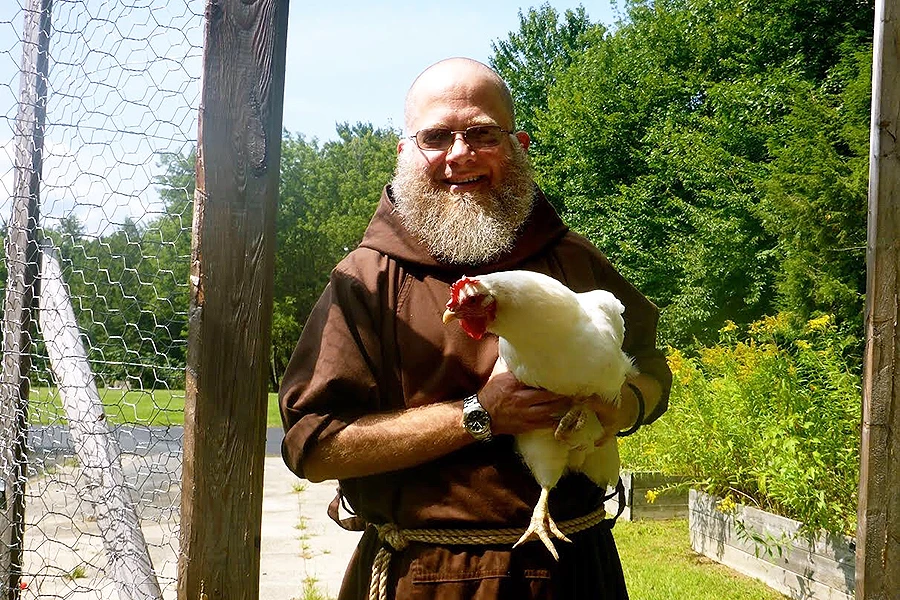
In the interview below, Brother Rex, a hermit at Little Portion Hermitage in the Diocese of Portland, told Catholic News Agency what it is like to live the eremitic life in the 21st century.


What does it mean to be a hermit?

According to the Church’s latest Code of Canon Law the canonical definition of a hermit is as follows:

Can. 603 §1. In addition to institutes of consecrated life, the Church recognizes the eremitic or anchoritic life by which the Christian faithful devote their life to the praise of God and the salvation of the world through a stricter withdrawal from the world, the silence of solitude, and assiduous prayer and penance.

§2. A hermit is recognized by law as one dedicated to God in consecrated life if he or she publicly professes in the hands of the diocesan bishop the three evangelical counsels, confirmed by vow or other sacred bond, and observes a proper program of living under his direction.

A shorthand and non-canonical definition that I use is to say that a hermit is a woman or man who lives alone expressly for the glory of God, the good of the Church and the salvation of souls. Some hermits are consecrated by the Church per Canon 603 above and live their vocation in the name of the Church; some hermits live out their calling without publicly professing their commitment in the hands of the diocesan bishop. I am hermit of the former kind, i.e. according to Canon 603.

How did you find out about this way of life, and what drew you to it?

Grace drew me to this life. The example of the Desert Fathers and Mothers drew me to this life. The example of many of the great saints throughout history – Francis of Assisi, just to name one well-known saint who lived as hermit for a time before he was called to found a religious fraternity of Brother – drew me to this life. Through all and with all and in all of this it was God’s grace calling me to this particular way of discipleship.

How does one become a hermit? Was there someone you followed or learned from? How is the formation process different than that of a religious in community?

If a person wishes to discern a vocation to the eremitic life according to Canon 603, that person will want to contact the chancery of the diocese in which they live to determine whether or not the Ordinary of the diocese is open to the possibility of having a hermit under his canonical jurisdiction. If he is, the Ordinary or his representative in conversation with the would-be hermit will determine how the discernment process is to proceed.

What does a day in the life of a hermit look like?

Each hermit has his or her own schedule. My schedule looks like this:

My day begins around 4:00 a.m. I make a daily Holy Hour from 5:00-6:00 a.m. during which I pray the Morning Office. I attend daily Mass at a local parish at 7:00 a.m. After returning from Mass I have breakfast and spend the rest of the morning engaged in spiritual reading, Lectio Divina, and meeting occasionally with any person who has made an appointment to see me for spiritual direction. After Noonday Prayer and lunch, the afternoon (approximately 1-5 p.m.) consists of a work period during which I respond to email, and take prayer requests via email or regular mail. I pray the Evening Office at 5:00 p.m., my evening meal is at 5:30pm, Night Prayer is at 7 p.m., and lights out by 8 p.m. most nights.

This schedule is rigid enough to provide stability for my vocation in the silence of solitude, yet flexible enough to accommodate running errands, doctor’s appointments, accomplishing tasks around the hermitage and so forth.

How isolated are hermits, in practice? How often or in what context do you encounter other people?

It varies. Some hermits rarely venture out of their hermitage. Some hermits venture out a couple of days a week to some form of work to provide financial support. The amount of time a hermit spends outside the hermitage or otherwise encounters other people is determined to a large degree by the interpretation of Canon 603 in dialogue with their Ordinary or his representative, and the hermit’s Rule or Plan of Life.

What are some of the biggest misconceptions about this way of life that you have encountered?

The biggest misconception I have encountered is that people seem to think that hermits are misanthropes who dislike other people and so hide away from them; that our life is not so because we love God, but because we can’t get along with other people (at best) or dislike humans altogether (at worst).

I remember one person telling me I couldn’t possibly be a hermit because I am too outgoing and friendly toward others! That being said, I would argue that eremitic life and misanthropy are two very different things. Eremitic life is a calling from God and includes a love of others. Misanthropy on the other hand is a psychologically maladaptive response to the world. This is not to say that all hermits are friendly and outgoing – being friendly and outgoing are a matter of temperament – but it is to say that hermits in a healthy and Christian sense do not, indeed cannot, “dislike humankind” which is the very definition of misanthropy.

What are some of the most joyful aspects of the life of a hermit?

One of the most joyful aspect of my life as a hermit is the opportunity God has given me to spend long periods in the silence of solitude to practice being present to God and to my neighbor through prayer. Paradoxically perhaps, another joyful aspect of my vocation is the part I am blessed to play in the lives of other people as they invite me to join them on their life journey through the ministry of intercessory prayer. Thus, in a particular way i am able to fulfill Our Lord’s command to love God and neighbor.

Are there other hermits in the U.S. that you know of, or have met? Is there a hermit network of sorts?

I’m sure someone somewhere keeps an official tally of the total number of consecrated hermits in the Church throughout world, but I don’t know who or where. In the diocese where I live there are five or six other hermits listed in the official Diocesan Directory. I am also aware of hermits, both male and female, in other dioceses in the U.S. and abroad. As for a ‘hermit network,’ I know of nothing official, but some of us do keep in touch via an occasional email, or letter or phone call. As I said, we not misanthropes. Not most of us, anyway!

Is there anything that you wish other Catholics, Christians or society at large knew about being a hermit?

What I pray for other Catholics, non-Catholic Christians and society at large is that they, like me, come to experience the freedom, happiness and joy that comes from submitting one’s will and life to the loving lordship of Jesus Christ in whatever state of life they find themselves.

Anything else you’d like to add?

Assure your readers that I live my vocation as a prayer for them. Ask them to please pray for me, a sinner.


Prayer requests for Brother Rex, as well as his spiritual reflections and links for financial support, can be found at Friends of Little Portion Hermitage.

[…]

No Picture
News Briefs

Pope urges Catholics to be moved by joy of the resurrection

April 15, 2018 CNA Daily News 1

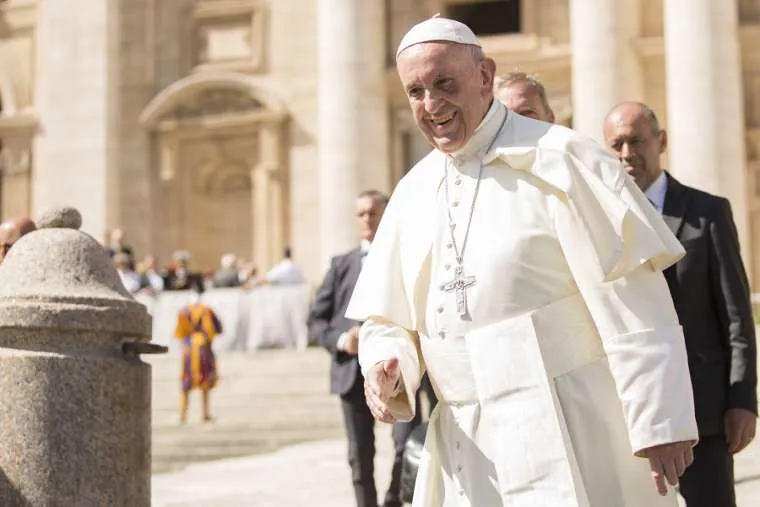
Rome, Italy, Apr 15, 2018 / 10:28 am (CNA/EWTN News).- On Sunday Pope Francis visited a Roman parish, telling Mass-goers to allow themselves to be moved by the immense joy of the resurrection, which overcomes sin and renews believers, allowing them to have a youthful heart.

Noting how the disciples had a hard time believing it was really Jesus who appeared to them in the day’s Gospel, Francis asked “why didn’t they believe? Why did they doubt?”

“There is a word in the Gospel that gives us an explanation: While they were still incredulous for joy and were amazed.”

The disciples, he said, couldn’t believe it was Jesus because “they couldn’t believe that there was so much joy, the joy that brings Christ.”

He said the same thing happens to each person when they receive news that seems too good to be true, and urged Catholics to allow the joy of Christ’s resurrection to enter their hearts and to be transformed by the renewal he offers.

Pope Francis spoke during his April 15 visit to the parish of St. Paul of the Cross in the western quarter of Rome. After arriving around 4 p.m. local time, he was greeted by the Vicar of Rome, Archbishop Angelo de Donatis; Bishop Paolo Selvadagi, auxiliary bishop for Rome’s western sector, and the pastor Fr. Roberto Cassano, among others.

During his visit, the pope met with and took four questions from youth involved in catechesis at the parish. He then met with the elderly, sick and the poor before hearing the confession of three parishioners and celebrating Mass.

In his homily, which focused on the day’s Gospel reading from Luke in which Jesus appears to the disciples after his resurrection, Francis noted that even though they doubted, the disciples knew Jesus had risen.

They knew, he said, because by that time they had heard the testimonies of Mary Magdalene, Peter and the disciples who met Jesus on the road to Emmaus, yet they still had a hard time believing Jesus when he appeared to them in the upper room.

“They knew…but that truth didn’t enter into their heart. That truth, yes, they knew, but they doubted, and the preferred to have that truth in the mind,” he said, noting that perhaps “it’s less dangerous to have truth in the mind than to have it in heart.”

Eventually the disciples believed, he said, explaining that this faith and the joy of Christ’s resurrection is “the renewed youthfulness that the Lord brings us.”

Sin makes the heart grow old and tired, he said, whereas faith makes the heart grow young. However, referring to the day’s second reading from the First Letter of Saint John, he said that when a person sins, “we have an advocate with the Father.”

The Father, he said, “forgives,” and Christ in his death and resurrection wants “to defend us” and make each person young again with the joy of being freed from sin and death.

Pope Francis closed his brief homily asking for the grace to believe that Jesus is truly alive and risen, because “other things are secondary” in life.

If a person does not believe that Christ is risen and present in the world, “we will never be a good Christian, we can’t be,” he said, and prayed for the grace to encounter the Risen Jesus in prayer, the Eucharist and the forgiveness of sins.

“Let us ask for the grace to be a joyful community,” he said, asking that each person would be “sure in the faith of encountering the Risen Christ.”

In his Q&A with youth before Mass, Pope Francis said his favorite bible verse is the calling of Matthew, because it shows “the strength Jesus has to change the heart.”

He also told the children that even if someone is not baptized, they are still a child of God. This, he said, goes for the good, the bad and even the mafia, who he said need to be prayed for “so that they return to God.”

When asked about how he felt after being elected pope, Francis said he didn’t feel anything special, but he had a strong sense of peace. “When the Lord calls you, he gives you peace, and you feel it when there is a true call from the Lord,” he said, explaining that this is also true when God calls one to a consecrated vocation.

Finally, the pope embraced a young boy named Manuele whose father recently died, and who was an atheist, but allowed each of his four children to be baptized in the Catholic Church. In his question, Manuele said his father was a good person, and asked if he was in heaven, even if he didn’t believe in God.

Pope Francis answered by praising Manuele’s courage to cry and to ask the question, and said that if a man can raise a child the way that Manuele’s father had, then this man is indeed a good person, and good people are never far from God.

“It’s a great witness that the child can say [his father] was good,” he said, explaining that God never abandons his children, and encouraged Manuele to talk to his father, because “surely God loved him.”

He then prayed an Our Father with the children before meeting briefly with the elderly, sick and poor of the parish, telling them that they are “the center of the Gospel.”

“I know that each one of you have many problems, sicknesses, pains, the family, each one has their own pain, their own wound, everyone, but may this not take your hope or your joy, because Jesus came to pay for our wounds with his wounds,” the pope said.

He closed his brief greeting by encouraging them to do good to those around them and led them in praying a Hail Mary. He then spent time greeting them personally before hearing confessions and saying Mass.


[…]

No Picture
News Briefs

Pope Francis: Every violation of the body is an ‘outrage’ to God

April 15, 2018 CNA Daily News 2

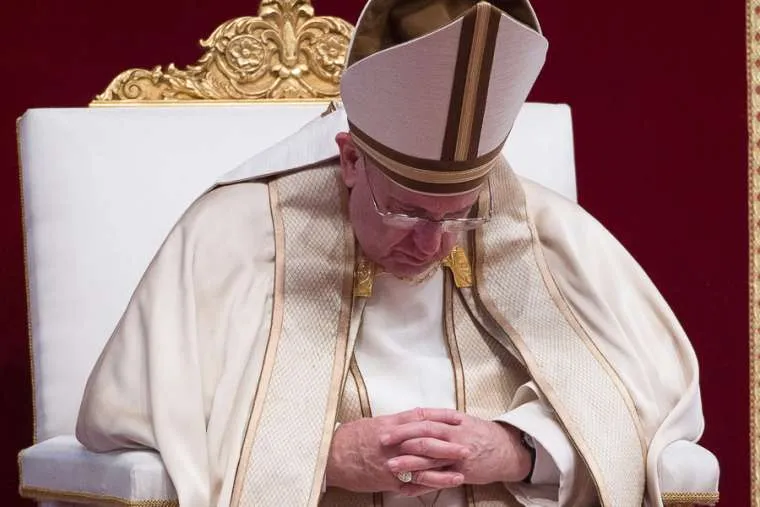
Vatican City, Apr 15, 2018 / 04:55 am (CNA/EWTN News).- On Sunday Pope Francis issued a moving prayer for all those whose bodies have been hurt or exploited, including those who have suffered abuse and those who are sick, pointing to the high-profile cases of Alfie Evans and Vincent Lambert.

“Every offense or wound or violence against the body of our neighbor is an outrage to God the creator,” the pope said April 15, pointing to the children, women and elderly “who are mistreated in the body. In the flesh of these people we find the flesh of Christ.”

“Mocked, slandered, humiliated, scourged, crucified, Jesus taught us love. A love which, in its resurrection, has shown itself as stronger than sin and death, and wants to redeem all those who experience in their own flesh the slavery of our times.”

Pope Francis spoke to pilgrims in St. Peter’s Square during his Sunday Regina Coeli address, which he prays during Easter instead of the Angelus.

He noted how when Jesus appears to the disciples in the day’s Gospel reading from Luke, at first they think he is a ghost. “But the Risen Jesus is not a ghost, he is a man with body and spirit,” and he shows the disciples this by eating a fish, the pope said.

Speaking directly about the body, Francis said the resurrection brings to light the Christian perspective about the body, which he said “is not an obstacle or a prison for the soul,” but is a gift created by God, and as such, “man is not complete if he is not a union of body and soul.”

The fact that Jesus rose from the dead in body and spirit means Christians should have a positive idea about the body, he said, noting that while the body can become an occasion for sin resulting from our “moral weakness,” it is also a “marvelous gift” that reflects our likeness to God.

Because of this, “we are called to have great respect and care for our bodies and that of others,” he said, adding that in a world where “too often arrogance against the weakest prevails and materialism suffocates the spirit,” today’s Gospel reading is an invitation to go deeper, and to be men and women full of wonder and joy for having met the Risen Lord.

After leading pilgrims in the Regina Coeli, Pope Francis made several pleas for prayer on behalf of those who are suffering either from illness, or from war.

He made an appeal for pilgrims to pray for “the people, such as Vincent Lambert in Francis, little Alfie Evans in England, and others in different countries who live, at times for a long period, in a serious state of illness, medically assisted for their basic needs.”

The reference was  to two specific cases currently circulating in the international news cycle. Alfie Evans, 23 months, suffers from an unidentified degenerative neurological condition, has been under continuous hospitalization since December 2016.

In February, the court ruled that Alder Hey Children’s Hospital, where Evans is receiving care, could legally stop treatment for Alfie against his parent’s wishes, arguing that continuing treatment is not in his best interest, and that his life support should be switched off.

Despite the desire for Alfie’s parents, Kate James and Tom Evans, to take their son to Bambino Gesu hospital in Rome, several judges have ruled in the hospital’s favor.

The case has drawn international attention, and protesters gathered outside the Liverpool hospital Thursday and Friday to peacefully oppose the decision.

Evans and James recently launched a new legal challenge, asking the Court of Appeal judges to continue life support and treatment for Alfie. The court officials posted their hearing for Monday, saying that a court judge has decided that Alfie could continue treatment, pending the hearing.

In the case of Vincent Lambert, a severely disabled Frenchman without a terminal illness, courts have decided that the Sebastopol Hospital in Reims can remove Lambert’s food and water April 19.

Lambert suffered severe head injuries after a tragic car accident in 2008, and as a result has been a quadriplegic and severely disabled for 10 years. Yet despite his injuries, other doctors and his parents have insisted that Lambert is not sick, nor is he in a coma. They argue that he breathes unassisted and his internal organs function normally.

However, despite these arguments, the hospital ruled that continuing to feed and hydrate Lambert constituted “unreasonable obstinacy” toward him, and said that his feeding tubes ought to be shut off.

These and similar cases “delicate situations, very painful and complex,” Francis said, and asked faithful to pray with him that every person who is sick would “always be respected in their dignity and cared for in a way suited to their condition, with the consent of family members, and of other healthcare workers.”

He also offered prayers for three Ecuadorean men who were recently kidnapped and killed along the Ecuador-Colombia border, voicing his closeness to their families and praying for peace and unity in the area.

Francis then prayed for areas of the world torn by conflict “despite the instruments available to the international community,” and pointed specifically to Syria, where conflict has again flared up in recent days.

A fresh round of threats began when the United States and their allies in France and the UK on Friday ordered a series of bombings on chemical facilities in Syria in retaliation for a chemical attack allegedly carried out last week by Syrian President Bahsar al-Assad which killed more than 40 civilians.

World leaders immediately reacted supporting both sides, with Syria promising retaliation, and U.S. President Donald Trump threatening further attacks if Assad does not stop using chemical weapons on civilians.

In his Regina Coeli address, Francis said he is “deeply troubled” by ongoing global conflict, and invited all men and women of goodwill to continue to “incessantly pray for peace.” He issued a fresh appeal to political leaders, “so that justice and peace will prevail” over violence.

[…]