

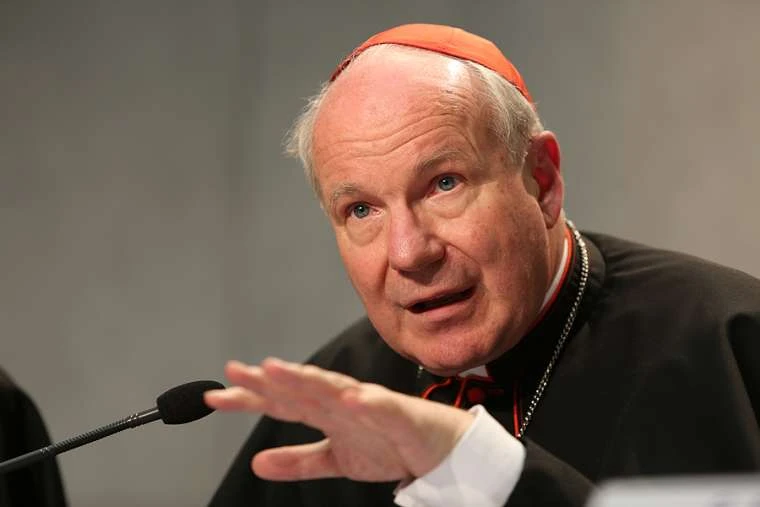
Vienna, Austria, Sep 29, 2018 / 08:57 am (CNA/EWTN News).- Cardinal Christoph Schönborn has said that in his view, whether the Church could ordain women as deacons remains an “open question.”
The Archbishop of Vienna was speaking Sept. 29 to 1700 delegates from parish councils and other bodies in St. Stephen’s Cathedral. Reflecting that he recently had ordained 14 men to the permanent diaconate, he added, according to local news agency Kathpress, “perhaps one day also female deacons.”
Schönborn said that there had been female deacons in the Church in times past, and that “basically, this [question] is open.”
Pope Francis has spoken often about the importance of the role of women in the Church. In 2016 he appointed a new commission to examine the possibility of ordaining women to the permanent diaconate.
Archbishop Luis Ladaria, Prefect of the Congregation for the Doctrine of the Faith, was appointed president of that commission, consisting of 12 members – 6 men and 6 women.
According to sources, drafting of their final report was completed in April. Whether it has yet been submitted to the pope is unknown.
In 2002 the International Theological Commission, an advisory body to the Congregation for the Doctrine of the Faith, issued a report which gave a thorough historical context of the role of the deaconess in the ancient Church.
The commission overwhelmingly concluded that female deacons in the early Church had not been equivalent to male deacons, and had neither a liturgical nor a sacramental function.
If you value the news and views Catholic World Report provides, please consider donating to support our efforts. Your contribution will help us continue to make CWR available to all readers worldwide for free, without a subscription. Thank you for your generosity!
Click here for more information on donating to CWR. Click here to sign up for our newsletter.

Since female “deacons” in the early Church were historically and now are decidedly not equivalent to male deacons (International Theological Commission in 2002, plus the sidelined Gerhard Cardinal Muller’s book: “The Priesthood and the Diaconate”, German 2000/English 2002), it seems the Pope Francis has four options.
He can either (1) invent a contradiction and throw the three-tiered sacrament of Holy Orders into complete chaos, or perhaps,(2) create a “deaconess” subcategory of deacon-like ministry that is no not-quite-an-ordination, or (3) simply reject any misguided advice (the term “inadmissible” comes to mind), or he can (3) remain silent.
Option Two seems to have been unwittingly pre-empted in recent years by the creation Lay Ecclesial Ministers. These ministers, as it was clarified in writing only at the last minute, serve by virtue of their sacramental Baptism and Confirmation, and not by any unspoken, grey-area-sort-of sacrament-ish Holy Orders.
How now to foster a category of service specifically for women and that does not look (speaking theologically) a hell of a lot like clericalism?
Other than Lay Ecclesial Ministers, another unmentioned and long-existing path for the laity is that of the “religious life”–very much in decline for reasons not mentioned. A new insignia and non-sacramental bucket list probably won’t reverse the post-Christian threats now eating away at the perennial Church.
Under the DOA Option One, would we now be tutored to look forward to a new set of amendments to the still-recent Catechism of 1994/97 (for which the same Cardinal Schonborn was the lead editor), that is, paragraphs 886, 896, 1256, 1538, 1554, 1570, 1569-74,1588, 1596?
And what are we to say of the implied marginalization of other ministries: Extraordinary Ministers of Holy Communion (sic Eucharistic Ministers), the ministry of welcoming, the ministry of teaching, the ministry of visitation, the ministry of (fill in the blank). Ministry inflation (like secular grade inflation) cannot be resolved by incrementally dissolving the Sacrament of Holy Orders, nor the Second Vatican Council’s “universal call to holiness.”
I wish someone could explain to me how this “conservative” mind , behind large chunks of the CCC, got to the place where he endorses nonsense after for so long being regarded as solidly reliable.
Probably for the same reason as Cardinal Oullet after he endorsed Amoris Laetitia. He either gave up after realizing that nobody would listen to his orthodox advise, or he is fearful of being put on a bus.
While Female Deacons are not explicitly prohibited, I think they should not be allowed given that in the minds of some it will open the door to women priests.
@Joe M – This Cardinal, for years, has vacillated between orthodoxy and heterodoxy. He has participated or allowed quite a lot of crazy or stupid things in his diocese. He is quite the contradiction and I have never been able to figure him out. He seems content to be blown about whichever way the wind blows.
Schönborn should be drug tested.