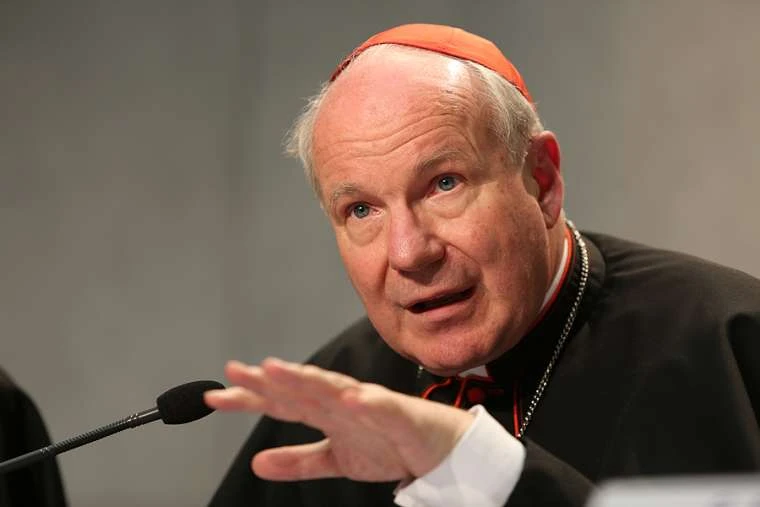
Vienna, Austria, Sep 29, 2018 / 08:57 am (CNA/EWTN News).- Cardinal Christoph Schönborn has said that in his view, whether the Church could ordain women as deacons remains an “open question.”
The Archbishop of Vienna was speaking Sept. 29 to 1700 delegates from parish councils and other bodies in St. Stephen’s Cathedral. Reflecting that he recently had ordained 14 men to the permanent diaconate, he added, according to local news agency Kathpress, “perhaps one day also female deacons.”
Schönborn said that there had been female deacons in the Church in times past, and that “basically, this [question] is open.”
Pope Francis has spoken often about the importance of the role of women in the Church. In 2016 he appointed a new commission to examine the possibility of ordaining women to the permanent diaconate.
Archbishop Luis Ladaria, Prefect of the Congregation for the Doctrine of the Faith, was appointed president of that commission, consisting of 12 members – 6 men and 6 women.
According to sources, drafting of their final report was completed in April. Whether it has yet been submitted to the pope is unknown.
In 2002 the International Theological Commission, an advisory body to the Congregation for the Doctrine of the Faith, issued a report which gave a thorough historical context of the role of the deaconess in the ancient Church.
The commission overwhelmingly concluded that female deacons in the early Church had not been equivalent to male deacons, and had neither a liturgical nor a sacramental function.
If you value the news and views Catholic World Report provides, please consider donating to support our efforts. Your contribution will help us continue to make CWR available to all readers worldwide for free, without a subscription. Thank you for your generosity!
Click here for more information on donating to CWR. Click here to sign up for our newsletter.
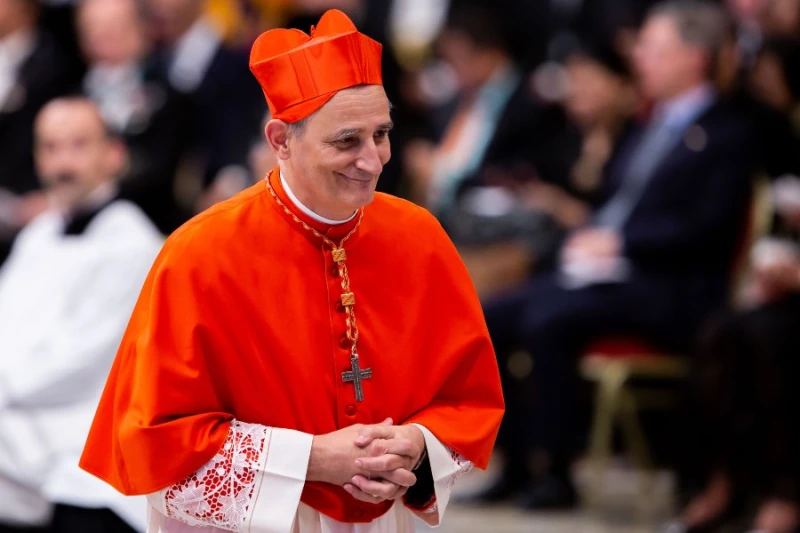
Cardinal Matteo Zuppi, Archbishop of Bologna, Italy, in St. Peter’s Basilica on Oct. 5, 2019. / Daniel Ibáñez/CNA
Rome, Italy, Nov 25, 2021 / 11:00 am (CNA).
No, it does not seem as if Pope Francis is going to resign. Indeed, his dynamism and desire to do things, working to bring the Church closer to the people, should be appreciated.
That is how Cardinal Matteo Zuppi responded when asked if the Pope Francis era was about to come to an end.
The questions, however, were legitimate because they were asked at the launch of a book explicitly addressing the papacy’s future.
Zuppi was on a panel for the Nov. 18 presentation of the book “Cosa Resta del Papato? Il futuro della Chiesa dopo Bergoglio” (“What Remains of the Papacy? The future of the Church after Bergoglio”), by the Italian Vaticanist Francesco Antonio Grana.
The book examines what the institution of the papacy is and what it can become after the resignation of Benedict XVI and the pontificate of Pope Francis.
It reconstructs the last part of Benedict XVI’s pontificate, revealing that among the few people aware of the forthcoming resignation was Italy’s then president, Giorgio Napolitano. The book also offers a glimpse of what the next conclave might look like.
Returning from Slovakia in September, Pope Francis had complained about the prelates who were allegedly already seeking to identify his successor. For this reason, the presence of a cardinal at the launch of a book that also looks at the papal succession risked being viewed as part of a “hidden electoral campaign.”
This is especially the case as Zuppi, the archbishop of Bologna, northern Italy, is seen by many as one of the possible papabili in a future conclave.
A leading figure in the Community of Sant’Egidio, and known internationally also for his role as a peace mediator in Mozambique, Zuppi has nevertheless always maintained a low-key and ascetic profile. This approach made him a beloved parish priest, first at the Rome church of Santa Maria in Trastevere and then in a parish on the city’s outskirts.
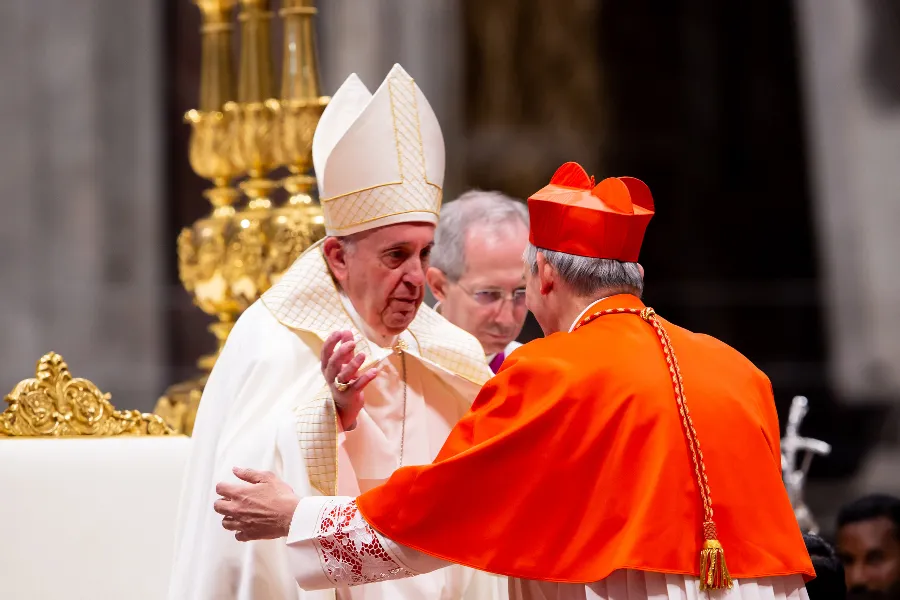
His hierarchical ascent began with his appointment as an auxiliary bishop of Rome in 2012. He was then called by Pope Francis to be archbishop of Bologna, a major Italian see, in 2015, receiving the cardinal’s red hat in 2019.
Cardinal Matteo Zuppi receives the red hat on Oct. 5, 2019. Daniel Ibanez/CNA.
Zuppi’s presence at the book launch was all the more striking because he is a cardinal loved by Pope Francis, who gives little indication of wanting to detach himself from the legacy of the reigning pope and always defends his pastoral activities. (The one exception might be his decision not to clamp down severely on the Traditional Latin Mass in his archdiocese following the motu proprioTraditionis custodes.)
The 66-year-old cardinal’s words at the book launch were cautious. He began by reflecting on the book’s title. He then focused on the Statio Orbis of March 27, 2020: the solitary prayer in St. Peter’s Square in which Pope Francis asked for an end to the pandemic. Zuppi said that on that occasion, “for the first time, Ecclesialese — the language spoken among us priests — became the common language.”
Speaking of the crisis in the Church, Zuppi said that “we can spend a lifetime arguing among ourselves, fueling an internal conflict. But the point is that it is a crisis, generative of something new.”
He stressed that John XXIII was considered “a simpleton, who seemed to impoverish the greatness of the Church,” and that Benedict XVI “defined himself as a humble worker in the Lord’s vineyard.”
In short, Francis is not, according to Zuppi, a pope who is diminishing the institution’s importance. Rather, he is giving it a new impetus. So much so, that there is “anything but an air of resignation,” Zuppi said. “In the many decisions he has made, and in the processes he has initiated, there is a great awareness and sense of the future.”
He added: “Pope Francis tells us that there is so much to do now, and he helps us not to have a renunciatory attitude, as a retreating minority. His significant reform is pastoral and missionary conversion.”
“He allows us to place ourselves in an evangelical, straightforward way, close to the people, and shows us some priorities for a Church that speaks to the heart. He helps us to be more Church, in a world that makes identity fade.”
There was also talk of the Zan bill, a proposed anti-homophobia law discussed in the Italian Senate. The Holy See presented a formal diplomatic note to the Italian state, highlighting that the bill violated the Concordat between the Holy See and Italy as part of the freedom of education.
It was not an opinion of the Holy See, but rather a diplomatic initiative to avoid the violation of a treaty. One of the panelists, Peter Gomez, director of IlFattoquotidiano.it, suggested erroneously that the Holy See expresses an opinion and the secular state is free to make its own decisions. But this was not the focus of the discussion.
Zuppi has repeatedly refused to address the controversy publicly. Many have interpreted this as a tactical move. The general assembly of the Italian bishops’ conference is currently discussing who should be its next president. Zuppi is one of the leading candidates to succeed Cardinal Gualtiero Bassetti of Perugia-Città della Pieve.
Then there is the question of the next conclave that continues to hang over Zuppi. It was the author of the book himself, Francesco Grana, who sought to damp down any speculation. He explained that, despite its arresting title, the book was not presenting a manifesto.
He referred to a book recently published by Andrea Riccardi, founder of the community with which Zuppi is closely associated.
“Andrea Riccardi, the founder of the Community of Sant’Egidio, wrote the book ‘The Church burns.’ And if the Church burns, how can we not ask ourselves about the papacy of the future?” he asked.
CNA Staff, Sep 10, 2020 / 05:10 am (CNA).- A cardinal said Wednesday that Europe should be “ashamed” after fire devastated the continent’s largest refugee camp, leaving 13,000 people without shelter.
Brussels, Belgium, Nov 3, 2018 / 09:00 am (CNA).- The Brothers of Charity, a Belgian religious congregation, did not renew the terms for two board members of the organization that controls their hospitals in Belgium. The former board members had accept… […]
6 Comments
Since female “deacons” in the early Church were historically and now are decidedly not equivalent to male deacons (International Theological Commission in 2002, plus the sidelined Gerhard Cardinal Muller’s book: “The Priesthood and the Diaconate”, German 2000/English 2002), it seems the Pope Francis has four options.
He can either (1) invent a contradiction and throw the three-tiered sacrament of Holy Orders into complete chaos, or perhaps,(2) create a “deaconess” subcategory of deacon-like ministry that is no not-quite-an-ordination, or (3) simply reject any misguided advice (the term “inadmissible” comes to mind), or he can (3) remain silent.
Option Two seems to have been unwittingly pre-empted in recent years by the creation Lay Ecclesial Ministers. These ministers, as it was clarified in writing only at the last minute, serve by virtue of their sacramental Baptism and Confirmation, and not by any unspoken, grey-area-sort-of sacrament-ish Holy Orders.
How now to foster a category of service specifically for women and that does not look (speaking theologically) a hell of a lot like clericalism?
Other than Lay Ecclesial Ministers, another unmentioned and long-existing path for the laity is that of the “religious life”–very much in decline for reasons not mentioned. A new insignia and non-sacramental bucket list probably won’t reverse the post-Christian threats now eating away at the perennial Church.
Under the DOA Option One, would we now be tutored to look forward to a new set of amendments to the still-recent Catechism of 1994/97 (for which the same Cardinal Schonborn was the lead editor), that is, paragraphs 886, 896, 1256, 1538, 1554, 1570, 1569-74,1588, 1596?
And what are we to say of the implied marginalization of other ministries: Extraordinary Ministers of Holy Communion (sic Eucharistic Ministers), the ministry of welcoming, the ministry of teaching, the ministry of visitation, the ministry of (fill in the blank). Ministry inflation (like secular grade inflation) cannot be resolved by incrementally dissolving the Sacrament of Holy Orders, nor the Second Vatican Council’s “universal call to holiness.”
I wish someone could explain to me how this “conservative” mind , behind large chunks of the CCC, got to the place where he endorses nonsense after for so long being regarded as solidly reliable.
Probably for the same reason as Cardinal Oullet after he endorsed Amoris Laetitia. He either gave up after realizing that nobody would listen to his orthodox advise, or he is fearful of being put on a bus.
While Female Deacons are not explicitly prohibited, I think they should not be allowed given that in the minds of some it will open the door to women priests.
@Joe M – This Cardinal, for years, has vacillated between orthodoxy and heterodoxy. He has participated or allowed quite a lot of crazy or stupid things in his diocese. He is quite the contradiction and I have never been able to figure him out. He seems content to be blown about whichever way the wind blows.



Since female “deacons” in the early Church were historically and now are decidedly not equivalent to male deacons (International Theological Commission in 2002, plus the sidelined Gerhard Cardinal Muller’s book: “The Priesthood and the Diaconate”, German 2000/English 2002), it seems the Pope Francis has four options.
He can either (1) invent a contradiction and throw the three-tiered sacrament of Holy Orders into complete chaos, or perhaps,(2) create a “deaconess” subcategory of deacon-like ministry that is no not-quite-an-ordination, or (3) simply reject any misguided advice (the term “inadmissible” comes to mind), or he can (3) remain silent.
Option Two seems to have been unwittingly pre-empted in recent years by the creation Lay Ecclesial Ministers. These ministers, as it was clarified in writing only at the last minute, serve by virtue of their sacramental Baptism and Confirmation, and not by any unspoken, grey-area-sort-of sacrament-ish Holy Orders.
How now to foster a category of service specifically for women and that does not look (speaking theologically) a hell of a lot like clericalism?
Other than Lay Ecclesial Ministers, another unmentioned and long-existing path for the laity is that of the “religious life”–very much in decline for reasons not mentioned. A new insignia and non-sacramental bucket list probably won’t reverse the post-Christian threats now eating away at the perennial Church.
Under the DOA Option One, would we now be tutored to look forward to a new set of amendments to the still-recent Catechism of 1994/97 (for which the same Cardinal Schonborn was the lead editor), that is, paragraphs 886, 896, 1256, 1538, 1554, 1570, 1569-74,1588, 1596?
And what are we to say of the implied marginalization of other ministries: Extraordinary Ministers of Holy Communion (sic Eucharistic Ministers), the ministry of welcoming, the ministry of teaching, the ministry of visitation, the ministry of (fill in the blank). Ministry inflation (like secular grade inflation) cannot be resolved by incrementally dissolving the Sacrament of Holy Orders, nor the Second Vatican Council’s “universal call to holiness.”
I wish someone could explain to me how this “conservative” mind , behind large chunks of the CCC, got to the place where he endorses nonsense after for so long being regarded as solidly reliable.
Probably for the same reason as Cardinal Oullet after he endorsed Amoris Laetitia. He either gave up after realizing that nobody would listen to his orthodox advise, or he is fearful of being put on a bus.
While Female Deacons are not explicitly prohibited, I think they should not be allowed given that in the minds of some it will open the door to women priests.
@Joe M – This Cardinal, for years, has vacillated between orthodoxy and heterodoxy. He has participated or allowed quite a lot of crazy or stupid things in his diocese. He is quite the contradiction and I have never been able to figure him out. He seems content to be blown about whichever way the wind blows.
Schönborn should be drug tested.