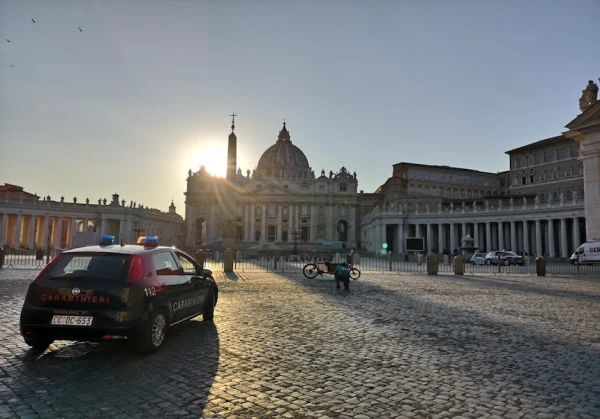
Vatican City, Mar 16, 2020 / 01:06 pm (CNA).- Few were surprised when the Chinese Communist Party banned church services in the wake of the coronavirus outbreak in Hubei province. But the Italian government decree suspending all public religious ceremonies — leading to the suspension of Masses in the pope’s own diocese — provided more of a jolt.
All four of the vastly different countries with the most documented cases of the Covid-19 coronavirus — China, Italy, Iran, and South Korea — have suspended religious services.
As more government leaders will soon face tough decisions in the face of a spreading pandemic, the president of the Religious Freedom Institute told CNA about important criteria to ensure the protection of a foundational freedom.
“There must be a presumption in favor of full religious freedom for all religious communities in every country, especially in democratic countries. Italy’s decision in this case does not change that presumption, but it does show that in very limited circumstances, temporary limits on the freedom to gather may licitly be applied,” the RFI’s Tom Farr told CNA.
“No right with public effects is absolute, including the precious right of religious freedom,” he added.
Farr was the first director of the U.S. State Department’s Office of International Religious Freedom, and subsequently taught religion and foreign affairs at Georgetown University and the U.S. Foreign Service Institute.
He said that these “limited circumstances” include instances when the extent of deadly infection is exceptionally high.
“Given Italy’s current designation as Level 3 by the U.S. CDC, which indicates the presence of ‘Widespread Community Transmission,’ Italy’s decision seems reasonable, especially in light of the fact that, to use the CDC’s description, ‘There is limited access to adequate medical care in affected areas’ of Italy and this reality understandably contributes to this extraordinary move,” Farr said.
“Absent this level of community transmission, the justification for such extraordinary measures to restrict religious gatherings quickly becomes much more tenuous,” he added.
When Italian government decreed the suspension of all civil and religious ceremonies, including funerals, on March 8, there had been 7,375 documented cases of the coronavirus leading to the deaths of 366 people.
In the days since that decree and a national quarantine, the number of cases in Italy has soared to 27,980 confirmed cases of COVID-19 and 2,470 deaths on March 16.
Along with religious ceremonies, the Italian government also decreed the closure of all schools, universities, museums, movie theaters, concerts, gyms, archaeological sites throughout the country. The following day, the Prime Minister announced a national quarantine.
The religious freedom advocate explained that any government exercising its authority in such an extraordinary fashion should abide by the following criteria to ensure religious freedom:
“Such decrees may not be employed arbitrarily, for example, to target a particular religion or religion in general. They must be public, clear, and transparent. They should be preceded by consultation with the religious communities involved.”
Decrees banning religious freedom also “must be grounded in overwhelming evidence, available to all, that public health would be severely endangered without such a decree. They must be time-limited, with a clear and public expression of when the ban will end,” Farr told CNA.
The Diocese of Rome announced the cancellation of all public Masses shortly after the Italian government decree went into effect. Since then, Church leaders in Rome have debated whether churches in Rome could remain open for private prayer during a national quarantine.
“It is of course the right and the duty of any religious community to challenge in lawful ways any act by government that it considers an illicit restriction of its religious freedom. In some cases a community might find itself in the position of needing to engage in principled, civil disobedience. As I understand it the Catholic Bishops of Italy and the Holy Father have agreed to this decree, from which I infer they believe it prudent and just,” Farr said.
“It would be difficult to imagine such a sweeping decree in the United States, where the Constitution provides to all Americans and all their religious communities the right of free exercise of religion. However, should there be clear and overwhelming evidence that, in particular locations, the public health required a ban on all gatherings, it is not inconceivable,” Farr said.
Numerous state governments have announced prohibitions on gatherings of more than 250 people in recent days.
The Archdiocese of Seattle was the first in the U.S. to cancel public Masses in response to a government directive, and dozens of dioceses have followed suit. Others have granted general dispensations from the obligation to attend Sunday Mass, and some bishops, like Archbishop Alexander Sample of Portland, have encouraged parishes with high Sunday Mass attendance to consider adding more Masses.
Farr said that such banning large gatherings, if not specifically targeting religion, is understood to be within the government’s prerogative at a time of crisis.
“An American bishop bringing suit against a ban, whatever its size, would very likely prevail if the ban were only on religious gatherings. However, he would have trouble prevailing if the ban is on all gatherings, religious or not, and the act is easily justified by a dire threat to public health and welfare,” Farr said.
“Speaking as a Catholic for whom the sacraments are not optional, and are necessary to health and welfare, however, I would hope that the Italian Church, or the Church in any jurisdiction would do everything it could reasonably do to make the sacraments available in ways that would be consistent with just authority,” he added.
 […]
[…]




So they are meeting on a problem that currently has good stats but not meeting on the presence of active gays in the clergy like the orgy incident in Rome and the two priests caught in a sexual act in Miami with each other last week and the male prostitute in the Milan area two months ago who avers having had sinful contact with 36 priests. But the meeting is about the largely gay area that is currently quiet…abuse of minors. Well that sounds like we don’t need consultancy help.
Does anybody have any information about what is happening to Cardinal Pell? There’s been blank silence for quite some time, and considering that there seems to be a fair amount of evidence that he is being railroaded, I’m concerned.
I wish I could help you out there Leslie. It seems that for some reason things have stalled. As far as I know though: the trial is still going ahead. I have heard him speak a few times and met him once. I have always had grave fears as to there being a fair trial. He said himself once that he doesn’t go making things up. He simply upholds what the Church teaches, come fair weather or foul. There are those who hate him for it.
Stephen in Australia.
I should have mentioned. There is an Australian journal of conservative opinion. The name of it is Quadrant. When in a newsagents; I was amazed to see an essay in it, written very recently by Cardinal Pell. The essay is titled – The Church in a Post Christian World. It is dated: September 12Th 2018. Search Quadrant and you will be able to see it. However, unless you subscribe, you won’t be able to read it in full just yet. The whole matter is of great concern. Hope this has been some help.
Stephen.
39 mnutes ago..ny times…Di Nardo, president of Bishops facing accusation of transferring molestor…..
https://www.nytimes.com/aponline/2018/09/12/us/ap-us-clergy-abuse-dinardo.html
Bergoglio’s synod on “the protection of minors” is a sham. As we all know, the problem is not pedophilia but massive homosexuality among 50% to 70% of all priests and the priest-bishop-Cardinal homosexual networks that are strangling the Church. Still less does the Church need another synod to talk rather than to act. Again, as everyone should know, it was Bergoglio who unilaterally destroyed the bishop sexual abuse investigation-and-trial proceeding that his own sexual abuse commission had strongly recommended. Since Bergoglio has doubled down on his delay-deflect-and-deny strategy with this cynical synod announcement, it is time for the DOJ and the Attorney-Generals in all 50 states to treat him and the American PervChurch for what they are: criminals and moral degenerates.
Paul, I don’t doubt that there are men who are priests and who are gay. There are a few I’ve met that I suspect lean that way. I’ll give them the benefit of the doubt that they are faithful to their vow of chastity. You claim that 50 – 70% of priests are gay. From where do you get that statistic? I’ve been around priests all my life. My closest friend is a priest. I know he’s not gay and neither are the men I’ve known who are priests. Please tell me from where you get this statistic.
It might come from this much discussed and cited 2003 essay by Fr. Paul Mankowski, in which he states: “I would estimate that between 50 and 60 percent of the men who entered religious life with me in the mid-70s were homosexuals who had no particular interest in the Church, but who were using the celibacy requirement of the priesthood as a way of camouflaging the real reason for the fact that they would never marry.” Or perhaps from Sipes.
I think you are quite correct. The Bishop’s Conferences have no canonical authority at all. This is like a high school principal asking the Student Council to address the problem of incompetent teachers. Except that it doesn’t sound so obviously stupid.