Santiago, Chile, Sep 10, 2018 / 05:00 pm (CNA).- The Archdiocese of Santiago in Chile has requested that the country’s Court of Appeals send an “exhorto” or judicial request, to the Vatican Secretary of State, asking the Vatican to provide all available information about the abuses perpetrated by Fr. Fernando Karadima. The request comes amid litigation following a lawsuit that has accused the archdiocese of covering-up Karadima’s actions.
“This request seeks to obtain all the information that may help determine the facts of the case,” the archdiocese wrote in a statement.
In Chilean judicial proceedings, an “exhorto” is akin to a subpoena for documents or information.
In 2011, Karadima was declared guilty of sexual abuse by the Vatican, which sentenced him to “a life of prayer and penance, also in reparation of the victims of his abuse.” In addition, the Vatican prohibited him from “the public exercise of any ministerial act, in particular confession or the spiritual direction of all categories of persons.” Controversially, he was not laicized.
In 2015, Juan Carlos Cruz, José Andrés Murillo and James Hamilton, three of Karadima's victims, filed a lawsuit for “moral damages” against the Archdiocese of Santiago and requested the compensation of 450 million pesos (about $640,000) in addition to a public apology by the Church for the alleged cover-up of abuses.
In March 2017, after an investigation and more than 30 statements given, the Chilean court determined that there was no cover-up by the archdiocese and so dismissed the case.
The plaintiffs appealed the ruling and the lawsuit is now being reviewed by the Court of Appeals.
Archdiocese of Santiago spokesman Nicolas Luco said in a recent statement that “the judicial proceedings have not shown any evidence of cover-up as the lower court determined and for that reason it's important to discover any new evidence in this matter.”
On April 28-29, the victims of Karadima met with Pope Francis in the Vatican. Those attending said that “the pope formally asked forgiveness in his own name and in the name of the universal church.”
This article was originally published by our sister agency, ACI Prensa. It has been translated and adapted by CNA.
If you value the news and views Catholic World Report provides, please consider donating to support our efforts. Your contribution will help us continue to make CWR available to all readers worldwide for free, without a subscription. Thank you for your generosity!
Click here for more information on donating to CWR. Click here to sign up for our newsletter.
Rodrigo Iván Cortés, president of the National Front for the Family, described Claudia Sheinbaum’s victory as “very bad news for life, family, and freedoms.” / Credit: EWTN Noticias/Screenshot
ACI Prensa Staff, Jun 5, 2024 / 18:50 pm (CNA).
Various pro-life, pro-family, and lay leaders of the Catholic Church in Mexico have reacted with concern to the election of Claudia Sheinbaum as president of the country.
Rodrigo Iván Cortés, president of the National Front for the Family, described Sheinbaum’s victory as “very bad news for life, family, and freedoms.”
For the pro-family leader, Sheinbaum represents continuity with the same progressive agenda of the outgoing administration of President Andrés Manuel López Obrador. Citing the growing legalization of abortion and use of gender ideology throughout the country, Cortés explained that “the López Obrador regime culminated in a culture of death, of ideology, not only of gender confusion but also of socialist populist indoctrination.”
However, in an interview with “EWTN Noticias,” EWTN’s Spanish-language news program, Cortés emphasized that just as people didn’t vote for López Obrador because of his position on abortion, gender ideology, or for freedoms to be canceled, people didn’t vote for Sheinbaum for those same reasons. What happens, he indicated, is that “when they come to power, they implement [that agenda].”
For Juan Dabdoub, president of the Mexican Family Council (ConFamilia), there are “two important factors” that would explain Sheinbaum’s victory in the presidential elections.
The first, he told ACI Prensa, CNA’s Spanish-language news partner, is that in Mexico there is “a poor political culture, which makes a large majority of the people manipulable.”
A second factor, Dabdoub noted, is that “Mexican Catholicism has failed in something extremely important that Pope St. John Paul II already pointed out: ‘A faith that does not create culture is a useless faith.’”
In a Jan. 16, 1982, speech, John Paul II said: “A faith that does not become culture is a faith that is not fully accepted, not entirely thought out, not faithfully lived.”
For the president of ConFamilia, “Mexico has stopped being a country of practicing Catholics and has become one of simply baptized people; and when a Catholic doesn’t live his faith in the outside world, that is, outside his home and his parish, those who dominate the world take control.”
Dabdoub considered Sheinbaum’s victory to be “a brutal threat” to the defense of life, family, and freedoms, since she has “a radical progressive agenda.”
‘Formation and serious work are needed’
For Father Hugo Valdemar, who for 15 years headed the communications office of the Primatial Archdiocese of Mexico when Cardinal Norberto Rivera led the archdiocese, “Catholics must learn that social media are not enough to really influence; serious formation and work are needed, otherwise everything remains up in the air.”
“The big problem is that we haven’t been seriously forming the laity, and nothing is being done to do so,” he told ACI Prensa. However, he noted that with a Sheinbaum administration, “the Church is not in danger. I don’t see an adverse climate, much less persecutory, and Christian values have been violated for a long time.”
What’s next in the battle for life and family?
Pilar Rebollo, director of the Steps for Life platform, pointed out that Sheinbaum’s election “means much more work” for pro-lifers: “It requires us to be united, it requires us to be coordinated,” anticipating possible “frontal attacks on what we know as our values that are foundational.”
Rebollo also emphasized the importance of serving underserved and vulnerable populations, which, she considered, were key to Sheinbaum’s victory. This, she said, must be done “not out of a desire for numbers but zeal for souls, a desire to [heal] wounds, zeal for humanity, to see Christ in others.”
It should be noted that all three candidates for president — Sheinbaum, Xóchitl Gálvez, and Jorge Álvarez Máynez — backed the legalization of abortion and the LGBTQ policy agenda, so Mexican voters had no real alternative to vote for a pro-life and pro-family candidate.
Sheinbaum is the first person of Jewish ancestry to be elected to Mexico’s presidency. In February of this year, she visited Pope Francis at the Vatican, where she asked him to bless a rose wrought in silver by a Mexican artisan. She later presented it to the rector of the Basilica Shrine of Our Lady of Guadalupe in Mexico City.
Jason Poblete of the Global Liberty Alliance anticipates that Claudia Sheinbaum will govern under the shadow of the current president and his leftist party. Credit: EWTN News Nightly/Screenshot
During her campaign, Sheinbaum was seen wearing a skirt bearing the image of the revered Virgin of Guadalupe. According to Jason Poblete of the Global Liberty Alliance, Sheinbaum also wore a rosary around her neck at a public event. He and others suggested that this was an act of demagoguery intended to appeal to Catholics, who comprise approximately 78% of the country’s population.
Sheinbaum, 61, holds a doctorate in physics specializing in energy and taught at Mexico’s National Autonomous University. Her political militancy began during her student years, joining a group that became the founding youth movement of the socialist Party of Democratic Revolution. She later joined the ruling Morena party. She has been described as a climate activist, having been part of a Nobel Prize-winning commission advising the United Nations on climate change.
Sheinbaum’s tenure as Mexico City mayor was marked by progressive initiatives. For example, the World Economic Forum, led by Klaus Schwab, noted that as mayor she ended public school policy requiring gender-appropriate uniforms for children. Sheinbaum said: “The era when girls had to wear a skirt and boys had to wear trousers has been left behind; I think that’s passed into history,” and added: “Boys can wear skirts if they want and girls can wear pants if they want.”
While she did not raise the issue during her campaign, Sheinbaum’s Morena party is a firm supporter of abortion. The newly-elected congress will be seated in September, one month before Sheinbaum’s inauguration, thus allowing incumbent president López Obrador an opportunity to push through his legislative initiatives.
Poblete told “EWTN News Nightly” that the 2024 election may have led to a Morena majority in Mexico’s Congress, which has vowed to amend the constitution in order for Mexican Supreme Court justices to be elected by popular ballot, thereby confirming partisan control of the heretofore independent judiciary, which would rule on issues such as abortion and matters of gender ideology. He fears that Sheinbaum will govern under the shadow of the current president and his leftist party.
This story was first published by ACI Prensa, CNA’s Spanish-language news partner. It has been translated and adapted by CNA.
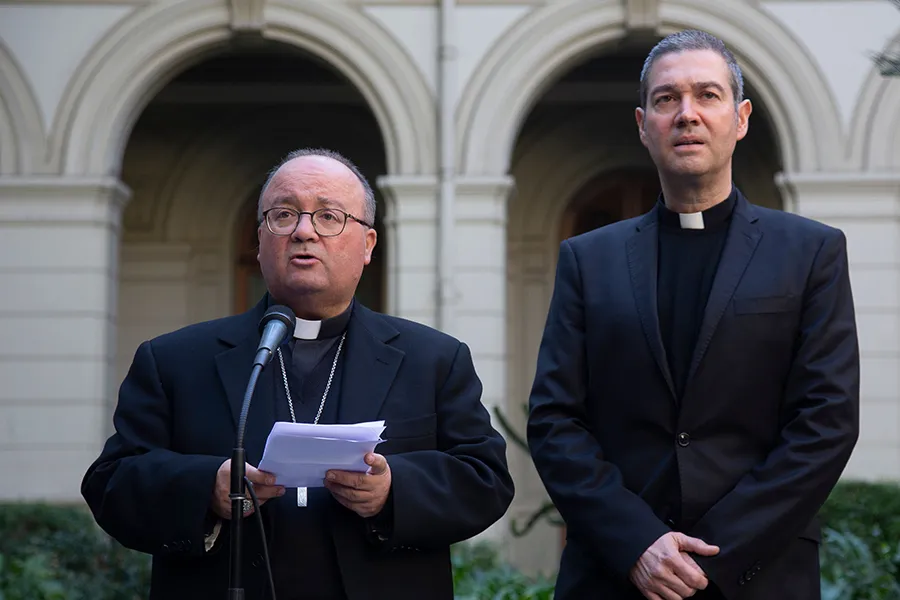
Osorno, Chile, Jun 15, 2018 / 02:51 pm (CNA/EWTN News).- As part of their special mission to help bring healing to the troubled Chilean diocese of Osorno, Archbishop Charles Scicluna and Msgr. Jordi Bertomeu are holding several pastoral meetings this week which they say are aimed at listening.
Speaking to Chilean media at the airport after landing in Osorno, Scicluna said they came “to convey the special closeness of the pope to the beloved people of Osorno. We are going to have a lot of discussion and will listen to our brothers, which is the most important [task] for us.”
Similarly, Bertomeu said they are “happy to be here in Osorno,” and voiced hope that they would be able “to communicate the Holy Father’s request for forgiveness in peace, in concord and in harmony.”
Scicluna, Archbishop of Malta and the Vatican’s former top prosecutor on cases of clerical abuse, is currently in Osorno with Bertomeu, an official of the Congregation for the Doctrine of the Faith, for a June 12-19 pastoral mission to the Chilean Dioceses of Osorno and Santiago in order to advance “the process of healing and reparation for victims of abuse” in Chile.
After spending two days in Santiago, in which they led a day of formation on the guidelines to be followed in investigations into sexual abuse in the Church, the pair arrived to Osorno June 14, where they will stay until June 17, and will hold a number of meetings with different communities in the diocese.
Immediately after landing in Osorno Thursday, Scicluna and Bertomeu held meetings with two groups of local Catholics – the “Catholic Faithful of Osorno” and a group of lay men and women from the diocese.
On Friday the pair met with clergy from Osorno, including priests and deacons, as well as the communities of Santa Rosa Parish and the Parish of the Holy Spirit.
They will meet with another parish community Saturday, and that afternoon will speak with religious men and women from Osorno. The day will close with a second encounter at a parish, after which there will be time for adoration.
On Sunday, Scicluna and Bertomeu’s last day in Osorno before heading back to Santiago, they will celebrate Mass in the Cathedral of San Mateo, after which they will meet with all parish communities in the diocese to pray for peace and reconcilation.
Scicluna and Bertomeu will then go back to Santiago for two days before returning to Rome June 19.
Osorno has been at the center of the Chilean clerical abuse crisis ever since Pope Francis’ 2015 appointment of Juan Barros Madrid as the diocese’s bishop – a move that was met with heavy opposition due to accusations he had covered up the crimes of notorious Chilean abuser, Fr. Fernando Karadima.
Francis had initially defended Barros, saying he believed the accusations against him were “calumny” during a visit to Chile in January. However, after new evidence was presented and news of old evidence resurfaced following his trip, the pope in February sent Scicluna and Bertomeu to Chile to investigate, resulting a 2,300-page report on the crisis which prompted the pope to pen a letter to Chilean bishops in April saying he had made “serious errors” in judging the case.
Since then, Pope Francis has met with all Chilean bishops and two groups of Chilean abuse survivors at the Vatican.
On Monday the Vatican announced that Pope Francis has accepted Barros’ resignation and that of two other Chilean bishops. Every active bishop in Chile had submitted his resignation at the close of a May 15-17 meeting between the pontiff and the country’s bishops, during which Francis chastised them for systematic cover-up.
Scicluna and Bertomeu, whose current visit to Santiago and Osorno coincided with the news of Barros’ resignation, have from the beginning stressed that they have come to ask for forgiveness on behalf of the pope, to provide formation on how to respond to abuse, and to listen.
In a June 13 press conference before heading to Osorno, Scicluna said that “to recognize and admit the whole truth, with all of its painful repercussions and consequences, is the point of departure for an authentic healing, both for the victim and the abuser. These brothers and sisters deserve our special attention and assistance.”
He also defended the papal nuncio to Chile, Archbishop Ivo Scapolo, who has been accused of inaction when presented with abuse allegations, saying “we have a wonderful collaboration with the nuncio.”
In comments to Chilean media after landing in Osorno, Bertomeu backed Scicluna’s defense of Scapolo, saying “the nuncio has a very complicated role, because he has a role as a representative of the Holy Father before the Chilean state and then there are also actions which can also be easily misinterpreted,” La Cooperativa reports.
“I myself am aware that in any moment of the day I can do something which can be misinterpreted, so I think that the procedures of justice must be respected before condemning someone and one must be a little more sure,” he said, adding that “until now the nuncio has acted correctly.”
Lima, Peru, Aug 31, 2022 / 08:00 am (CNA).
The Archdiocese of Medellín, Colombia, has published the list of complaints of sexual abuse by priests it has received in the last 30 years as well as the actions t… […]





Chile Supreme Court made same request in 2015 but no response from Vatican https://ca.reuters.com/article/topNews/idCAKCN0T224X20151113