Pope Francis to issue apostolic exhortation on holiness, “Gaudete et exsultate”
Subtitled “on the call to holiness in the contemporary world”, the exhortation will be presented April 9 by Archbishop Angelo De Donatis, vicar general of the Diocese of Rome and archpriest of the Archbasilica of St. John Lateran.
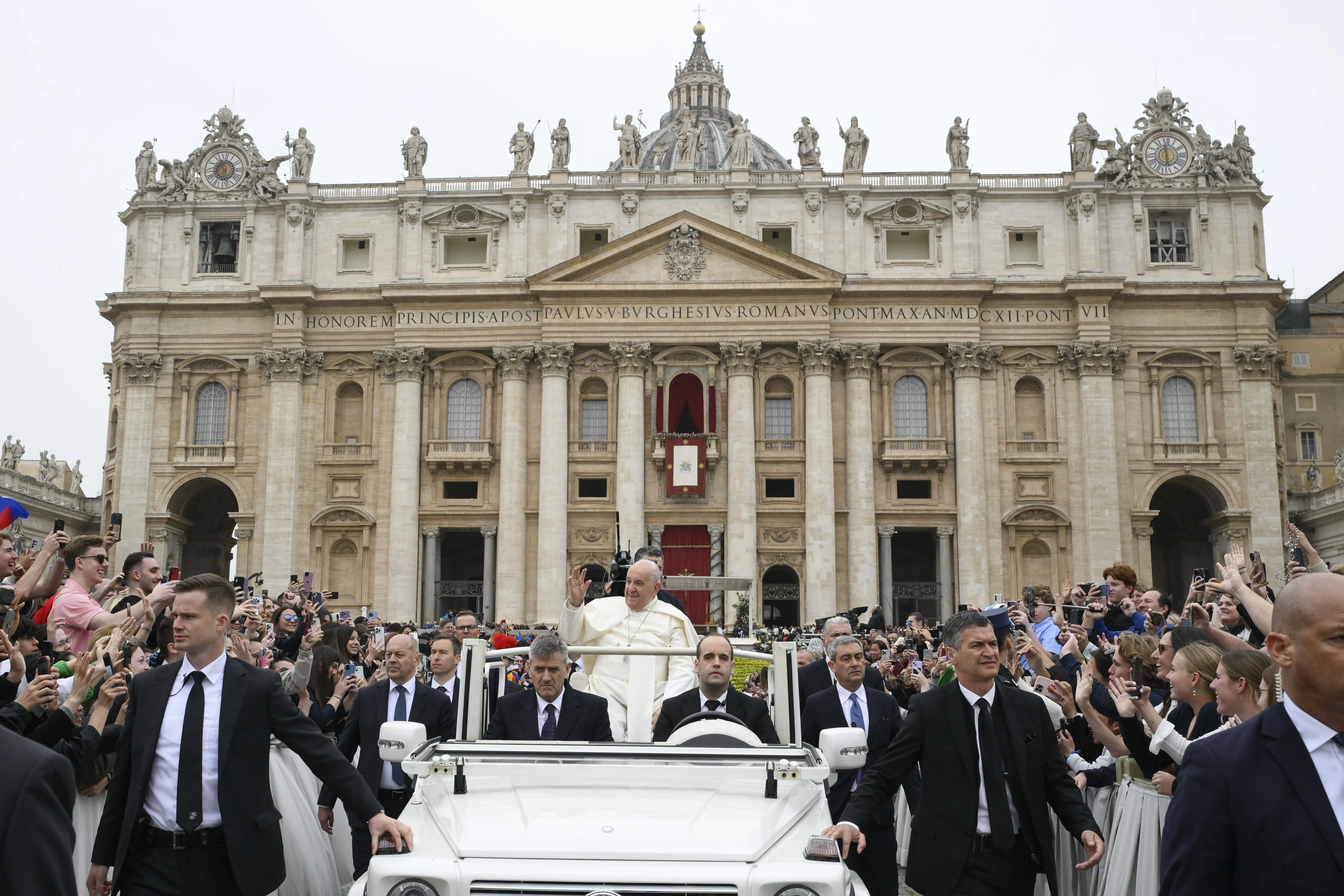
Pope Francis gestures during his general audience in St. Peter's Square at the Vatican April 4. (CNS photo/Paul Haring)
Vatican City, Apr 5, 2018 / 10:07 am (CNA/EWTN News).- Pope Francis will next week publish an apostolic exhortation on holiness titled Gaudete et exsultate, or “Rejoice and be glad”, the Vatican announced Thursday.
Subtitled “on the call to holiness in the contemporary world”, the exhortation will be presented April 9 by Archbishop Angelo De Donatis, vicar general of the Diocese of Rome and archpriest of the Archbasilica of St. John Lateran.
Italian journalist Gianni Valente and Paola Bignardi, former president of Catholic Action Italy, will also speak at the presentation.
Gaudete et exsultate will be the third apostolic exhortation issued by Pope Francis. In 2016 he issued Amoris laetitia, on love in the family, and in 2013 Evangelii gaudium, on the proclamation of the Gospel in today’s world.
An apostolic exhortation is one form of the ordinary teaching authority of the Pope. Through an exhortation, the Pope conveys a message to faithful about a particular area relevant to living out the Catholic faith.
An apostolic exhortation is often written as a follow-up document to a Synod of Bishops, as was the case for Amoris laetitia.
Gaudete et exsultate follows just a little more than a month behind the Congregation for the Doctrine of the Faith’s March 1 letter to bishops on certain aspects of Christian salvation, Placuit Deo, which refers to the errors of Pelagianism and Gnosticism in helping to explain the threat of the errors Pope Francis has called “new Pelagianism” and “new Gnosticism.”
According to Placuit Deo, the new Pelagianism is an “individualism centered on the autonomous subject [which] tends to see the human person as a being whose sole fulfilment depends only on his or her own strength.”
The document cites a 2013 address of Pope Francis to explain that the new Gnosticism “presumes to liberate the human person from the body and from the material universe, in which traces of the provident hand of the Creator are no longer found, but only a reality deprived of meaning, foreign to the fundamental identity of the person, and easily manipulated by the interests of man.”
In his latest exhortation, Pope Francis will likely expound on these modern errors giving guidance on how to avoid them and how to achieve holiness in the modern age.
If you value the news and views Catholic World Report provides, please consider donating to support our efforts. Your contribution will help us continue to make CWR available to all readers worldwide for free, without a subscription. Thank you for your generosity!
Click here for more information on donating to CWR. Click here to sign up for our newsletter.
Vatican City, Jan 13, 2021 / 04:02 am (CNA).- Pope Francis urged Catholics on Wednesday to praise God not only in happy times, “but above all in difficult moments.”
In his general audience address on Jan. 13, the pope compared those who pr… […]
CNA Staff, Jun 27, 2024 / 14:20 pm (CNA).
Pope Francis this week called on the faithful to a conversion of heart that extends Christian charity to all of God’s creation and urged them to commit themselves t… […]
A defining theme of Pope Francis’ papacy has been his urging of humanity to better care for the natural environment, which he has done most prominently in his landmark 2015 encyclical Laudato Si’ and numerous subsequent writings and speeches.
The pope’s emphasis on this topic — especially his foray into climate science via his recent encyclical Laudate Deum — has variously drawn both praise and consternation from Catholics in the United States, about half of whom do not share Pope Francis’ views on climate change, according to surveys.
In Laudate Deum, which was released in October as a continuation to Laudato Si’, Francis wrote that the effects of climate change “are here and increasingly evident,” warning of “immensely grave consequences for everyone” if drastic efforts are not made to reduce emissions. In the face of this, the Holy Father criticized those who “have chosen to deride [the] facts” about climate science, stating bluntly that it is “no longer possible to doubt the human — ‘anthropic’ — origin of climate change.”
The pope in the encyclical laid out his belief that there must be a “necessary transition towards clean energy sources, such as wind and solar energy, and the abandonment of fossil fuels.” This follows a call from Pope Francis in 2021 to the global community calling for the world to “achieve net zero carbon emissions as soon as possible.”
He further lamented what he called “certain dismissive and scarcely reasonable opinions [on climate change] that I encounter, even within the Catholic Church.”
In light of the new encyclical — which extensively cites the U.N.’s Intergovernmental Panel on Climate Change (IPCC) — Pope Francis was invited to speak at this week’s United Nations Climate Change Conference, known as COP28. Though the 86-year-old pope was forced to cancel his trip due to health issues, the Vatican has indicated that he aims to participate in COP28 this weekend in some fashion. It announced today that Vatican Secretary of State Cardinal Pietro Parolin will represent the pope at the conference.
While various Catholic groups have welcomed the pope’s latest encyclical, some Catholics have reacted with persistent doubts, questioning whether the pope’s policy prescriptions would actually produce the desired effects.
How do Americans feel about climate change?
According to a major survey conducted by Yale University, 72% of Americans believed in 2021 — the latest available data year — that “global warming is happening,” and 57% believe that global warming is caused by human activity.
More recent polling from the Pew Research Center, conducted in June, similarly suggests that two-thirds of U.S. adults overall say the country should prioritize developing renewable energy sources, such as wind and solar, over the expansion of the production of oil, coal, and natural gas. That same survey found that just 3 in 10 adults (31%) say the U.S. should completely phase out oil, coal, and natural gas. The Yale study found that 77% of U.S. adults support at least the funding of research into renewable energy sources.
Broken down by party affiliation, Pew found that a large majority of Democratic and Democratic-leaning independents — 90% — favor alternative energy sources, while just under half, 42%, of Republicans and Republican-leaning adults think the same. Within the Republican cohort, however, 67% of Republicans under age 30 prioritize the development of alternative energy sources, compared with the 75% of Republicans ages 65 and older who prioritize the expansion of oil, coal, and natural gas.
In terms of the expansion of alternative energy sources, two-thirds of Americans think the federal government should encourage domestic production of wind and solar power, Pew reported. Just 7% say the government should discourage this, while 26% think it should neither encourage nor discourage it.
How do America’s Catholics feel about climate change?
Surveys suggest that Catholics in the United States are slightly more likely than the U.S. population as a whole to be skeptical of climate change, despite the pope’s emphatic words in 2015 and since.
A separate Pew study suggests that 44% of U.S. Catholics say the Earth is warming mostly due to human activity, a view in line with Pope Francis’ stance. About 3 in 10 (29%) said the Earth is warming mostly due to natural patterns, while 13% said they believe there is no solid evidence the planet is getting warmer.
According to the same study, 71% of Hispanic Catholics see climate change as an extremely or very serious problem, compared with 49% of white, non-Hispanic Catholics. (There were not enough Black or Asian Catholics in the 2022 survey to analyze separately, Pew said.)
One 2015 study from Yale did suggest that soon after Laudato Si’ was released, U.S. Catholics were overall more likely to believe in climate change than before. That same study found no change, however, in the number of Americans overall who believe human activity is causing global warming.
Pope Francis’ climate priorities
Beyond his groundbreaking writings, Pope Francis has taken many actions during his pontificate to make his own — admittedly small — country, Vatican City, more sustainable, including the recent announcement of a large order of electric vehicles, construction of its own network of charging stations, a reforestation program, and the continued importation of energy coming exclusively from renewable sources.
Francis has often lamented what he sees as a tepid response from developed countries in implementing measures to curb climate change. In Laudate Deum, he urged that new multinational agreements on climate change — speaking in this case specifically about the COP28 conference — be “drastic, intense, and count on the commitment of all,” stating that “a broad change in the irresponsible lifestyle connected with the Western model would have a significant long-term impact.”
The pope lamented what he sees as the fact that when new projects related to green energy are proposed, the potential for economic growth, employment, and human promotion are thought of first rather than moral considerations such as the effects on the world’s poorest.
“It is often heard also that efforts to mitigate climate change by reducing the use of fossil fuels and developing cleaner energy sources will lead to a reduction in the number of jobs,” the pope noted.
“What is happening is that millions of people are losing their jobs due to different effects of climate change: rising sea levels, droughts, and other phenomena affecting the planet have left many people adrift. Conversely, the transition to renewable forms of energy, properly managed, as well as efforts to adapt to the damage caused by climate change, are capable of generating countless jobs in different sectors.”
‘Leave God’s creation better than we found it’
Dr. Kevin Roberts, president of the Washington, D.C.-based Heritage Foundation think tank, told CNA that he has noticed a theme of frustration and confusion among many Catholics regarding the Holy Father’s emphasis on climate change.
A self-described outdoorsman and former president of Wyoming Catholic College, Roberts spoke highly to CNA of certain aspects of Laudato Si’, particularly the pope’s insights into what he called “human ecology,” which refers to the acceptance of each person’s human body as a vital part of “accepting the entire world as a gift from the Father and our common home.”
Dr. Kevin Roberts, president of the Heritage Foundation. Courtesy of Heritage Foundation.
“I like to think [Pope Francis] personally wrote that, because I could see him saying that,” Roberts said of the passage, which appears in paragraph 155 of the encyclical. Roberts said he even makes a point to meditate on that “beautiful and moving” passage during a retreat that he does annually.
That portion of Laudato Si’ notwithstanding, Roberts said he strongly believes that it detracts from other important issues, such as direct ministry to the poor, when Pope Francis elevates care for God’s natural creation as “seemingly more important than other issues to us as Catholics.” He also said he disagrees with Pope Francis’ policy prescriptions, such as a complete phasing out of fossil fuels, contained in Laudate Deum.
“We of course want to pray for him. We’re open to the teaching that he is providing. But we also have to remember as Catholics that sometimes popes are wrong. And on this issue, it is a prudential matter. It is not a matter of morality, particularly when he’s getting into the scientific policy recommendations,” Roberts said.
Roberts said the Heritage Foundation’s research and advocacy has focused not on high-level, multinational agreements and conferences to tackle the issues posed by climate change but rather on smaller-scale, more community-based efforts. He said this policy position is, in part, due to the historical deference such multinational conglomerates of nations have given to China, the world’s largest emitter of greenhouse gases overall.
He said agreements within the U.S. itself, with businesses and all levels of government working together, have produced the best results so far when it comes to improving the environment. He also pointed to examples of constructive action that don’t involve billions of dollars, such as families making the choice to spend more time outdoors or engaging in local activities that contribute to environmental conservation and community life, such as anti-litter campaigns and community gardening. The overarching goal, he said, should be to “leave God’s creation better than we found it.”
Roberts — who said he personally believes humans likely have “very little effect” on the climate — said he was discouraged to read other portions of Laudato Si’, as well as Laudate Deum, that to him read as though they had come “straight out of the U.N.” Despite his criticisms, Roberts urged his fellow Catholics to continue to pray for the Holy Father and to listen to the pope’s moral insights.
“I just think that the proposed solutions are actually more anti-human and worse than the purported effects of climate change,” he added.
‘A far more complex issue’
Greg Sindelar, a Catholic who serves as CEO of the Texas Public Policy Foundation (TPPF), a conservative think tank that studies the energy industry, similarly expressed concerns to CNA about the potential impact of certain climate change mitigation policies on human flourishing.
Like Roberts, Sindelar spoke highly of certain aspects of the pope’s message while expressing reservations about some of the U.N.-esque solutions proposed in Laudate Deum.
“I think the pope is right about our duty as Catholics to be stewards and to care for the environment. But I think what we have to understand — what we have to balance this with — is that it cannot come at the expense of depriving people of affordable and reliable energy,” Sindelar said in an interview with CNA.
“There’s ways to be environmentally friendly without sacrificing the access that we all need to reliable and affordable energy.”
Greg Sindelar is CEO of the Texas Public Policy Foundation, a think tank in America’s leading energy-producing state. Courtesy of Texas Public Policy Foundation
Sindelar said TPPF primarily promotes cheap, reliable access to energy as a means of promoting human flourishing. The free-market-focused group is skeptical of top-down governmental intervention, both in the form of regulation and incentives or disincentives in certain areas of the energy sector.
When asked what he thinks his fellow Catholics largely think about the issue, Sindelar said many of the Catholics he hears from express the view that government policies and interventions rarely produce effective solutions and could potentially hinder access to energy for those in need.
“I think it’s a far more complex issue than just saying we need to cut emissions, and we need to transfer away from fossil fuels, and all these other things. What we need to do is figure out and ensure ways that we are providing affordable and reliable electricity to all citizens of the world,” he reiterated.
“When the pope speaks, when the Vatican speaks, it carries a lot of weight with Catholics around the world, [and] not just with Catholics … and I totally agree with him that we need to be thinking about the most marginalized and the poorest amongst us,” Sindelar continued.
“[But] by going down these policy prescription paths that he’s recommending, we’re actually going to reduce their ability to have access to that,” he asserted.
Sindelar, while disagreeing with Pope Francis’ call for an “abandonment of fossil fuels,” said he appreciates the fact that Pope Francis has spoken out about the issue of care for creation and has initiated so much public discussion.
“I think there is room for differing views and opinions on the right ways to do that,” he said.
Effective mitigation efforts
Susan Varlamoff, a retired biologist and parishioner at St. John Neumann Catholic Church in the Atlanta area, is among those Catholics who are committed to Pope Francis’ call to care for creation and to mitigate the effects of climate change. To that end, Varlamoff in 2016 created a peer-reviewed action plan for the Archdiocese of Atlanta to help Catholics put the principles contained in Laudato Si’ into action, mainly through smaller, more personal actions that people can take to reduce their energy usage.
Retired biologist Susan Varlamoff. Photo courtesy of Susan Varlamoff
The Atlanta Archdiocese’s efforts have since garnered recognition and praise, Varlamoff said, with at least 35 archdioceses now involved in an inter-diocesan network formed to exchange sustainability ideas based on the latest version of the plan from Atlanta.
“It’s fascinating to see what everybody is doing, and it’s basically based on their talents and imaginations,” Varlamoff said, noting that a large number of young people have gotten involved with their efforts.
As a scientist, Varlamoff told CNA it is clear to her that Pope Francis knows what he’s talking about when he lays out the dangers posed by inaction in the face of climate change.
“He understands the science, and he’s deeply concerned … he’s got remarkable influence as a moral leader,” she said.
“Part of what our religion asks us to do is to care for one another. We have to care for creation if we’re going to care for one another, because the earth is our natural resource system, our life support, and we cannot care for one another if we don’t have that life support.”
Responding to criticisms about the financial costs associated with certain green initiatives, Varlamoff noted that small-scale sustainable actions can actually save money. She offered the example of parishes in the Atlanta area that have drastically reduced their electric bills by installing solar panels.
“[But,] it’s not just about saving money. It’s also about reducing fossil fuels and greenhouse gas emissions, and protecting the natural resources for future generations,” she said.
Moreover, Varlamoff said, the moral imperative to improve the natural environment for future generations is worth the investment. “When [Catholics] give money, for example, for a social justice issue like Walking with Moms in Need or special needs, the payback is improving lives. We’re improving the environment here,” she emphasized.
Would rather wait for another pontiff to write an apostolic exhortation on holiness. In fact, the People of God could use one on holiness and wisdom. Pope Francis lack sufficient credibility since he is too judgmental toward traditional Catholics, indicating some lack of humility, and unwisely gives aid and comfort to enemies of the Church all too frequently. Developing a reputation for sowing confusion and not cleaning up after your own messes will make it hard for many of the faithful to not tune him out or otherwise willingly cite his words even if the content of the proposed apostolic exhortation proves laudable.
Is this document the result of a groundswell of demand by the faithful… because the words of Christ just don’t cut it?
One weakness of the post Vatican II media watching the Church now… period… is this idea that Popes should constantly write, travel or talk…or all three with Francis…because the media wants travel or books or great sayings.
And the recent Popes like the travel/author part….because it’s easier than cleaning house…admin work…you know…ruling. There is a thing called global administrative work…checking what can be done about pro abortion speakers at Catholic colleges…why are there night coed visitation rights at Catholic colleges while some Catholic colleges have sizable hookup rate percentages per the Newman Society website….are there lgbt clubs on campuses that affirm gay sex while the Holy Spirit condemns such in Romans 1:26-27. Popes should be cleaning house worldwide…not just Francis. St. John Paul II was writing TOB for months while sexual abuse was simultaneously taking place against children in some cases. Irony at its maximum. Benedict wrote too much on the saints. We have Catholic authors trying to make a living for their families to do that. When will we again have Popes who don’t turn the office into a writer in residence stint. There should be nothing untoward at any Catholic colleges if Popes we’re doing their essential job of ruling the worldwide Church a sufficient percent of each day. Frankly Benedict quit when the admin jobs had grown up to his ears while he was writing.
Given everything we have seen, read, and observed over the past five years, a reasonable forecast is that it will equate holiness with secular left-wing political shibboleths, including open borders, gun control, climate-change activism, the abolition of the death penalty and lifetime imprisonment, the socialism of central planners, the “positive aspects” of homosexuality and pan-sexual gender ideology, and the smashing of rigid, traditional “idols of truth”. Let us not forget that this pope is explicitly on record as declaring that Communists. In other words, we should prepare ourselves for yet another anti-magisterial “apostolic exhortation”.
Gaudete et Exultate in which he will likely decree that the new theological virtues are tolerance, diversity and inclusion. That the new cardinal virtues are accompaniment, flexibility, indifference and not judging.
Be glad and exult because Francis says there is no hell, or there is, but no one goes there, or they do, but not forever… Gay commitment rites and transgender rebaptisms – just as long as you don’t call it marriage…
So, Go therefore into all the world and build bridges, not walls.
I suppose that is why Pope Bergoglio chose the name of a 13th century saint named Francis of Assisi whose life of absolute poverty is so widely followed in the “new times” of today.
The title of this Apostolic Exhortation is beyond ironic in the mouth of a pipe who praises the destruction of the Church’s “idols of truth” and claims that the divine commandments of Jesus on the indissolubility of marriage and exceptionless negative moral norms are merely “ideals” that are impossible as a practical matter:
“11 beati estis cum maledixerint vobis et persecuti vos fuerint et dixerint omne malum adversum vos mentientes propter me 12 gaudete et exultate quoniam merces vestra copiosa est in caelis sic enim persecuti sunt prophetas qui fuerunt ante vos. (Mt. 5:11-12)
What’s the under/over on whether Francis’ main themes of holiness will be dialogue, accompanying, openness, love for migrants, climate change, etc., blah, blah, blah. The Church is being destroyed from within and Francis is leading the charge.
I can hardly wait! 🙂
Sounds like the pope has been reading the Opus Dei 101 documents. He’s run out of ramblings and he’s channeling modern saints now.
Who wrote it?
What has Tucho been up to?
Would rather wait for another pontiff to write an apostolic exhortation on holiness. In fact, the People of God could use one on holiness and wisdom. Pope Francis lack sufficient credibility since he is too judgmental toward traditional Catholics, indicating some lack of humility, and unwisely gives aid and comfort to enemies of the Church all too frequently. Developing a reputation for sowing confusion and not cleaning up after your own messes will make it hard for many of the faithful to not tune him out or otherwise willingly cite his words even if the content of the proposed apostolic exhortation proves laudable.
Is this document the result of a groundswell of demand by the faithful… because the words of Christ just don’t cut it?
One weakness of the post Vatican II media watching the Church now… period… is this idea that Popes should constantly write, travel or talk…or all three with Francis…because the media wants travel or books or great sayings.
And the recent Popes like the travel/author part….because it’s easier than cleaning house…admin work…you know…ruling. There is a thing called global administrative work…checking what can be done about pro abortion speakers at Catholic colleges…why are there night coed visitation rights at Catholic colleges while some Catholic colleges have sizable hookup rate percentages per the Newman Society website….are there lgbt clubs on campuses that affirm gay sex while the Holy Spirit condemns such in Romans 1:26-27. Popes should be cleaning house worldwide…not just Francis. St. John Paul II was writing TOB for months while sexual abuse was simultaneously taking place against children in some cases. Irony at its maximum. Benedict wrote too much on the saints. We have Catholic authors trying to make a living for their families to do that. When will we again have Popes who don’t turn the office into a writer in residence stint. There should be nothing untoward at any Catholic colleges if Popes we’re doing their essential job of ruling the worldwide Church a sufficient percent of each day. Frankly Benedict quit when the admin jobs had grown up to his ears while he was writing.
Betting it will be a mixed bag, fine on fundamentals, questionable with respect to contemporary application.
Given everything we have seen, read, and observed over the past five years, a reasonable forecast is that it will equate holiness with secular left-wing political shibboleths, including open borders, gun control, climate-change activism, the abolition of the death penalty and lifetime imprisonment, the socialism of central planners, the “positive aspects” of homosexuality and pan-sexual gender ideology, and the smashing of rigid, traditional “idols of truth”. Let us not forget that this pope is explicitly on record as declaring that Communists. In other words, we should prepare ourselves for yet another anti-magisterial “apostolic exhortation”.
I think you’re right
Let us not forget that this pope is explicitly on record as declaring that Communists are closet Christians.
Gaudete et Exultate in which he will likely decree that the new theological virtues are tolerance, diversity and inclusion. That the new cardinal virtues are accompaniment, flexibility, indifference and not judging.
Be glad and exult because Francis says there is no hell, or there is, but no one goes there, or they do, but not forever… Gay commitment rites and transgender rebaptisms – just as long as you don’t call it marriage…
So, Go therefore into all the world and build bridges, not walls.
Perhaps he would care to “exhort” confrere James Martin “SJ” to cease exhorting sodomy?
Credence spent poorly is not easily regained.
New times call for fresh ways of being holy.
I suppose that is why Pope Bergoglio chose the name of a 13th century saint named Francis of Assisi whose life of absolute poverty is so widely followed in the “new times” of today.
The title of this Apostolic Exhortation is beyond ironic in the mouth of a pipe who praises the destruction of the Church’s “idols of truth” and claims that the divine commandments of Jesus on the indissolubility of marriage and exceptionless negative moral norms are merely “ideals” that are impossible as a practical matter:
“11 beati estis cum maledixerint vobis et persecuti vos fuerint et dixerint omne malum adversum vos mentientes propter me 12 gaudete et exultate quoniam merces vestra copiosa est in caelis sic enim persecuti sunt prophetas qui fuerunt ante vos. (Mt. 5:11-12)
What’s the under/over on whether Francis’ main themes of holiness will be dialogue, accompanying, openness, love for migrants, climate change, etc., blah, blah, blah. The Church is being destroyed from within and Francis is leading the charge.