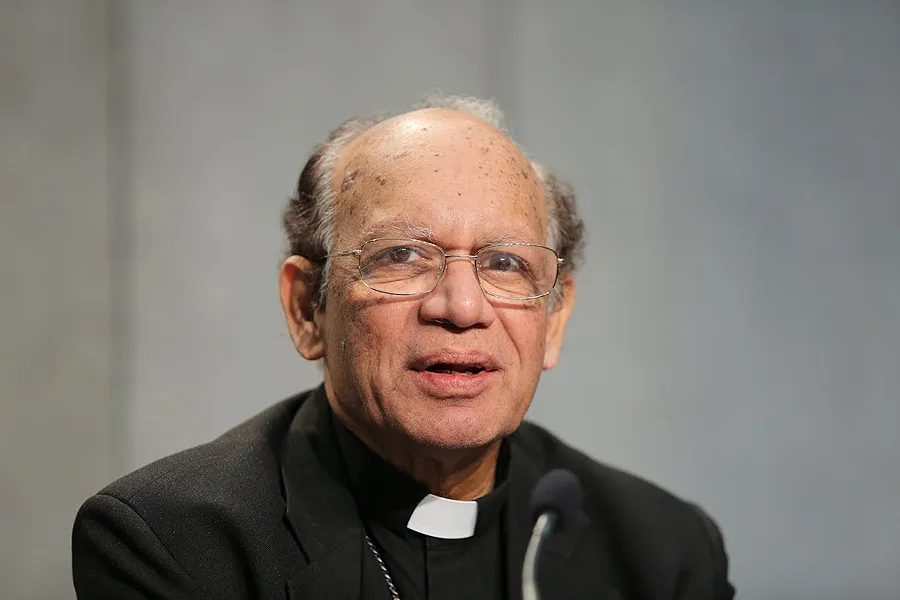
Vatican City, Sep 18, 2017 / 01:57 pm (CNA/EWTN News).- Nearly four years after the Pope established his Council of Cardinal advisers to help him in the task of reforming the Roman Curia, one member of the group said their work is wrapping up, and that it could take only a few more meetings to finish what they set out to do.
The ongoing process of reform “is being done at various stages of development, and I hope we’ll come to an end in all of these matters soon,” Cardinal Oswald Gracias of Bombay told CNA Sept. 14.
“It will take two or three more meetings more,” he said, adding that “by June perhaps we’ll be seeing the end of the tunnel.”
Cardinal Gracias is also President of the Asian Bishops Conference and in 2013 was chosen by the Pope along with eight other prelates from around the world to advise him in matters of Church governance and reform.
He spoke to CNA in a lengthy, sit-down interview after the council – also called the “C9” – concluded their latest round of meetings last week.
As far as the reform goes, Cardinal Gracias said “there won’t be very major changes; it’s the governance of the Church, we can’t just turn everything upside down.” Rather, it will be “a gradual change, a change of mentality, a change of approach, restructuring a bit of the departments so that they are more logically suited to the needs of today.”
He said a key goal of the C9 is to implement the vision of the Second Vatican Council, specifically when it comes to the importance of the role of the laity and women, and incorporating greater synodality and collegiality into the Church’s structures.
From the beginning Pope Francis “had very clear what he wanted this group to do,” the cardinal said. “He had no hesitation, he’s a good leader. He had a clear vision.”
Cardinal Gracias admitted that in the beginning he had doubts as to whether or not they were going in the right direction, and had started to worry what people on the outside might say, since many fruits of the meetings weren’t and likely won’t be immediately visible. He said he also struggled with doubts about the pace at which they were moving, and believed that things were going “too slow.”
“I will confess that once at the beginning I was wondering, ‘are we going in the right direction?’ I asked myself. But now I can see it is,” he said, explaining that Pope Francis’ Christmas speech to the Roman Curia last year was a “tipping point” for him.
More than anything, there is a change in mentality that’s needed, which will take longer than simply reforming the Vatican’s structures, he said, but said the group is “rather confident that it will happen because the Pope is giving very effective leadership.”
In addition to the ongoing curial reform, Cardinal Gracias also spoke about the recent release of Indian priest Fr. Tom Uzhunnalil 18 months after he was abducted in Yemen. He also spoke about the Pope’s upcoming trip to Myanmar and Bangladesh, and when a possible papal trip to India might take place.
Below are excerpts from CNA’s interview with Cardinal Gracias:
You’ve seen Fr. Tom and you were at his meeting with Pope Francis. How is he doing?
I was pleasantly surprised with calmness with which he came out, because he did not know, to my knowledge, that he was being released. But he said I know people have prayed for me, I’m grateful for the people who were praying for me, but he kept on saying ‘Jesus is great, Jesus is great.’ And then he told the Holy Father. It was a very moving moment. As soon as the Holy Father came he prostrated in front of the Holy Father and kissed his feet, and he said, ‘thank you, thank you, thank you. Thank you Holy Father, but just one message I want to give you: Jesus Christ is great. Jesus was with me right through, I could sense the presence of God with me’…And once I thought the Holy Father had tears in his eyes. When Tom kept on speaking about Jesus, this is what he told the Holy Father: please tell the people that Jesus is great! I would say that he’s come out of it with an experience of the presence of the Lord, and I think at that moment the Holy Father had tears in his eyes…I met the Holy Father later that afternoon, and he was telling me how impressed he was. He was also surprised with the calmness of the man, with Tom…He was a man who is perhaps strengthened in the faith after this experience, and not bitter about anything. Particularly about his captors, he was very understanding. It was a special experience, very edifying. He needs rest, certainly, he’ll have a medical exam and he’ll be with his superiors, but eventually he’ll go back (to India). So thank God really. It was an anxious moment for the whole Church in India. We didn’t know what was happening, but we understood that putting more pressure, in the perspective of the government, could make things more difficult for him. (But) he’s not really stressed in any way you can make out. Physically weak, but spiritually strong. When he met the Holy Father, he was weeping right through it. And the Holy Father was very touched, he kissed his hand and blessed him…He felt the comfort and strength of the entire Church. As he said, there was never a moment when he felt abandoned, either by the Church or by God. He kept saying, ‘Jesus is great.’ So he came out spiritually strengthened in that sense. It was a big relief, a big blessing, and the Holy Father was overjoyed. I think the government of Oman did a very splendid job of helping out…they even brought a Salesian to accompany him on the last plane. It was very human of them, so had the comfort of a spiritual companion.
What role did the Holy See play in working out his release?
They only offered help, they kept the issue open and kept sharing. The Holy See was told he was alive, and the Holy See communicated with the Indian government. In Yemen, the political situation is very fragile, and one doesn’t know who is in charge. There are bombardments and all sorts of groups are taking over, so there was always a risk I suppose, that if you tried to liberate him you could have harmed him. But they were always interested, they kept it alive. Every time I came to Rome somebody from the Secretariat of State updated me. The Vatican made sure there was interest. Any information the Holy See had, they shared it with the Indian government, the Omani government, so that was good.
It’s interesting that there is still no word on who is responsible…
It’s not a terrorist attack, it’s a kidnapping. They wouldn’t glory in taking him. That has not come out. I spent about half an hour with him before the Holy Father, and he was speaking continuously. I did not at any point attempt to ask him questions, because I think that would be a stress for him. He has got to share…he wants to share it and then I imagine you feel lighter. He’s probably just got to rest, and rest and rest, physically and then mentally too, he’s got to get it out of his mind. He’s not come out of it a broken man at all. I was afraid of that, that he would come out a broken man, but no…It’s a moment of grace, a moment of faith, a special experience. The high point was when he told the Holy Father, ‘just tell everybody that Jesus is great, Jesus is great.’ Just three simple words. That was like the sum of his whole experience, what he meant and why he meant it…he felt not abandoned, I suppose. I hope recovers. I imagine he needs a couple of months really, or maybe more than a couple of months, to really rest. He needs time with the family also, natural circumstances…I’m not sure about this, but I have a feeling that the Omani government decided to bring him to Rome, because they (wanted) to hand him over to the Vatican. I think it was better for him, because I think if he had gone to India he would have been mobbed by everybody. He just needs space to recover, and for doctors to examine him. Physically to see if he’s alright, and psychologically also, to be investigated. I think it was a wise decision, but I think it was a decision more of the Omani government.
I don’t want to exploit your time, but I wanted to ask a few questions about the process of reform and the C9. You just finished your latest round of meetings…
Yes, we just finished the latest round, the 21st meeting. I can’t imagine we’ve had 21. I didn’t realize it’s 21 already. I think we are working hard. What’s nice is that we’re a cohesive group now. In the beginning we were all (gestures). Now we know each other so well and we work together, and of course trying to implement the Holy Father’s vision of the Church. Also, one of the things we always say, and it’s very clear, before the conclave the cardinals had spoken a lot of their vision of the Church, and we have the texts of what all of the cardinals said, and all the cardinals gave their vision. We picked up from that, the Holy Father picked up from that, his own vision. We’ve focused so far … it’s for a dual purpose that the group was formed: one is to help him help him in the governance of the universal Church, and the second is to revise Pastor bonus, the papal document of St. John Paul II for establishing the Curia and giving the job descriptions and the vision of each dicastery. It’s to revitalize, I suppose that’s what Pope Francis wants us to do, and to have a new mentality which is applying Vatican II also; how to make the Roman Curia at the service of the Holy Father more effectively, but the Churches at the local level, the Churches in the dioceses, how to make the Roman Curia assist the local Churches to be more effective pastorally, so they can be more vibrant in that sense. So I think the holy Father is satisfied with what’s happening. I’m satisfied too with the way we are going ahead. We come for three days and work intensely, we work from 9:00 on the first day to 7:00 (pm) on the last day trying to wrap things up, but lots of work has been done. But it’s coming to the end. I think it will take maybe two or three more meetings until we wrap up our conclusions about the dicasteries. Then of course the Holy Father will study the thing and decide. So we’re going well. The feedback we receive is the Holy Father is happy, he is satisfied, and he has been using the Christmas messages sometimes to give an indication, a little progress report, so this year’s Christmas message (2016). I didn’t realize it, but when I read it I realized it’s practically giving a progress report of what this group has been doing. I hope that it will make an impact. There won’t be very major changes; it’s the governance of the Church, we can’t just turn everything upside down. But a gradual change, a change of mentality, a change of approach, restructuring a bit of the departments so that they are more logically suited to the needs of today, and also of answering the vision of the Second Vatican Council: the importance of lay people, synodality, collegiality, then concern about women, getting more women involved, then giving importance to the local Churches. Then reflecting on the role of episcopal conferences in all this, because that’s another big issue. So all of this is being done at various stages of development, and I hope we’ll come to an end in all of these matters soon. It will take two or three more meetings more, I foresee at least February, June…by June perhaps we’ll be seeing the end of the tunnel.
It’s been a long process…
It’s been a really long process, really, but it’s good. I’ve been in other committees of this sort, in which at the beginning we don’t what we’re doing, where to begin, and they you find your way and you find your vision. But here it was very clear, the Holy Father had very clear what he wanted this group to do…we were not clear in why we were called and what he wanted to do, but gradually we understood his mind. He had no hesitation, he’s a good leader. He had a clear vision and he had his people with him. He’s there with us, he genuinely doesn’t take any other appointments. He’s there except the general audience. There are emergencies of course, this time there were lots of things happening, but he participates and he listens to discussion, and every now and then he raises his hand when he wants to speak. It’s very odd, but now we’re accustomed to it, the Pope raising his hand (laughs) … it’s very valuable, he’s part of the discussion all the way through, completely inserted right in the thick of it. Certainly he doesn’t speak that much, because I think we would feel inhibited and want to go in his direction. So it’s just the right amount and at the right time.
Well he’s very much about the process, isn’t he? He doesn’t want to interrupt the process that’s happening…
Yes, absolutely. And he’s happy. And everybody speaks their mind. We know each other so well, and we know that the Holy Father wants us to speak our minds, so no one is at any stage (overly) conscious that the Pope is there with us, no…but it’s going well, I think it’s going well. I will confess that once at the beginning I was wondering, ‘are we going in the right direction?’ I asked myself. But now I can see it is. He’s a man of deep faith, the Pope. I remember having spoken to him once about the synod, I was sharing him my anxieties on whether the synods were going well, and he told me, ‘Cardinal, I am not worried.’ He told me that. I told him I was worried, I don’t know what direction we’re taking, whether we’ll be able in two synods to give your vision. (He said) ‘I’m not worried. It’ll work out.’ He knows what he wants, he’s a good Jesuit, and the Jesuits know exactly what they want.
At what point were you convinced that things were going in the right direction?
After about seven or eight or nine meetings, I was beginning to wonder. My worry was what will the world say? Everybody knows we’re meeting over here, but we are very limited in what we say are the fruits. What are these eight men – nine, we became nine after the Secretary (of State) joined – the nine cardinals are coming and discussing here, what’s happening? They’re not just coming here for debate. I was worried about the fruits not being seen, and the process being too slow. But then, especially after I heard the Holy Father’s speech (at Christmas 2016), for me that was it. I was like, wow, there has been a lot done. That was absolutely…this past Christmas, it was like a progress report of this group. I’m in the group, right, but I never realized the number of things we had really discussed. Besides modifying the document, the protection of minors, the economy, updates on these things, general principles of collegiality, synodality, we’re thinking about these things. Care of the Curia personnel. It’s everything that the Holy Father…he isn’t like us, who when we go back home we’re fully in the diocese, he has this in mind and he keeps working on this fully afterwards. We go back to our dioceses and are concerned about the local Church, but he certainly follows up with what we say. I’ve seen it several times. He takes the group very seriously. Every now and then he would ask us to take up some point on the agenda to discuss it a bit, which he wants advice on. I think it’s a new system he has started in which he gets feedback from all over the world, and he gets it from the grassroots. I think, anyway, I hope. We come from different continents and we bring in our own experiences. But it is going well. In fact I really, really think there has been a contribution to the Holy Father, and then the Holy Father takes decisions. I have a feeling this is shared by all now. I have no doubt, this would be the general feeling of all about it. The tipping point was really his speech, but already before that, say about six or seven months before that, we began to see really when we reflected that…perhaps the Holy Father knew that that was in our minds. It was in my mind, and maybe I expressed it indirectly. And the Holy Father once commented also, he said ‘we have done this much, so don’t get discouraged.’ So at one stage he sort of answered that doubt in my mind.
You mentioned that there’s also a change of mentality needed. Other than the structural shifts, it seems that the change of mentality will be the more challenging task…
That will take longer. But we hope it will percolate down, because once you have a certain mentality you generally don’t change unless the circumstances change, the ambiance changes. And in a certain sense not changing dramatically. That will I think take longer. But I’m positive that it will happen. We’re very, very hopeful. We’re rather confident that it will happen because the Pope is giving very effective leadership, and every now and then there is a clear message from him. But it will come about and suddenly we’ll realize, oh there has been a change! That’s how it will happen. It won’t come overnight, but at a certain point we’ll realize things have changed. He knows what he wants. And he’s happy. Certainly the indication I can see is this way; the relationship he has with the group and the joy he has in being with the group. He says he feels that it has helped him. Thank God. We do what we can. I don’t know how or why he chose us, but he’s happy. I was very surprised when I got a call from him. I said ‘why me? What have I done?’ I suppose he knows. I don’t know why. I did not know the Holy Father before, we’ve never been in any other committee before. Only at the conclave. I don’t even remember having chatted with him at the conclave, or before the conclave. After the conclave it was true that I was with him. It’s true that after I was with the Pope at Santa Marta for a few days. Then we were having meals together – breakfast, lunch and dinner for four or five days. That’s the time we came to know each other. So we were thrown together for about a week. It struck me that after his election I was at Santa Marta, because there were five or six cardinals. All the American cardinals were there, the European cardinals, all the ones from close by left and came back (for the installation). I stayed for the installation and then went back to India. And then you share, when you speak. He was very comfortable with us, very comfortable with me. But still, he had to make a choice.
Has he mentioned anything about when a visit to India might take place?
He’s very interested. We’re working it out, and I’m very hopeful. He would like to come and we would like to have him, and the government would like to have him. But now we must see his program, the government’s program, but I’m certain he will come. There are no details at all for the moment. I’m rather certainly positive that we will be able to get the Holy Father, he’s interested and I think he’s getting more interested. And the people will be excited…we are looking forward. In the beginning, as soon as he was elected, I asked him, ‘when are you coming to India?’ And he was sort of (disinterested), but gradually he began to like the idea. He’s never been to India before. As a Jesuit I think he was supposed to go to Japan, that’s what he was telling me. He’s going now to Bangladesh and Myanmar. It will be very sensitive. Bangladesh has it’s own problems, I believe they have elections next year, and Myanmar has problems to solve, also the refugee problem at the moment. Of late it is continuously on, I believe yesterday or this morning I saw it on CNN, and BBC is reporting on it. It’s an issue for the world. I’ve been there (Bangladesh) a few times. It’s a nice Church, concentrated mostly in Dhaka, a living faith. I’ve been to Myanmar also, I went as a papal legate there some years back, and I found the Church very vibrant. A simple faith, but I’m happy. I think it will mean a lot to the people. It will also strengthen the people. I think the Church is also very vibrant, it’s not have any specific difficulty, in my impression as a papal legate about two or three years back, but I was very impressed by the faith and the organization. It was vibrant. The Church was small, but strong and alive. It will make a difference for the Churches, and for the governments I expect.
Will you be there?
I plan to go to both places yes. In all of these trips in Asian I’ve come along: Sri Lanka, Korea, the Philippines. At the moment I’m president of the Asian Bishops Conference, so I suppose in that capacity I’ll have to go.
 […]
[…]




“His willingness to go off script or speak without one has been challenging and often refreshing:”
I’ve yet to see an instance in which it was refreshing.
That is understandble. It’s hard to find the putrid refreshing.
My first thought as well. I would add that Francis needs to take a lesson from Shakespeare’s Henry V. Have a good time while a prince (bishop of Argentina?), but once Pope chose who you associate with FOR THE SAKE OF THE KINGDOM. You are not free anymore to hobnob with “flakes” and give them access to what is sacred for their own use or misuse.
IV. Hell
1033 We cannot be united with God unless we freely choose to love him. But we cannot love God if we sin gravely against him, against our neighbor or against ourselves: “He who does not love remains in death. Anyone who hates his brother is a murderer, and you know that no murderer has eternal life abiding in him.”610 Our Lord warns us that we shall be separated from him if we fail to meet the serious needs of the poor and the little ones who are his brethren.611 To die in mortal sin without repenting and accepting God’s merciful love means remaining separated from him for ever by our own free choice. This state of definitive self-exclusion from communion with God and the blessed is called “hell.”
1034 Jesus often speaks of “Gehenna” of “the unquenchable fire” reserved for those who to the end of their lives refuse to believe and be converted, where both soul and body can be lost.612 Jesus solemnly proclaims that he “will send his angels, and they will gather . . . all evil doers, and throw them into the furnace of fire,”613 and that he will pronounce the condemnation: “Depart from me, you cursed, into the eternal fire!”614
1035 The teaching of the Church affirms the existence of hell and its eternity. Immediately after death the souls of those who die in a state of mortal sin descend into hell, where they suffer the punishments of hell, “eternal fire.”615 The chief punishment of hell is eternal separation from God, in whom alone man can possess the life and happiness for which he was created and for which he longs.
1036 The affirmations of Sacred Scripture and the teachings of the Church on the subject of hell are a call to the responsibility incumbent upon man to make use of his freedom in view of his eternal destiny. They are at the same time an urgent call to conversion: “Enter by the narrow gate; for the gate is wide and the way is easy, that leads to destruction, and those who enter by it are many. For the gate is narrow and the way is hard, that leads to life, and those who find it are few.”616
Since we know neither the day nor the hour, we should follow the advice of the Lord and watch constantly so that, when the single course of our earthly life is completed, we may merit to enter with him into the marriage feast and be numbered among the blessed, and not, like the wicked and slothful servants, be ordered to depart into the eternal fire, into the outer darkness where “men will weep and gnash their teeth.”617
1037 God predestines no one to go to hell;618 for this, a willful turning away from God (a mortal sin) is necessary, and persistence in it until the end. In the Eucharistic liturgy and in the daily prayers of her faithful, the Church implores the mercy of God, who does not want “any to perish, but all to come to repentance”:619
There is the teaching of Our Holy Father Pope Francis.
Why are we letting ourselves be blown here and there?. When the Holy Father seems to contradict Tradition, Just take no notice, and let the collage of cardinals deal with the problem.
We already know the Great Slander Mechanism’s tactics.
What’s perennially, and disappointingly eye-opening, is how many “catholics” react to its lies and innuendoes, and how readily and lustily they do so.
“Hosanna! Crucify Him!”
The Pontiff should give serious consideration to entering into a life of contemplative prayer and reparation.
Let’s be perfectly honest here, Pope Francis has a communication problem and this is not the first. One of the more glaring gaffs he has made is stating in the recent past that the crucifixion was a failure. Now we can all dance around that statement and inject our own “this is not what he meant”, but he does not follow up such statements to put his comment into context and then we have to deal with the fall out. Perhaps he needs to not do interviews or answer direct questions and just release statements through the Vatican.
A communication problem or a spiritual one?
I can’t believe people have not caught on yet. It is likely that Pope Francis told Scalfari that there was no hell. The fact that he said at other places and times that their IS a hell does not matter. What the Pope says changes from time to time. If Scalfari found it a stumbling block to believe in hell, then the Pope would have no trouble telling him there is no hell. The Pope was “accompanying” Scalfari, trying to move him closer to the church. If this involved the POPE denying or altering doctrine, then so be it. When Scalfari is ready to accept the idea of hell, the Pope will re-introduce it. It will appear again. What we just saw was the Pope’s idea of how to lead someone into the church. You deny or alter doctrine, if necessary. Then, when the person has accepted the fundamentals, you move the goalposts again, hell re-appears, and Voila! Now, the critical thing is that the POPE is endorsing this approach. Truth is situationally relative for the Pope, and he will say whatever he needs to say to get to his goal. He is flexible. Doctrine does not matter. So Germans want to give communion to divorced and remarried and bless gay marriage. Who cares? Not the Pope. So maybe Jesus did not rise from the dead. Who cares? Not the Pope.
Except for the last three sentences, I would have framed this post of yours and triple matted it in navaho white. We agreed on good Friday about something.
“You deny or alter doctrine, if necessary.”
You do realize you’re saying that one should lie–give false advertisement–in order to win people to the Truth. Sorry. That is not Catholic.
We are called to preach the truth in season and out.
Lying at the outset establishes one as an untrustworthy source who will be castigated later for their double tongue.
What he was saying is that is what is happening, not that he advocates doing it. It seems that he disapproves of it as strongly as you do, if not more so.
This a very perceptive and profound reflection,samton909. It rings most true. As Pope Pius XII said in his last words on his deathbed: “Pray, pray, pray for the Church in this most terrible time”.
All that matters is that you try to reduce your use of the electric fan.
The flaw in your logic samton909 (and it shows everyone here you likely NEVER ever debated a Unitarian Universalist or a Jehovah’s Witness in your life. I have BTW) is people who deny Hell do so because they erroneously believe it makes God look less merciful so they substitute “merciless eternal Hell” with “God saves everyone” and or “God painlessly blots bad people out of existence” heresies (thought 7th day Adventists believe mortal sinners will suffer actual pain in a temporary Hell for a time before annihilation).
Pope Francis is all about “mercy” so why would he deny this doctrine and continue to mercilessly teach it? If he never taught the existence of Hell in public or mentioned the Devil that would make this story seem credible. But the evidence says otherwise.
This is not a new claim by Scalfari. He made it about Pope Francis before and between that time and now the Pope has openly taught about Hell. This gives him more then enough plausible deniability and it is an offense against charity to speculate on what you think are the Pope’s motives. It also detracts from valid criticism that Pope Francis should do more to correct confusion and not cause confusion.
Two wrongs don’t make a right & you cannot do good by doing evil. You are better then this..
Stick with criticizing the Pope’s actions (or lack there of) and don’t cause scandal with your unsubstanciated conspiracy theories. Again you are better then that.
Jean Paul Sartre said I think in “Being and Nothingness” or in the biography of Jean Genet that a man in bad faith believes what he does not believe and does not believe in what he believes.
In the severity of God area, Pope Francis has that problem. He is mercurial on hell so it is Catholic mascara application ( rampant on the net) to only cite his moments of affirming hell without quoting him on Judas and within AL….
Paragraph 297, AL: “No one is condemned forever, because that is not the logic of the Gospel!”
Aboard the papal plane, Oct 2, 2016 / 06:08 pm (CNA/EWTN News).- During his flight from Baku, Azerbaijan to Rome on Sunday, Pope Francis:
“Mercy has the last word. I like to tell, I do not know if I told you, because I repeat it so much … in the Church of Santa Maria Maddalena – I told you or no? – There is a beautiful capital, but it is more or less from the thirteenth century. Medieval cathedrals were catechesis with sculptures. And in a part of the capital there is Judas hanged with his tongue out and eyes (bulging) out, and on the other side of the capital there is Jesus the Good Shepherd who takes (Judas) and carries him with him. And if you look closely, the face of Jesus, the lips of Jesus are sad on the one hand, but with a small smile of understanding in the other. They understood what mercy is … with Judas, huh! “
This is Balthasarian theology. It has been embraced informally for a while now. I love and respect IP, but it has been part of this whole strange discussion. Consistently. We can hope no one is damned. IOW, we can hope Hell is an empty threat. Which could also be explained as “There is no Hell.” As an aside, otherwise very orthodox Protestants have said the same thing, the evangelical John Stott for instance. I am not sure what is more disturbing: the Pope’s reticence to teach clearly, or all the people scampering to insist Francis is Very Orthodox. This column insists the Pope believes in Hell. Come on. Who is very confident they know what Francis really believes about anything unless it title liberal? Not me.
Joe M Christians hope for the salvation of all, which is not of itself audacity and similarly accept by faith what scripture already confirms that not all will be saved. If von Balthazar had hope of salvation of all yet claimed belief in scriptural pronouncements on condemnation why does he justify his query in his book Dare We Hope that All Men Be Saved on the premise “We’re all under judgment” if not understood as possible salvation for all and to establish a possibility based not on hope but on scripture. Von Balthazar provided the premise not based on faith and scripture but presumption followed by many today that there is no eternal Hell.
Amen…see Christ below in Luke….Amen and thank you.
While I am on a roll. Fr. Morello if you will indulge me.
>Christians hope for the salvation of all, which is not of itself audacity and similarly accept by faith what scripture already confirms that not all will be saved.
Whose interpretation of Scripture? We don’t confess Luther’s perspecuity errors regarding Holy Writ?
As far as I know the Church has never said anyone is in Hell but the Devil and the fallen angels via the extra -ordinary magestarium.
>If von Balthazar had hope of salvation of all yet claimed belief in scriptural pronouncements on condemnation why does he justify his query in his book Dare We Hope that All Men Be Saved on the premise “We’re all under judgment” if not understood as possible salvation for all and to establish a possibility based not on hope but on scripture.
Father if Protestantism has taught us anything it is you can justify anything from scripture. Which is why we need the Church to rule on matters of doctrine. Cardinal Dulles said he didn’t find Balthazar’s views contrary to the faith since unlike true universalism which denies hell altogether Balthazar allows for the real potential for souls to go to Hell.
>Von Balthazar provided the premise not based on faith and scripture but presumption followed by many today that there is no eternal Hell.
No, an honest reading of his theology shows he does teach being damned is a real possibility for everyone even if in the end everyone is somehow saved. Or should we deny the Catholic doctrine of sufficient grace being truly sufficient in favor of Calvinism?
Like I said elsewhere the heresy of universalism teaches damnation is absolutely impossible. Balthazar teaches damnation is truly possible for individuals. Thus one should hope for the salvation of all and still fear the damnation of themselves and other individuals.
PS. I personally don’t think everyone is going to be saved FYI. But it could happen. OTOH maybe everyone will be saved but me so I should listen to the wife and say more Rosaries.
Cheers.
That whole movement contradicts Christ:
Luke 13:24 Douay-Rheims 1899 American Edition (DRA)
24 “Strive to enter by the narrow gate; for many, I say to you, shall seek to enter, and shall not be able.”
It’s based on the epistle saying of God…” who desires all men to be saved and to come to a knowledge of the truth”. Aquinas in the Summa T. noted that this refers to the antecedent willing of God ( before we act) not His consequent willing ( after we act ) and of that former willing Aquinas noted…” but the antecedent will of God does not always take place”…..” but the will of God simply always does take place” ( the final over arching willing ).
Read Aquinas on the will of God but have a Bacardi Black with pineapple juice not far away…not very far away at all….word.
Bannon you deserve an A+ rating for your comment on antecedent and consequent will in God. Have one of those suggested concoctions on me.
I already had two Jack Daniel’s double mellowed Tennessee whisky’s today….you have to buy it Father…whiskey without the brutality and a finish so long that it’s like me talking about the death penalty…that’s how long it lingers. Ask for Gentleman Jack….small if you’re on budget…750ml is $29-$36….depending on where but it comes smaller.
Not me, either, Joe M
Balthasarian pseudo-Universalism is different from heterodox Universalism in that it affirms people have the real potential to go too Hell. True heterodox Universalism takes away any fear of Hell under this pseudo version of it the fear remains. Indeed given the premises of Balthasarian theology I seen no reason why it is not possible for everyone to be saved BUT ME if I persist in sin? So I can hope for everyone else & have a healthy fear for myself…
Pope Francis’ obsession with mercy and forgiveness, his “devil” talk and simultaneous denial of Hell is itself symptomatic of cognitive dissonance and an emotional imbalance, as is his compulsion to do repeat performances with Scalfari which always end up the same way. Jorge Mario Bergoglio is terrified of Hell and Satan and he should be. We all should have a healthy fear of that reality. But I sense in him an unhealthy fear – so what better course than to deny it.
Born in the thirties he is likely afflicted by unresolved scrupulousness – a spiritual malady not so familiar to those born after the Council. It is a painful obsessive-compulsive preoccupation with personal sin and many found relief from it in the absurdities of the “spirit” of Vatican II. That same “spirit” has become their new obsession because it represents their “release” from the neurotic cycle which subsumed their emotional and spiritual lives. A concurrent reaction against what is perceived as “rigidity” would seem to be reasonable in such a personality.
But unless you deal with the root problem within yourself and in the light of Grace the neurotic cycle just morphs into another neurotic cycle. Unfortunately all of us, and indeed history, are witness to it playing out in him and the overcompensation of the multiple cases in his cabal.
Apparently his antiquity and the trappings of the office have ignited within him the idea that he is a genuine wisdom figure.
He is rather more frequently appearing a basket case.
His need to speak with this bizarre atheist Scalfari is absurd.
He is a dangerous obstacle to his own salvation and that of others.
“The Holy Spirit was not given to the Roman Pontiffs so that they might disclose new doctrine, but so that they might guard and set forth the Deposit of Faith handed down from the Apostles.”
– Pastor Aeternus, July 18, 1870.
He needs to absent himself.
Very interesting analysis James. It could also be applied to Luther (with little modification). It is no surprise that Pope Francis echoes Luther’s teachings.
The Vatican did not say that Francis did not say this, only that the quote is not fully correct… they did not say Francis affirms hell, but a hell where souls go until the Parousia and then both he’ll and the souls, damned spirits, all disappear….
BINGO! Anyone still insisting this Pope remotely believes in Catholicism is either a liar or an idiot.
Option 2?
You mean Pope Francis does not believe in the immortality of the human soul?
BTW, Pope John XXII in the 14th century also believed that Heaven (Beatific Vision) can only be attained by good souls at the end of the world, i.e., after the Last Judgement. John XXII was condemned for this heresy, which (come to think of it) is just the other side of Pope Francis’ coin of hell by annihilation.
Marietta: You mean Pope Francis does not believe in the immortality of the human soul?
Well it seems not quite. It goes like this: some souls are immortal others are not. It’s anyone guess which souls are one or the other.
Or more correctly: hell for those who he dislikes and heaven for his cohorts.
People who have known Bergoglio for several decades describe him as a “Peronist,” in the sense that he tells individuals and whole crowds what they want to hear. He seems incapable of controlling himself when there is applause to be had. He would, as Archbishop, give a rip-roaring pro-life speech in the morning, and a rip-roaring radical feminist speech in the afternoon.
There are several quite profound, high-quality comments already on this thread–the exceptions being the same-old same-old “victim of bad communication” excuses. The truth–the real truth–is to be seen in the fact that being a Catholic is the kiss of death in Bergoglio’s Vatican, while being a boodler and/or a notorious homosexual seems to be the ticket to high office and power.
It does seem, though, that this is the pontificate of mixed and sometimes contradictory messages. Isn’t this what we see in his great concern for the poor while at the same time he criticizes all but the most statist and oppressive of economic systems? And there is the insistance of his team that Amoris Laetitia is in perfect harmony with the teaching of previous popes while interpretations of AL irreconcilably opposed to the teaching of St. John Paul II and Benedict XVI are tolerated or receive encouragement from Rome. So I would not be surprised in the least if Pope Francis says one thing about Hell on Tuesday and something entirely different on Wednesday.
In all honesty, I wouldn’t be surprised at this point if he proclaimed himself to be Emperor of Japan.
As a methodology-for it is not, itself, doctrine – *Doctrinal Development” needs to be put out to pasture for a serious rethink. Catholic dissidents (whom Francis encourages, and nurtures within himself) have mangled the concept into uselessness.
I am sorry, but I have to react viscerally here. Pope Francis believes in Hell? How so? You don’t get that impression form his overall agenda. And we all know that in the postconciliar Church, theological terms ,mean little if anything. “Inerrancy”… huh, what? “No salvation outside the Church”… duck, or the explain-away will hit you in the as-. The bottom line is the ambiguity and the desire to accommodate is coming home to roost. We wither know what we believe, or we are Unitarians with a Jesus- and a liturgy-fixation. You can’t be Catholic like that identity has been understood for years on these shores and also embrace the sucker punches of this elderly Argentine’s shock papacy. At some point someone has to pull the curtain on the wizard. YEs, he’s pope. And yes, he also seems heterodox. Unless the definition of orthodoxy is up for grabs. Which it IS, of James Martin and Michael Sean Winters would have received a smack down. They have not.
Even if I am typo-afflicted!
When you can’t look to the Pope for guidance on Hell, Heaven, or Sex and Marriage, it’s time to tune out the Pope. Not Catholicism, but its political head. And thank God that He will not let him formally declare falsehoods, even if the man stuffs his homilies with ambiguities. As for giving allegiance to the everyday Magisterium, well, I think that may be as fuzzy an obligation as the one involved in this whole communion for the divorced thing! I assume that’s OK. Further muddying the waters, I am now praying that this Pope resigns. And thus feeling very in communion with both this Pope and the last!!
I believe in hell – that’s where your immortal soul goes if you die in a state of mortal sin. For my sake – that’s really all that matters.
If you need some prep work you go to purgatory, if you’re ready you go to Paradise.
Forever
Forever
Forever
Scalfari looks an awful like the late George C. Scott.
Serving humanity and the Planet in all humility – could be one of the many ways to heaven.
Serving “The Planet” is serving a false god.
“And the Planet” with a capital P.
What religion might this be?
Strange, I thought thatservice first and foremost is to God. But then maybe the planet is god for some.
If i am correct, the Vatican did NOT deny that the pope said what he was reported to have said, they simply advised that it may not be what he said… what they used to call a non denial denial. And of course the pope refuses to ‘correct’ the record because he is so far above that sort of thing and we’re all just pharisees or rigorists or neo-palegians or whatever for wondering anyway. What does the pope believe? Who knows? We do know that he is either the most careless man to hold the office, or the most cunning.
Please, dear author, open your eyes.
The pope has no sense of responsibility deliver clarity to his flock. Francis knows what Scalfari does with his words. That he should grant this man yet another interview is nauseating. Francis has not and will not make a clear rebuttal to Scalfari’s words. This is not rocket science. It is only common sense to see what is happening here.
I do not trust Francis. It grieves me to say this about any pope.
Does his denial of hell make him a material heretic?
Pope John XXII denied the Beatific Vision to a good person newly dead. He claimed Heaven is attained only at the end of history, i.e., after the Last Judgement. John XXII was condemned as a heretic.
To Chris Altieri’s point Pope Francis has affirmed the existence of Hell. Neither can we confirm what atheist journalist Scalfari says regarding Pope Francis’ remarks. Reputable journalists note however the faith damaging issue of ambiguity. For example Greg Burke his spokesman simply says Scalfari misquoted his exact words, which is itself ambiguous. Also true to his ambiguous modus operandi it was reported by Edward Pentin Nat Catholic Reg 3.29.18 that regarding Scalfari “The Pope’s comments on this occasion are questionable as they are at odds with previous statements in which he has spoken of Hell’s existence, most recently last week when he appealed to the mafia to ‘give up their lives of crime and avoid eternal damnation.’” But Pentin added “Francis has also given signals to the contrary, preaching last year that ‘everything will be saved — everything’ and that at the end of history there will be an ‘immense tent, where God will welcome all mankind so as to dwell with them definitively’”. As a matter of justice to the Church the Roman Pontiff is obliged to repudiate heresy and clarify truth. At best he is misquoted and careless. At worst he seems to purposely couch what he really believes ambiguously so as to promote heresy obliquely.
Try raising teenage children in the Faith under these conditions. This is appalling and deliberate and it’s time the hierarchy put a stop to it by removing him from office.
Fr. Morello,
Here are the Pope’s actual words.
“If we remain united to Jesus, the cold of difficult moments does not paralyse us; and if even the whole world were to preach against hope, if it said that the future will bring only dark clouds, the Christian knows that in that same future there is the return of Christ. When this will happen, no-one knows, but the thought that at the end of our history there is the merciful Jesus is enough to have confidence and not to curse life. Everything will be saved. Everything. We will suffer, there will be moments that cause anger and indignation, but the gentle and potent memory of Christ will eliminate the temptation to think that this life is a mistake.”END QUOTE
He is not talking about the salvation of everyone(since when are people things?)
he is talking about people who “remain united to Jesus”.
It is also obvious he is making a reference to Romans 8:19-25 & 1 Corinthians 15:26-28 the later I will quote.
1 Corinthians 15:26-28 The last enemy to be destroyed is death. [27] “For God has put all things in subjection under his feet.” But when it says, “All things are put in subjection under him,” it is plain that he is excepted who put all things under him. [28] When all things are subjected to him, then the Son himself will also be subjected to him who put all things under him, that God may be everything to every one.
[Pope Francis cited part of 15:28 in the General Audience address from which the quote is taken, and also the “return of Christ”: when these wonderful things regarding all of creation will occur]
To get the idea out of this he hold to heterodox universalism views is dishonest.
The Pope may deserve just criticism but that never authorizes his would be critics to themselve criticize unjustly.
“simple as doves” or “gentle as doves”?
It has been translated both ways. Mr. Altieri is using the RSV translation.
The Vatican clarification doesn’t really say what Francis believes, it only says that Scalfari’s recollection doesn’t contain Francis’ precise words. This hardly seems to be a denial of the substance of what may have been said. At any rate, this is all very confusing.
Just saying, on Holy Saturday:
https://mobile.twitter.com/EOrthodoxy/status/980163117433982977
I’ve attended very good churches in the Roman Catholic Church that recognize the Pope and I’ve done so for almost three decades. My own father is a sedevacantist. When we discuss things and are in agreement or I affirm something he’s saying, it’s an affirmation of his faith which is predicated on the denial my faith. Never mind that the former Mass was unable to fend off the Reformation, the French Revolution, American Revolution, the Rights of Man, Communism and multiple coups against Catholic governments in the 19th and 20th centuries, nor the sexual revolution, somehow, through an ahistorical fantasy, all this would be fixed if everyone went back the same mass that was overwhelmed by the same revolutions of selfism. Though my father is elderly, the impossibility of the relationship has undermined all filial and familial values. It’s been a long painful and ruinous relationship.
Our current Pope is indulging in something similar, where even though he is’t speaking consistently, he’s always right and everyone else is always wrong. It’s reached a point where one really has to ask oneself, who needs persecution, chaos and subversion when it’s coming from the Church itself? Again, we await clarity. Why are we awaiting clarity if we are only going to be told it’s our fault for not being generous and merciful enough. Because one is willing to be humble, it doesn’t mean they’re going to buy into things that don’t add up, especially when such follows a pattern of you lose, I win.
I pay him little mind. I see Pope Francis as the result of the permissive willing of God…punishment for a church that over praised his predecessors. A real great Pope would have sent our sex criminals to the police and jail pronto …in 1986 tops…the way Christ took two minutes cleaning the temple. Instead…it was the slow, wise movements….of the wise Church….yeah..right. It was conspiracy theories in his head that 26 countries had false accusers. So God gave us a Pope…Francis…who is impossible to call great…even by his admirers. He grates on nerves. God is punning us as punishment.
Your dad probably agrees with you alot when you leave. There was a book out of Harvard…” Getting to Yes”….which said once a person makes a definite assertion in a public forum, they won’t retract it in public….their ego is at stake. After you drive off, your dad may in his head agree with you. Go on strike as to discussing religion. He might fear its the only reason he is interesting to you. Show him there are other things in which he is interesting. Don’t react at all to bait he gives you on the Church topic.
Thank you Bill Bannon. Your advise makes sense and I appreciate it. I will give it a go.
He is punishment alright, for our sins.
It doesn’t seem Francis believed Our Lord’s words about adultery and remarriage and therefore, it’s not far fetched to think he may not believe Our Lord’s words about Hell.
Remember he wrote magisterially, “no one is condemn (to Hell) forever, it is contrary to the Logic of God,” ‘they simply disappear’…” see AL
We get what we want and deserve: when Antichrist appears he will be an outstanding hit.
When he is in effect teaching (whether deliberately or through lack of caution and good sense) billions through his journalist friend that Hell does not exist, it is immaterial what he personally believes, or what his evangelical strategy might be in making such comments. It is false and heretical teaching. It immediately paves the way for the world, the flesh and the devil to work their will.
There is little doubt that people inspired by this teaching already have gone to their eternal doom on the wings of this teaching. For example, the suicide who had his courage buoyed and his mind relieved of apprehension. What a relief for a potential suicide in the face of his suffering and lack of hope just to disappear,a choice pursued with papal reassurance. This pope has to go, and it seems perfectly legitimate to pray that the Lord will take him out of the way one way or another.
Who am I to judge?
Some, here, may not care for Antonio Socci (and Google Translate does a miserable job with his Facebook post), but he does have a point or two.
There was one phrase which caught my attention. It nicely sums up the cultural/political (maybe doctrinal) working out of Francis’ papacy – “double magisterial track” . As they say, much within to unpack.
A turn of phrase which even Google Translator couldn’t mangle.
https://translate.google.com/translate?sl=auto&tl=en&js=y&prev=_t&hl=en&ie=UTF-8&u=https%3A%2F%2Fwww.antoniosocci.com%2Funa-sollevazione-di-cardinali-ha-fermato-per-ora-leresia-bergogliana-sullinferno-la-smentita-farlocca-e-il-rischio-impeachment%2F&edit-text=
IMHO It was the wording of the clarification that was most distressing to me, the only thing it said was that the pope’s exact words were not used. Besides, given whatever the pope has said, who can really say what he believes? I know I am less certain every day as to his Catholic Faith because he has been and continues to be deliberately vague to the point that even Cardinals are not sure, let alone literate, rational, members of the laity. Besides this, it is widely reported that the head of the Jesuits does not believe there is a devil, Satan. Now if such a dolt can remain in office under a Jesuit brother, what does that say? Francis is not truthful and forthright in my estimation and he wilds power like a mobster. These are onky my opinions, I could be all wrong, I hope I am.
When somebody appears ambivalent, with rare exceptions they seem to truly hold the more contradicty view, otherwise why not strongly affirm the orthodox position?
And why can the pope not answer the questions of his own ”Easter visit” with an enemy of Christ?
I liked the article, but the last few lines irked me. Generally speaking, why is the papacy incompatible with following the example of the Good Shepherd in going out in search of the lost sheep? I think the author is guilty of rhetorical excess here.
It seems like a lot of people are mad at the idea that most of the rest of the world won’t be suffering in extreme torture whilst you and your cohort are highly privileged.
Seems like this issue is a litmus test of Jesus to separate the people who really care about others from the rest.
Conditionalists also believe in hell. But they believe in the biblical view of hell: It is a second death.