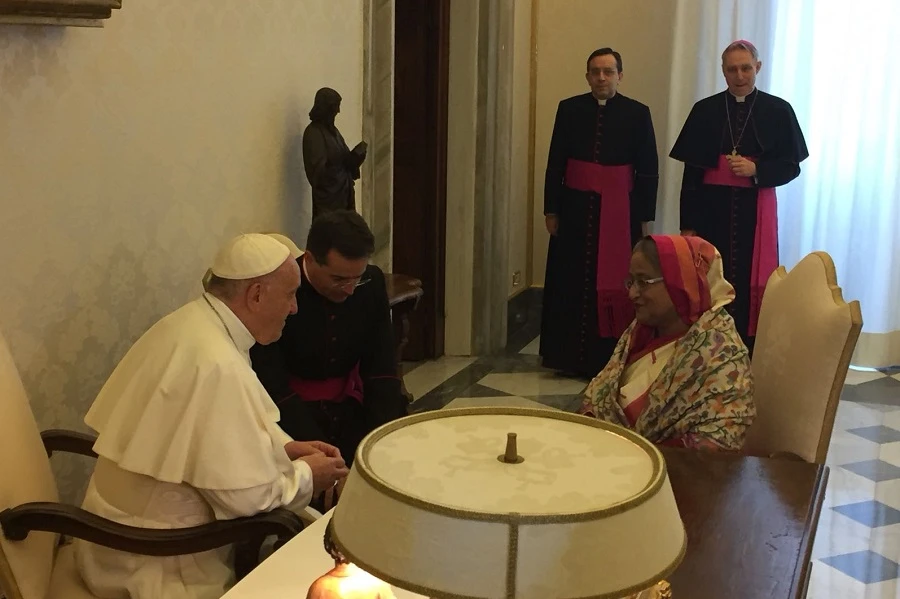
Vatican City, Feb 12, 2018 / 08:05 am (CNA/EWTN News).- Just two months after his recent visit to Bangladesh, Pope Francis Monday welcomed Prime Minister Sheikh Hasina to the Vatican, where they discussed positive inter-faith relations in the country and the need to find a lasting solution to the ongoing Rohingya refugee crisis.
According to a Feb. 12 Vatican communique, the conversation was cordial and highlighted the positive bilateral relations between the two and the success of Francis’ recent, Nov. 30-Dec. 2 visit to Bangladesh.
In particular, the “keen participation” of many non-Catholics was emphasized, as Bangladesh is a majority Muslim nation. Catholics are a small minority in Bangladesh, numbering only 375,000 – 0.2 percent – out of a total population of almost 156 million people.
The two spoke in English with the help of the Pope’s official interpreter, Monsignor Mark Miles. As Hasina walked in, she told the Pope that she was “very glad you were able to visit Bangladesh,” and Francis expressed his own gratitude, saying “thank you.”
In the conversation, which lasted for 20-minutes, Francis and Hasina also discussed the Catholic Church’s contribution to education in the country, as well as the State’s efforts in promoting peaceful relations among different religious communities.
They also focused on the need to defend minorities and refugees. To this end, appreciation was voiced to the Bangladeshi government for welcoming Rohingya Muslim refugees, whose plight was a major underlying theme of the Pope’s visit to both Burma – also called Myanmar – an Bangladesh last fall.
A largely Muslim ethnic group who reside in Burma’s Rakhine State, the Rohingya have faced a sharp increase in state-sponsored violence in their homeland, recently reaching staggering levels that have led the United Nations to declare the crisis “a textbook example of ethnic cleansing.”
With an increase in persecution in their home country of Burma, more than 600,000 Rohingya have fled across the border to Bangladesh, and are living in refugee camps.
Pope Francis personally greeted 18 members of the Rohingya community who were present at a Dec. 1 interreligious encounter in Dhaka, Bangladesh, asking forgiveness on behalf of all who persecute the Burmese minority.
In the Pope’s meeting with Hasina, the two voiced hope that a “just and lasting solution to their ordeal” might be reached soon.
After the meeting the Pope met the Prime Minister’s nine-person delegation and the two exchanged gifts. For her part, Hasina gave Francis an image of a boat, believed to be filled with migrants.
Pope Francis in turn gifted Hasina the medal of peace, which he often gives to the heads of state he receives, as well as a copy of his 2018 Message for Peace and his environmental encyclical Laudato Si.
Hasina then met with Vatican Secretary of State Cardinal Pietro Parolin and Msgr. Antoine Camilleri, under-Secretary for Relations with States.
If you value the news and views Catholic World Report provides, please consider donating to support our efforts. Your contribution will help us continue to make CWR available to all readers worldwide for free, without a subscription. Thank you for your generosity!
Click here for more information on donating to CWR. Click here to sign up for our newsletter.

Pope Francis opens the Holy Door in L’Aquila, Italy on Aug. 28, 2022. / Daniel Ibanez/CNA
Rome Newsroom, Aug 28, 2022 / 04:15 am (CNA).
Pope Francis became the first pope in 728 years to open the Holy Door of a 13th-century basilica in L’Aquila, Italy on Sunday.
During a visit to the Italian city located about 70 miles northeast of Rome on Aug. 28, the pope participated in a centuries-old tradition, the Celestinian Forgiveness, known in Italian as the Perdonanza Celestiniana.
The opening of the Holy Door marked a key moment in the annual celebration established by Pope Celestine V in 1294.
“For centuries L’Aquila has kept alive the gift that Pope Celestine V left it. It is the privilege of reminding everyone that with mercy, and only with it, the life of every man and woman can be lived with joy,” Pope Francis said in his homily during Mass at L’Aquila’s Basilica of Santa Maria di Collemaggio.
“To be forgiven is to experience here and now what comes closest to the resurrection. Forgiveness is passing from death to life, from the experience of anguish and guilt to that of freedom and joy. May this church always be a place where we can be reconciled, and experience that grace that puts us back on our feet and gives us another chance,” he said.
Pope Francis began the day trip at 7:50 a.m. traveling by helicopter from the Vatican to L’Aquila. He visited the city’s cathedral, which is still being rebuilt after it was badly damaged during a 2019 earthquake in which more than 300 people died.
The pope wore a hard hat while touring the reconstruction area of the damaged church. He spoke to family members of earthquake victims in the town square in front of the cathedral, where local prisoners were also present in the crowd. People cheered and waved Vatican flags as Pope Francis greeted them from a wheelchair.
Pope Francis wore a hard hat while visiting the L’Aquila cathedral, which was damaged by a 2019 earthquake. Vatican Media
Pope Francis said: “First of all I thank you for your witness of faith: despite the pain and loss, which belong to our faith as pilgrims, you have fixed your gaze on Christ, crucified and risen, who with his love redeemed the nonsense of pain and death.”
“And Jesus has placed you back in the arms of the Father, who does not let a tear fall in vain, not even one, but gathers them all in his merciful heart,” he added.
After speaking to the families of the victims, Pope Francis traveled in the popemobile to L’Aquila’s Basilica of Santa Maria di Collemaggio, where he celebrated an outdoor Mass, recited the Angelus, and opened the Holy Door.
In his brief Angelus message, the pope offered a prayer for the people of Pakistan, where flash floods have killed more than 1,000 people and displaced thousands more.
Pope Francis also asked for the intercession of the Virgin Mary to obtain “forgiveness and peace for the whole world,” mentioning Ukraine and all other places suffering from war.
Pope Francis prayed for peace in his Angelus address following Mass in L’Aquila, Italy. Pope Francis prayed for peace in his Angelus address following Mass in L’Aquila, Italy.
During his visit to L’Aquila, the pope said that he wanted the central Italian city to become a “capital of forgiveness, peace, and reconciliation.”
“This is how peace is built through forgiveness received and given,” he said.
L’Aquila is the burial place of Pope Celestine V, who led the Catholic Church for just five months before his resignation on Dec. 13, 1294. The pope, who was canonized in 1313, is buried in L’Aquila’s Basilica of Santa Maria di Collemaggio.
In the spring, the Vatican’s announcement that Pope Francis would visit L’Aquila prompted unsourced speculation that the trip could be the prelude to the 85-year-old pope’s resignation.
When Benedict XVI became the first pope to resign in almost 600 years in 2013, Vatican-watchers recalled that he had visited the tomb of Celestine V years earlier. During his trip on April 28, 2009, he left his pallium — the white wool vestment given to metropolitan archbishops — on the tomb. In hindsight, commentators suggested that Benedict was indicating his intention to resign.
In his homily in L’Aquila, Pope Francis praised Pope Celestine V for his humility and courage.
Mentioning Dante Alighieri’s description of Celestine as the man of “the great refusal,” Pope Francis underlined that Celestine should not be remembered as a man of “no” — for resigning the papacy — but as a man of “yes.”
Pope Francis said: “Indeed, there is no other way to accomplish God’s will than by assuming the strength of the humble, there is no other way. Precisely because they are so, the humble appear weak and losers in the eyes of men, but in reality they are the true winners, for they are the only ones who trust completely in the Lord and know his will.”
At the end of the Mass, the crowd prayed the Litany of Saints and watched as Pope Francis made history when he opened the basilica’s Holy Door. According to Cardinal Giuseppe Petrocchi of L’Aquila, Pope Francis is the first pope to open the Holy Door in 728 years.
Visiting cardinals have opened the Holy Door for the Celestinian Forgiveness in past years, after a reading of the bull of forgiveness by the local mayor. Celestine donated the papal bull to L’Aquila, where it is kept in an armored chapel in the tower of the town hall.
The bull of forgiveness drawn up by Celestine V offered a plenary indulgence to all who, having confessed and repented of their sins, go to the Basilica of Santa Maria di Collemaggio from Vespers on Aug. 28 to sunset on Aug. 29. A plenary indulgence is a grace granted by the Catholic Church through the merits of Jesus Christ, Mary, and all the saints to remove the temporal punishment due to sin.
Celestine’s indulgence was exceptional at the time, given it was available to anyone, regardless of status or wealth, and cost nothing except personal repentance at a time when indulgences were often tied to almsgiving.
Pope Francis prays at the tomb of Pope Celestine V in L’Aquila, Italy. Vatican Media
After opening the Holy Door, Pope Francis was wheeled through the basilica to the tomb of Pope Celestine V, where he spent a moment in silent prayer before the relics of his papal predecessor who was declared a saint in 1313.
“In the spirit of the world, which is dominated by pride, today’s Word of God invites us to be humble and meek. Humility does not consist in the devaluation of self, but rather in that healthy realism that makes us recognize our potential and also our miseries,” Pope Francis said.
“Starting precisely from our miseries, humility causes us to look away from ourselves and turn our gaze to God, the One who can do everything and also obtains for us what we cannot have on our own. ‘Everything is possible for those who believe (Mark 9:23).'”
Vatican City, Feb 20, 2021 / 06:18 am (CNA).- Pope Francis on Saturday named Cardinal Mauro Gambetti, O.F.M. Conv., to succeed Cardinal Angelo Comastri as archpriest of St. Peter’s Basilica and vicar general for Vatican City State.
Leave a Reply