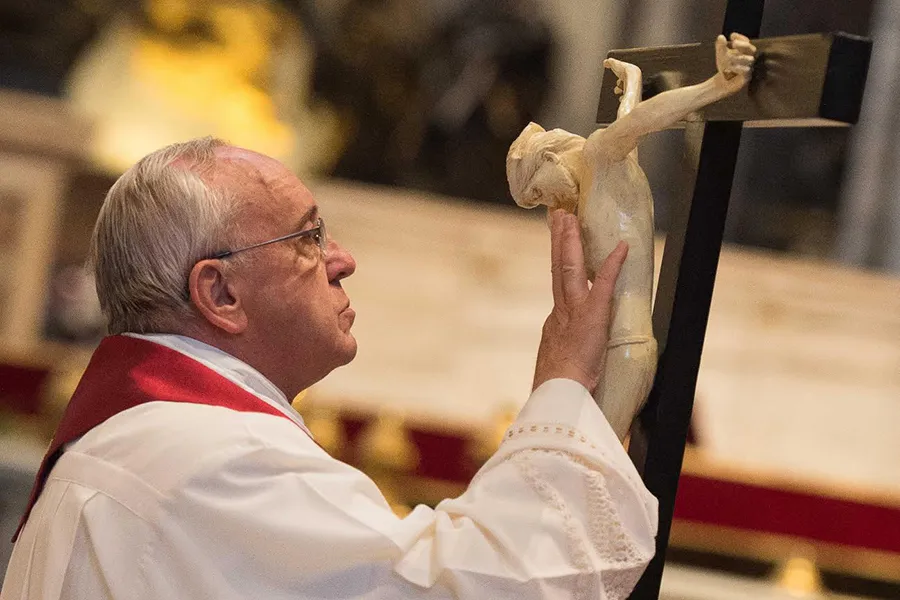
Vatican City, Jan 31, 2018 / 10:00 am (CNA/EWTN News).- The annual Lenten retreat for the Pope and members of the Roman Curia will this year focus on the theme, “Praise of Thirst.”
Themes of meditation during the week-long spiritual exercises include: Apprentices of Amazement, the Science of Thirst, The thirst of Jesus, and Listen to the Thirst of the Peripheries.
Held this year Feb. 18-23, the retreat will be led by Fr. José Tolentino de Mendonça, a Portuguese priest, poet, and Biblical theologian, who was selected by Pope Francis to prepare and deliver meditations during the spiritual exercises.
De Mendonça is vice-rector of the Portuguese Catholic University in Lisbon and has been a consultant of the Pontifical Council for Culture since 2011.
Ordained a priest in 1990, he completed his Master’s degree in Biblical Studies in Rome, before obtaining his doctorate in Biblical Theology from the Portuguese Catholic University, where he later taught as an assistant professor.
From 2011-2012 he was a Straus Fellow at New York University studying the topic of “Religion and Public Space.”
His books, well-known in Portugal, are beginning to be translated into other languages. De Mendonça is also an award-winning poet and essayist. In 2015, he won the Italian Res Magnae Literary Prize for his book, “A Mística do Instante” (The Mystique of the Instant).
The program for the spiritual exercises will begin Sunday evening with adoration and the recitation of vespers, also called Night Prayer. The remaining days will each follow a basic schedule of Mass at 7:30 a.m., followed by the first meditation of the day.
In the afternoon will be a second meditation, again ending with adoration and vespers. The final day will have only a morning meditation.
The week of prayer and meditation will take place at the Casa Divin Maestro in Ariccia, a town just 16 miles outside of Rome.
Located on Lake Albano, the retreat house is just a short way from the papal summer residence in Castel Gandolfo. It will be the fifth consecutive year the Pope and members of the Curia have held their Lenten retreat at the house in Ariccia.
While the practice of the Roman Pontiff going on retreat with the heads of Vatican dicasteries each Lent began some 80 years ago, it had been customary for them to follow the spiritual exercises on Vatican ground. Beginning in Lent 2014, Pope Francis chose to hold the retreat outside of Rome.
If you value the news and views Catholic World Report provides, please consider donating to support our efforts. Your contribution will help us continue to make CWR available to all readers worldwide for free, without a subscription. Thank you for your generosity!
Click here for more information on donating to CWR. Click here to sign up for our newsletter.

Vatican City, Oct 11, 2019 / 12:00 pm (CNA).- A senior legal official in the Vatican has dismissed the idea that a planned “synodal process” in Germany will be “binding,” noting that bishops must exercise their authority in unity and obedience to the authority of the pope.
Bishop Juan Ignacio Arrieta Ochoa, secretary of the Pontifical Council for Legislative Texts, said the idea that a synodal process in any particular country could change universal Church teaching and discipline is “not a possible way of thinking” in the Church.
“It is useless for anyone to pretend that the German synod is binding, because no one has given that authority to the German synod. No one can bind the faithful beyond their authority to bind or pastors beyond their authority to bind,” Arrieta said in an Oct. 11 interview.
Arrieta was one of the drafters and signatories to a legal assessment of the draft statutes for a Synodal Assembly currently being advanced by the bishops of Germany.
That assessment, which concluded that the German plans were “not ecclesiologically valid” was sent to Cardinal Reinhard Marx, president of the German bishops’ conference, on September 4 by Cardinal Marc Ouellet, head of the Congregation for Bishops.
Speaking to Alejandro Bermudez, executive director of the ACI Group, of which CNA is a part, Arrieta explained that bishops’ conferences are not autonomous bodies, but subject to the authority of the Congregation for Bishops because of their obligation of obedience to the pope.
“The bishops and their synods, and episcopal conferences, fall under the authority of the Congregation for Bishops,” Arrieta said.
“The connection is direct; they depend upon the pope, but through the Congregation for Bishops. In a vicarious, stable, delegated way, the pope has entrusted them to the direction of the congregation.”
In March of this year, Cardinal Marx announced that the Church in Germany would embark on a “binding synodal process” to tackle what he called the “key issues” arising from the clerical abuse crisis: clerical celibacy, the Church’s teaching on sexual morality, and a reduction of clerical power.
The synodal proposals call for the creation of an assembly in partnership with the Central Committee of German Catholics, a group whose leadership supports the ending of clerical celibacy, the changing of Church teaching on sexual morality to endorse homosexual unions, and the ordination of women to the priesthood.
In May, the committee’s leadership informed its members that the group would participate in the synodal process because it had received guarantees that the synod assembly could and would treat issues of universal teaching and discipline and pass “binding” resolutions, something Arrieta said went far beyond the authority of any country’s bishops to do.
“The philosophy of legal positivism is not the way of the Church,” Arrieta said. “For the Church it is not a possible way of thinking. What truly links the Church, and the faithful, are the sacraments, the word of Christ. No authority is binding that rejects the sacraments; that is not possible, acting that way would not be possible, even if some say that it could be so.”
“Pastors depend upon the pope, and only the pope can give the authority by which a synod would be binding,” Arrieta added. “Without that, saying ‘this is binding,’ or ‘I accept that this is binding’ does not make it so; no one would be bound. It is not useful for anyone to say that it is, or for someone to pretend that it is, or write a norm about it, because the norm itself would not have authority.”
In response to Ouellet’s September letter and the PCLT assessment, Marx flew to Rome and met with both Pope Francis and Cardinal Ouellet last month. Officials in the Congregation for Bishops told CNA that Marx had used the meetings to attempt to “minimize” the significance of the synodal plans, and to insist that Vatican criticisms are unfounded.
Before Marx arrived in Rome, Matthias Kopp, a spokesman for the German bishops’ conference told Catholic News Service that the term “binding” was not meant to imply any Church figure would be bound by the synodal conclusions. “Binding means it is a vote,” not simply a discussion, Kopp said.
The German bishops’ conference subsequently voted to adopt the statutes by a margin of 51-12 with 1 abstention during their plenary session on Sept. 25. At that time, Bishop Rudolph Voderholzer of Regesburg said that there was “a dishonesty at the beginning of the Synodal Process.”
The statutes are now with the Central Committee of German Catholics, the leaders of which will agree on an amended version with Cardinal Marx.
The synodal process in Germany is due to begin on the first day of Advent.
Cardinals follow the ceremony during the ordinary public consistory for the creation of new cardinals at St. Peter’s Basilica, Vatican City, Dec. 7, 2024. / Credit: Daniel Ibáñez/CNA
Vatican City, Apr 28, 2025 / 11:09 am (CNA).
At the upcoming papal conclave, set to begin May 7, the College of Cardinals will include several notably young members who have traveled to Rome from across the world, from Mongolia to Australia.
Among the 135 cardinals who are eligible to vote in a conclave, 15 of them are under the age of 60.
Historically, the age of cardinals participating in papal conclaves has varied. One of the youngest was Cardinal Alfonso Gesualdo di Conza, who attended the 1565–1566 conclave at the age of 25.
In more recent times, during the 2013 conclave, Cardinal Baselios Cleemis Thottunkal, major archbishop of the Syro-Malankara Catholic Church, was the youngest cardinal elector at 53. In the upcoming conclave, there are six cardinals the same age or younger.
Three of the youngest cardinals who will take part in the Conclave: Americo Manuel (51), from Portugal; Cardenal Mykola (45), Ukrainian Greek Catholic cardinal from Australia; and Cardinal Giorgio Marengo, (50), from Mongolia. They took a selfie yesterday in St Peter’s Basilica. pic.twitter.com/8rNa3vUWwA
The five youngest cardinals lead sees in Australia, Mongolia, Portugal, and Canada as well as a dicastery of the Roman Curia. Two of them are Eastern-rite Catholics. Three were made cardinals in the last consistory before the conclave.
Here are the five youngest cardinals who will help select the next pope:
Cardinal Mykola Bychok, 45
Born on Feb. 13, 1980, in Ternopil, Ukraine, Bychok felt the call to the priesthood at the age of 15. He joined the Congregation of the Most Holy Redeemer (the Redemptorists) in 1997, inspired by their missionary zeal. His service has been extensive, including roles as a missionary in Russia, parish priest, and provincial bursar in Ukraine as well as vicar of the Ukrainian Catholic Parish of St. John the Baptist in Newark, New Jersey.
Bishop Mykola Bychok, CSSR, speaks to journalists ahead of being made a cardinal on Dec. 6, 2024. The Ukrainian Greek Catholic prelate has served as eparch of Sts. Peter and Paul of Melbourne, Australia, since 2020. Credit: EWTN News
In January 2020, Pope Francis appointed him as the eparchial bishop of the Ukrainian Catholic Eparchy of Sts. Peter and Paul in Melbourne, Australia. His episcopal consecration took place on June 7, 2020. Bychok has worked to foster community among the Ukrainian diaspora in Australia and to increase youth engagement within the Church.
On Dec. 7, 2024, Pope Francis elevated him to the College of Cardinals, making him the current world’s youngest cardinal.
Cardinal Giorgio Marengo, 50
Cardinal Giorgio Marengo, born on June 7, 1974, in Cuneo, Italy, has been a Consolata missionary in Mongolia since 2003. He was ordained a priest in 2001 and appointed apostolic prefect of Ulaanbaatar in 2020.
Cardinal Giorgio Marengo was one of the first to welcome Pope Francis to Mongolia on Sept. 1, 2023. Marengo is an Italian cardinal who has served as a missionary in Mongolia for nearly 20 years. He is the current apostolic prefect of Ulaanbaatar, Mongolia. Credit: Vatican Media
Pope Francis created him a cardinal on Aug. 27, 2022, making him the youngest member of the College of Cardinals at the time at age 48. He welcomed Pope Francis to Mongolia in 2023 as the first pope to ever visit the country. Marengo is fluent in Mongolian, Italian, and English.
Cardinal Américo Manuel Aguiar Alves, 51
Cardinal Américo Manuel Aguiar Alves, born on Dec. 12, 1973, is the bishop of Setúbal, Portugal. Before entering the priesthood, Aguiar had a brief political career, serving as a town councilor under the Socialist Party. He was ordained a priest at the age of 27 in 2001 and went on to serve in roles such as vicar general and communication director for the Diocese of Porto. He became the auxiliary bishop of Lisbon in 2019 and gained recognition for his leadership in organizing the 2023 World Youth Day in Lisbon, which drew over 1.5 million attendees.
Pope Francis made him a cardinal in late 2023.
Cardinal Américo Manuel Aguiar Alves. Credit: Daniel Ibañez/CNA
Cardinal George Jacob Koovakad, 51
Cardinal George Jacob Koovakad, born on Aug. 11, 1973, in Kerala, India, is a Vatican diplomat and Syro-Malabar archbishop. His diplomatic career included assignments in various countries, including Algeria, South Korea, Iran, Costa Rica, and Venezuela. In July 2020, Koovakad returned to Rome to work as an official in the Secretariat of State. He was responsible for organizing Pope Francis’ international travels from 2021 to 2024.
Indian Cardinal George Jacob Koovakad of the Syro-Malabar Church, official of the Secretariat of State and organizer of papal trips, was created a cardinal by Pope Francis during the consistory at St. Peter’s Basilica on Dec. 7, 2024. Credit: Daniel Ibañez/CNA
The pope elevated Koovakad to cardinal on Dec. 7, 2024, and appointed him as prefect of the Dicastery for Interreligious Dialogue in January.
Cardinal Francis Leo, 53
Cardinal Francis “Frank” Leo, born on June 30, 1971, in Montreal to Italian immigrant parents, is the current archbishop of Toronto. He was ordained as a priest for the Archdiocese of Montreal in 1996. Leo holds a doctorate in systematic theology with a specialization in Mariology from the University of Dayton. He served as the general secretary of the Canadian Conference of Catholic Bishops from 2015 to 2021 and was appointed archbishop of Toronto in 2023, an archdiocese with a population of about 2 million Catholics.
Pope Francis made Leo a cardinal in December 2024.
Cardinal Francis Leo of Toronto was created a cardinal by Pope Francis during the consistory at St. Peter’s Basilica on Dec. 7, 2024. Credit: Daniel Ibañez/CNA
Leave a Reply