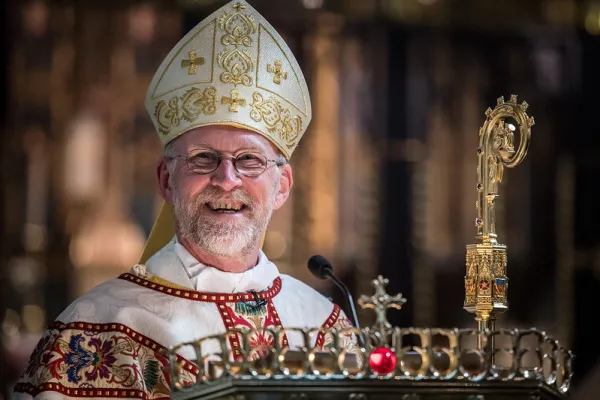
Lancaster, England, Mar 6, 2020 / 03:19 pm (CNA).- The Bishop of Lancaster on Thursday issued a decree meant to reduce the risk of coronavirus transmission at Mass, which focused on suspending the sign of peace and the reception of Holy Communion from the chalice.
The March 5 decree, signed by the diocese’s bishop and its chancellor, discouraged, but did not attempt to prohibit, reception of the Host on the tongue.
Bishop Paul Swarbrick introduced seven “pastoral measures” in the diocese effective March 5-21 “to reduce possible transmission” of coronavirus.
The sign of peace, reception from the chalice by the lay faithful, and the use of holy water stoups have been suspended.
“Those who choose to receive the Sacred Host on the tongue should be encouraged to receive on the hand instead. Their doing this represents an act of loving charity to their community. Alternatively, they should be encouraged to make a ‘Spiritual Communion’,” the decree states.
It addes that churches and chapels open for private prayer should remain open, with regular sanitization; ministers should wash and sanitize their hands before and after distributing Holy Communion; and “shared hymnbooks and Mass books should ideally not be used at this time.”
There are 147 confirmed cases of coronavirus in England. There has been one death in the country due to the infection.
Many Churches around the world have issued precautionary guidelines for Masses, or cancelled public Masses entirely, because of the coronavirus outbreak which originated in China late last year.
The new strain of coronavirus causes a respiratory disease, COVID-19, and has a fatality rate of roughly 3%. There have been more than 100,000 confirmed cases of coronavirus in at least 81 countries, and more than 3,400 deaths. The vast majority of cases and deaths have been in China.
Like the Diocese of Lancaster, the Archdiocese of Chicago has urged hygienic practices, and it it said that “given the frequency of direct contact with saliva in the distribution of Holy Communion on the tongue, every consideration should be given by each individual to receive Holy Communion reverently in open hands for the time being.”
The Archdiocese of Portland in Oregon said March 2 that “a parish cannot ban the reception of Holy Communion on the tongue, nor may an Ordinary or Extraordinary minister refuse a person requesting Holy Communion on the tongue.”
Its worship office emphasized that ministers of Holy Communion should be “able to distribute Holy Communion without risk of touching the hands or the tongue,” and that “parishioners should also be instructed how to receive Holy Communion properly either on the tongue or in the hand.”
The Portland archdiocese said, “We consulted with two physicians regarding this issue, one of which is a specialist in immunology for the State of Oregon. They agreed that done properly the reception of Holy Communion on the tongue or in the hand pose a more or less equal risk.”
“The risk of touching the tongue and passing the saliva on to others is obviously a danger however the chance of touching someone’s hand is equally probable and one’s hands have a greater exposure to germs.”
The Portland archdiocese referred to Redemptionis sacramentum, the Congregation for Divine Worship’s 2004 instruction on certain matters to be observed or to be avoided regarding the Most Holy Eucharist, which notes that “each of the faithful always has the right to receive Holy Communion on the tongue, at his choice.”
Immediately to Portland’s north, in the Archdiocese of Seattle, Archbishop Paul Etienne issued a differing set of directives in response to coronavirus.
The Northwest Catholic wrote March 3 that Archbishop Etienne “said that holy water should be removed from fonts” and “that Communion hosts should be received only in the hand, not on the tongue.”
On March 4, Bishop Thomas Daly of Spokane encouraged pastors to suspend the sign of peace, and to refrain from distributing the Precious Blood. He added that “this might also provide a catechetical opportunity to remind the faithful that reception of the Sacred Host is indeed reception of the body, blood, soul, and divinity of Christ.”
The following day, after a meeting “with local health experts, the vicars, school and other diocesan leaders,” Bishop Daly added that clerics should “consider encouraging parishioners to receive Holy Communion in the hand. Receiving in the hand carries a risk of infection, but there is an increased danger of transmitting this virus through droplets in the mouth.”
Archbishop John Wester of Santa Fe issued directives March 3 that directly prohibited the reception of the Eucharist on the tongue.
“During the flu season and given the possibility of being exposed to the coronavirus, ALL communicants are to receive Communion in the hand,” the archbishop said.
The Diocese of Tucson said March 5 that “as receiving Holy Communion on the tongue almost always involves some accidental touch with tongues and lips, Holy Communion should be distributed only in the hand for the immediate future.”
In guidelines updated March 6, the Diocese of Phoenix said that at the current stage of the outbreak, pastors “may implement” voluntary precautions, among which is that they “may invite communicants to receive on the hand,” adding that “reception of Communion on the tongue could inadvertently contaminate the hands of those distributing Communion. However, individual communicants have the right to decide.”
Should the outbreak become worse, pastors would be mandated to “invite communicants to receive on the hand.”
On March 5, Bishop Peter Baldacchino of Las Cruces issued guidelines which said that “it is still left to the discretion of the communicant how they wish to receive the Host. Please note that it may be good to notify them that receiving Holy Communion in the hand and not on the tongue is preferred to limit the exposure of being exposed to the Coronavirus Disease.”
Bishop Baldacchino added that “as the distribution of Holy Communion involves contact with both the mouth and hands, any Extraordinary Minister of Holy Communion who feels uncomfortable distributing Communion should be allowed to temporarily step down from ministry.”
Archbishop Leonard Blair of Hartford wrote March 3 to the clerics of his local Church to say that “Communion on the tongue should be strongly discouraged” as a precautionary measure against the spread of coronavirus.
A Feb. 28 memo sent from Archbishop Blair in his capacity as chairman of the US Conference of Catholic Bishops’ Committee on Divine Worship to the US bishops regarded “liturgical celebrations amid public health concerns regarding the spread of the coronavirus.”
The memo offered considerations “meant to be helpful” to bishops “if and when it becomes necessary to take preventative steps with regard to the celebration of the liturgy in your local church.”
The precautionary measures it offered were “suspending the exchange of the sign of peace” and “suspending the distribution of Holy Communion to the faithful via the chalice.”
Prohibiting the reception of Holy Communion on the tongue was not mentioned in the memo.
CNA contacted the USCCB and the archdioceses of Seattle and Santa Fe March 5 to inquire whether an ordinary is able to prohibit the reception of Communion on the tongue, considering that the Congregation for Divine Worship has called this a right that each of the faithful always has. No responses have been forthcoming.
 […]
[…]



My wife and I have a problem with our pastor (the only priest in the parish) recognizing our voices. He’s a fantastic priest (FSSP, not surprisingly) but he’s human. On the other hand, I guess it’s a help in avoiding serious sin!
I’m in a bit of a quandry. At first I’d go to Confession every week, just before Mass, so that I can partake in Communion but then I read that, unless I’m honestly planning not to repeat the sin that the Confession isn’t valid. Well, I live with my fiance and have physical relations with her. I realize that, due to the realities of our shared space, this won’t change and, until we marry, it will be sinful. As such, I’ve stopped going to Confession and stopped taking Communion, deciding that it won’t be right until we marry (months from now). I don’t see any other way as this reality is a mortal sin and I realize that I can’t take Communion under present circumstances. I don’t see any other way. I miss Communion but stay in my pew at the time as it would be wrong to do otherwise
Perhaps you could move to an unshared space, thus avoiding a near occasion of sin?
You’ve made the right decision to your credit. The best decision is to refrain. Ask God for the grace.
I asked a friend this before:
Would you trade the Lord of Heaven and Earth who was scourged, beaten, spat at, hammered to the cross and died an excruciating date FOR YOU, for sex with your girlfriend? Jesus or the girlfriend. Your answer is the girlfriend.
That falls then under the very serious sin of idolatry.
So yes, why pretend that you are sorry and thus go to confession when you really are not if there is no resolve to amend your life. That is the promise you make when you pray the Act of Contrition so right after confession you are already lying. God is not really God for you.
Look at Jesus on the cross and tell Him he matters less than the girl on your bed.
Apropos my earlier reply, while it is good to abstain from Communion, why would you choose to abstain from Communion with the Lord of Heaven and Earth than abstain from sin? Why would you choose a girlfriend over the God who formed you in your mother’s womb, who created your girl friend, who loves you more than anyone ever could?
St Paul said where sin abounds, grace abounds even more.
So right this very minute, an over abundance of grace is being poured upon you so you can turn away from a life of sin. It’s just for you to accept that grace and cooperate with it.