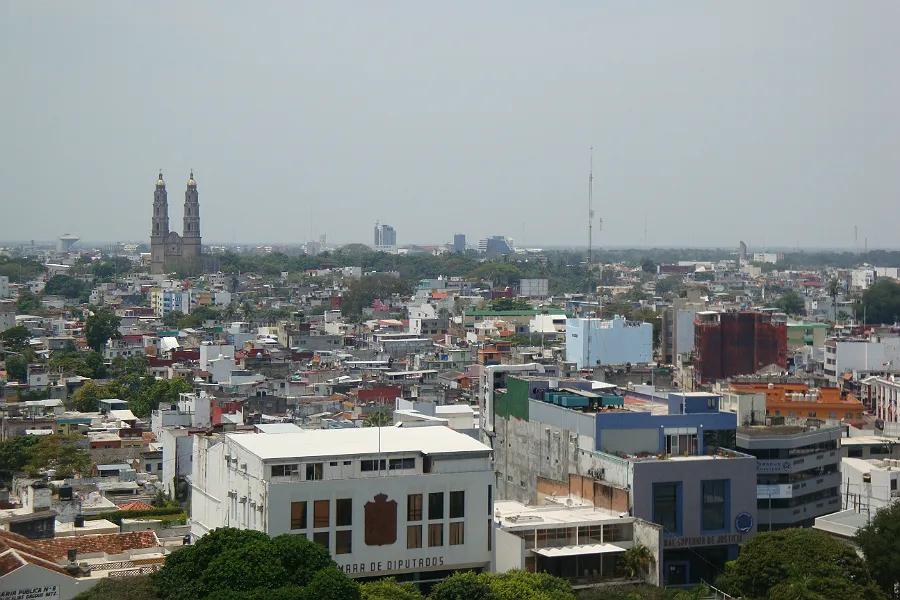
Villahermosa, Mexico, Dec 9, 2017 / 06:08 am (ACI Prensa).- A diocese in one of Mexico’s most violence-ridden states has indicated it will avoid scheduling Masses for Christmas and its octave at “high risk” times. It has also asked the state’s police to protect parishioners.
“With respect to the problem of insecurity, for the most part the established schedule has been kept, but we are trying to avoid scheduling certain times that could be high risk,” Fr. José Luis Compeán Rueda, vicar general of the Diocese of Tabasco, said at a Dec. 3 press conference in Villahermosa, capital of the Mexican state of Tabasco.
El Heraldo de Tabasco reported that Fr. Compean said he had met with the head of Tabasco’s Department of Public Safety, Jorge Aguirre Carbajal, to talk about the problem of the lack of public safety and said that “they will take appropriate steps as needed.”
“We hope the different state or municipal authorities will take corresponding measures to provide protection, not exclusively to the Church, but to all of society,” he said.
Fr. Compeán noted that during the year end festivities crime increases because people are getting paid Christmas bonuses and buying Christmas presents.
A September report prepared by the Tabasco Citizens’ Observatory revealed that in 2017 Tabasco occupied first place in the nation in kidnappings per capita.
“The State of Tabasco held first place in five categories of crime: kidnapping, aggravated robbery, robbery of businesses, holdups of passersby and livestock rustling” the director of Analysis and Statistics of the Tabasco Citizens’ Observatory, Julia Arrivillaga, told Televisa.
The Catholic Multimedia Center released a report in August showing that Tabasco is one of the most dangerous states for priests, and that Mexico is the most violent country for priests in Latin America.
This article was originally published by our sister agency, ACI Prensa. It has been translated and adapted by CNA.
If you value the news and views Catholic World Report provides, please consider donating to support our efforts. Your contribution will help us continue to make CWR available to all readers worldwide for free, without a subscription. Thank you for your generosity!
Click here for more information on donating to CWR. Click here to sign up for our newsletter.

Left photo: Pivato and Pope Francis in March 2024. | Right photo: Francis and Pivato in December 2013, at the start of his pontificate. / Credit: Photos courtesy of Marcelo Pivato
Lima Newsroom, May 3, 2025 / 08:00 am (CNA).
Following Pope Fran… […]
The President of the Communications Commission of the 2024 International Eucharistic Congress, Father Livingston Olivares (left), accompanies EWTN Vice President for Programming and Production Peter Gagnon (center-right), EWTN Vice President for Spanish-language Production, Marketing, and Radio Enrique Duprat (center-left), EWTN Production Director Michael Holmes (far right), and IEC Quito 2024 Communications Coordinator Marcelo Mejía (front, kneeling) at the Monument to the Equator, the exact location of the Equator (from which the country of Ecuador takes its name) on the outskirts of the country’s capital city of Quito, site of the 2024 International Eucharistic Congress. / Credit: Communications Commission of the 2024 International Eucharistic Congress
ACI Prensa Staff, May 21, 2024 / 06:40 am (CNA).
The 53rd International Eucharistic Congress (IEC) has chosen EWTN as the official channel for providing live coverage of the event, which will take place from Sept. 8–15 in Quito, Ecuador.
“The 53rd International Eucharistic Congress, which will be held in Quito Sept. 8–15, has chosen EWTN as its official channel, which will broadcast everything related” to this great event, said Father Juan Carlos Garzón, secretary-general of the IEC Quito 2024, in a statement sent from Rome to ACI Prensa, CNA’s Spanish-language news partner.
The theme for this year’s International Eucharistic Congress is “Fraternity to Heal the World.” On Monday, the Vatican also announced that Pope Francis designated Cardinal Kevin Farrell, prefect for the Dicastery for the Laity, the Family, and Life, as pontifical legate to the congress.
Garzón was in Rome last week as part of a delegation, chaired by Alfredo Espinoza Mateus, archbishop of Quito and primate of Ecuador, “to hold a series of meetings with the main papal authorities.”
Since the beginning of the preparations for IEC 2024, Garzón added: “EWTN has been present at the orientation and training for IEC 2024 communications personnel.”
Logo for the 53rd International Eucharistic Congress that will take place in Quito, Ecuador, from Sept. 8-15, 2024. Credit: Communications Commission of the 2024 International Eucharistic Congress
EWTN preparations for IEC Quito 2024
In tandem, to coordinate EWTN’s transmissions of IEC Quito 2024, a team from the network visited the Ecuadorian capital, including the Quito Metropolitan Convention Center, where the congress will be held.
The team was comprised of EWTN Vice President for Programming and Production Peter Gagnon, EWTN Director of Production Michael Holmes, and EWTN Vice President for Spanish-language Production, Marketing, and Radio Enrique Duprat.
Gagnon said EWTN transmissions of the event will be offered in Spanish, English, and German. “This will be a wonderful event for those attending and for those watching,” Gagnon said.
“For EWTN, it is an immense joy to be the channel for the Quito 2024 International Eucharistic Congress,” Duprat said. “It is essential for us to be the platform on which, no matter where our audience is, everyone can enjoy the most important Catholic events in the Church.”
As for coverage details, Duprat said: “The plan is to be able to offer this International Eucharistic Congress live and direct from Quito and in multiple languages [Spanish, English, and German] both through our television and radio signals, the internet, and through our digital app.”
The event coincides with the 150th anniversary of the 1874 consecration of Ecuador to the Sacred Heart of Jesus. In 1886, Quito was also the site of the first National Eucharistic Congress.
During their preparatory visit, the EWTN team traveled the route of a procession that will take place on Sept. 14 in the historic center of Quito, which will begin with a Mass in San Francisco Plaza and then head to the Basilica of the National Vow, where benediction will be given.
They also visited the IEC offices, where they were received by Garzón, who explained how the organization of the event is progressing, including the schedule of a theological symposium to be held Sept. 4–7, just prior to the Sept. 8–15 congress.
The EWTN delegation also visited the Middle of the World Park and Monument to the Equator, marking the equator dividing the northern and southern hemispheres and where a Liturgy of the Word is planned with emphasis on care for creation.
Registration underway
Registration for the International Eucharistic Congress, both for the theological symposium and for the congress itself, is underway and available through the event website.
The largest Catholic media organization in the world, EWTN’s 11 global TV channels and numerous regional channels are broadcast in multiple languages 24 hours a day, seven days a week to over 425 million television households in more than 160 countries and territories. EWTN platforms also include radio services transmitted through SIRIUS/XM, iHeart Radio, and more than 600 domestic and international AM and FM radio affiliates and a worldwide shortwave radio service.
Headquartered in Washington, D.C., EWTN News operates multiple global news services, including Catholic News Agency; The National Catholic Register newspaper and digital platform; ACI Prensa in Spanish; ACI Digital in Portuguese; ACI Stampa in Italian; ACI Africa in English, French, and Portuguese; ACI Mena in Arabic; CNA Deutsch in German; and ChurchPop, a digital platform that creates content in several languages. It also produces numerous television news programs including “EWTN News Nightly,” “EWTN News In Depth,” “EWTN Pro-Life Weekly,” and “The World Over with Raymond Arroyo.”
This story was first published by ACI Prensa, CNA’s Spanish-language news partner. It has been translated and adapted by CNA.
Mexico’s murder rate is 16.75 per 100,000 with no death penalty while China’s murder rate is .74 per 100,000 with a quickly carried out death penalty. Both countries have multiple millions of poor unlike Europe where mild affluence helps greatly against murder.
The Vatican should be examining Mexico, Brazil and half of the Central American countries whose very high murder rates might warrant the rare use of the death penalty according to the catechism’s rare use concept. I say that with a smile. Follow up by the Vatican on rare use does not have one case since the catechism was written revised in 1997….because we are imaging in this issue. We’re signaling liberal values to the Nobel jury. If the Vatican cared about the lives involved, it would have completed a serious deterrence study by now….and looked into the five non death penalty Catholic countries which are in the top ten worst murder rates of the world. There is no research by Catholic offices in this area because we all know…we were never serious about rare but necessary use. We knew that when three Popes publicly sought abolition which makes rare use impossible. It’s the fib within the catechism. It was signaling from the get go. This week in non death penalty New Jersey, an Ecuadorian father was shot in the head before his wife and child for not having money for two robbers in Irvington. The family had just come from a prayer group at St. Leo’s parish. Two friends of mine were murdered in NJ when I was young within a block from my house in two different years and one felon got out in five years for being 16 when murdering Kathleen. He then bragged about it in the wrong Irish bar…which closed it’s front door and removed all his teeth the ufc way. He was very lucky since years later they shot a boxer to death for adultery with a gang members wife. Where you don’t have the death penalty by the law giver, you have it in the bars and streets eventually. Catholic Brazil has it by police now and then while forbidding it by the state.
Mexico’s murder rate is 16.75 per 100,000 with no death penalty while China’s murder rate is .74 per 100,000 with a quickly carried out death penalty. Both countries have multiple millions of poor unlike Europe where mild affluence helps greatly against murder.
The Vatican should be examining Mexico, Brazil and half of the Central American countries whose very high murder rates might warrant the rare use of the death penalty according to the catechism’s rare use concept. I say that with a smile. Follow up by the Vatican on rare use does not have one case since the catechism was written revised in 1997….because we are imaging in this issue. We’re signaling liberal values to the Nobel jury. If the Vatican cared about the lives involved, it would have completed a serious deterrence study by now….and looked into the five non death penalty Catholic countries which are in the top ten worst murder rates of the world. There is no research by Catholic offices in this area because we all know…we were never serious about rare but necessary use. We knew that when three Popes publicly sought abolition which makes rare use impossible. It’s the fib within the catechism. It was signaling from the get go. This week in non death penalty New Jersey, an Ecuadorian father was shot in the head before his wife and child for not having money for two robbers in Irvington. The family had just come from a prayer group at St. Leo’s parish. Two friends of mine were murdered in NJ when I was young within a block from my house in two different years and one felon got out in five years for being 16 when murdering Kathleen. He then bragged about it in the wrong Irish bar…which closed it’s front door and removed all his teeth the ufc way. He was very lucky since years later they shot a boxer to death for adultery with a gang members wife. Where you don’t have the death penalty by the law giver, you have it in the bars and streets eventually. Catholic Brazil has it by police now and then while forbidding it by the state.