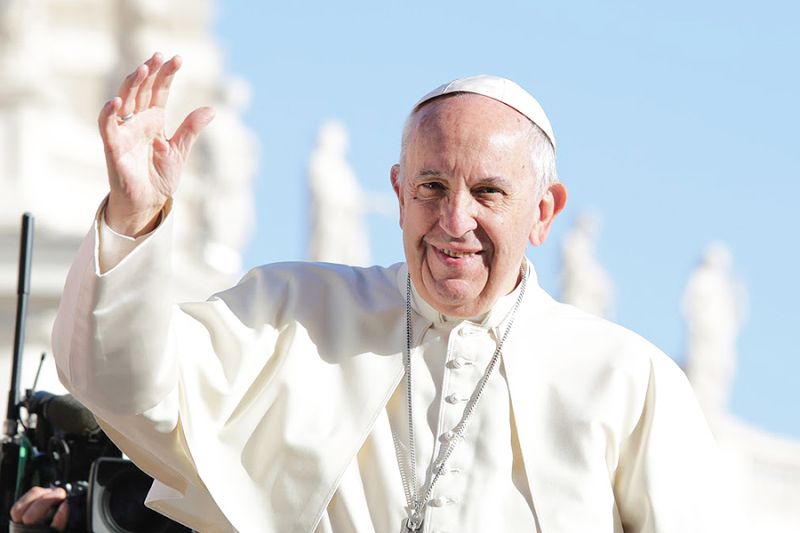
Pope Francis arrives for his weekly audience in Paul VI hall at the Vatican Aug. 23. (CNS/Alessandro Bianchi, Reuters)
If you are an Anglophone and you follow the affairs of the Catholic Church, you likely heard something about Pope Francis’ remarks to a society of liturgical experts on Thursday. A good deal of hay has been made with the Pope’s words already, and much ink spilt in the effort to understand what it could possibly mean to say that “the liturgical reform is irreversible,” and more to understand what it could mean to say it, “with magisterial authority.”
The really interesting thing about the Holy Father’s speech, though, is the light it sheds on the way he intends to use the powers of his office.
One of the complaints we heard early and often about Pope Francis is that he had no real understanding of what Papal power really is, let alone how to use it.
Anyone persisting in that opinion will need to account for the Pope’s actual use of that power, which has been – almost from day one – more frank and confident than such an opinion would appear to allow.
After all, this is a Pope who has been perfectly happy to canonize his favorite confrère as a birthday present to himself: who is content to govern outside the constitutional structure provided him; who appears perfectly willing to let the men supposed to be his closest advisors say what they will about his leadership, while keeping his own counsel when it comes to decision-making; and who understands, without either a shadow of doubt or a smither of ambiguity, that he is in charge.
In a word: Pope Francis is the decider.
In any case, and in despite of the breathless claims that Pope Francis did, indeed, assert with magisterial authority the irreversibility of the liturgical reform, the plain fact of the matter is that an assertion of just such a thing is precisely what Pope Francis did not make. Rather, the Pope said that he can make such an assertion: that is a very different thing from actually asserting it.
Make no mistake: the Pope’s precise formulation does tell us that he believes the reform to be in some sense irreversible, and that he is willing in principle to make that assertion with magisterial authority.
Therefore, Francis’ assertion of magisterial authority to say that the post-Conciliar liturgical reform is irreversible – which actually calls attention to his not saying it – tells us more about his estimation of the scope of his powers as Pope and about the manner in which he intends to use the powers he does not doubt he has, than it does about his personal opinion regarding the state and direction of the Church’s liturgical life.
At bottom, the Church’s “journey” of reform in the post-Conciliar era is a fact of history. History happens, and once it does happen, it cannot be undone. In this sense, the reform that has gone before us is irreversible. Nevertheless, we are still very much in the process – Francis often prefers to say that we are on the journey – of reform: a process “that requires time, faithful reception, practical obedience, wise implementation…” This reform, moreover, begins with the books, but ultimately must speak to “the mentality of the people” which “must be reformed as well.”
Francis, in short, understands that he presides with direct, immediate, and supreme authority over the whole Church and all the faithful – in other words, that he is the Roman Pontiff – and that the purpose he has set for himself in the exercise of the powers that inhere in the office he holds is the precise direction of the process of reform.
This is work – the work of reform, hence the work of directing it – the Holy Father believes far from finished.
“There is still work to do in this direction,” Pope Francis said in his remarks on Thursday, “in particular,” the work of, “rediscovering the reasons for the decisions made with the liturgical reform, overcoming unfounded and superficial readings, partial receptions, and practices that disfigure it.”
With the announcement of the common task of the Church – the hierarchical leadership and the faithful together – as one of seeking anew the reasons in view of which specific reforms have been undertaken, Pope Francis is focusing his (and our) attention on the rational substance of the reform process.
The specific choices made along the way remain in place – including, presumably, the significant contributions of Benedict XVI, especially though by no means exclusively Benedict’s choice in Summorum Pontificum to liberalize the use of the 1962 liturgical books. Those choices, however, are to be understood in light of a common understanding of the animating principles of the Church’s whole liturgical life, which – again, presumably – are those so ably and eloquently outlined and detailed in Sacrosanctum Concilium.
Here, it is worth our while to pause for a moment to reflect on the polyvalence of the word, “partial” which the Holy Father deployed to modify “receptions” in the remark quoted above.
Even in English, but more so in Italian, “partial” can indicate something less than complete or perfect, and a commitment to or preference for one side of thing – say, an argument. If one is offered five propositions, and assents to three, one’s acceptance of the propositions may be said to be partial. Given a pair of options, one might say, “I am partial to the former,” or the latter.
Pope Francis’ insistence on both the irreversibility of the reform, and the need for rediscovery of the reasons of the reform, itself, strongly suggest that he believes we must reject receptions that are partial in both senses: we cannot take the reform of the liturgy in a piecemeal fashion; nor can we use the process as an opportunity to hijack the institutional power of the Church at any level to impose our own liturgical preferences on those who do not share them.
The Pope is willing to use his power to steer the course of the process, while leaving the question of substance open to free discussion and debate among all the faithful – and this is a potentially fruitful tack to take, albeit a risky one.
The risk in such an approach is that an attempt to implement it might give new impetus to the so-called “liturgy wars” that ravaged the ecclesiastical landscape in the decades that immediately followed the close of the II Vatican Council, and that have given way for the moment to an often hard and bitter peace.
Whatever his motivations, that is a risk Pope Francis appears willing to take: si pacem vis, paras bellum.
Whether or not the Pope’s bid to establish a firm foundation for the peace of the Church does result in a renewal of hostilities will depend in large part on the generous and charitable response of all the faithful in every state of life.
If you value the news and views Catholic World Report provides, please consider donating to support our efforts. Your contribution will help us continue to make CWR available to all readers worldwide for free, without a subscription. Thank you for your generosity!
Click here for more information on donating to CWR. Click here to sign up for our newsletter.
Pope Francis at the general audience in St. Peter’s Square, Oct. 5, 2016. / Credit: Daniel Ibanez/CNA
CNA Staff, Mar 13, 2024 / 12:00 pm (CNA).
March 13 marks the anniversary of the election of Pope Francis as the 266th successor of St. Peter. Here is a timeline of key events during his papacy:
2013
March 13 — About two weeks after Pope Benedict XVI steps down from the papacy, Cardinal Jorge Bergoglio is elected pope. He takes the papal name Francis in honor of St. Francis of Assisi and proclaims from the central balcony of St. Peter’s Basilica: “Let us begin this journey, the bishop and people, this journey of the Church of Rome, which presides in charity over all the Churches, a journey of brotherhood in love, of mutual trust. Let us always pray for one another.”
March 14 — The day after he begins his pontificate, Pope Francis returns to his hotel to personally pay his hotel bill and collect his luggage.
July 8 — Pope Francis visits Italy’s island of Lampedusa and meets with a group of 50 migrants, most of whom are young men from Somalia and Eritrea. The island, which is about 200 miles off the coast of Tunisia, is a common entry point for migrants who flee parts of Africa and the Middle East to enter Europe. This is the pope’s first pastoral visit outside of Rome and sets the stage for making reaching out to the peripheries a significant focus.
Pope Francis gives the Wednesday general audience in St. Peter’s Square on Oct. 2, 2013. Elise Harris/CNA.
July 23-28 — Pope Francis visits Rio de Janeiro, Brazil, to participate in World Youth Day 2013. More than 3 million people from around the world attend the event.
July 29 — On the return flight from Brazil, Pope Francis gives his first papal news conference and sparks controversy by saying “if a person is gay and seeks God and has goodwill, who am I to judge?” The phrase is prompted by a reporter asking the pope a question about priests who have homosexual attraction.
Nov. 24 — Pope Francis publishes his first apostolic exhortation Evangelii Gaudium (The Joy of the Gospel). The document illustrates the pope’s vision for how to approach evangelization in the modern world.
2014
Feb. 22 — Pope Francis holds his first papal consistory to appoint 19 new cardinals, including ones from countries in the developing world that have never previously been represented in the College of Cardinals, such as Haiti.
March 22 — Pope Francis creates the Pontifical Commission for the Protection of Minors. The commission works to protect the dignity of minors and vulnerable adults, such as the victims of sexual abuse.
Pope Francis greets pilgrims during his general audience on Nov. 29, 2014. Bohumil Petrik/CNA.
Oct. 5 — The Synod on the Family begins. The bishops discuss a variety of concerns, including single-parent homes, cohabitation, homosexual adoption of children, and interreligious marriages.
Dec. 6 — After facing some pushback for his efforts to reform the Roman Curia, Pope Francis discusses his opinion in an interview with La Nacion, an Argentine news outlet: “Resistance is now evident. And that is a good sign for me, getting the resistance out into the open, no stealthy mumbling when there is disagreement. It’s healthy to get things out into the open, it’s very healthy.”
2015
Jan. 18 — To conclude a trip to Asia, Pope Francis celebrates Mass in Manila, Philippines. Approximately 6 million to 7 million people attend the record-setting Mass, despite heavy rain.
March 23 — Pope Francis visits Naples, Italy, to show the Church’s commitment to helping the fight against corruption and organized crime in the city.
May 24 — To emphasize the Church’s mission to combat global warming and care for the environment, Pope Francis publishes the encyclical Laudato Si’, which urges people to take care of the environment and encourages political action to address climate problems.
Pope Francis at a Wednesday general audience in St. Peter’s Square on June 17, 2015. Bohumil Petrik.
Sept. 19-22 — Pope Francis visits Cuba and meets with Fidel Castro in the first papal visit to the country since Pope John Paul II in 1998. During his homily, Francis discusses the dignity of the human person: “Being a Christian entails promoting the dignity of our brothers and sisters, fighting for it, living for it.”
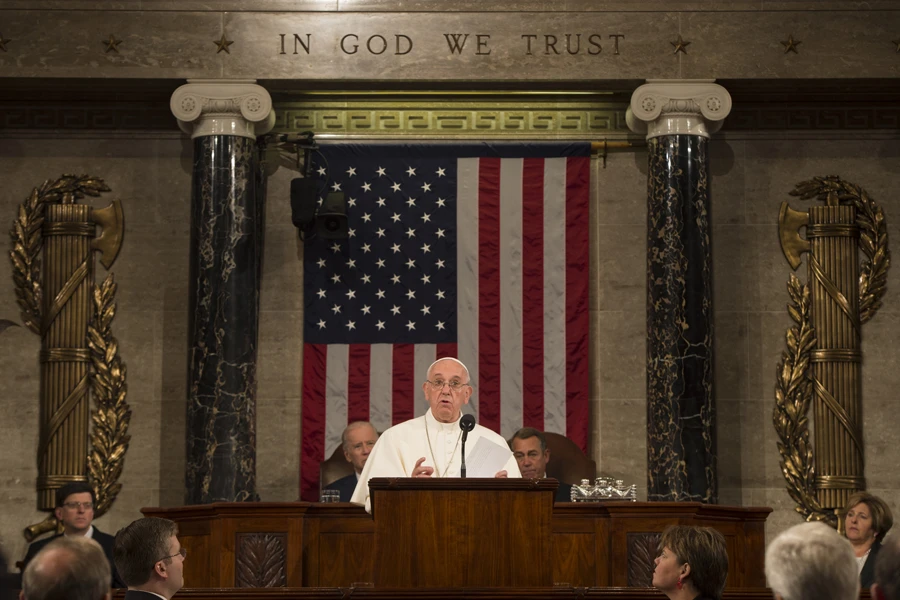
Sept. 22-27 — After departing from Cuba, Pope Francis makes his first papal visit to the United States. In Washington, D.C., he speaks to a joint session of Congress, in which he urges lawmakers to work toward promoting the common good, and canonizes the Franciscan missionary St. Junípero Serra. He also attends the World Meeting of Families in Philadelphia, which focuses on celebrating the gift of the family.
Pope Francis speaks to the U.S. Congress in Washington, D.C. on Sept. 24, 2015. . L’Osservatore Romano.
Oct. 4 — Pope Francis begins the second Synod on the Family to address issues within the modern family, such as single-parent homes, cohabitation, poverty, and abuse.
Oct. 18 — The pope canonizes St. Louis Martin and St. Marie-Azélie “Zelie” Guérin. The married couple were parents to five nuns, including St. Therese of Lisieux. They are the first married couple to be canonized together.
Dec. 8 — Pope Francis’ Jubilee Year of Mercy begins. The year focuses on God’s mercy and forgiveness and people’s redemption from sin. The pope delegates certain priests in each diocese to be Missionaries of Mercy who have the authority to forgive sins that are usually reserved for the Holy See.
2016
March 19 — Pope Francis publishes the apostolic exhortation Amoris Laetitia, which discusses a wide variety of issues facing the modern family based on discussions from the two synods on the family. The pope garners significant controversy from within the Church for comments he makes in Chapter 8 about Communion for the divorced and remarried.
April 16 — After visiting refugees on the Greek island of Lesbos, Pope Francis allows three Muslim refugee families to join him on his flight back to Rome. He says the move was not a political statement.
Pope Francis at the General Audience in St. Peter’s Square, Feb. 24, 2016. Daniel Ibanez/CNA.
July 26-31 — Pope Francis visits Krakow, Poland, as part of the World Youth Day festivities. About 3 million young Catholic pilgrims from around the world attend.
Sept. 4 — The pope canonizes St. Teresa of Calcutta, who is also known as Mother Teresa. The saint, a nun from Albania, dedicated her life to missionary and charity work, primarily in India.
Sept. 30-Oct. 2 — Pope Francis visits Georgia and Azerbaijan on his 16th trip outside of Rome since the start of his papacy. His trip focuses on Catholic relations with Orthodox Christians and Muslims.
Oct. 4 — Pope Francis makes a surprise visit to Amatrice, Italy, to pray for the victims of an earthquake in central Italy that killed nearly 300 people.
2017
May 12-13 — In another papal trip, Francis travels to Fatima, Portugal, to visit the Shrine of Our Lady of Fatima. May 13 marks the 100th anniversary of the first Marian apparition to three children in the city.
July 11 — Pope Francis adds another category of Christian life suitable for the consideration of sainthood: “offering of life.” The category is distinct from martyrdom, which only applies to someone who is killed for his or her faith. The new category applies to those who died prematurely through an offering of their life to God and neighbor.
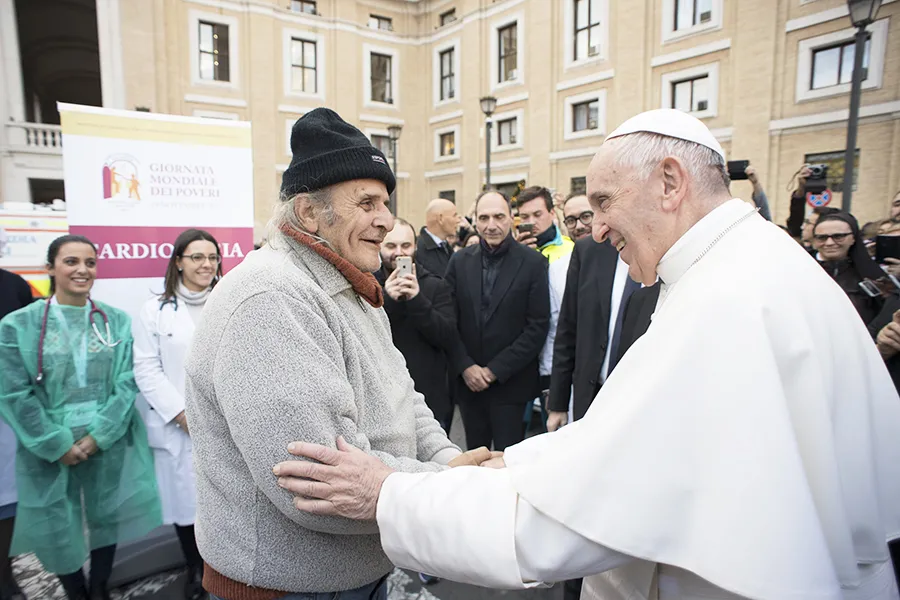
Pope Francis greets a participant in the World Day of the Poor in Rome, Nov. 16, 2017. L’Osservatore Romano.
Nov. 19 — On the first-ever World Day of the Poor, Pope Francis eats lunch with 4,000 poor and people in need in Rome.
Nov. 27-Dec. 2 — In another trip to Asia, Pope Francis travels to Myanmar and Bangladesh. He visits landmarks and meets with government officials, Catholic clergy, and Buddhist monks. He also preaches the Gospel and promotes peace in the region.
2018
Jan. 15-21 — The pope takes another trip to Latin America, this time visiting Chile and Peru. The pontiff meets with government officials and members of the clergy while urging the faithful to remain close to the clergy and reject secularism. The Chilean visit leads to controversy over Chilean clergy sex abuse scandals.
Aug. 2 — The Vatican formally revises No. 2267 of the Catechism of the Catholic Church, which concerns the death penalty. The previous text suggested the death penalty could be permissible in certain circumstances, but the revision states that the death penalty is “inadmissible.”
Aug. 25 — Archbishop Carlo Viganò, former papal nuncio to the United States, publishes an 11-page letter calling for the resignation of Pope Francis and accusing him and other Vatican officials of covering up sexual abuse including allegations against former Cardinal Theodore McCarrick. The pope initially does not directly respond to the letter, but nine months after its publication he denies having prior knowledge about McCarrick’s conduct.
Aug. 25-26 — Pope Francis visits Dublin, Ireland, to attend the World Meeting of Families. The theme is “the Gospel of family, joy for the world.”
Pope Francis at the 2018 World Meeting of Families in Ireland. Daniel Ibanez/CNA.
Oct. 3-28 — The Synod on Young People, the Faith, and Vocational Discernment takes place. The synod focuses on best practices to teach the faith to young people and to help them discern God’s will.
2019
Jan. 22-27 — The third World Youth Day during Pope Francis’ pontificate takes place during these six days in Panama City, Panama. Young Catholics from around the world gather for the event, with approximately 3 million people in attendance.
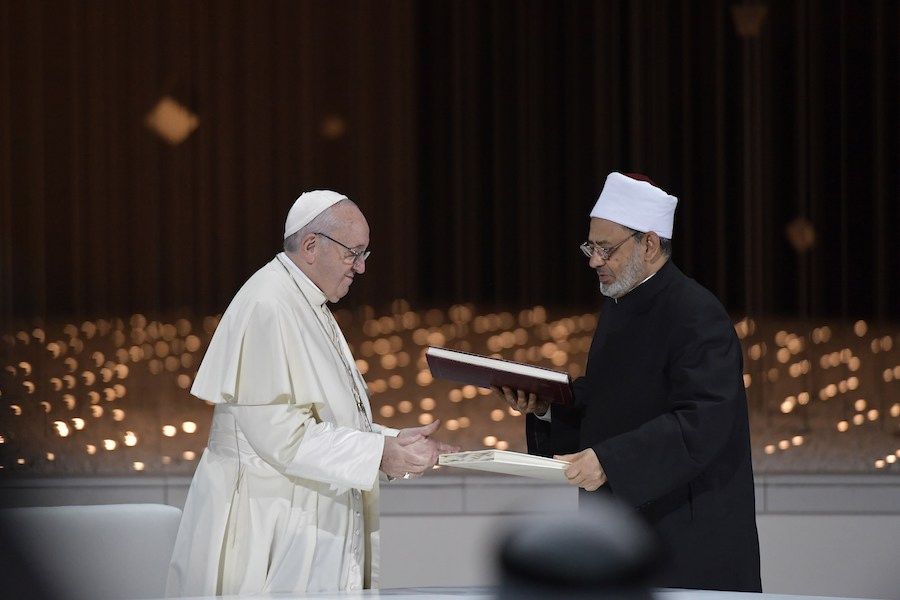
Feb. 4 — Pope Francis signs a joint document in with Sheikh Ahmed el-Tayeb, the grand imam of Al-Azhar, in Abu Dhabi, United Arab Emirates, titled the “Document on Human Fraternity for World Peace and Living Together.” The document focuses on people of different faiths uniting together to live peacefully and advance a culture of mutual respect.
Pope Francis and Ahmed el-Tayeb, grand imam of al-Azhar, signed a joint declaration on human fraternity during an interreligious meeting in Abu Dhabi, UAE, Feb. 4, 2019. Vatican Media.
Feb. 21-24 — The Meeting on the Protection of Minors in the Church, which is labeled the Vatican Sexual Abuse Summit, takes place. The meeting focuses on sexual abuse scandals in the Church and emphasizes responsibility, accountability, and transparency.
Oct. 6-27 — The Church holds the Synod of Bishops for the Pan-Amazon region, which is also known as the Amazon Synod. The synod is meant to present ways in which the Church can better evangelize the Amazon region but leads to controversy when carved images of a pregnant Amazonian woman, referred to by the pope as Pachamama, are used in several events and displayed in a basilica near the Vatican.
Oct. 13 — St. John Henry Newman, an Anglican convert to Catholicism and a cardinal, is canonized by Pope Francis. Newman’s writings inspired Catholic student associations at nonreligious colleges and universities in the United States and other countries.
2020
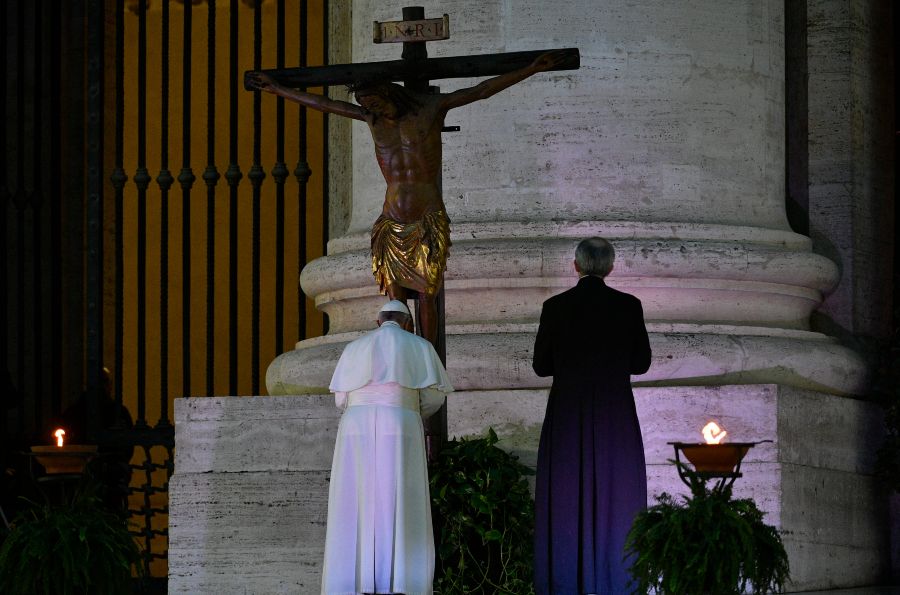
March 15 — Pope Francis takes a walking pilgrimage in Rome to the chapel of the crucifix and prays for an end to the COVID-19 pandemic. The crucifix was carried through Rome during the plague of 1522.
March 27 — Pope Francis gives an extraordinary “urbi et orbi” blessing in an empty and rain-covered St. Peter’s Square, praying for the world during the coronavirus pandemic.
Pope Francis venerates the miraculous crucifix of San Marcello al Corso in St. Peter’s Square during his Urbi et Orbi blessing, March 27, 2020. Vatican Media.
2021
March 5-8 — In his first papal trip since the start of the COVID-19 pandemic, Pope Francis becomes the first pope to visit Iraq. On his trip, he signs a joint statement with Grand Ayatollah Ali al-Sistani condemning extremism and promoting peace.
July 3 — Cardinal Giovanni Angelo Becciu, who was elevated to the College of Cardinals by Pope Francis, is indicted in a Vatican court for embezzlement, money laundering, and other crimes. The pope gives approval for the indictment.
July 4 — Pope Francis undergoes colon surgery for diverticulitis, a common condition in older people. The Vatican releases a statement that assures the pope “reacted well” to the surgery. Francis is released from the hospital after 10 days.
July 16 — Pope Francis issues a motu proprio titled Traditionis Custodes. The document imposes heavy restrictions on the celebration of the Traditional Latin Mass.
Dec. 2-6 — The pope travels to Cyprus and Greece. The trip includes another visit to the Greek island of Lesbos to meet with migrants.
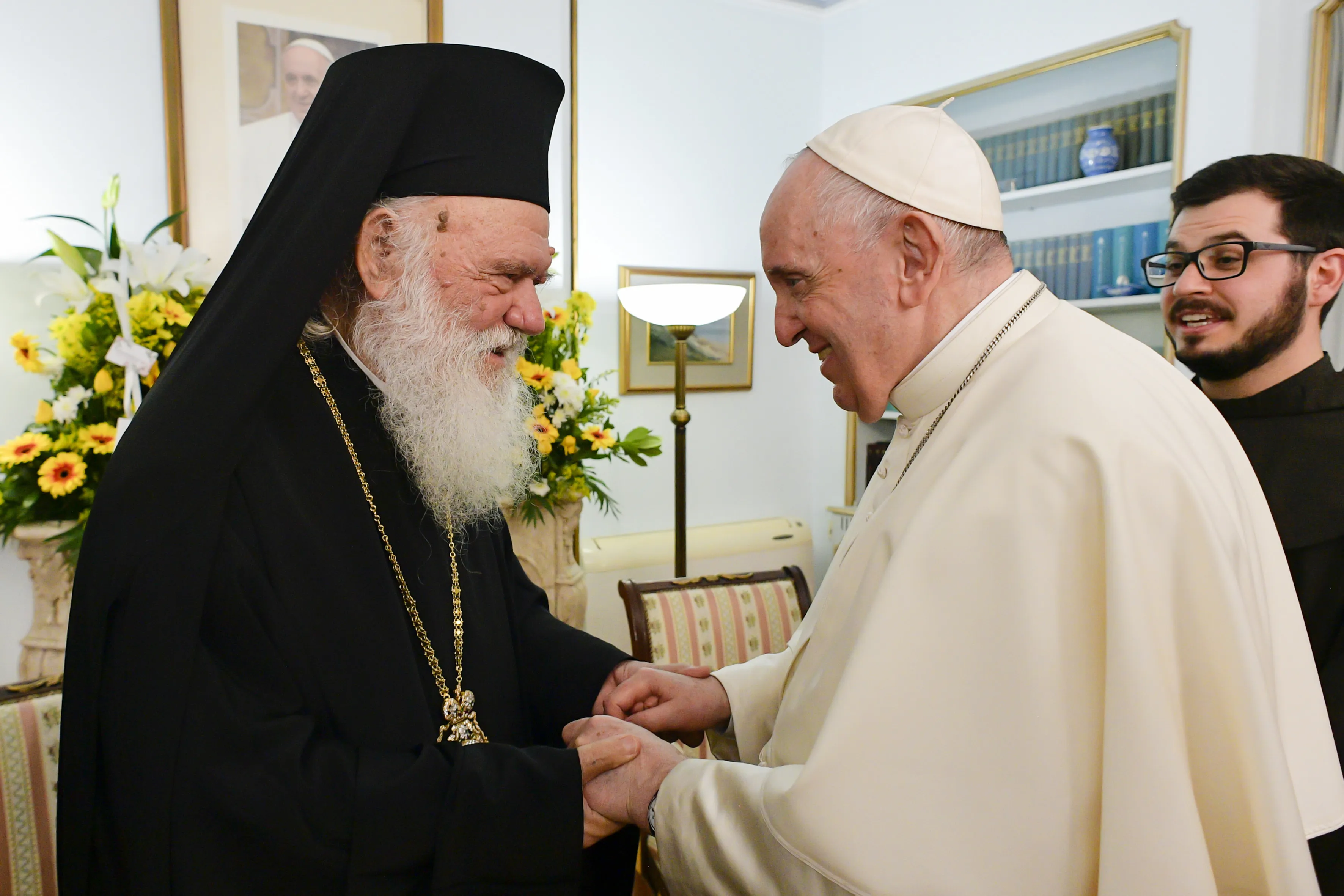
Pope Francis greets His Beatitude Ieronymos II in Athens, Greece on Dec. 5, 2021. Vatican Media
2022
Jan. 11 — Pope Francis makes a surprise visit to a record store in Rome called StereoSound. The pope, who has an affinity for classical music, blesses the newly renovated store.
March 19 — The pope promulgates Praedicate Evangelium, which reforms the Roman Curia. The reforms emphasize evangelization and establish more opportunities for the laity to be in leadership positions.
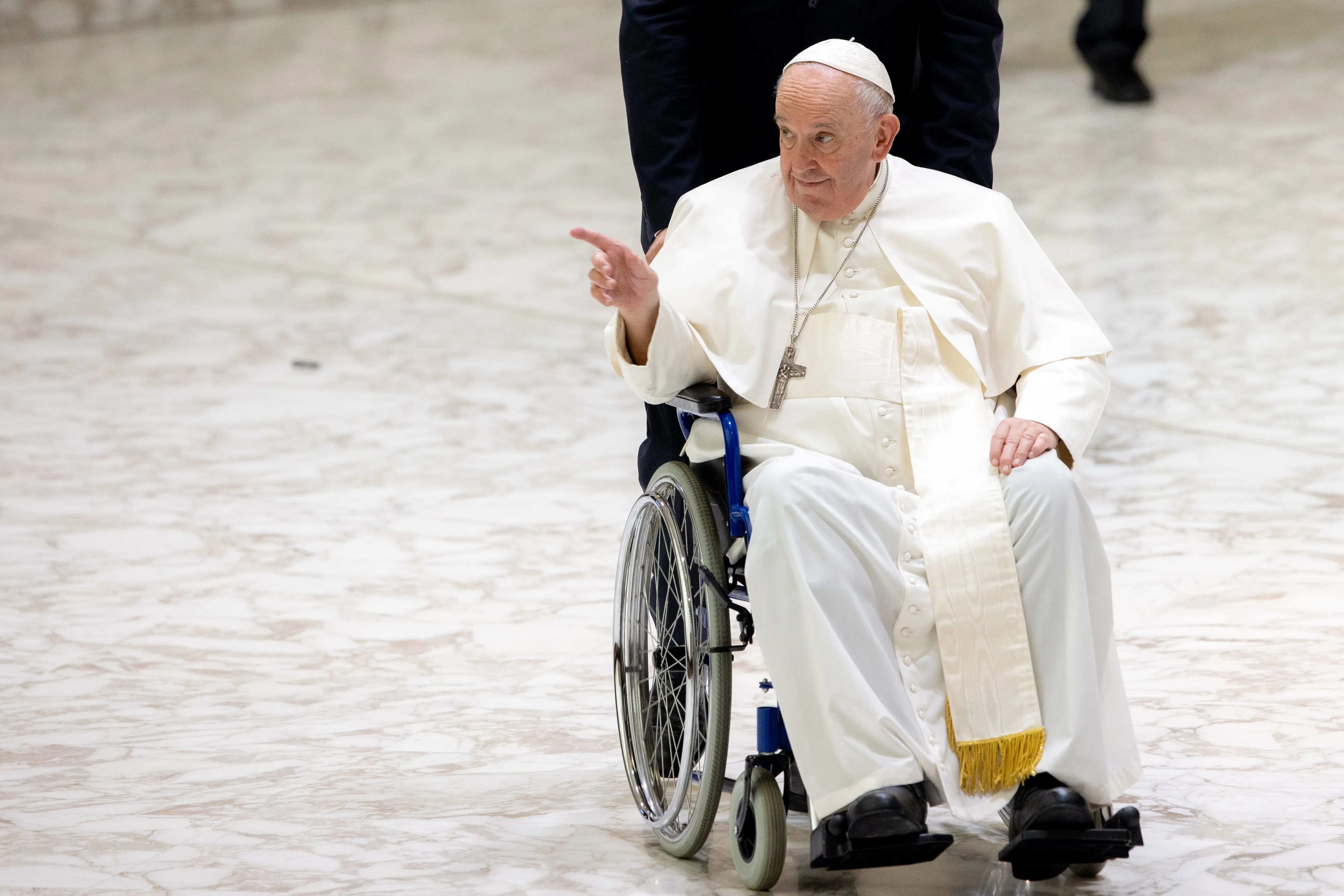
May 5 — Pope Francis is seen in a wheelchair for the first time in public and begins to use one more frequently. The pope has been suffering from knee problems for months.
Pope Francis greeted the crowd in a wheelchair at the end of his general audience on Aug. 3, 2022. Daniel Ibanez/CNA
July 24-30 — In his first papal visit to Canada, Pope Francis apologizes for the harsh treatment of the indigenous Canadians, saying many Christians and members of the Catholic Church were complicit.
2023
Jan. 31-Feb. 5 — Pope Francis travels to the Democratic Republic of Congo and South Sudan. During his visit, the pope condemns political violence in the countries and promotes peace. He also participates in an ecumenical prayer service with Anglican Archbishop of Canterbury Justin Welby and Moderator of the Church of Scotland Iain Greenshields.
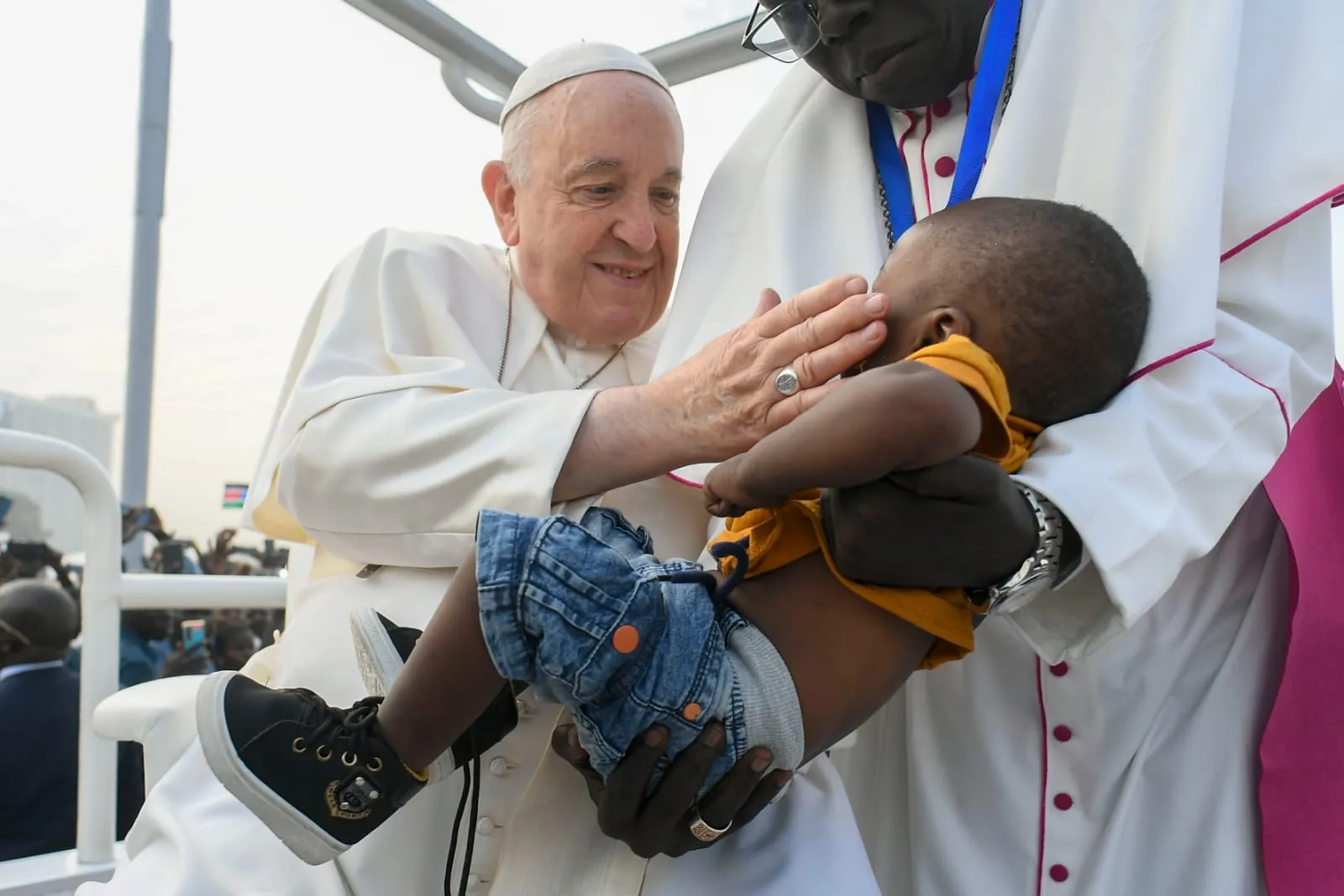
Pope Francis greets a young boy a Mass in Juba, South Sudan on Feb. 5, 2023. Vatican Media
March 29-April 1 — Pope Francis is hospitalized for a respiratory infection. During his stay at Rome’s Gemelli Hospital, he visits the pediatric cancer ward and baptizes a newborn baby.
April 5 — The pope appears in the Disney documentary “The Pope: Answers,” which is in Spanish, answering six “hot-button” issues from members of Gen Z from various backgrounds. The group discusses immigration, depression, abortion, clergy sexual and psychological abuse, transgenderism, pornography, and loss of faith.
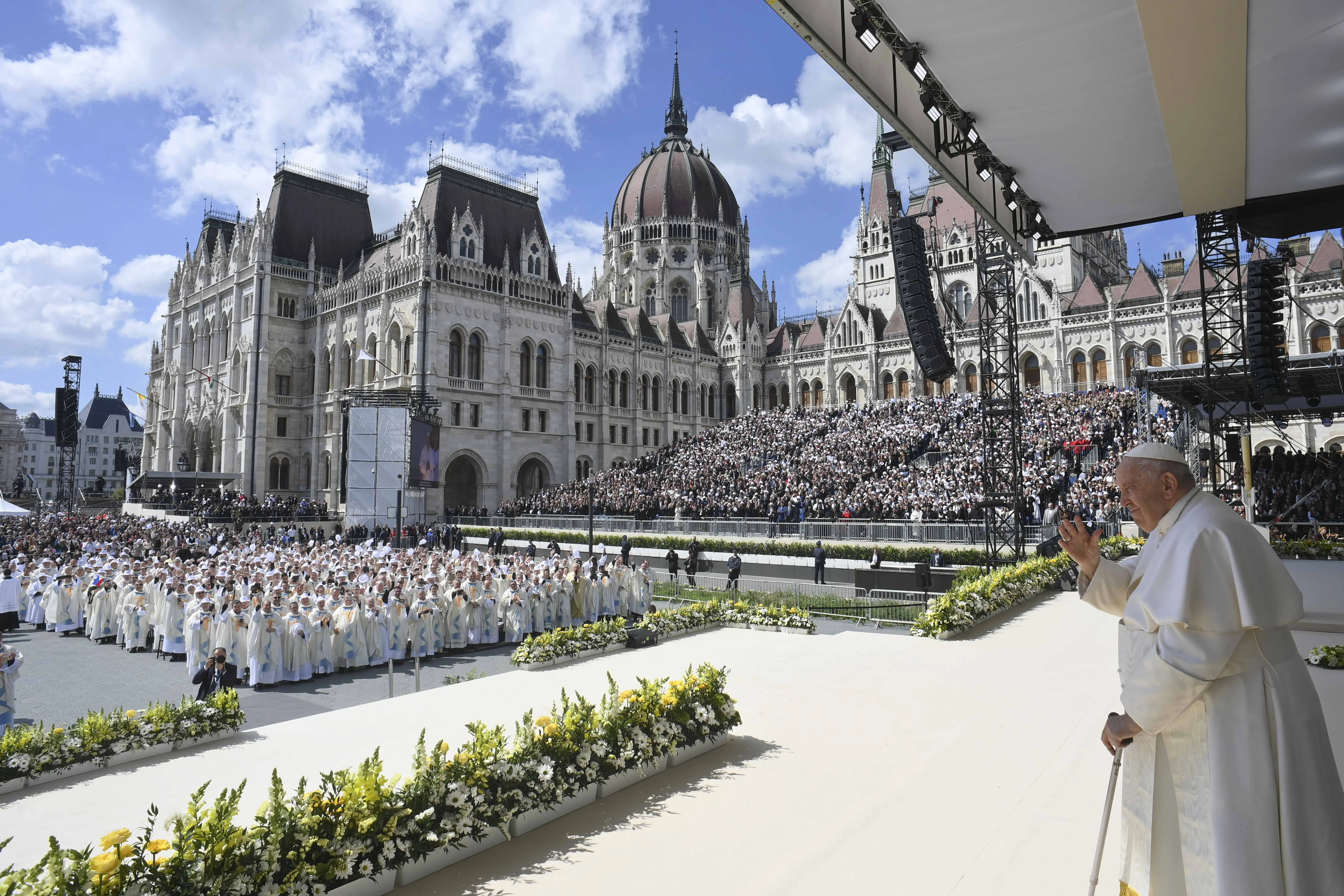
April 28-30 — Pope Francis visits Hungary to meet with government officials, civil society members, bishops, priests, seminarians, Jesuits, consecrated men and women, and pastoral workers. He celebrates Mass on the final day of the trip in Kossuth Lajos Square.
Pope Francis stands on an altar erected outside the Parliament Building in Budapest’s Kossuth Lajos’ Square during a public outdoor Mass on April 30, 2023. Vatican Media
June 7 — The Vatican announces that Pope Francis will undergo abdominal surgery that afternoon under general anesthesia due to a hernia that is causing painful, recurring, and worsening symptoms. In his general audience that morning before the surgery, Francis says he intends to publish an apostolic letter on St. Thérèse of Lisieux, “patroness of the missions,” to mark the 150th anniversary of her birth.
June 15 — After successful surgery and a week of recovery, Pope Francis is released from Gemelli Hospital.
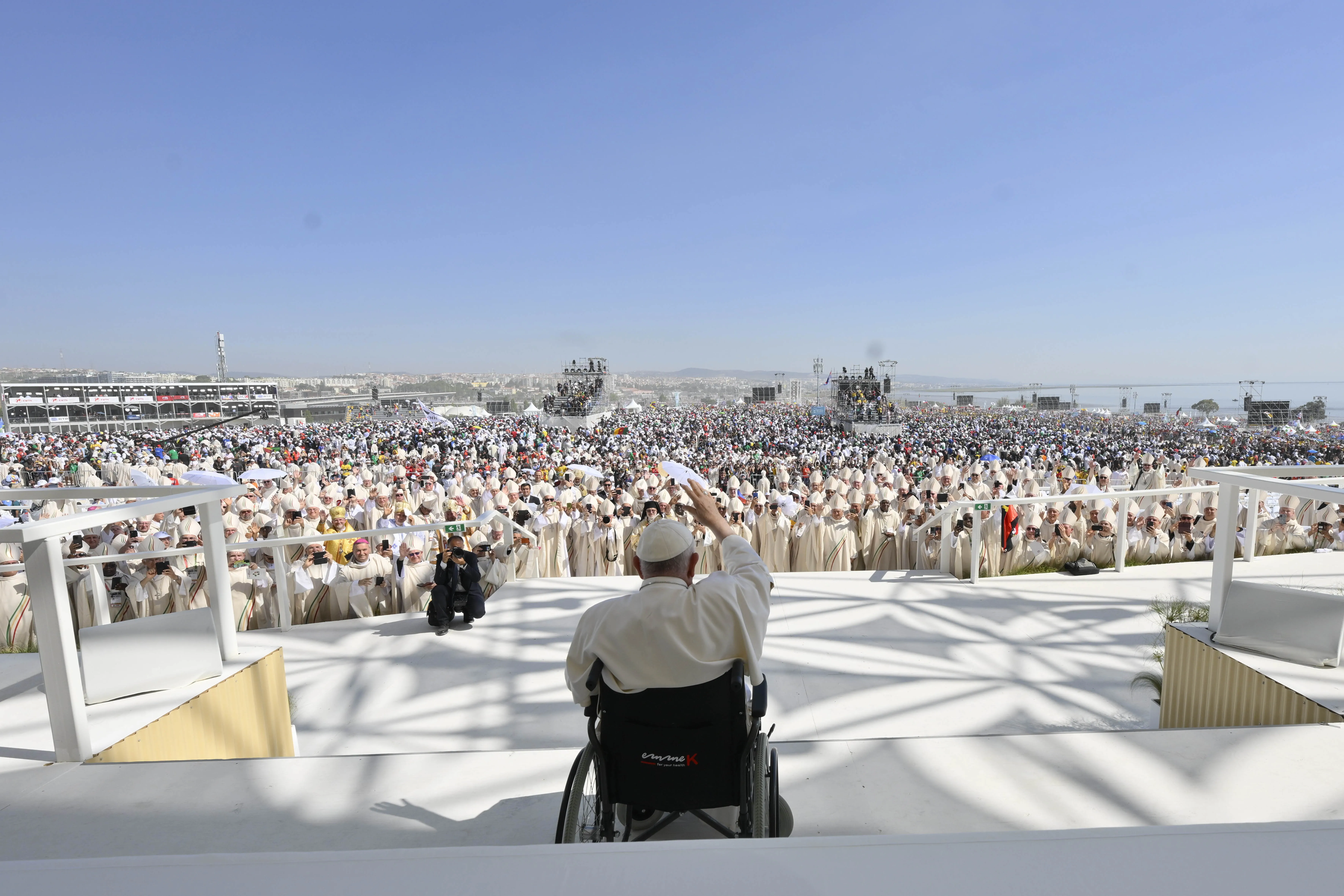
Aug. 2-6 — Pope Francis travels to Lisbon, Portugal, for World Youth Day 2023, taking place from Aug. 1-6. He meets with Church and civil leaders ahead of presiding at the welcoming Mass and Stations of the Cross. He also hears the confessions of several pilgrims. On Aug. 5, he visits the Shrine of Our Lady of Fátima, where he prays the rosary with young people with disabilities. That evening he presides over the vigil and on Sunday, Aug. 6, he celebrates the closing Mass, where he urges the 1.5 million young people present to “be not afraid,” echoing the words of the founder of World Youth Days, St. John Paul II.
Pope Francis waves at the crowd of 1.5 million people who attended the closing Mass of World Youth Day 2023 in Lisbon, Portugal on Aug. 6, 2023. Vatican Media.
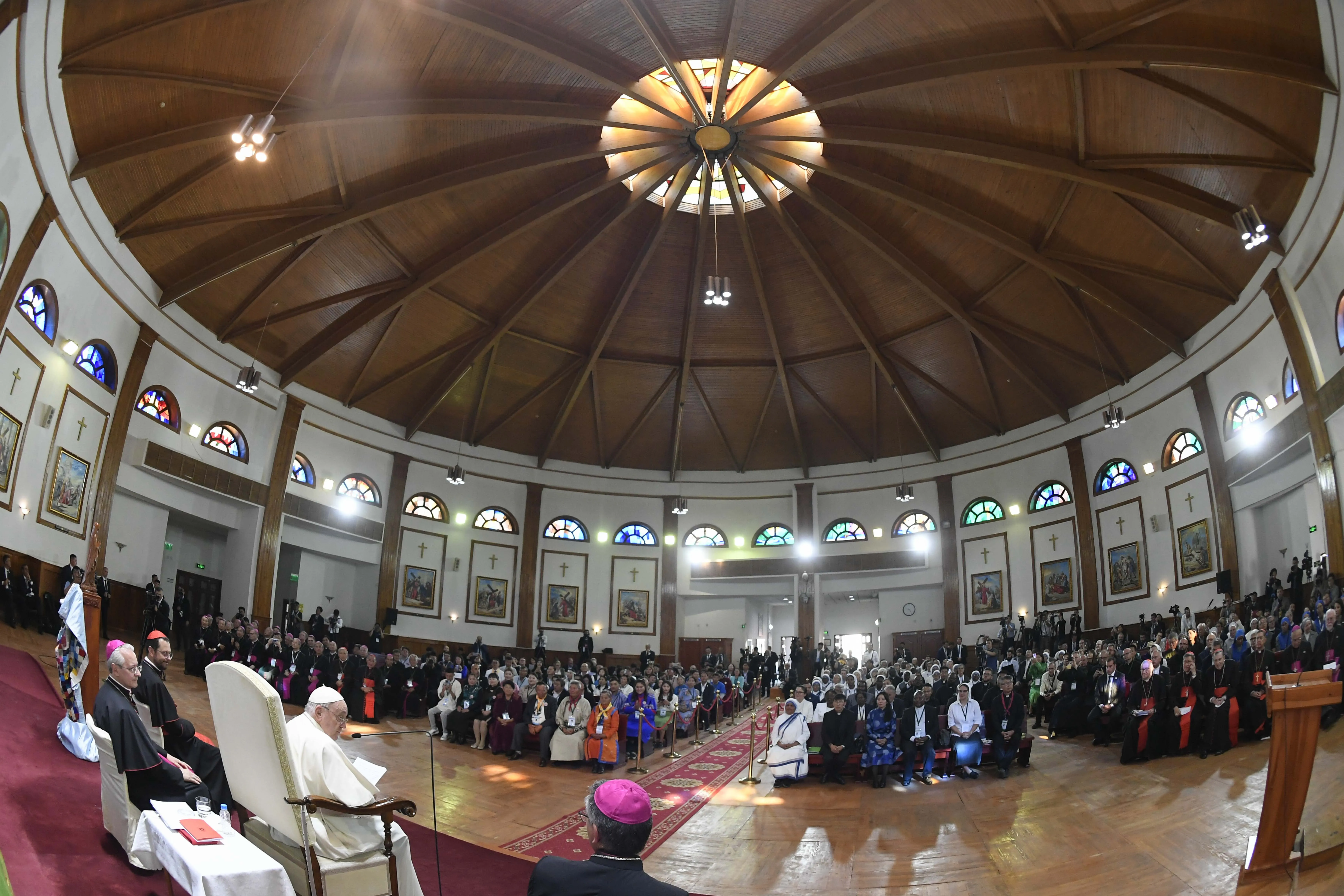
Aug. 31-Sept. 4 — Pope Francis travels to Mongolia, the world’s most sparsely populated sovereign country. The trip makes Francis the first pope to visit the Asian country that shares a 2,880-mile border with China, its most significant economic partner. Mongolia has a population of about 1,300 Catholics in a country of more than 3 million people.
Pope Francis meets with local priests and religious of Mongolia, which includes only 25 priests (19 religious and six diocesan), 33 women religious, and one bishop — Cardinal Giorgio Marengo — in Ulaanbaatar’s Cathedral of Sts. Peter and Paul on Sept. 2, 2023. Credit: Vatican Media
Sept. 22-23 — On a two-day trip to Marseille, France, Pope Francis meets with local civil and religious leaders and participates in the Mediterranean Encounter, a gathering of some 120 young people of various creeds with bishops from 30 countries.
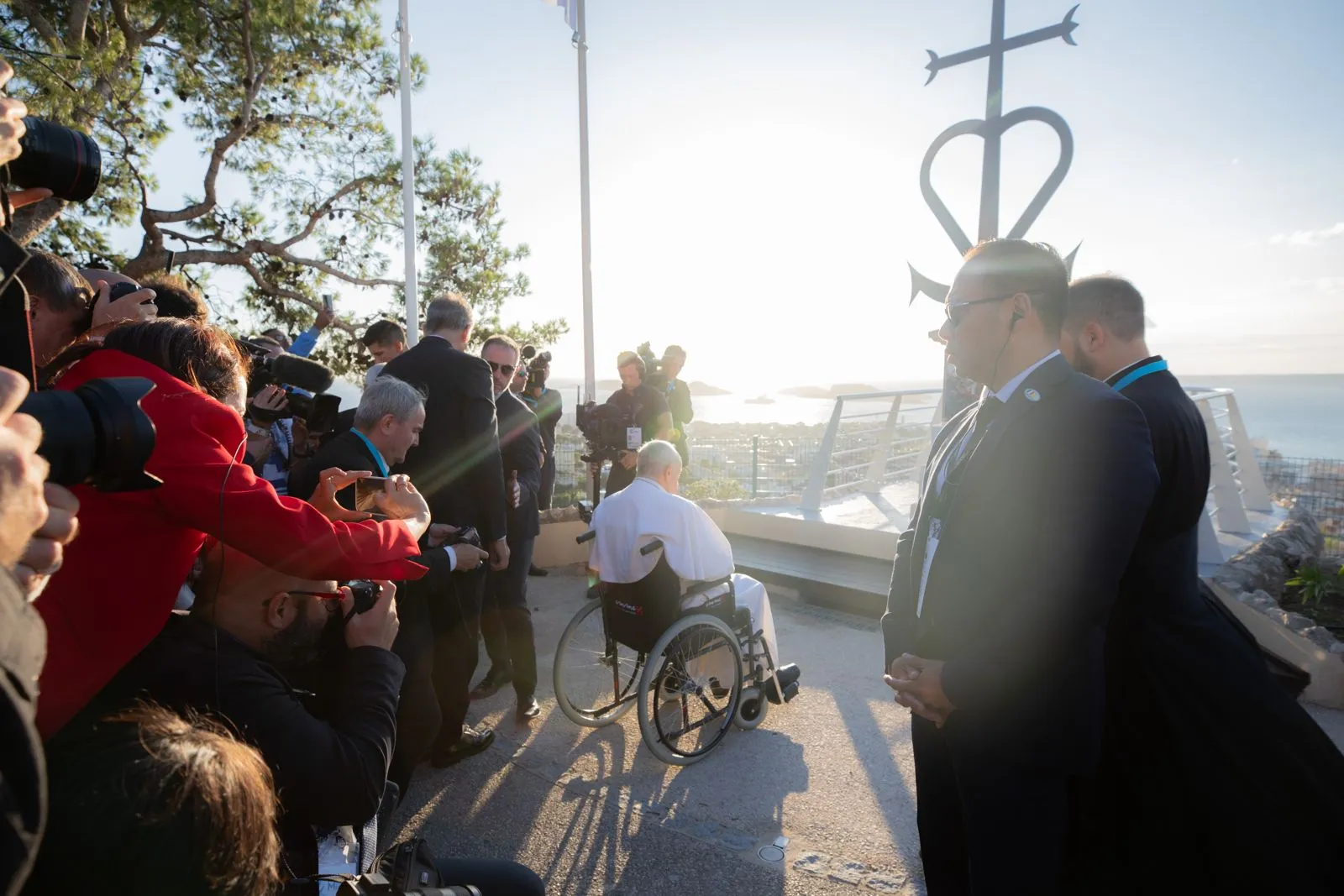
Pope Francis asks for a moment of silence at a memorial dedicated to sailors and migrants lost at sea on the first of a two-day visit to Marseille, France, Sept. 22, 2023. A Camargue cross, which comes from the Camargue area of France, represents the three theological virtues of faith, hope, and charity. The three tridents represent faith, the anchor represents hope, and the heart represents charity. Credit: Daniel Ibañez/CNA
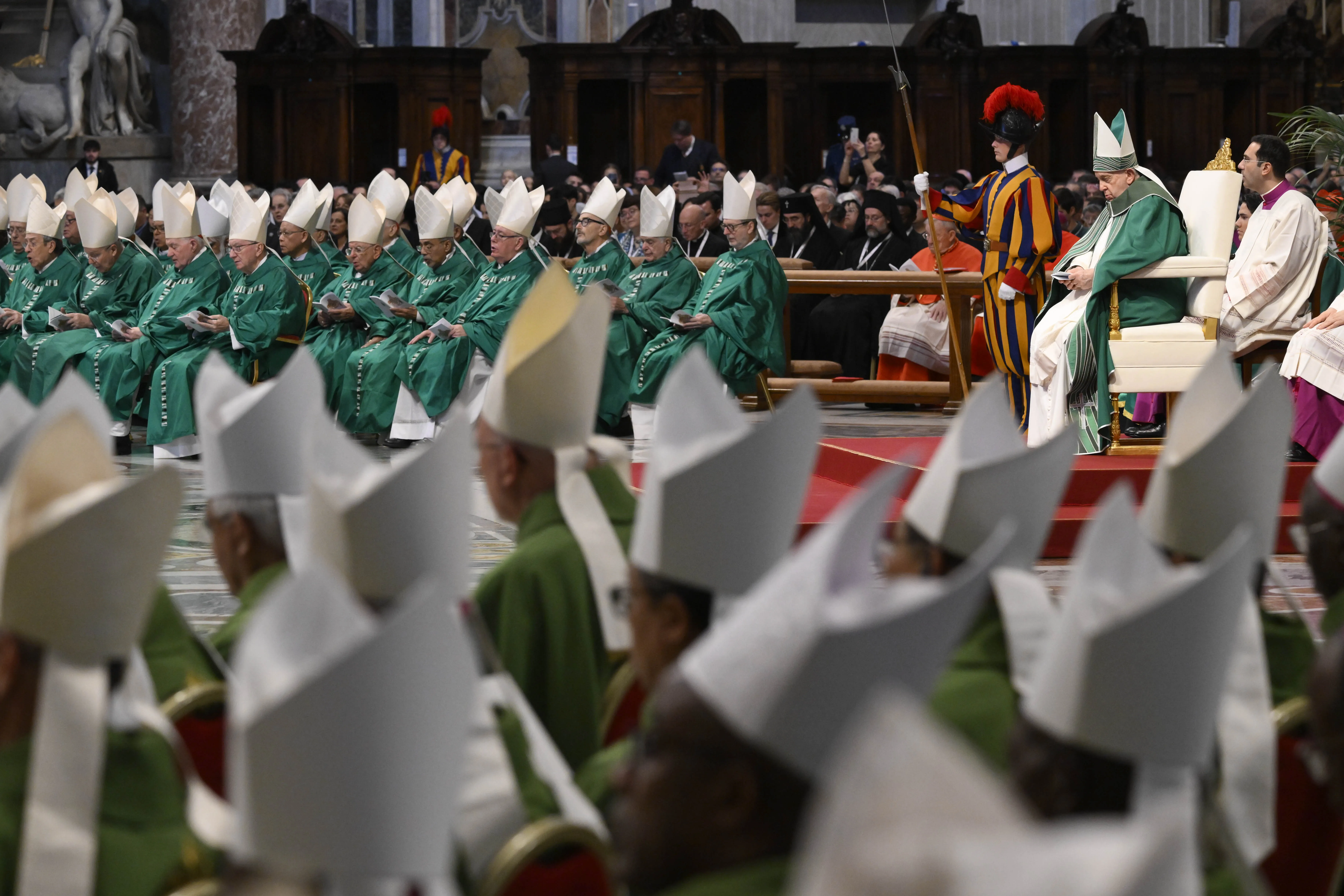
Oct. 4-29 — The Vatican hosts the first of two monthlong global assemblies of the Synod on Synodality, initiated by Pope Francis in 2021 to enhance the communion, participation, and mission of the Church. Pope Francis celebrates the closing Mass of the synod at St. Peter’s Basilica on Oct. 29. The second and final global assembly will take place at the Vatican in October 2024.
Pope Francis at the Synod on Synodality’s closing Mass in St. Peter’s Basilica on Oct. 29, 2023. Vatican Media
Nov. 25 — Pope Francis visits the hospital briefly for precautionary testing after coming down with the flu earlier in the day. Although he still participates in scheduled activities, other officials read his prepared remarks. The Vatican on Nov. 28 cancels the pope’s planned Dec. 1–3 trip to Dubai for the COP28 climate conference, where he was scheduled to deliver a speech, due to his illness.
Dec. 18 — The Dicastery for the Doctrine of the Faith issues the declaration Fiducia Supplicans, which authorizes nonliturgical blessings for same-sex couples and couples in “irregular situations.” Various bishops from around the world voice both support for and criticism of the document.
2024
Jan. 4 — Amid widespread backlash to Fiducia Supplicans, Cardinal Victor Manuel Fernández, prefect of the Dicastery for the Doctrine of the Faith, publishes a five-page press release that refers to Fiducia Supplicans as “perennial doctrine” and underlines that pastoral blessings of couples in irregular situations should not be “an endorsement of the life led by those who request them.”
Jan. 14 — Pope Francis for the first time responds publicly to questions about Fiducia Supplicans in an interview on an Italian television show. The pope underlines that “the Lord blesses everyone” and that a blessing is an invitation to enter into a conversation “to see what the road is that the Lord proposes to them.”
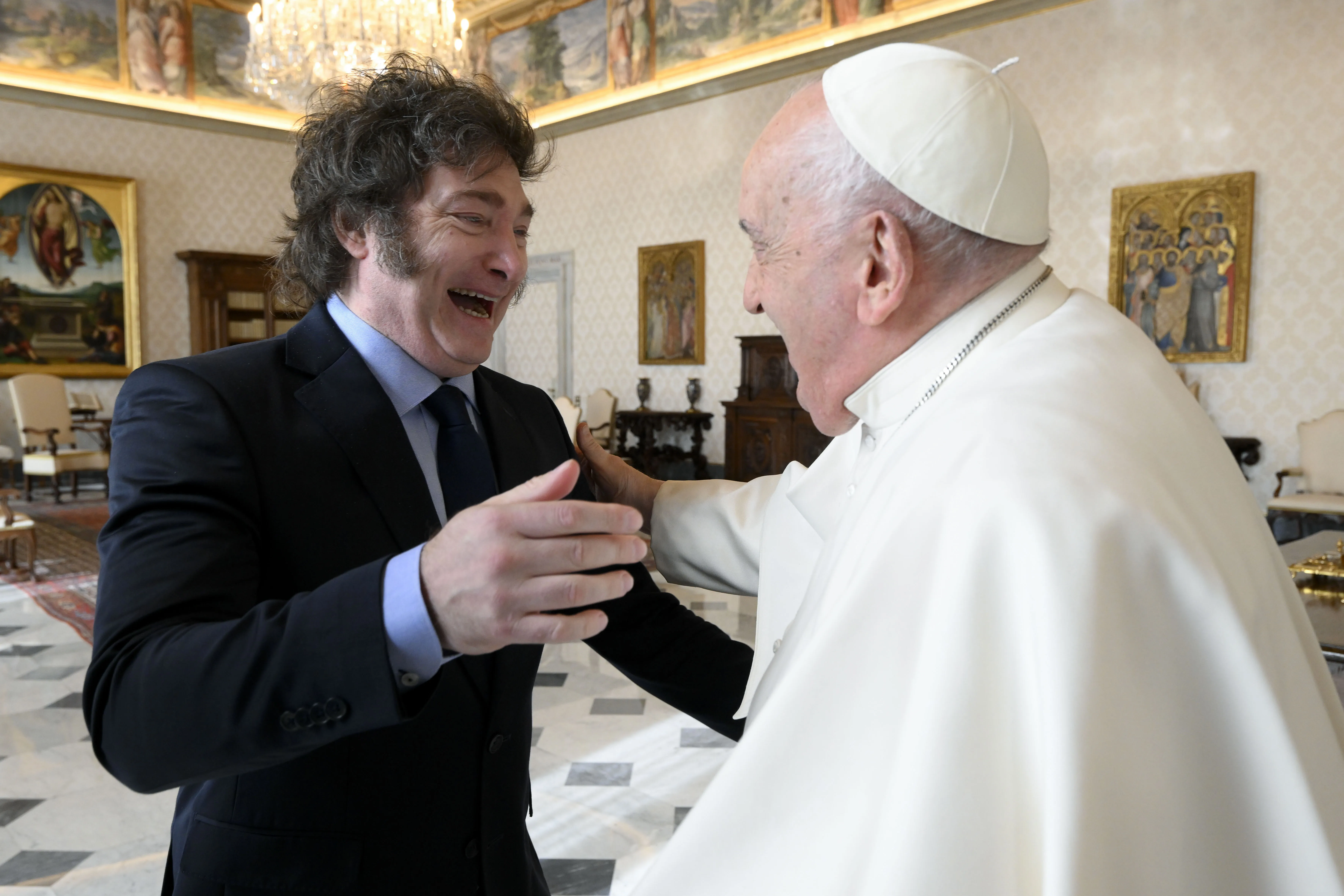
Feb. 11 — In a ceremony attended by Argentine president Javier Milei, Pope Francis canonizes María Antonia of St. Joseph — known affectionately in the pope’s home country as “Mama Antula” — in a Mass at St. Peter’s Basilica. The president and the former archbishop of Buenos Aires embrace after the ceremony. Pope Francis, who has not returned to his homeland since becoming pope in 2013, has said he wants to visit Argentina in the second half of this year.
Pope Francis meets with Argentina President Javier Milei in a private audience on Feb. 12, 2024, at the Vatican. Credit: Vatican Media
Feb. 28 — After canceling audiences the previous Saturday and having an aide read his prepared remarks at his Wednesday audience due to a “mild flu,” Pope Francis visits the hospital for diagnostic tests but returns to the Vatican afterward.
March 2 — Despite having an aide read his speech “because of bronchitis,” the pope presides over the inauguration of the 95th Judicial Year of the Vatican City State and maintains a full schedule.
March 13 — Pope Francis celebrates 11 years as Supreme Pontiff of the Roman Catholic Church.
I would have expected to see this sort of sycophancy in the National So-Called Catholic Reporter, not CWR. This man who occupies the See of Peter has made it crystal clear by word and deed that he despises the traditions of the Church and anyone who holds to them in the face of the Modernist revolt of the past 60-plus years. There really is nothing more of which to “make sense” in this pontificate. I pray daily for his conversion of heart.
In writing “nor can we use the process as an opportunity to hijack the institutional power of the Church at any level to impose our own liturgical preferences on those who do not share them”, perhaps Mr. Altieri is as frustrated as many of us when we experience Father’s own liturgical preferences imposed upon us at virtually every experience of the Ordinary Form.
What you write in your last sentence is quite true, but that same phrase of Mr. Altieri can also be applied to those commenters (we see them on CWR, certainly, but also on Crisis, First Things, Church Militant, and OnePeterFive) who call for a complete suppression of the Ordinary Form (Missale Romanum) in the Roman Catholic Church, that only the Extraordinary Form of the Mass is to remain.
To be completely fair, that same phrase of Mr. Altieri’s can also be applied to the current push among the heterodox within the hierarchy, clergy, deacons, male religious, female religious, and laity in the U.S. and in other English-speaking countries to suppress the current prayerful, worshipful, and accurate English translation of the Mass and to restore the 1969-2011 abominable, inaccurate, un-prayerful, un-worshipful translation which we had to suffer through – or, worse still, to “modify” that translation so as to satisfy all of their heterodox teachings and beliefs.
Sure, Dominic but the unrealistic proposal to suppress the Ordinary Form is just that–a proposal that Pope Francis just said is off the table. However, I fear the ubiquitous liturgical abuses Mr. Altieri cautions against are here to stay.
For example, regarding your second paragraph, at a recent Mass of the Assumption my newly appointed pastor had just finished with the Prayer After Communion, when he drew laughter by referring to “whoever came up with the new translation” as providing us with “some real tongue-twisters”.
More often than not I am at the Ordinary Form because I want to worship with my family, but my heart is usually with Dr. Kwasniewski…
I was an altar boy trained in the Mass that before what is called the Novus Ordo (NO).
Obviously – when the NO was implemented all priests and seminarians were ordered to eliminate the use of The Roman Canon (what the NO calls Eucharistic Prayer #1).
I can only conclude that given the near universal suppression of The Roman Canon, that most Bishops and priests disbelieve some of the theology in The Roman Canon.
This evidence completely undermines the claim of authentic reform made by the promoters of the NO liturgy, which Laszlo Dobszay calls the Bugnini Mass – a liturgy that has no cultural connection to the Roman Rite – but is merely “Roman” because it was ordered by the Pope.
Our current pontiff is so impoverished of faith and reason because his entire “formation” was under this new and impoverished cult of “formlessness.”
Are you serious? This is as convoluted as “it depends on what your definition of ‘is’ is…” As for history being irreversible, that’s like saying you can’t reverse Obamacare. What you mean is we won’t reverse it, not that we can’t. Hence so many of our present woes. Clerics and academics think too much.
Well, Mr. Altieri, that is your interpretation of what the Pope said. As we have come to find out, every person who reads what he said will come away with a different interpretation. Some on the left are claiming that since he did not refer to Benedicts numerous writings on the subject, therefore what he meant was to IGNORE everything that Benedict said, and that the clown masses may resume. Some on the right took heart from his acknowledgment that some things had gone wrong, so they are encouraged, hoping that this means the Pope wants to roll back some of the excesses. Some on the left believe that this means that all of the Protestantization of the American Mass is fine and dandy. The possiblities of interpretation of this gobbledegook are infinite.
Once again, we are presented with a Papal statement that says everything and nothing at the same time. Perhaps the Pope wanted to just give a speech and not make any news so he said everything and nothing. What exactly is irreversible? No one knows. But as the Pope says, not everything needs to be decided in Rome, so everyone go out to your dioceses and YOU decide what is irreversible. No need for a Pope, then is there?
The weirdness of proclaiming the irreversibility of something that you do not define is overpowering. This is the everything and nothing Pope. The merciful and authoritarian, insulter pope. This is the Rohrsach Pope.
Let’s be frank: Mr Altieri doesn’t know what the Pope meant. He panders in meliorism in such a way that the deliberate ambiguity of Bergoglio’s comments becomes even less coherent.
So let’s clear some of this up: Bergoglio has had to maintain Cardinal Sarah as the prefect of the Congregation of Divine Worship for a variety of reasons beyond his control. But he has undermined and contramandes him several times. These comments are first and foremost pointed against the good Cardinal’s attempt to introduce reforms in the current crazy-quilt disciplines for the liturgy. Ad Orientem, remarks on Holy Thursday foot washing, reintroduction of prayers at the foot of the altar, etc, had some progressive liturgiologists shaking with rage, that liturgical reforms of Vatican II were being undone. This was the proximate target of Bergolio’s remarks. Other more distant targets may have been Benedict’s theology of the liturgy and even Summun Pontificorum, but that’s unclear.
Alteri gets one thing right: this Pope behaves like a autocrat, not like a Pastor. He acts as if his patron, rather than being a Christian saint, is Juan Peron.
The foregoing comments by other readers demonstrate how fatuous, ignorant, and obtuse this most recent statement of Pope Bergoglio is. I do not wish to belabor these aspects further. What I would point out, however, is that Pope Bergoglio’s claim of the supposed irreversibility of the liturgical reforms of Vatican II constitutes a “magisterial” act or declaration requires antecedently that the Vatican II liturgical reforms are either part of the divinely revealed deposit of the Faith or are required to safeguard reverently and to expound faithfully the same deposit of faith (see CIC s. 750). The absurdity of such a claim is self-evident when understood in proper theological and canonical and serves only to underline the fatuity, ignorance, and obtuseness of Pope Bergoglio’s claim.
the Jesuit Order is the LEAST LITURGICAL ORDER IN THE ENTIRE 2000 YRS OF THE CHURCH. Until Vat II the Jesuits NEVER, AND I MEAN NEVER GATHERED TOGETHER DAILY PRAYING THE LITURGY OF THE HOURS OR HAD A COMMUNITY MASS. They ONLY got together on Sat evening to pray the Litany of the BVM. Each priest or deacon said his breviary privately at his own chosen time and anywhere he chose. St Ignatius took the MILITARY MODEL OF A STRICT TOP DOWN CHAIN OF COMMAND so that the practical work of the individual would NOT be burdened by time consuming attendance at common liturgy. I attended a Jesuit U from 1961-65 (which still was male attendance only, and had us minor in Cath. philosophy (even non catholics) AND theology (if one was a baptized Cath. EVERY SEMESTER. NO EXCEPTIONS if you were going for a degree. It was a very good education; STILL orthodox with daily Mass and confession available.
So you could have a Jesuit residence with dozens of priests NEVER PRAYING TOGETHER THE LITURGY OF THE CHURCH, EXCEPT THAT SAT. EVENING LITANY, if they were on campus.
Moreover, the Provincial was top dog of the Provence and the Superior General was the Black Pope of the Order AND every Jesuit who makes solemn vows (a minority does not) ADDS AVOW OF PERSONAL OBEDIENCE TO THE PERSON OF THE POPE.
This is just like the regular military, so that the soldier has to accept the superiors ‘ orders WITHOUT QUESTION (” MINE IS NOT TO QUESTION WHY; MINE IS TO DO OR DIE). The Jesuit Fr. Pacwa, featured prominently on EWTN, when asked about the Pope’s statements, often
replies “that’s a management issue; I’m in sales”. Exactly.
Now
Now, of course, Pope Francis is going to act like a Black Pope over the whole Church. His sense of his authority is Jesuit; his sense of obedience is Jesuit: e.g. to the German Cardinal until recently head of CDF as to why the Pope removed three excellent priests without even talking to the Cardinal was: “the pope does not have to explain why”.
but Holy Father THE REST OF THE CHURCH DOES NOT TAKE JESUIT VOWS. AND THE ECCLESIOLOGY OF THE CHURCH IS NOT A MILITARY CHAIN OF COMMAND (which is valued for practical efficiency).
Ambiguity is personally his own way of communicating. That’s not Jesuit, cf. St Robert Bellarmine, Doctor of the Church, the clearest of teachers. I guess that is his way of actually making the pope a true Black Pope in being IN CONTROL. He’s the Boss, to use a blue collar frase.
BUT HE DOESN’T ACT THIS WAY TOWARDS THE EASTERN ORTHODOX CHURCHES, ESPECIALLY REGARDING LITURGY!
“the Jesuit Order is the LEAST LITURGICAL ORDER IN THE ENTIRE 2000 YRS OF THE CHURCH.”
And yet it was the “St. Louis Jesuits” that imposed upon us the most revolting pop songs to fill the void left by Gregorian chant when the Vetus Ordo was suppressed. Sad.
I have never had any problems understanding clearly the writings of St.Pope Pius X. He didn’t require that there be surrogates available (daily) to explain what he meant, reminiscent of those with barrels and brooms trailing at the end of a 1800s parade. I think a new gauge of true, faithful Catholics ought to be whether or not they are fed up with being told what Jorge Bergoglio really meant on any given day.
“The Pope is willing to use his power to steer the course of the process, while leaving the question of substance open to free discussion and debate among all the faithful” -Yet in our diocese because of the influence of the Pope Francis’ liturgical sense upon our bishop, the faithful and their parish pastors cannot even get permission to build (or even repair!) altar rails in their churches. It would be nice if this so-called process was truly about allowing for a natural development of the (say, Eucharistic) spirit of parishes; but this reform is a process of “forced” development by a whole team of non-impartial developers.
As others have responded already, I think that Altieri’s is another attempt to find a thread of orthodoxy or benign intent in Francis’ ramblings. This is a project that is doomed to failure.
Francis said a long time ago that talk of or action on a reform of the reform should cease. In effect he has said that the reform is irreformable. What his purported “magisterial” pronouncement adds is simply belligerence in the form of a kind of “l’Eglise c’est moi” assertion.
It is cut out of the same cloth as his refusal to answer the dubia which merely ask him to settle some disputed questions on important doctrinal/moral issues arising from Amoris Laetitia. He claims that doctrine doesn’t change, but that practice can change according to principles of proportionalism, consequentialism and gradualism. His God, what’s more, like the Moslem god, can make evil good.
Francis is no bumbler. He knows what he’s doing: taking the edifice of Church doctrine/practice down, brick by brick. The time for tortured rationalizations of his words and works in the name of reconciling them with traditional Church teaching is long since past.
“Making sense of Pope Francis’ statement about…” Just supply your own completion to the title. Every topic broached by this Pope requires an article “making sense of” it. We are living through, quite literally, the most nonsensical papacy in history.
The bottom line is that this pope is still the pope. He is Peter and he speaks for the Church. We have have autocratic popes before, popes who made very bad decisions for which the Church paid a heavy price [the sacking of Rome in 1527 as a result of the policies of Clement VII somes to mind]. All of the popes, beginning with John XXXIII have some degree of responsibility in failing to follow through on Pope Saint Pius X’s program to protect the Church against modernist teachings. The results are self-evident in Belgium, Holland, France, Germany, and Switzerland. Popes come and go, but the Mystical Body of Christ, suffering self-inflicted wounds by those who should know better, always continues doing the saving work of Jesus Christ and will to the end of time. Read through the 40 volume of Pastor’s History of the Popes. It gives a very comforting historical perspective on the papacy.,
Perhaps because they don’t have a completely closed hierarchical structure with a Pope on top of it. In order to maintain unity in the absence of a strict hierarchy one has the emphasize Tradition. All renewal is risky because there’s no final authority which can enforce it. Therefore things are best left as they are in the Eastern orthodox churches. Conservatism is their principle of unity. And perhaps the Eastern churches which are united with Rome don’t want to get out of line, for fear of losing their typical Eastern characteristics.
How do you experiment with something upon which people’s salvation depends!!!! For sixty years!!!!! The arrogance, (talk about elitism). And after 60 years of failure how do you justify continuing to experiment!!!!
Are all those souls that lost the faith because of your experiments with clown masses etc just collateral damage? I shudder to think of these people on judgment day!
And by the way, it takes an awfully big ….. nerve to try to blame the guitar music and clown masses on Pius X or even Pius Xii, either one of which would have fled the average NO celebration in disgust.







To hear this Pope say things are irreversible is amusing.
He has no qualms about “reversing” the commands of Jesus about marriage.
The word arrogant comes to mind…
Excellent observation.
WHAT NONSENSE, PRAISE THE LORD THAT FRANCIS IS IN CHARGE!!
Dear Author,
You are too smart by half.
Matthew 5:47 is anathema to the bishop of Rome.
I would have expected to see this sort of sycophancy in the National So-Called Catholic Reporter, not CWR. This man who occupies the See of Peter has made it crystal clear by word and deed that he despises the traditions of the Church and anyone who holds to them in the face of the Modernist revolt of the past 60-plus years. There really is nothing more of which to “make sense” in this pontificate. I pray daily for his conversion of heart.
Spot on. Why has CWR promoted so many pollyannaish articles about the Bergoglio Papacy recently? Has Carl nodded?
I second all of your comments, TexasThomist, and wholeheartedly.
This is an extremely charitable reading of Pope Francis’ motivations compared to, say, Phil Lawler, whom I believe to be the greater realist here…
http://www.catholicculture.org/commentary/otn.cfm?id=1237
In writing “nor can we use the process as an opportunity to hijack the institutional power of the Church at any level to impose our own liturgical preferences on those who do not share them”, perhaps Mr. Altieri is as frustrated as many of us when we experience Father’s own liturgical preferences imposed upon us at virtually every experience of the Ordinary Form.
What you write in your last sentence is quite true, but that same phrase of Mr. Altieri can also be applied to those commenters (we see them on CWR, certainly, but also on Crisis, First Things, Church Militant, and OnePeterFive) who call for a complete suppression of the Ordinary Form (Missale Romanum) in the Roman Catholic Church, that only the Extraordinary Form of the Mass is to remain.
To be completely fair, that same phrase of Mr. Altieri’s can also be applied to the current push among the heterodox within the hierarchy, clergy, deacons, male religious, female religious, and laity in the U.S. and in other English-speaking countries to suppress the current prayerful, worshipful, and accurate English translation of the Mass and to restore the 1969-2011 abominable, inaccurate, un-prayerful, un-worshipful translation which we had to suffer through – or, worse still, to “modify” that translation so as to satisfy all of their heterodox teachings and beliefs.
Sure, Dominic but the unrealistic proposal to suppress the Ordinary Form is just that–a proposal that Pope Francis just said is off the table. However, I fear the ubiquitous liturgical abuses Mr. Altieri cautions against are here to stay.
For example, regarding your second paragraph, at a recent Mass of the Assumption my newly appointed pastor had just finished with the Prayer After Communion, when he drew laughter by referring to “whoever came up with the new translation” as providing us with “some real tongue-twisters”.
More often than not I am at the Ordinary Form because I want to worship with my family, but my heart is usually with Dr. Kwasniewski…
http://www.newliturgicalmovement.org/2015/04/in-much-wisdom-is-much-vexation.html#.WaSsFCh96Ul
I was an altar boy trained in the Mass that before what is called the Novus Ordo (NO).
Obviously – when the NO was implemented all priests and seminarians were ordered to eliminate the use of The Roman Canon (what the NO calls Eucharistic Prayer #1).
I can only conclude that given the near universal suppression of The Roman Canon, that most Bishops and priests disbelieve some of the theology in The Roman Canon.
This evidence completely undermines the claim of authentic reform made by the promoters of the NO liturgy, which Laszlo Dobszay calls the Bugnini Mass – a liturgy that has no cultural connection to the Roman Rite – but is merely “Roman” because it was ordered by the Pope.
Our current pontiff is so impoverished of faith and reason because his entire “formation” was under this new and impoverished cult of “formlessness.”
Are you serious? This is as convoluted as “it depends on what your definition of ‘is’ is…” As for history being irreversible, that’s like saying you can’t reverse Obamacare. What you mean is we won’t reverse it, not that we can’t. Hence so many of our present woes. Clerics and academics think too much.
And what “the Pope really meant” continues.
Well, Mr. Altieri, that is your interpretation of what the Pope said. As we have come to find out, every person who reads what he said will come away with a different interpretation. Some on the left are claiming that since he did not refer to Benedicts numerous writings on the subject, therefore what he meant was to IGNORE everything that Benedict said, and that the clown masses may resume. Some on the right took heart from his acknowledgment that some things had gone wrong, so they are encouraged, hoping that this means the Pope wants to roll back some of the excesses. Some on the left believe that this means that all of the Protestantization of the American Mass is fine and dandy. The possiblities of interpretation of this gobbledegook are infinite.
Once again, we are presented with a Papal statement that says everything and nothing at the same time. Perhaps the Pope wanted to just give a speech and not make any news so he said everything and nothing. What exactly is irreversible? No one knows. But as the Pope says, not everything needs to be decided in Rome, so everyone go out to your dioceses and YOU decide what is irreversible. No need for a Pope, then is there?
The weirdness of proclaiming the irreversibility of something that you do not define is overpowering. This is the everything and nothing Pope. The merciful and authoritarian, insulter pope. This is the Rohrsach Pope.
Let’s be frank: Mr Altieri doesn’t know what the Pope meant. He panders in meliorism in such a way that the deliberate ambiguity of Bergoglio’s comments becomes even less coherent.
So let’s clear some of this up: Bergoglio has had to maintain Cardinal Sarah as the prefect of the Congregation of Divine Worship for a variety of reasons beyond his control. But he has undermined and contramandes him several times. These comments are first and foremost pointed against the good Cardinal’s attempt to introduce reforms in the current crazy-quilt disciplines for the liturgy. Ad Orientem, remarks on Holy Thursday foot washing, reintroduction of prayers at the foot of the altar, etc, had some progressive liturgiologists shaking with rage, that liturgical reforms of Vatican II were being undone. This was the proximate target of Bergolio’s remarks. Other more distant targets may have been Benedict’s theology of the liturgy and even Summun Pontificorum, but that’s unclear.
Alteri gets one thing right: this Pope behaves like a autocrat, not like a Pastor. He acts as if his patron, rather than being a Christian saint, is Juan Peron.
Perhaps I’m just really dense, but your assertion that what he said proves just the opposite, struck me the same way his statement did, “HUH”?
This article fills the CWR’s quota of allowable bafflegab for the next five years.
The foregoing comments by other readers demonstrate how fatuous, ignorant, and obtuse this most recent statement of Pope Bergoglio is. I do not wish to belabor these aspects further. What I would point out, however, is that Pope Bergoglio’s claim of the supposed irreversibility of the liturgical reforms of Vatican II constitutes a “magisterial” act or declaration requires antecedently that the Vatican II liturgical reforms are either part of the divinely revealed deposit of the Faith or are required to safeguard reverently and to expound faithfully the same deposit of faith (see CIC s. 750). The absurdity of such a claim is self-evident when understood in proper theological and canonical and serves only to underline the fatuity, ignorance, and obtuseness of Pope Bergoglio’s claim.
the Jesuit Order is the LEAST LITURGICAL ORDER IN THE ENTIRE 2000 YRS OF THE CHURCH. Until Vat II the Jesuits NEVER, AND I MEAN NEVER GATHERED TOGETHER DAILY PRAYING THE LITURGY OF THE HOURS OR HAD A COMMUNITY MASS. They ONLY got together on Sat evening to pray the Litany of the BVM. Each priest or deacon said his breviary privately at his own chosen time and anywhere he chose. St Ignatius took the MILITARY MODEL OF A STRICT TOP DOWN CHAIN OF COMMAND so that the practical work of the individual would NOT be burdened by time consuming attendance at common liturgy. I attended a Jesuit U from 1961-65 (which still was male attendance only, and had us minor in Cath. philosophy (even non catholics) AND theology (if one was a baptized Cath. EVERY SEMESTER. NO EXCEPTIONS if you were going for a degree. It was a very good education; STILL orthodox with daily Mass and confession available.
So you could have a Jesuit residence with dozens of priests NEVER PRAYING TOGETHER THE LITURGY OF THE CHURCH, EXCEPT THAT SAT. EVENING LITANY, if they were on campus.
Moreover, the Provincial was top dog of the Provence and the Superior General was the Black Pope of the Order AND every Jesuit who makes solemn vows (a minority does not) ADDS AVOW OF PERSONAL OBEDIENCE TO THE PERSON OF THE POPE.
This is just like the regular military, so that the soldier has to accept the superiors ‘ orders WITHOUT QUESTION (” MINE IS NOT TO QUESTION WHY; MINE IS TO DO OR DIE). The Jesuit Fr. Pacwa, featured prominently on EWTN, when asked about the Pope’s statements, often
replies “that’s a management issue; I’m in sales”. Exactly.
Now
Now, of course, Pope Francis is going to act like a Black Pope over the whole Church. His sense of his authority is Jesuit; his sense of obedience is Jesuit: e.g. to the German Cardinal until recently head of CDF as to why the Pope removed three excellent priests without even talking to the Cardinal was: “the pope does not have to explain why”.
but Holy Father THE REST OF THE CHURCH DOES NOT TAKE JESUIT VOWS. AND THE ECCLESIOLOGY OF THE CHURCH IS NOT A MILITARY CHAIN OF COMMAND (which is valued for practical efficiency).
Ambiguity is personally his own way of communicating. That’s not Jesuit, cf. St Robert Bellarmine, Doctor of the Church, the clearest of teachers. I guess that is his way of actually making the pope a true Black Pope in being IN CONTROL. He’s the Boss, to use a blue collar frase.
BUT HE DOESN’T ACT THIS WAY TOWARDS THE EASTERN ORTHODOX CHURCHES, ESPECIALLY REGARDING LITURGY!
“the Jesuit Order is the LEAST LITURGICAL ORDER IN THE ENTIRE 2000 YRS OF THE CHURCH.”
And yet it was the “St. Louis Jesuits” that imposed upon us the most revolting pop songs to fill the void left by Gregorian chant when the Vetus Ordo was suppressed. Sad.
I have never had any problems understanding clearly the writings of St.Pope Pius X. He didn’t require that there be surrogates available (daily) to explain what he meant, reminiscent of those with barrels and brooms trailing at the end of a 1800s parade. I think a new gauge of true, faithful Catholics ought to be whether or not they are fed up with being told what Jorge Bergoglio really meant on any given day.
Agreed,
I hope this horrible pontificate ends soon.
“The Pope is willing to use his power to steer the course of the process, while leaving the question of substance open to free discussion and debate among all the faithful” -Yet in our diocese because of the influence of the Pope Francis’ liturgical sense upon our bishop, the faithful and their parish pastors cannot even get permission to build (or even repair!) altar rails in their churches. It would be nice if this so-called process was truly about allowing for a natural development of the (say, Eucharistic) spirit of parishes; but this reform is a process of “forced” development by a whole team of non-impartial developers.
Ultramontanism will never die!
“the Church’s “journey” of reform in the post-Conciliar era”
Not the Church Universal, but the patriarchate of Rome.
As others have responded already, I think that Altieri’s is another attempt to find a thread of orthodoxy or benign intent in Francis’ ramblings. This is a project that is doomed to failure.
Francis said a long time ago that talk of or action on a reform of the reform should cease. In effect he has said that the reform is irreformable. What his purported “magisterial” pronouncement adds is simply belligerence in the form of a kind of “l’Eglise c’est moi” assertion.
It is cut out of the same cloth as his refusal to answer the dubia which merely ask him to settle some disputed questions on important doctrinal/moral issues arising from Amoris Laetitia. He claims that doctrine doesn’t change, but that practice can change according to principles of proportionalism, consequentialism and gradualism. His God, what’s more, like the Moslem god, can make evil good.
Francis is no bumbler. He knows what he’s doing: taking the edifice of Church doctrine/practice down, brick by brick. The time for tortured rationalizations of his words and works in the name of reconciling them with traditional Church teaching is long since past.
“Making sense of Pope Francis’ statement about…” Just supply your own completion to the title. Every topic broached by this Pope requires an article “making sense of” it. We are living through, quite literally, the most nonsensical papacy in history.
Inane, pathetic drivel. What has happened to CWR?
Interesting that this comes out on the same day as Ed Peter’s take on the same topic
The bottom line is that this pope is still the pope. He is Peter and he speaks for the Church. We have have autocratic popes before, popes who made very bad decisions for which the Church paid a heavy price [the sacking of Rome in 1527 as a result of the policies of Clement VII somes to mind]. All of the popes, beginning with John XXXIII have some degree of responsibility in failing to follow through on Pope Saint Pius X’s program to protect the Church against modernist teachings. The results are self-evident in Belgium, Holland, France, Germany, and Switzerland. Popes come and go, but the Mystical Body of Christ, suffering self-inflicted wounds by those who should know better, always continues doing the saving work of Jesus Christ and will to the end of time. Read through the 40 volume of Pastor’s History of the Popes. It gives a very comforting historical perspective on the papacy.,
JMJ Another typical VII statement interpret as you want but not in a traditional way!
It will only end when enough of us are praying thr Rosary.
“Rather, the Pope said that he can make such an assertion: that is a very different thing from actually asserting it.”
So it was a threat? The Pope threatens with the full force of his magisterial authority if there’s even a thought of reversing the Novus Ordo Liturgy?
Get out of here, Mr. Altieri.
Why is it that the Eastern Church (Catholic or Orthodox) has not been wracked by these liturgical wars?
Perhaps because they don’t have a completely closed hierarchical structure with a Pope on top of it. In order to maintain unity in the absence of a strict hierarchy one has the emphasize Tradition. All renewal is risky because there’s no final authority which can enforce it. Therefore things are best left as they are in the Eastern orthodox churches. Conservatism is their principle of unity. And perhaps the Eastern churches which are united with Rome don’t want to get out of line, for fear of losing their typical Eastern characteristics.
We pray as (what) we believe.
Has this liturgical war changed our belief? Was the point of the liturgical change to change what we believe – if only subtlety and over time?
Did the (quite sudden) fad for puppet masses change our belief (perform a task, do ts “working”)?
for the most part – yes.
How do you experiment with something upon which people’s salvation depends!!!! For sixty years!!!!! The arrogance, (talk about elitism). And after 60 years of failure how do you justify continuing to experiment!!!!
Are all those souls that lost the faith because of your experiments with clown masses etc just collateral damage? I shudder to think of these people on judgment day!
And by the way, it takes an awfully big ….. nerve to try to blame the guitar music and clown masses on Pius X or even Pius Xii, either one of which would have fled the average NO celebration in disgust.
What is certain is that Pope Francis is against “the reform of the reform” – https://twitter.com/TheWarOurTime/status/902415843551674369 and his “affirmation” highly likely is about this.