St. Paul, Minn., Jul 18, 2017 / 12:08 am (CNA/EWTN News).- A proposed Satanic monument in a city-run veterans’ park has drawn strong opposition from Catholics in Minnesota, who have led prayer rallies and spoken before the Belle Plaine City Council.
Susie Collins was among the attendees of a rosary rally in Belle Plaine’s Veterans Memorial Park to oppose the monument. She told the Minneapolis Star-Tribune that the monument “is not the message of life and love, it is the message of death and decay.”
Other critics of the monument waved signs urging passersby to reject Satan. Several dozen people attended the rally, in a city with a population of about 7,000.
The Satanic Temple, based in Salem, Mass., had proposed to place its own monument in the city park. The monument, a black cube inscribed with pentagrams with an upside-down soldier’s helmet on top, was approved by the city.
In May city officials said that the application for the monument met the criteria of city policy. It has not yet been installed.
Lucien Greaves, a co-founder the five-year-old Satanic Temple, said his organization does not believe in the supernatural but sees Satan as a “metaphorical construct” of “the ultimate rebel against tyranny.” It claims 10,000 members worldwide, the Archdiocese of St. Paul-Minneapolis’ newspaper The Catholic Spirit reports.
The group tried to organize a “Black Mass” at Harvard University in 2014 before a student group moved the event off-campus. It has created an after-school program based around its beliefs and worked to install a Satanic statue at the Oklahoma State Capitol.
A smaller group of supporters of the monument, from Minnesota’s Left Hand Path group, also demonstrated on Saturday. The group includes Satanists.
Koren Walsh, a member of the group, said the presence of the monument would show “all faiths have a voice in the city of Belle Plaine and the state of Minnesota,” the Minnesota CBS affiliate WCCO reports.
The protest of the monument was organized by the Pennsylvania-based group America Needs Fatima, a lay-run non-profit that says it promotes the message of Our Lady of Fatima.
The proposed Satanic monument adds to a previous controversy at the park concerning a two-foot-tall statue of a soldier praying over a grave marked with a cross. The Wisconsin-based Freedom from Religion Foundation had objected to the statue, which was initially put up without city approval by the Belle Plaine Veterans Club. The foundation objected that the cross on a public veterans’ memorial could create the impression that the city only cares about Christian soldiers.
According to the foundation, it aims to place its own memorial to honor non-religious service members, including “atheists in foxholes and other free-thinkers who have served their country with valor and distinction.”
The city council initially sought to remove only the cross, then removed the statue entirely in January. In April, its location in the park was then designated a free speech zone by the city council, allowing the statue to return. The city council voted to allow private organizations to place memorials featuring religious symbols in the designated area as long as they met certain requirements related to material and size.
On Monday the city council was set to debate a resolution to remove the free speech zone, and thus preventing either the praying soldier or the Satanic monument from being placed in the park.
Local Catholics had spoken out against the Satanic monument.
Father Brian Lynch, pastor of Our Lady of the Prairie Church, was joined in prayer at the park by more than 50 Catholics at the park June 3.
“Sometimes these things which are evil can really, maybe, wake some people up,” Fr. Lynch said, according to The Catholic Spirit. “We really have to take our faith seriously and live it.”
He testified against the proposed monument before the city council in early June. He cited atheistic Satanists’ use of Satan “as a symbol of the rejection of moral authorities and the constraints on human behavior these authorities teach and support.” He said they also use inverted pentagrams as a symbol “almost exclusively associated with opposition to God and goodness.”
According to Fr. Lynch, the presence of Satanic symbols would have a negative effect on the public and violate several sections of the city code, including laws against committing offenses against decency or public morals in parks or public lands.
Jason Adkins, executive director of the Minnesota Catholic Conference, said both freedom of speech and religious freedom have legitimate limits.
“With rights come responsibilities,” he said, adding that more people should be shocked by the Satanist advocacy.
“You’re invoking Satan,” he said. “Traditionally, Christians have understood that when you invoke demons, you’re cursing yourself and your community.”
If you value the news and views Catholic World Report provides, please consider donating to support our efforts. Your contribution will help us continue to make CWR available to all readers worldwide for free, without a subscription. Thank you for your generosity!
Click here for more information on donating to CWR. Click here to sign up for our newsletter.
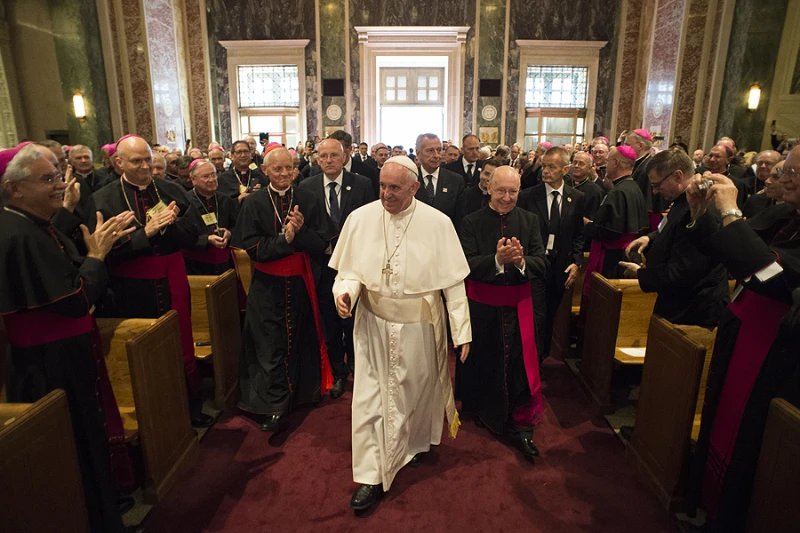
Pope Francis meets with the United States bishops at St. Matthew’s Cathedral in Washington, D.C., on Sept. 23, 2015. / Credit: L’Osservatore Romano
CNA Staff, Apr 22, 2025 / 07:00 am (CNA).
Pope Francis, who died on April 21 at the age of 88, visited the United States just once, nearly 10 years ago, in September 2015.
Despite the brevity of the visit, he accomplished a lot: Attracting hundreds of thousands of participants, he canonized a new saint (St. Junípero Serra), became the first pope to ever address a joint session of Congress, and galvanized the U.S. Catholic community with his presence and his speeches on the East Coast.
Washington, D.C.
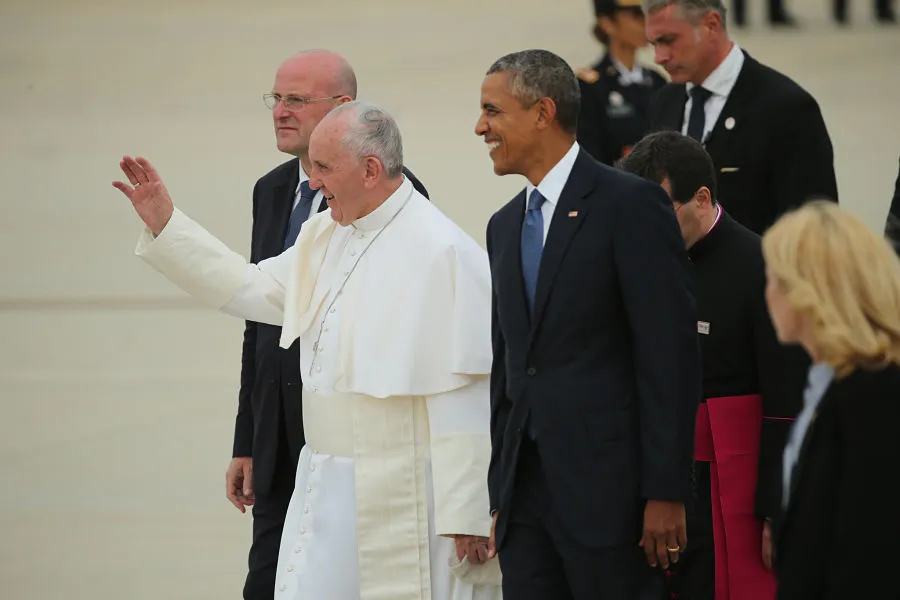
Pope Francis began his tour of North America with several days in Cuba. Landing in Washington, D.C., on Sept. 22, 2015, Pope Francis met with President Barack Obama first thing the next morning. The meeting came amid a time of concerns for many American Catholics regarding politics, including the Obama administration’s contraceptive mandate and the recent legalization of same-sex marriage nationwide, via the June 2015 Supreme Court decision in Obergefell v. Hodges.
Pope Francis is greeted by President Barack Obama on Sept. 22, 2015. Credit: Somodevilla/Getty Images
During the presidential meeting, Francis praised Obama’s commitment to inclusivity and noted that American Catholics have contributed greatly to building a tolerant and inclusive society while also stressing that religious liberty “remains one of America’s most precious possessions.” He also encouraged commitment to addressing the “urgent” issue of climate change, building on his expansive 2015 encyclical on the environment, Laudato Si’.
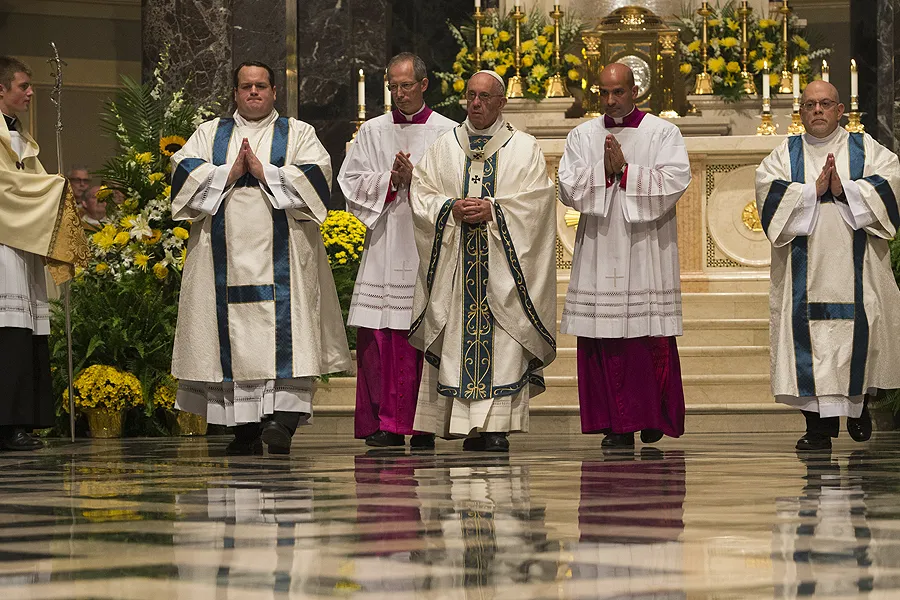
Pope Francis says Mass for clergy and religious in Philadelphia’s Cathedral Basilica of Sts. Peter and Paul, Sept. 26, 2015. Credit: L’Osservatore Romano.
While in D.C., that same day, the pope addressed bishops and priests at the Cathedral of St. Matthew the Apostle and later celebrated Mass at the Basilica of the National Shrine of the Immaculate Conception. At the latter Mass, he celebrated the first canonization on American soil by declaring Junípero Serra, who founded missions along present-day California, a saint.
“He was the embodiment of ‘a Church which goes forth,’ a Church which sets out to bring everywhere the reconciling tenderness of God,” the pope said.
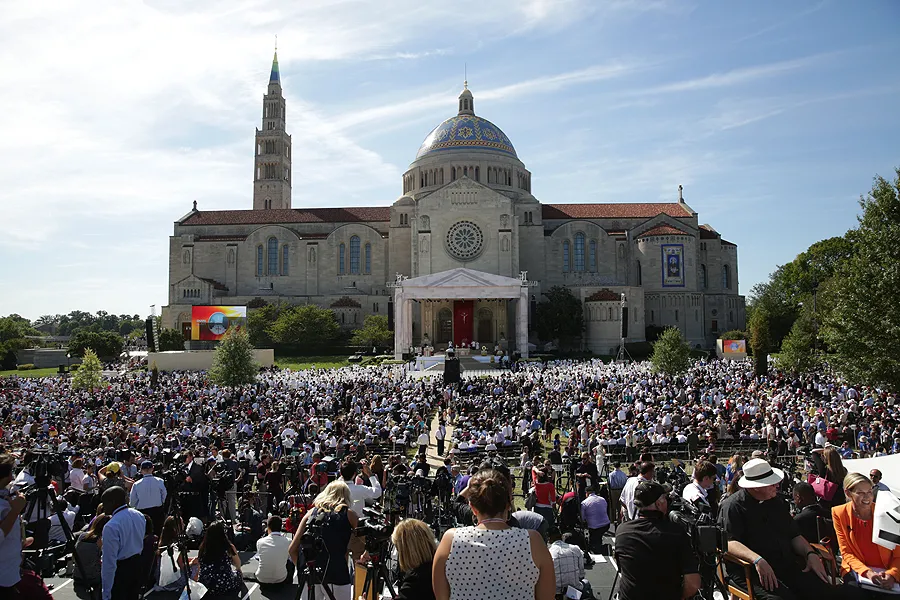
Crowds gather for the Mass canonizing St. Junipero Serra at the Basilica of the National Shrine of the Immaculate Conception in Washington, D.C., on Sept. 23, 2015. Credit: Alan Holdren/CNA
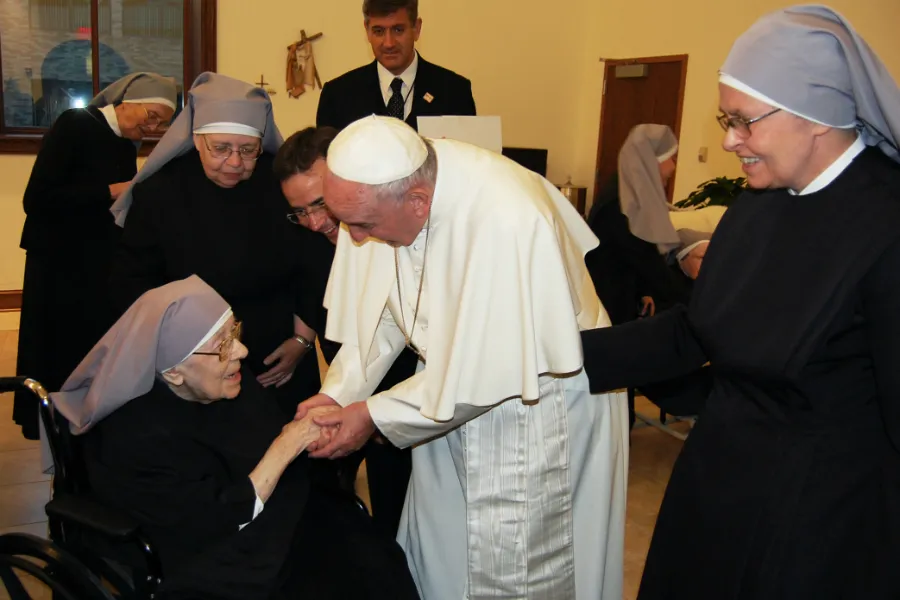
On the same day, Francis made an unscheduled stop to visit with the Little Sisters of the Poor in Washington, D.C., to support the sisters as they awaited word on whether or not the Supreme Court will hear their case against the federal contraception mandate. (The sisters are still fighting aspects of the mandate, even after more than 14 years in court.)
Pope Francis greets Sister Marie Mathilde, 102 years old, at the Jeanne Jugan Residence in Washington, D.C., Sept. 23, 2015. Credit: Photo courtesy of the Little Sisters of the Poor
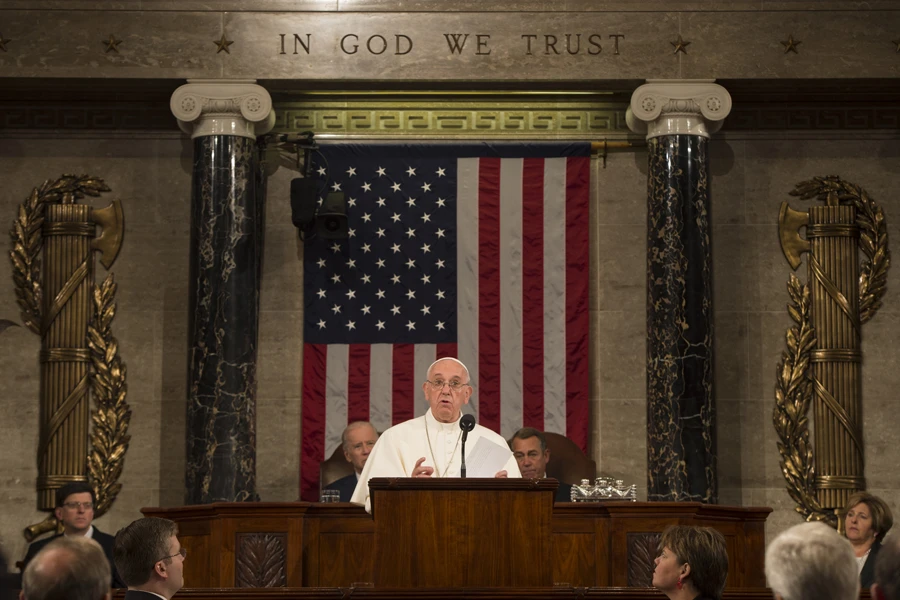
Francis addressed a joint session of Congress the next day, Sept. 24, making him the first pope to ever to do so. During his lengthy speech, he condemned the arms trade and the death penalty — statements that reportedly made some lawmakers in the room squirm.
Francis went on to assert that the family was being threatened like never before and praised American figures, including Abraham Lincoln and Martin Luther King Jr., for their tireless efforts to defend freedom and moral values. He also touched on respect for human life and the environment in the well-received speech.
Pope Francis speaks to the U.S. Congress in Washington, D.C., on Sept. 24, 2015. Credit: L’Osservatore Romano
The pope also visited St. Patrick Parish and met with people experiencing homelessness at Catholic Charities, addressing people who minister to the poor. He offered St. Joseph as their patron and model, because, he said, St. Joseph grappled with injustice and suffering in his care for Mary and Jesus.
“The Son of God came into this world as a homeless person,” the pope said. “The Son of God knew what it was to start life without a roof over his head.”
“We can find no social or moral justification, no justification whatsoever, for lack of housing. There are many unjust situations, but we know that God is suffering with us, experiencing them at our side. He does not abandon us.”
Controversially, while in D.C. Pope Francis met with Kim Davis, a Kentucky county clerk who had become a cultural lightning rod for refusing to issue same-sex marriage licenses. The pope reportedly told her to “stay strong,” offering rosaries to Davis and her husband. The Vatican later clarified that Francis met with Davis and her husband as part of a large group invited by the nunciature, with the Vatican spokesperson adding that the pope “did not enter into the details” of her situation.
New York City
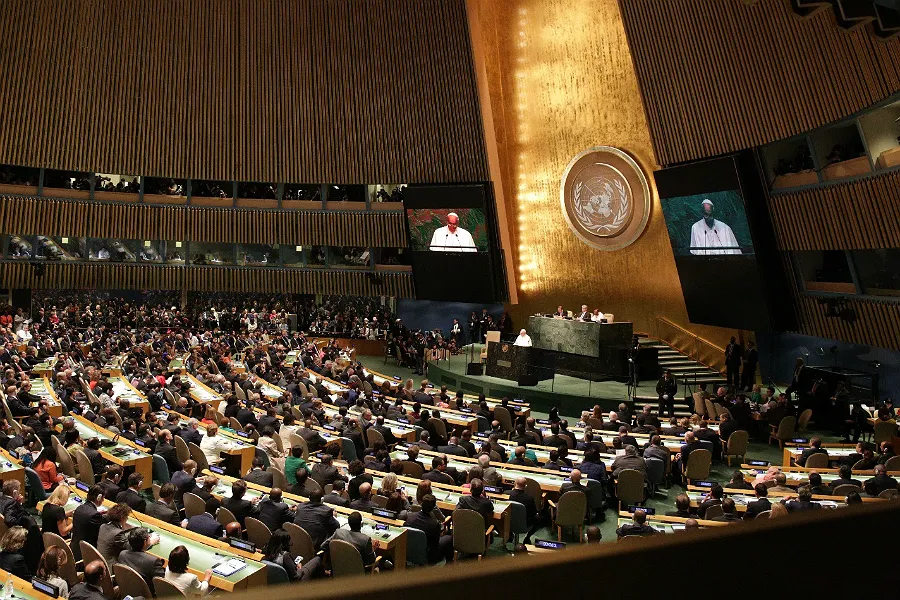
After flying to New York City the evening of Sept. 24 and praying vespers at St. Patrick’s Cathedral in Manhattan, Francis addressed the United Nations General Assembly the next day, Sept. 25, the fifth time a pope had addressed the body.
The pontiff issued a call to the countries of the world to reject what he called “ideological colonization” — the “imposition of anomalous models and lifestyles which are alien to people’s identity and, in the end, irresponsible.”
Pope Francis’ historic address to the U.N. in New York City on Sept. 25, 2015. Credit: Alan Holdren/CNA
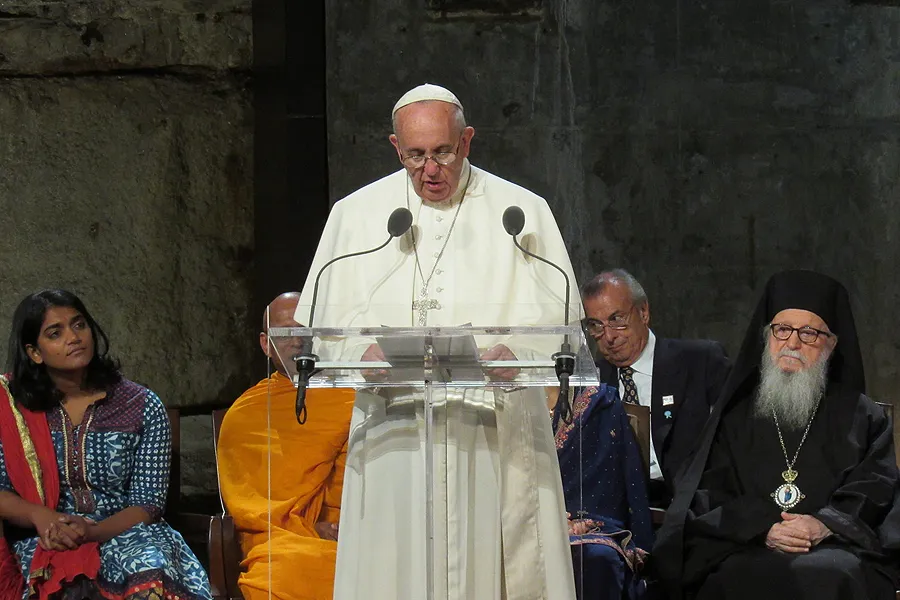
Like his predecessor, Benedict XVI, Pope Francis made a solemn visit with other religious leaders to Ground Zero, the site of the 9/11 attacks, later on Sept. 25. He met with families of first responders, saying at the site museum that acts of destruction always have “a face, a concrete story, names.” He offered a “prayer of remembrance” for all those killed that day, along with a prayer for the survivors and those who are mourning the loss of their loved ones.
Pope Francis speaks during an interreligious prayer service at Ground Zero, Sept. 25, 2015. Credit: Addie Mena/CNA
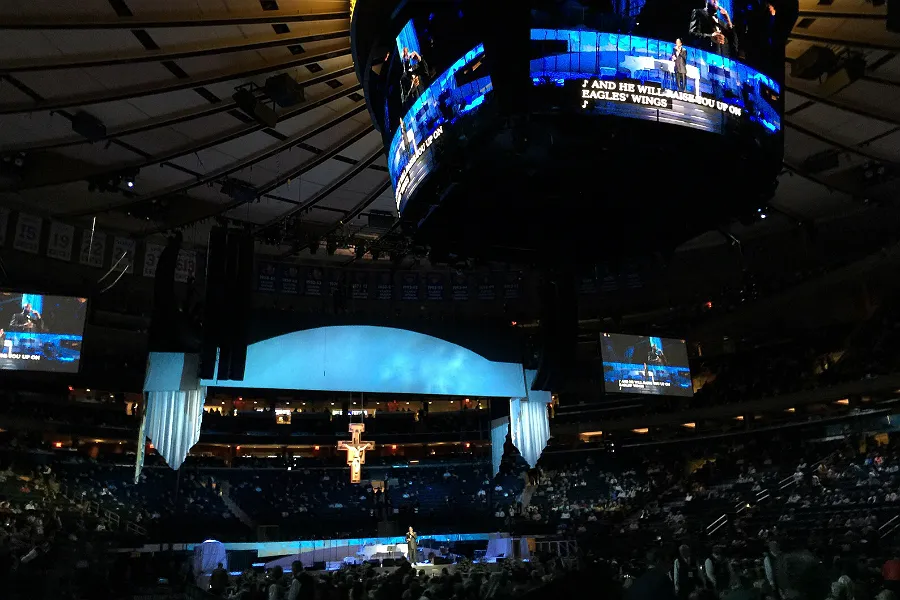
Later that day, after visiting Our Lady, Queen of the Angels School in the Harlem neighborhood of New York City, Francis celebrated Mass at Madison Square Garden. He encouraged people to remember those in the city who are often forgotten, including “foreigners, the children who go without schooling, those deprived of medical insurance, the homeless, the forgotten elderly.”
Madison Square Garden prepares for the papal Mass, Sept. 25, 2015. Credit: Alan Holdren/CNA
“Knowing that Jesus still walks our streets, that he is part of the lives of his people, that he is involved with us in one vast history of salvation, fills us with hope. A hope which liberates us from the forces pushing us to isolation and lack of concern for the lives of others, for the life of our city,” the pope said.
“A hope which frees us from empty ‘connections,’ from abstract analyses, or sensationalist routines. A hope which is unafraid of involvement, which acts as a leaven wherever we happen to live and work. A hope which makes us see, even in the midst of smog, the presence of God as he continues to walk the streets of our city.”
Philadelphia
Pope Francis’ visit included an appearance at the 2015 World Meeting of Families (WMF) in Philadelphia, an event that focuses on celebrating the gift of the family.
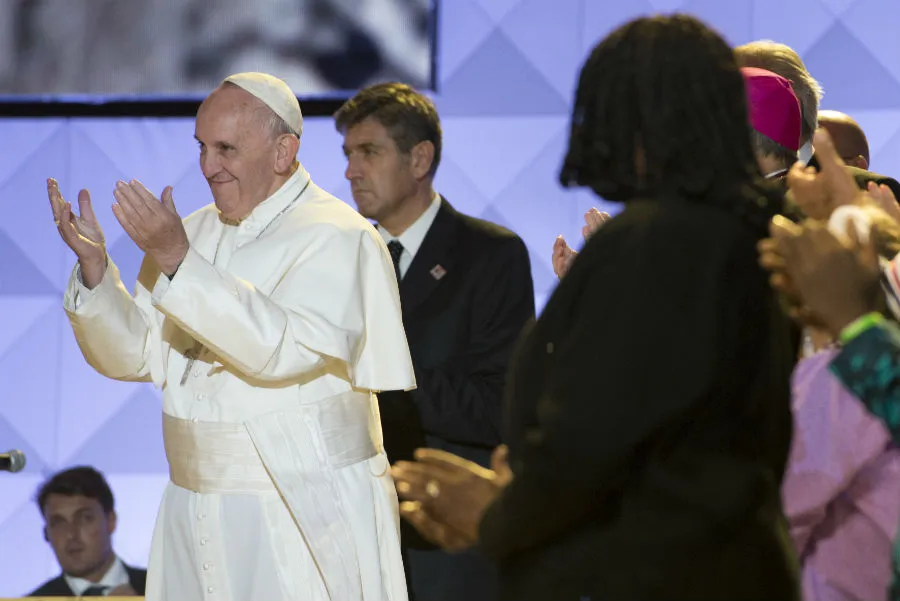
Pope Francis at the World Meeting of Families in Philadelphia on Sept. 26, 2015. Credit: L’Osservatore Romano
After flying to the “City of Brotherly Love” the morning of Sept. 26, Pope Francis took part in a Mass for clergy and religious at Philadelphia’s Cathedral Basilica of Sts. Peter and Paul. In his homily address, the pope challenged the clergy and religious to inspire new vocations.
He called for women to take on a greater role in the Church, highlighting the example of St. Katharine Drexel — a Philadelphia native — and he reminded the priests and religious present of their role in ministering to families, couples preparing for marriage, and young people.
He later addressed a crowd of some 50,000 people at Independence Mall, the site of Independence Hall and the Liberty Bell, for a religious freedom rally with Hispanic and other immigrants.
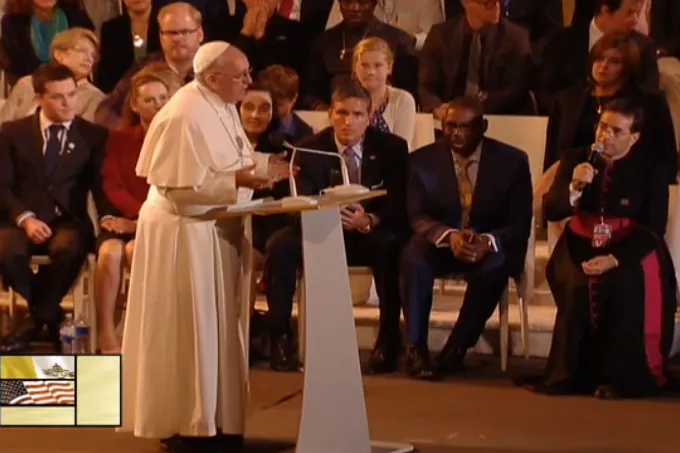
Speaking to thousands of families gathered on the Benjamin Franklin Parkway in Philadelphia that night, a visibly moved Pope Francis ditched his prepared remarks and instead gave an impromptu reflection on the beauty and dire importance of family life. He voiced his thanks at “the presence of all of you — who are a real witness that it’s worth being a family!” A society “is strong, solid, and edified on beauty, goodness, and truth,” he added.
Pope Francis addresses the Festival of Families in Philadelphia on Sept. 26, 2015. Credit: EWTN
On Sept. 27, the next day, Francis had an unscripted meeting with five abuse survivors — three women and two men — all of whom had been abused in childhood either by members of the clergy, family members, or educators. He promised accountability for perpetrators and expressed sorrow for the victims’ suffering.
In the face of such heinous acts as sexual abuse, “God cries,” he said, adding that “the criminal sins of the abuse of minors can’t be kept in silence any longer … I promise, with the vigilance of the Church, to protect minors and I promise [that] all of those responsible will be held accountable.”
He told a gathering of international bishops afterward that the survivors’ stories of suffering “have aggravated my heart” and said that crimes of abuse must never be kept in silence.
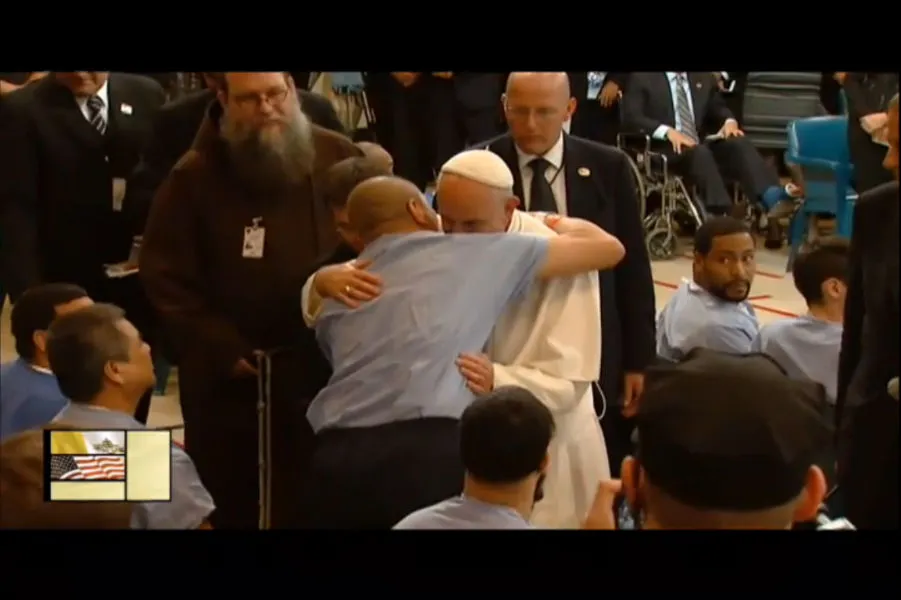
Later that morning, Francis visited a Philadelphia correctional facility, saying at the meeting with a group of 100 inmates and their families that every person is marked and bruised by life, but Jesus washes away our sins and invites us to live a full life.
Pope Francis embraces a man at Curran-Fromhold Correction Facility in Philadelphia on Sept. 27, 2015. Credit: EWTN
Reflecting on the trip, the Holy Father said it was “particularly moving for me to canonize St. Junípero Serra, who reminds us all of our call to be missionary disciples.”
He added that he was touched “to stand with my brothers and sisters of other religions at Ground Zero, that place which speaks so powerfully of the mystery of evil. Yet we know with certainty that evil never has the last word, and that, in God’s merciful plan, love and peace triumph over all.”
Furthermore, he promised his prayers for the U.S. people, saying: “This land has been blessed with tremendous gifts and opportunities. I pray that you may all be good and generous stewards of the human and material resources entrusted to you.”
“I thank the Lord that I was able to witness the faith of God’s people in this country, as manifested in our moments of prayer together and evidenced in so many works of charity.”
Concluding, he asked those present: “Do not let your enthusiasm for Jesus, his Church, our families, and the broader family of society run dry.”
“May our days together bear fruit that will last, generosity and care for others that will endure!” he said. “Just as we have received so much from God — gifts freely given us, and not of our own making — so let us freely give to others in return.”
Washington D.C., Nov 18, 2019 / 01:45 pm (CNA).- American fast-food chain Chick-Fil-A has announced it will stop donating to two large faith-based charitable organizations, after years of criticism from LGBT groups.
On Monday, the Chick-Fil-A Foundation announced the organizations it would donate to in 2020. Notably, the foundation will no longer donate to the Salvation Army or to the Fellowship of Christian Athletes. Instead, the foundation has pledged $9 million each to Junior Achievement, Covenant House International, and local food banks near new Chick-Fil-A locations.
“The Foundation will no longer make multi-year commitments and will reassess its philanthropic partnerships annually to allow maximum impact,” said the Chick-Fil-A Foundation in a press release. “These partners could include faith-based and non-faith-based charities.”
Previously, the Chick-Fil-A Foundation had donated to support the Salvation Army and Fellowship of Christian Athletes, and had signed multi-year commitments with each organization. According to a statement provided to Business Insider from Chick-Fil-A, those deals were fulfilled in 2018 and were not renewed.
The donations to Salvation Army and Fellowship of Christian Athletes were earmarked for specific programs that would assist underprivileged children.
Both the Fellowship of Christian Athletes and the Salvation Army promote the Biblical belief that marriage is a union between one man and one woman. Fellowship of Christian Athletes includes on its application for employment the organization’s belief that God does not approve of same-sex relationships or premarital sex.
The Salvation Army denies allegations that it is an anti-gay organization, and says that its charitable services are available to all, regardless of sexual orientation.
Chick-Fil-A has faced considerable controversy regarding its past charitable donations. In 2012, after the founder of Chick-Fil-A stated his opposition to same-sex marriage, there were calls for a nationwide boycott of the chain. This boycott largely failed, and Chick-Fil-A is now the third-largest restaurant chain in the country in terms of systemwide sales, trailing only McDonald’s and Starbucks.
After the outcry in 2012, Chick-Fil-A announced that it would no longer be supporting some organizations link to traditional views on marriage through its WinShape Foundation. The chain continued to provide support for both the Salvation Army and Fellowship of Christian Athletes.
Chick-Fil-A’s donation history has been cited in efforts to block the restaurant from opening locations in San Antonio and Buffalo’s airports. The opening of the company’s first restaurant in United Kingdom was met with extended protests by LGBT campaigners. The owners of the U.K. shopping center hosting the Chick-Fil-A announced that the lease would not be renewed after the six month trial.
Chick-Fil-A is closed on Sundays to give the chain’s workers a chance to attend religious services and be with their families.
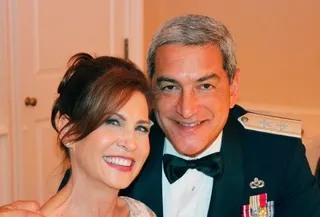
Nancy and Kelly McKeague of Alexandria, Va., say their Catholic faith provided an “anchor” to their marriage during Kelly’s service in the U.S. Air Force. / Courtesy of Nancy and Kelly McKeague
Boston, Mass., Nov 11, 2021 / 13:00 pm (CNA).
To coincide with Veterans Day, a marriage ministry has launched a free “virtual date night” video series specifically for military couples, providing mentoring and other resources to help spouses strengthen their bonds to one another, to their families and communities, and to God.
The new, three-part series is one of several developed by Witness to Love, a faith-centered marriage ministry based in St. Martinville, La. Founded by a Catholic couple, Mary-Rose and Ryan Verret, in effort to supplement existing church-based marriage preparation programs, Witness to Love provides a “virtues-based, Catechumenate model of marriage renewal and preparation that integrates modern principles of psychology and the virtues to help couples facilitate an authentic dialogue about their relationship,” according to its website.
Daniela Mazzone, vice president of content and leadership development and Spanish support lead at Witness for Love, told CNA that the idea for a date night video series came in response to the fact that so many couples were home together during the COVID-19 pandemic.
“We’ve always had in our hearts to do something for military couples, because we know that they also need a lot of support because there are challenges that they face in their own marriages which are much harder and could be different from what the average couple deals with,” especially when spouses are separated during a deployment, Mazzone said.
Couples can register online for free and will have access to Witness to Love’s app where they can see all the videos. It is not necessary to download the app on their mobile devices to see the videos, as they can also be viewed on the organization’s website, Mazzone said.
The military spouses series launches on Nov. 11, but couples will still have access to the videos on the website after that date. You can watch a promo video about the new military date night series below.
The new series features Kelly and Nancy McKeague, an Alexandria, Va. couple with four grown children who share the challenges and successes they experienced in their marriage while Kelly served in the U.S. Air Force.
“While a military spouse may not wear the uniform,” Kelly McKeague told CNA, “they’re going through the same tribulations and trials.”
“I just traveled with him and went along for the ride,” Nancy McKeague quipped. But her husband disagreed.
“I think, to be fair,” Kelly McKeague said, “the military spouse has a very unique role just because of separation, deployments, and what have you, and so in essence, a military spouse really does serve.”
Military life is a “higher calling,” Kelly McKeague said. “It’s a calling of service, but also a sacrifice that takes many, many forms.”
Nancy McKeague told CNA that “it would seem that whenever Kelly would leave and be gone, something pretty dramatic and traumatic would happen in our life.”
Speaking about a time when their son had an asthma attack in the middle of the night, Nancy McKeague said that she grabbed all her children and went to the emergency room, spending hours there.
She noted that emergencies like her son’s asthma attack happened “quite frequently,” and she just had to remind herself to stay strong for herself and children.
Nancy McKeague said she constantly reminded her children, while her husband was deployed, to “just remember that Daddy is doing this not only for our family, but for our country, and this is a really great thing that he’s doing.”
“I know it’s not easy for him to be gone,” she would say to her children, “but just remember we’re just going to pray for Daddy that he comes safely back home.”
The video series is not exclusively for Catholic couples. However, the McKeagues, who have been married for more than 37 years, say in their video testimony that their Catholic faith was their “anchor” during Kelly’s military service.
“Having that strong faith connection, in our view, as we present in the video, was so crucial to us, not only surviving as a military family, but thriving as a military family,” Kelly McKeague told CNA.
Staying close to the sacraments was “crucial” in keeping them strong as a couple and as a family, Nancy McKeague added.
Other presenters in the videos include a Navy couple, Shannon and Kim Walker, who speak about interpersonal relationship; an Air Force couple, Jon and Lea-Ann Virnig, who discuss family and community life; and Father Michael Murphy, the pastor at Sacred Heart Catholic Church in Coronado, Colo. Reflection questions and other resources resources are included with each video.
While each of the couples in the series has a unique perspective on the challenges that military spouses face, they also share a common experience, the McKeagues say.
“The thing that I’ve always loved so much about our military life was traveling to new places, getting to meet many new people, building friendships that have lasted since the beginning of our time in the military, and people that we’ve kept in touch with through the years that have made us stronger and have made us grow in our faith more,” Nancy McKeague told CNA.
“Those relationships and those friendships have been such a huge blessing to both of us,” she said.
“We were all in the crucible together, we were all experiencing the same challenges, and then some of those friends that Nancy talked about are from the chapel community, the Catholic chapel and they were lifelong friendships because they were honed in somewhat less than ideal circumstances, either the place or the situation or the operational tempo,” Kelly McKeague said.
“All of that starts to build a closeness with people who share the same uniform, but also share the same faith. So it’s an added bonus,” he said.
“Lucien Greaves, a co-founder the Satanic Temple, said his organization does not believe in the supernatural but sees Satan as a ‘metaphorical construct’ of ‘the ultimate rebel against tyranny'”. God is a Tyrant. That is a theme repeated by Karl Marx, Saul Alinsky. Both agnostic Jews perceived the God of Israel a monolithic and despotic construct. Privately however Marx railed against the divinity and said he preferred hell to subservience stating. “I wish to avenge myself against the One who rules above”. He wrote these poems:
1. “Invocation of One in Despair?
So a god has snatched from me my all. In the curse and rack of destiny. All his worlds are gone beyond recall! Nothing but revenge is left to me! I shall build my throne high overhead, Cold, tremendous shall its summit be. For its bulwark — superstitious dread. For its Marshall — blackest agony”.
2. “Human Pride
With disdain I will throw my gauntlet full in the face of the world,
And see the collapse of this pygmy giant whose fall will not stifle my ardor. Then will I wander godlike and victorious through the ruins of the world. And, giving my words an active force, I will feel equal to the Creator”.
Was God simply a hateful mental construct or an entity responsible for human oppression who Marx deemed himself capable of besting. We find similarity of thought in Cardinal Kasper’s hatred of a non changing God as insult to Man, an obstacle to the fulfillment of humanness. Saul Alinsky a non believer mused if he had a choice between heaven and hell he would choose hell because he would have opportunity to address conditions there. Tongue in cheek or personal conviction of his own sense of superiority? Lucien Greaves Karl Marx Saul Alinsky all have in common identity with the first and ultimate Rebel.




“Lucien Greaves, a co-founder the Satanic Temple, said his organization does not believe in the supernatural but sees Satan as a ‘metaphorical construct’ of ‘the ultimate rebel against tyranny'”. God is a Tyrant. That is a theme repeated by Karl Marx, Saul Alinsky. Both agnostic Jews perceived the God of Israel a monolithic and despotic construct. Privately however Marx railed against the divinity and said he preferred hell to subservience stating. “I wish to avenge myself against the One who rules above”. He wrote these poems:
1. “Invocation of One in Despair?
So a god has snatched from me my all. In the curse and rack of destiny. All his worlds are gone beyond recall! Nothing but revenge is left to me! I shall build my throne high overhead, Cold, tremendous shall its summit be. For its bulwark — superstitious dread. For its Marshall — blackest agony”.
2. “Human Pride
With disdain I will throw my gauntlet full in the face of the world,
And see the collapse of this pygmy giant whose fall will not stifle my ardor. Then will I wander godlike and victorious through the ruins of the world. And, giving my words an active force, I will feel equal to the Creator”.
Was God simply a hateful mental construct or an entity responsible for human oppression who Marx deemed himself capable of besting. We find similarity of thought in Cardinal Kasper’s hatred of a non changing God as insult to Man, an obstacle to the fulfillment of humanness. Saul Alinsky a non believer mused if he had a choice between heaven and hell he would choose hell because he would have opportunity to address conditions there. Tongue in cheek or personal conviction of his own sense of superiority? Lucien Greaves Karl Marx Saul Alinsky all have in common identity with the first and ultimate Rebel.
THAT is a statue which I would love to see pulled down.