Vatican City, Jun 14, 2017 / 03:47 am (CNA/EWTN News).- On Wednesday, Pope Francis said that God’s love isn’t something we earn or deserve by our good works, but that it is free and unconditional – no matter what.
“God’s first step towards us is that of an anticipated and unconditional love. God loves first,” Pope Francis said June 14.
“God does not love us because there is some reason that causes love. God loves us because He Himself is love, and love tends to spread and give by its nature. God does not even tie his benevolence to our conversion: if anything this is a consequence of God’s love.”
“Saint Paul says it perfectly,” he continued: “‘God demonstrates his love for us in the fact that while we were yet sinners, Christ died for us’ (Rm 5:8).”
“None of us can live without love,” the Pope said, but to believe that love is earned is to fall into a type of slavery. “Perhaps much of the anguish of contemporary man comes from this: to believe that unless we are strong, attractive and beautiful, then no one will take care of us.”
“Behind such seemingly inexplicable behavior arises a question,” he continued: “is it possible that I do not deserve to be called by name? That is, to be loved?”
Pope Francis reflected on this question during the general audience Wednesday, considering what it is like when we do not recognize that we are loved and cherished by God or the people around us, especially as children.
“Many people today,” he said, “look for visibility only to fill an inner void: as if we were people eternally in need of confirmation. But, imagine it, a world where everyone begs for reasons to attract the attention of others, and no one is willing to love one another for free?”
“Imagine a world like this: a world without the freedom to love! It looks like a humane world, but in reality it is a living hell.”
How much selfish and narcissistic behavior comes about because of this loneliness? he asked. When a child is not loved or does not feel loved, he said, this is when in adolescence they can start to act out, or even become violent. Behind this behavior “is often a heart that has not been recognized.”
What can we do to help people know they are loved by God? Francis said that when love is given and received freely between people, even in just a simple look or smile, this is what transforms sadness and loneliness into happiness and joy.
An exchange of glance, of smiles, has the power to open those closed in sadness, he said. By looking someone in the eyes, we can open the doors of someone’s heart.
“What can make us happy if not the experience of love given and received?” he said,
Just like in the story of the Prodigal Son, fathers and mothers are often one of the greatest examples of a Christ-like love on earth, the Pope pointed out, explaining how he has known many mothers with children in prison, who continue day after day to visit them, never ceasing “to suffer for her child.”
Parents love their children even when they are sinners and “God does the same thing with us: we are his beloved children! But is it possible God has some children he does not love? No. We are all God’s beloved children.”
“In Him, in Christ Jesus, we have been loved, beloved, desired. There is Someone who has engraved in us a primordial beauty, that no sin, no wrong choice will ever erase completely.”
Because of the heat, Pope Francis began the audience by stopping to greet the sick and their families in the Pope Paul VI hall, where they could watch and hear the audience on screens, but inside the air-conditioned building.
“But we all remain together connected by the Holy Spirit, who is the one who always creates unity,” he said.
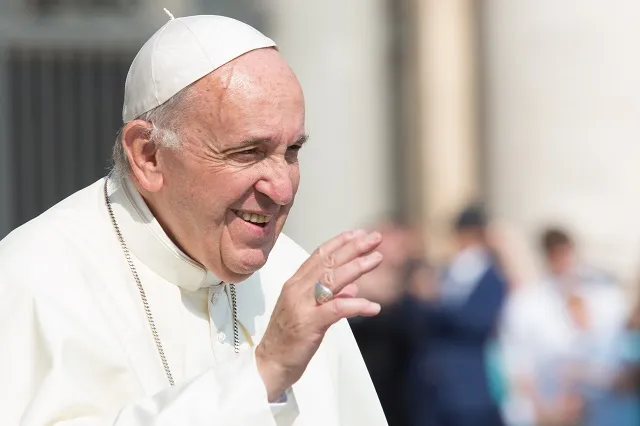
Concluding, Francis asked the crowd: “What is the medicine to change the heart of a person who is not happy?” “Love!” the crowd responded. “Stronger!” he said. “Love!” they shouted louder. “Very good, very good, everyone,” the Pope said smiling.
If you value the news and views Catholic World Report provides, please consider donating to support our efforts. Your contribution will help us continue to make CWR available to all readers worldwide for free, without a subscription. Thank you for your generosity!
Click here for more information on donating to CWR. Click here to sign up for our newsletter.
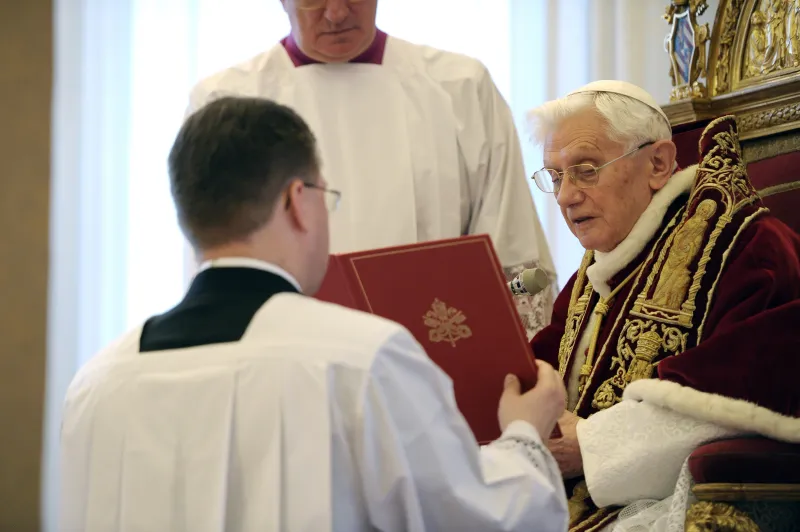
Pope Benedict XVI announced his intention to resign the papacy during a meeting of cardinals Feb. 11, 2013. The surprise announcement, which he made in Latin, took place in the Hall of the Consistory in the Vatican’s apostolic palace. / Vatican Media
Washington, D.C. Newsroom, Jan 2, 2023 / 06:00 am (CNA).
On Feb. 11, 2013, before a gathering of cardinals who had come to the Vatican expecting to hear the announcement of upcoming canonizations, Pope Benedict XVI dropped a bombshell.
After a few announcements about Church business at the conclusion of the meeting, the pope took out two sheets of paper and read a prepared statement in Latin.
“I have convoked you to this Consistory, not only for the three canonizations, but also to communicate to you a decision of great importance for the life of the Church. After having repeatedly examined my conscience before God, I have come to the certainty that my strengths, due to an advanced age, are no longer suited to an adequate exercise of the Petrine ministry,” the then 85-year-old pontiff told the gathering of the Catholic Church’s highest-ranking clergymen.
Because he spoke in Latin, the language used for official Vatican proclamations, reporters present did not at first realize that the pope had just stepped down.
‘Total surprise, total shock’
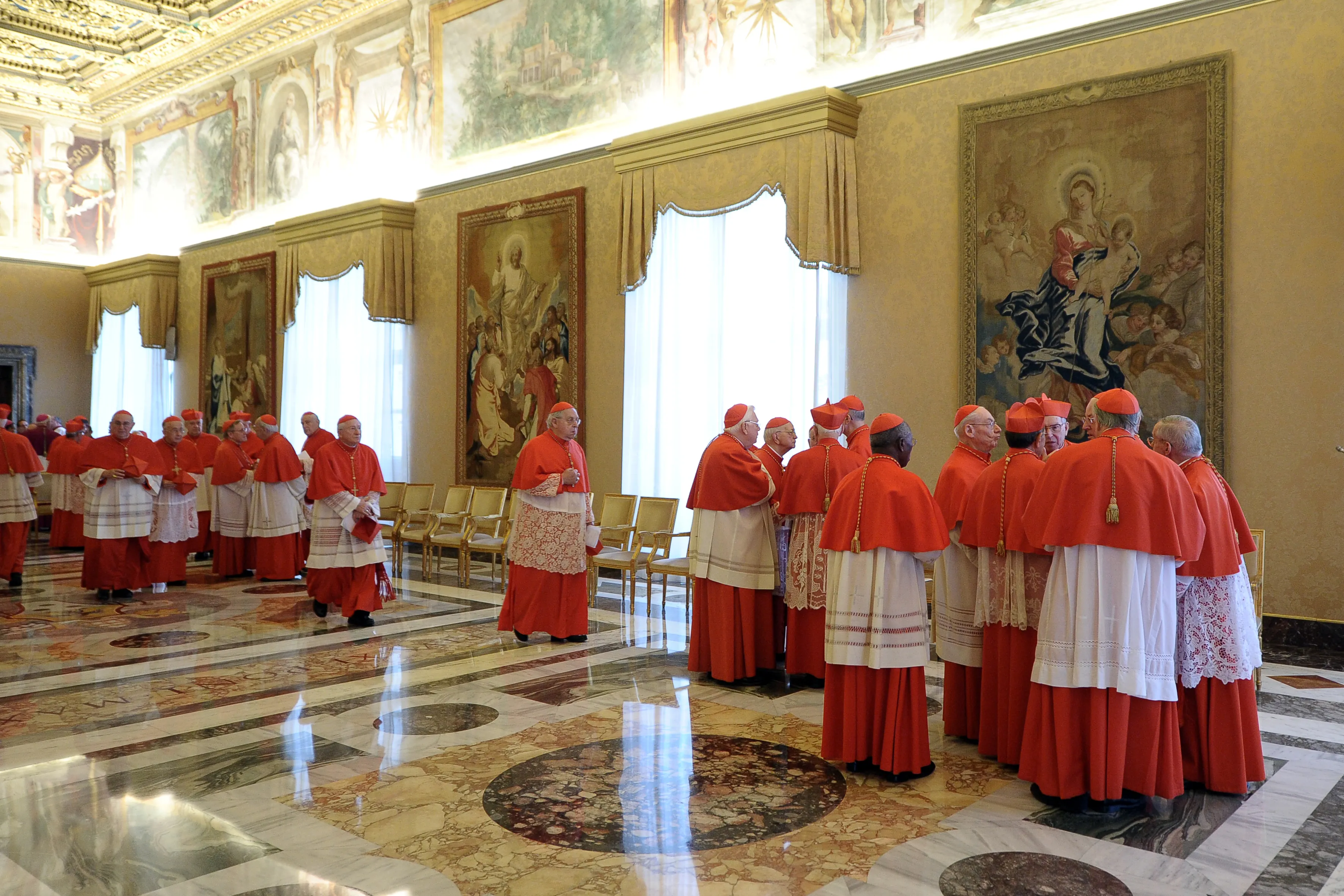
The assembled cardinals, on the other hand, who knew their Latin, reacted with stunned silence.
American Cardinal James Stafford later told CNA that the pope’s statement was received with “total surprise, total shock.”
“A cardinal who was sitting next to me said, ‘Did he resign?’ I said, ‘Yes, that’s what he did. He resigned.’ And we just all stood at our places.”
Cardinals react to Pope Benedict XVI’s announcement of his intention to resign the papacy Feb. 11, 2013. The surprise announcement, which Benedict made in Latin, took place in the Hall of the Consistory in the Vatican’s apostolic palace. Vatican Media
Nigeria’s Cardinal Francis Arinze, who was present that morning, said the announcement was a “surprise, like thunder that gives no notice that it’s coming,” reported The Catholic Telegraph.
In renouncing the papacy, Benedict became only the second pope in almost 600 years to voluntarily step down. In 1294, Pietro da Morrone, an elderly hermit, was crowned Pope Celestine V, but finding the demands of the job too much for him, he resigned after only five months.
In 1415, Pope Gregory XII also resigned, but under very different circumstances — he stepped down in order to end a crisis within the Church known as the Great Western Schism.
Title, white clothes, and papal coat of arms
What happened next with Benedict XVI was no less surprising to those who expected him to live as a retired cardinal.
In his last official statement as pope, before a general audience on Feb. 27, 2013, Pope Benedict assured the tens of thousands of people gathered to hear him speak as pope for the last time that even though he was stepping back from official duties, he would remain, in essence, pope.
“The ‘always’ is also a ‘forever’ — there can no longer be a return to the private sphere. My decision to resign the active exercise of the ministry does not revoke this,” Benedict said.
“I do not return to private life, to a life of travel, meetings, receptions, conferences, and so on. I am not abandoning the cross, but remaining in a new way at the side of the crucified Lord,” he told the crowd.
A day earlier, on Feb. 26, 2013, the director of the Vatican Press Office, Father Federico Lombardi, had silenced speculation over what Benedict would be called and what he would wear. He would, Lombardi said, retain the trappings of the papacy — most significantly, his title and dress.
“He will still be called His Holiness Benedict XVI,” Lombardi said. “But he will also be called Pope Emeritus or Roman Pontiff Emeritus.”
Lombardi said Benedict would continue to wear a white cassock but without the mozzetta, the short cape that covers the shoulders. The pope’s fisherman’s ring would be replaced by a ring from his time as cardinal. The red shoes would go as well, Lombardi said, and be replaced by a pair of brown ones.
“The city of León is known for beautiful shoes, and very comfortable shoes. And when the pope was asked what he wanted to wear he said, ‘I want the shoes from León in Mexico,’” Lombardi said at the press conference.
On May 2, the cardinal who designed Benedict’s coat of arms in 2005 told CNA that he had written the pope emeritus suggesting that his coat of arms would need to be redesigned to reflect his new status. Cardinal Andrea Cordero Lanza di Montezemolo proposed making the keys of St. Peter smaller and less prominent.
“That shows that he had a historic possession but not a current jurisdiction,” said the cardinal at the time.
Benedict, however, it seems, politely declined a new coat of arms. La Stampa reported the following year that the Vatican Publishing House’s manual of ecclesiastical heraldry in the Catholic Church contained the following note:
“Expressing deep appreciation and heartfelt gratitude to the author for the interesting study sent to him, [Benedict] made it known that he prefers not to adopt an expressive heraldic emblem of the new situation created with his renouncing of the Petrine Ministry.”
By his decision to continue to dress in white like the pope, retain the title of pope, and keep the coat of arms of his papacy, Benedict revealed that in giving up the “active exercise of the ministry,” he was not forsaking the role of pope altogether.
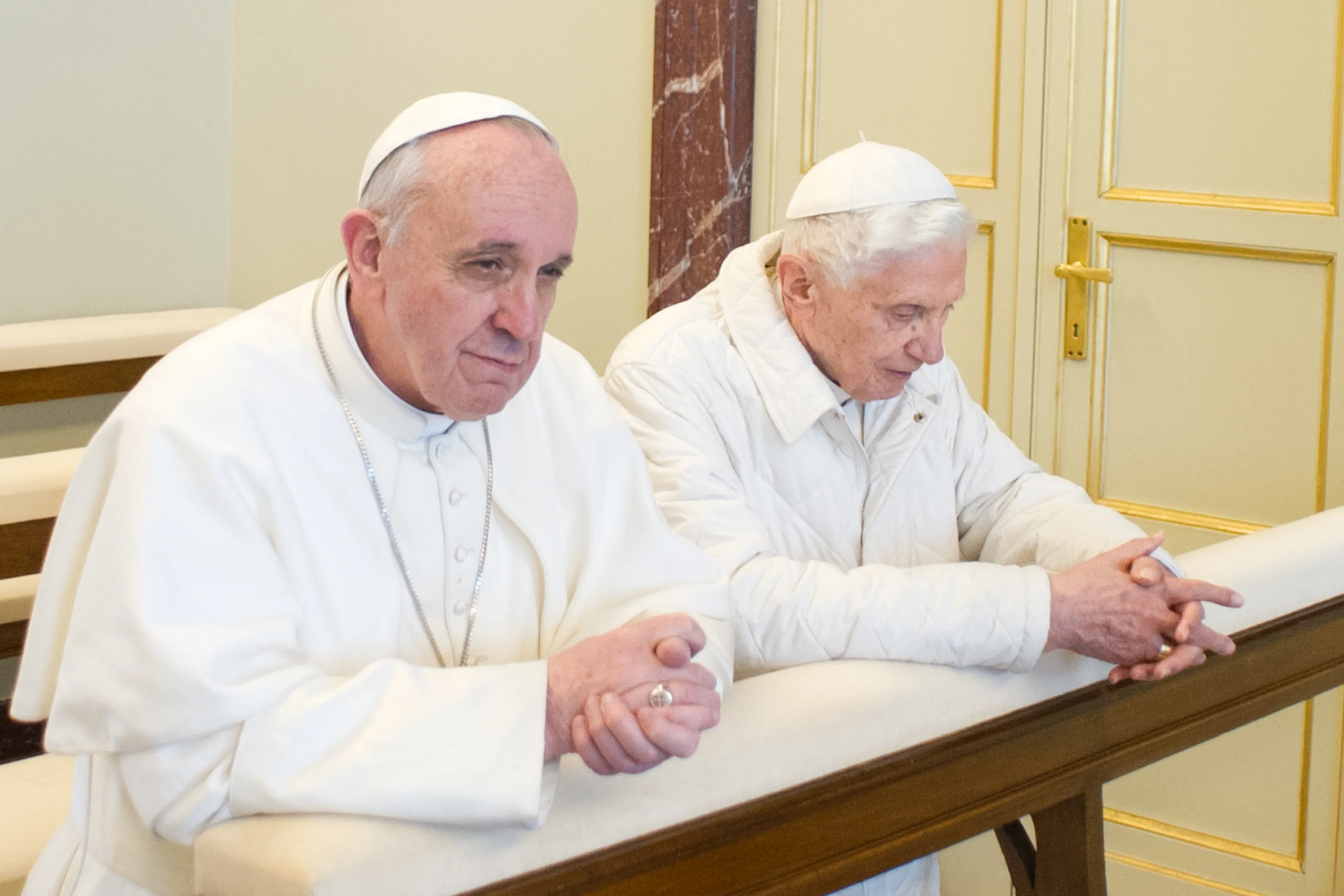
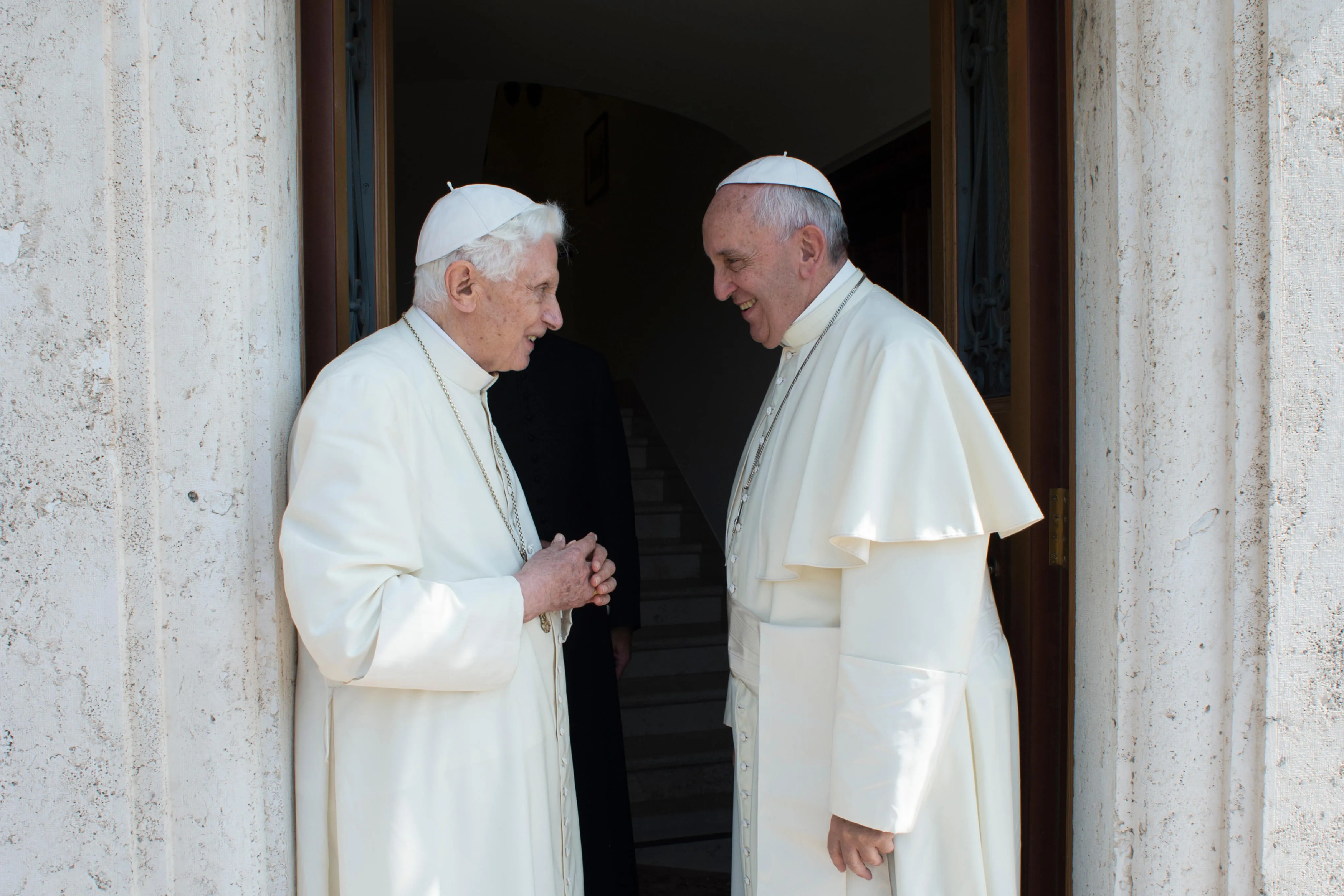
Pope Francis and Pope Emeritus Benedict XVI pray together at the papal residence in Castel Gandolfo March 23, 2013, their first meeting after Francis’ election. Vatican Media
An expanded Petrine ministry
In his 2013 announcement, Benedict clearly expressed his intention to step aside, even determining the date and time of his official departure. Nonetheless, his decision to keep the title of pope and maintain the ceremonial protocol that goes along with the papacy led some to speculate whether there were not actually “two popes.”
Benedict’s personal secretary and closest confidante, Archbishop Georg Gänswein, sought to clear up any confusion in 2016.
In a speech at the Pontifical Gregorian University in Rome on May 20, 2016, Gänswein said that Pope Francis and Benedict are not two popes “in competition” with one another but represent one “expanded” Petrine office with “an active member” and a “contemplative.”
Parsing Benedict’s speech, Gänswein explained that in stepping down, Benedict was not giving up his ministry.
“The key word in that statement is ‘munus petrinum,’ translated — as happens most of the time — with ‘Petrine ministry.’ And yet, ‘munus,’ in Latin, has a multiplicity of meanings: It can mean service, duty, guide, or gift, even prodigy. Before and after his resignation, Benedict understood and understands his task as participation in such a ‘Petrine ministry [munus],’” Gänswein said.
“He left the papal throne and yet, with the step he took on Feb. 11, 2013, he has not abandoned this ministry,” Gänswein explained, saying the latter scenario was something “quite impossible after his irrevocable acceptance of the office in April 2005.”
Benedict himself later made clear in an interview with his biographer Peter Seewald that he saw himself as continuing in his ministry. He said that a pope who steps down is like a father whose role changes, but always remains a father.
“Of course a father does not stop being father, but he is relieved of concrete responsibility. He remains a father in a deep, inward sense, in a particular relationship which has responsibility, but not with day-to-day tasks as such. It was also this way for bishops,” Benedict said.
“I think it is also clear that the pope is no superman and his mere existence is not sufficient to conduct his role, rather he likewise exercises a function.
“If he steps down, he remains in an inner sense within the responsibility he took on, but not in the function. In this respect one comes to understand that the office of the pope has lost none of its greatness, even if the humanity of the office is perhaps becoming more clearly evident,” Benedict said.
Benedict’s decision “not to abandon his ministry” inspired a cottage industry of conspiracy theories, with some questioning whether the pope emeritus truly stepped down because of his age and frailty.
George Weigel, author of the definitive biography of St. John Paul II, “Witness to Hope,” dismissed such speculation in an interview with CNA.
“I have no reason to think that there was anything more to Pope Benedict’s resignation than what he said was its cause: his conviction that he no longer had the strength, physical and intellectual, to give the Church what it needed from a pope,” he said.
“Everything else written about this is sheer speculation. Let’s take Benedict at his word,” Weigel said.
A life of prayer
In retiring to live in the Mater Ecclesiae Monastery in the Vatican Gardens, Benedict did not completely withdraw from the world. He attended public events in his new capacity as pope emeritus, received visitors, and pursued a life of fruitful study, writing, and prayer.
Pope Francis visits Pope Emeritus Benedict XVI at the Mater Ecclesiae monastery in Vatican City to exchange Christmas greetings Dec. 23, 2013. Vatican Media
Matthew Bunson, Catholic historian, author, and executive editor of EWTN News, told CNA that Benedict was determined not to exercise authority in his new role.
“He really embraced what it means to be pope emeritus, and refrained from making public comments, to instead live a life of prayer and reflection,” Bunson said.
“Benedict really was on retreat, and in prayer,” he said, “and that means we have his prayer for us as a Church.”
While becoming increasingly frail, Benedict continued to celebrate Mass daily with the other residents of the monastery and was known to enjoy spending time in the Vatican Gardens praying his daily rosary.
In the fall of 2021, more than eight years after Benedict stepped down, his private secretary, Gänswein, told Domradio in Cologne, Germany, that Benedict was “stable in his frailty.”
He described the pope emeritus as very weak physically but still clear in mind. Gänswein said he had not lost his “typical Bavarian humor.”
The meaning of Benedict’s renunciation for future popes
In 2013, after Benedict announced that he would step down as pope, Father Gianfranco Ghirlanda, a Jesuit theologian and canonist chosen by Pope Francis to be a cardinal, wrote an essay on what should happen when a pope steps down.
In the article, published in Civiltà Cattolica, Ghirlanda suggested the retiring Benedict take the title bishop emeritus of Rome.
“It is evident that the pope who has resigned is no longer pope; therefore he no longer has any power in the Church and cannot interfere in any government affair. One may wonder what title Benedict XVI will retain. We think that he should be given the title of bishop emeritus of Rome, like any other diocesan bishop who ceases,” he said.
In December 2021, at a congress on papal resignations, Ghirlanda took up the theme again.
“Having two people with the title of ‘pope,’ even if one added ’emeritus,’ it cannot be said that this might not generate confusion in public opinion,” he said.
To make clear that the pope who resigns is no longer pope, he said, he should perhaps be called “former Roman pontiff” or “former supreme pontiff.”
Pope Francis in July 2022 told reporters that if he were to retire from the papacy he would do things differently from his predecessor.
“The first experience went very well,” Pope Francis said, because Benedict XVI “is a holy and discreet man.”
In the future, however, “it would be better to define things or explain them better,” the pontiff added.
“I am the bishop of Rome. In that case I would be the bishop emeritus of Rome,” he said, and then suggested he would live in St. John Lateran Palace rather than at the Vatican.
Tokyo, Japan, Nov 25, 2019 / 01:04 am (CNA).- Amid the confusion and anxiety often found in modern society, Christ offers us the perspective and freedom to order our lives properly, Pope Francis said at Mass in Tokyo on Monday.
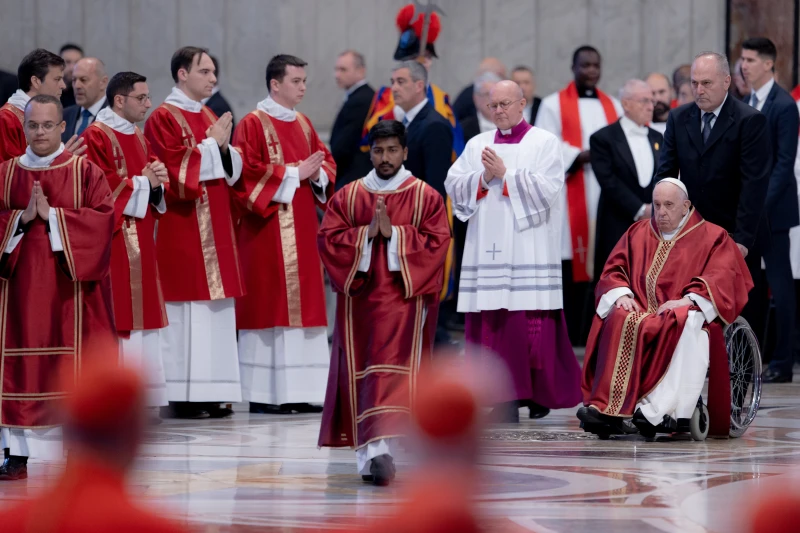
Pope Francis arrives at the Liturgy of the Lord’s Passion in St. Peter’s Basilica on Good Friday on April 7, 2023. / Credit: Daniel Ibanez/CNA
Rome Newsroom, Mar 29, 2024 / 08:00 am (CNA).
The Good Friday liturgy commemorates the apex of Christ’s passion with a remembrance of his crucifixion and death at Calvary.
The Good Friday Reproaches are a series of antiphons, known also as the “Improperia” or “Popule Meus” (“My people”), coming from the opening lines of the Latin text of the recitation.
Dating back to the ninth century, though not gaining a permanent place in the Roman Orders until the 14th century, the Good Friday Reproaches have long been an essential part of the Roman liturgy. But they largely disappeared from many parishes following the liturgical reforms of the Second Vatican Council.
The antiphons have, however, retained their prominence at the Vatican — and they will be chanted by the Sistine Chapel Choir during the Good Friday service presided over by Pope Francis on Friday in St. Peter’s Basilica.
In the moment leading up to the dramatic recitation, the priest chants three times, in an increasing pitch, “Ecce Lignum Crucis,” or “Behold the wood of the cross,” each time gradually unveiling the cross that hitherto has been covered in a purple veil.
Once the crucifix is placed in a central location at the edge of the sanctuary, cast against a bare altar, the faithful are invited to kneel before — and kiss — it, a powerful remembrance of Christ’s passion but also a recognition of the cross as an instrument of salvation.
During the adoration of the cross, the Good Friday Reproaches are chanted in an alternating manner between a cantor and choir. It opens: “Popule meus, quid feci tibi? Aut in quo contristavi te? Responde mihi” (“My people, what have I done to you? How have I offended you? Answer me”).
This hauntingly sorrowful and beautiful text is followed by the first reproach: “Quia eduxi te de terra Aegypti: parasti Crucem Salvatori tuo” (“Because I led thee out of the land of Egypt: thou hast prepared a cross for thy Savior”), showcasing the world’s fatal rejection of Christ despite his love and saving acts.
The following is the full text of the reproaches:
Popule meus, quid feci tibi? Aut in quo contristavi te? Responde mihi. (O my people, what have I done to thee? Or how have I offended you? Answer me.)
Quia eduxi te de terra Aegypti: parasti Crucem Salvatori tuo. (Because I led thee out of the land of Egypt: thou hast prepared a cross for thy Savior.)
Hagios o Theos. Sanctus Deus. Hagios Ischyros. Sanctus fortis. Hagios Athanatos, eleison himas. Sanctus immortalis, miserere nobis. (O holy God! O holy God! O holy strong One! O holy strong One! O holy and immortal, have mercy upon us. O holy and immortal, have mercy upon us.)
Quia eduxi te per desertum quadraginta annis: et manna cibavi te, et introduxi te in terram satis bonam: parasti Crucem Salvatori tuo. Hagios . . . (Because I led thee through the desert for forty years: and fed thee with manna, and brought thee into a land exceeding good: thou hast prepared a cross for thy Savior. O holy God! . . .)
Quid ultra debui facere tibi, et non feci? Ego quidem plantavi te vineam meam speciosissimam: et tu facta es mihi nimis amara: aceto namque sitim meam potasti: et lancea perforasti latus Salvatori tuo. Hagios . . . (What more ought I to have done for thee, that I have not done? I planted thee, indeed, my most beautiful vineyard: and thou hast become exceeding bitter to me: for in my thirst thou gavest me vinegar to drink: and with a spear thou hast pierced the side of thy Savior. O holy God! . . .)
Ego propter te flagellavi Aegyptum cum primogenitis suis: et tu me flagellatum tradidisti. Popule meus . . . (For thy sake I scourged the firstborn of Egypt: Thou hast given me up to be scourged. O my people . . .)
Ego te eduxi de Aegypto, demerso Pharone in mare Rubrum: et tu me tradidisti principibus sacerdotum. Popule meus . . . (I led thee out of Egypt, having drowned Pharaoh in the Red Sea: and thou hast delivered me to the chief priests. O my people . . .)
Ego ante te aperui mare: et tu aperuisti lancea latus meum. Popule meus . . . (I opened the sea before thee: and thou hast opened my side with a spear. O my people . . .)
Ego ante te praeivi in columna nubis: et tu me duxisti ad praetorium Pilati. Popule meus . . . (I went before thee in a pillar of cloud: and thou hast led me to the judgment hall of Pilate. O my people . . .)
Ego te pavi manna in desertum: et tu me cedisti alapis et flagellis. Popule meus . . . (I fed thee with manna in the desert: and thou hast assaulted me with blows and scourges. O my people . . .)
Ego te potavi aqua salutis de petra: et tu me potasti felle et aceto. Popule meus . . . (I gave thee the water of salvation from the rock: and thou hast given me gall and vinegar to drink. O my people . . .)
Ego propter te Chananeorum reges percussi: et tu percussisti arundine caput meum. Popule meus . . . (For thy sake I struck the kings of the Canaanites: and thou hast struck my head with a reed. O my people . . .)
Ego dedi tibi sceptrum regale: et tu dedisti capiti meo spineam coronam. Popule meus . . . (I gave thee a royal scepter: and thou hast given a crown of thorns for my head. O my people . . .)
Ego te exaltavi magna virtute: et tu me suspendisti in patibulo crucis. Popule meus . . . (I exalted thee with great strength: and thou hast hanged me on the gibbet of the cross. O my people . . .)



Leave a Reply