Denver, Colo., Apr 20, 2017 / 12:11 am (Denver Catholic).- It seems providential that a new order of Discalced Carmelite nuns, whose charism is to know and to make known the glory of the Holy Trinity, has arrived to Denver to care for the archdiocese’s Holy Trinity Center.
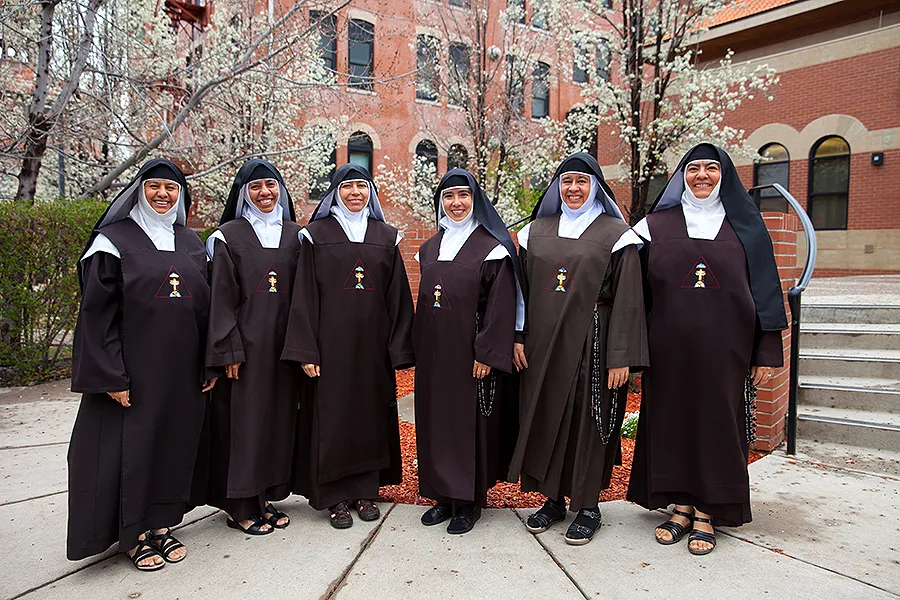
The six Allied Discalced Carmelites of the Holy Trinity are the first nuns of their order, which was born in Aguascalientes, Mexico, to open a convent in the United States.
“It is by the grace of God,” Mother Martha Patricia Malacara, superior of the community, told the Denver Catholic. “He is making history (here).
“We want to thank Archbishop Samuel Aquila for welcoming us,” she added, “we are very grateful.”
Founded by Sister Martha Maria Ramirez-Mora on July 16, 1986, the order has 200-plus nuns serving in various apostolates – ranging from assisting at nursing homes to retreat centers – in Mexico, Italy, Rome, Argentina and Chile.
The semi-cloistered nuns are active contemplatives.
“We have the Carmelite essence of contemplative prayer but we also have an apostolate,” Mother Malacara said.
Residing in the convent at the St. John Paul II Center campus, which includes the chancery offices and the archdiocese’s two seminaries, the nuns will help run the day-to-day functions of the Holy Trinity Center, which includes the archbishop’s residence and rooms for large-scale meetings, conferences and events. The nuns will also help maintain the various sacristies on the campus.
The nuns’ primary task, however, is prayer – particularly the Divine Office and daily Eucharistic adoration. They pray especially for the sanctification of priests and seminarians, for the conversion of sinners and for the needs of the Church. They also welcome prayer requests.
“We want to let people know that we are praying for them,” Mother Malacara said. “Prayer is our main charism.”
Ranging in age from 35 to 46, the nuns are all Spanish-speaking natives of Mexico. They arrived to Denver March 14. Serving under Mother Malacara are Sister Imelda Cardona, Sister Lidia Cortez, Sister Elvira Esparza, Sister Maria Patricia Mireles and Sister Laura Martinez-Silvestre.
Clad in sandals, black veils and brown habits, the nuns’ habits are emblazoned with a triangular emblem that represents the Holy Trinity: one God comprised of three persons – the Father, Son and Holy Spirit.
Inside the triangle, a cloud signifies the Father’s providence, which floats over his son Jesus’ cross, upon which the Holy Spirit, as a dove, issues tongues of fire for the Spirit’s seven gifts, which descend on a globe.
The nuns’ first impressions of their new land have been of warm hospitality.
“The United States is very beautiful,” Mother Malacara said. “People have welcomed us well. We do not speak English but people have tried to speak to us in Spanish.”
The nuns are learning English, but when language fails, the nuns said laughing, those involved have resorted to friendly gesturing.
“From the first moment we stepped on the land of the United States, very friendly people have helped us and guided us,” said Sister Mireles.
Not only do the nuns welcome prayer requests, but women interested in their order are invited to contact them.
“If you feel that call, answer it!” Sister Cardona said, adding that there is no need to be afraid. “God loves you, so you should answer.”
Prayer requests may be emailed to Carmelites@archden.org or mailed to Allied Discalced Carmelites of the Holy Trinity, 1300 S. Steele St., Denver, CO 80210.
This article originally appeared in the Denver Catholic. Reprinted with permission.
If you value the news and views Catholic World Report provides, please consider donating to support our efforts. Your contribution will help us continue to make CWR available to all readers worldwide for free, without a subscription. Thank you for your generosity!
Click here for more information on donating to CWR. Click here to sign up for our newsletter.
An Easter Vigil procession at St. Dominic Parish in San Francisco. / Credit: St. Dominic Parish/Lorelei Low
CNA Staff, Mar 15, 2025 / 06:00 am (CNA).
Five years ago this week, public health orders issued amid the uncertainty of the novel coronavirus turned Mass schedules across the country and the world upside down.
In those early days following the WHO’s March 11, 2020, declaration of COVID-19 as a pandemic, the bishops of every U.S. diocese issued some form of dispensation, suspending the obligation that Catholics must attend Sunday Mass in person.
Thousands of parishes and ministries scrambled to develop plans to offer livestreamed Masses, deliver the sacraments in a “socially distanced” manner, and live out the Church’s life as best they could under extraordinary circumstances. Public Masses at most parishes were suspended entirely for a time, and those that were able to reopen were subject, in many areas, to distancing requirements and numerical or percentage-based attendance caps.
As Catholics nationwide adapted to the changes — not knowing how long this new reality might last — observers feared that many Catholics, barred from their parishes for so long and now accustomed to attending from the comfort of home, might not return after the parish doors reopened.
A study from the Pew Research Center found that most Catholics continued participating in Mass throughout the pandemic — but many were only able to do so virtually. In November 2022, when the survey was done, only about 4 in 10 U.S. Catholics said they attended Mass in person as often as they did before the pandemic.
Indeed, from the start of the COVID pandemic lockdowns in the U.S. to the declared end of the pandemic in May 2023, in-person Mass attendance averaged just 15% — a dismal figure, but not markedly lower than the 24% it was before. (The Catholic Church teaches that Catholics are obligated to attend Mass in person every Sunday, except for a serious reason such as illness or if they’ve been dispensed from their obligation by their pastor or bishop.)
Some bishops lifted the dispensations they had issued as early as late 2020, while a few held out until 2022. In lifting the dispensations they issued amid the lockdowns, many U.S. bishops implored Catholics to return to Mass in person.
While Mass attendance today among Catholics in the U.S. remains much lower than among Catholics in other countries, recent data has suggested that U.S. in-person Mass attendance levels have quietly returned to where they were in 2019 after years of uncertainty over whether they would ever rebound.
For some thriving parishes in the U.S., the lockdowns — while challenging — presented an opportunity to continue sharing the faith in a creative manner and come out even stronger than they were before.
Father John Mosimann, pastor at St. Mary of the Immaculate Conception Parish in Fredericksburg, Virginia, told CNA that the parish has seen its numbers grow since the pandemic.
On a typical weekend, Mosimann and his four parochial vicars celebrate 11 total Masses in English, plus another in Spanish at a different parish where they are kick-starting a Spanish Mass ministry.
All told, roughly 3,800 people attended St. Mary’s weekend Masses on a typical week in 2019. According to headcounts, the parish had already exceeded its pre-pandemic levels by 2023, with around 4,300 attendees on average. The parish, which is about 55 miles south of Washington, D.C., has 6,700 registered families and nearly 100 active ministries.
Father John Mosimann poses with altar servers and Bishop Michael Burbidge of Arlington, Virginia. Credit: Photo courtesy of Father John Mosimann
During the pandemic, St. Mary’s added extra Masses — since for a time, Masses were limited to a smaller-than-usual number of attendees — and continued hosting adoration. Like so many other parishes, the parish had to quickly adapt to a livestreaming paradigm in order to stay connected with the community.
“I was in the office and I was looking at Facebook and I said, ‘What if I hit this button and go live, what would happen?’” Mosimann remembers thinking as the lockdowns began.
“And so I started streaming on Facebook Live and everybody started jumping in … ’What’s going on, Father? What’s going to happen?’ And I didn’t have answers, because I wasn’t that great a prophet. But we did immediately start streaming.”
He said parishioners were grateful for the effort the priests made to stay in touch, despite the occasional technical challenge — a problem far from unique to St. Mary’s.
“If you want perfect sound and you want a studio, go to EWTN. They’ve got professional equipment. If you want to see your priests, come talk to us,” Mosimann said he told his parishioners.
“We’re not going to be anxious over having studio quality, because what’s important is for us to be connected to you. People responded to that. People were very grateful for that. It was very frequently cited by parishioners, how grateful they were for our staying in touch with them during that difficult moment.”
Father John Mosimann baptizes a child at his parish, St. Mary of the Immaculate Conception in Fredericksburg, Virginia. Credit: Ginny Foreman
The last of Virginia’s capacity-restricting public health orders on venues was lifted in late May 2021, and Bishop Michael Burbidge of the local Diocese of Arlington in the following month lifted the dispensation he had issued, inviting Catholics to return to Mass throughout the diocese. So far, as in most U.S. dioceses, Mass attendance overall in Arlington has risen significantly but has not quite returned to pre-pandemic levels.
Since the pandemic’s end, Mosimann said his focus has been on encouraging parishioners to use their time and talents generously to help rebuild and grow the parish community.
For Mosimann, the pandemic experience was proof that by remaining faithful even through troubling and difficult times, God can and does bring good out of bad situations through his grace.
“[We] did everything we could to provide the sacraments to God’s people and to make it available as much as possible with all the restrictions. That should be the goal of every parish, every day, whether there’s a pandemic or not,” Mosimann said.
‘We are proud to be who we are’
Father Michael Hurley, OP, pastor of St. Dominic Parish in San Francisco, said his parish, which offers what he believes is the largest young adult presence in the entire archdiocese, regularly sees attendance numbers today that are similar to pre-pandemic levels.
The parish was able to safely provide the sacraments to those in need during the pandemic and had, providentially, already set up livestreaming for Masses shortly before the start of the pandemic. To this day the parish maintains a healthy online base of Dominican laypeople who tune in for Masses and prayer.
Father Michael Hurley, OP, (left) and his fellow priests from St. Dominic Parish in San Francisco cross the street in a homage to “Abbey Road.” Credit: St. Dominic Parish/Ivi Fandino
Hurley said he personally never worried during lockdown about people not returning to Mass, instead trusting that Catholics would return when they could. He said his main concern was keeping the church building open safely during the pandemic — in a state with some of the strictest lockdown measures in the country — to maintain sacramental support.
California finally lifted all capacity restrictions on religious gatherings in April 2021 after previously implementing a near-total ban on indoor services that was contested all the way to the U.S. Supreme Court.
The sanctuary of St. Dominic Parish in San Francisco. Credit: St. Dominic Parish/Alex Mizuno
Though the demographics of St. Dominic Parish has changed somewhat, in-person worshippers, many of whom work in the Bay Area’s high-tech sector, have returned in large numbers.
“The Lord is always searching for the strays, right? … All you have to do is open the doors and do what you’re doing, and people will come,” Hurley told CNA.
That said, Hurley said he believes St. Dominic’s beautiful church building, welcoming atmosphere, and a strong sense of identity — as a Dominican-led parish that aims to “radiate the joy of the Gospel in the heart of the city” — helps to make it an attractive place for Catholics, especially young adults. They also keep the church building open for personal prayer throughout the day, a rarity in a city that occasionally struggles with crime.
“We are proud to be who we are as Catholics, and for us as clergy, as Dominicans. And that makes a huge difference,” Hurley said.
Denver Newsroom, Aug 7, 2020 / 05:21 pm (CNA).- Archbishop-designate Mitchell Rozanski is set to take over the Archdiocese of St. Louis, after heading the Diocese of Springfield, Mass. since 2014. Though Rozanski himself backed major changes in the Springfield diocese’s handling of abuse, one unnamed abuse victim has asked for a Church investigation into whether the archbishop-designate was involved in covering up abuse.
Olan Horne, an advocate for victims of sex abuse by clergy, said the request to investigate Archbishop-designate Rozanski was made by a Berkshire County resident who had taken part in the Boston archdiocese’s multi-million dollar settlement, the Springfield newspaper The Republican reports. Horne said the request had support from “other concerned Catholics here in the diocese.”
The complaint was made through the Catholic Bishops Abuse Reporting Service website, and Horne said he received confirmation that the allegation had been filed.
Mark Dupont, secretary of communications for the Diocese of Springfield, told CNA August 6 that Rozanski had worked to make improvements in responding to sexual abuse allegations since before June 2019, when he commissioned an independent investigation into the mishandling of an allegation about a previous bishop.
“Even prior to commissioning the Judge Velis Report, then-Bishop Rozanski had directed a total revamping of our Safe Environment office, bringing in a new director, hiring new investigators, negotiating an agreement with all local district attorneys’ offices, and naming a task force to review all procedures for handling complaints,” Dupont told CNA.
Dupont said the complaint about Rozanski would have been directed to Springfield’s metropolitan, the Archdiocese of Boston, but added “to the best of our knowledge no such complaint has been filed.”
CNA sought comment from the Boston archdiocese, the St. Louis archdiocese, and Archbishop-designate Rozanski, but received no response by deadline.
Pope Francis named Rozanski Archbishop of St. Louis in early June. He will be installed Aug. 25.
In June, the Springfield diocese released the final report of an independent investigation led by retired Superior Court Judge Peter A. Velis, an adjunct professor of criminal evidence at Westfield State University who handled Catholic clergy sex abuse cases as a judge.
The report examined the case of an alleged victim, known under the pseudonym John Doe, who said he told the diocesan review board that Springfield Bishop Christopher J. Weldon, who died in 1982, had abused him, as did two priests, when he was an altar boy in the 1960s.
However, Bishop Weldon was not listed on the Springfield diocese’s list of clergy credibly accused of abuse. Although at least three witnesses and a letter to Doe from the review board supported Doe’s claim that he told the review board about Weldon in 2018, the review board only acknowledged the claim that the two priests had abused him.
On June 24, the diocese released Velis’ 373-page report finding that Doe’s claim he was molested by Bishop Weldon were “unequivocally credible.”
The Velis report indicated that there were two accounts of the diocesan investigator’s findings, one of which was more clear in accusing Weldon of abusing Doe. That version, however, was not shared with the review board. Some diocesan responses, which indicated Doe had never testified about Weldon’s abuse, relied on the version which had been shared with the review board.
The Velis report said that “from the inception of the complaint through the follow-up process, the procedure was greatly flawed.”
In June, Rozanski apologized for the “chronic mishandling of the case, time and time again, since 2014.”
“At almost every instance, we have failed this courageous man who nonetheless persevered thanks in part to a reliable support network as well to a deep desire for a just response for the terrible abuse which he endured,” the archbishop-designate said at a June press conference, one year after he commissioned Velis to conduct the investigation.
Both a diocesan investigator and a victim’s advocate involved in Doe’s case are no longer employed by the diocese, and Weldon is now named on the Springfield diocese website as a “deceased bishop who was found to have credible allegations of abuse.”
Horne was still critical of the diocese.
“It should not have taken this herculean effort to get justice for the Weldon survivor,” he said. “Look at the names and the games — they are the same and finally we have had a few investigations to get to the bottom of the claims we all have been making here for years without any results.”
This is not the first time abuse concerns regarding a bishop have surfaced in the Diocese of Springfield. In 2004, Bishop Thomas Dupre became the first Catholic bishop in the U.S. to be indicted on criminal charges for sexual abuse. The case did not go to trial due to the statute of limitations on some charges and because the grand jury decided not to indict on other charges, The Republican reported.
Horne accused the diocese of handling abuse through “an archaic system” that should have been updated after Dupre left, but never was.
The sex abuse victims’ advocate also objected to the diocese’s delay in naming diocesan priest Father Paul Archambault to its list of credibly accused priests. The priest’s name was added in 2016, the year the diocese disclosed its 2011 settlement with an alleged victim. Archambault committed suicide in 2011, after being confronted about his alleged abuse of a teenage boy.
Dupont, the spokesman for the diocese, told CNA the Velis report “had no finding of any cover-up.”
However, Velis said his findings raise questions about whether there was an attempt to conceal the report’s contents about Bishop Weldon from the review board or Bishop Rozanski. It was not the scope of his investigation to determine responsibility for the apparent deceptive practice or “if and when the reports were switched.”
Rozanski told Velis he was not aware of the specifics of Doe’s allegation of abuse by Weldon and did not know about the different reports about Doe’s allegation produced by the diocesan investigator.
Velis reported that Rozanski “immediately felt a call to action” when he was made aware there were possible discrepancies in how the complaint was handled.
However, Rozanski said he knew that Weldon was accused of being “present during incidents of abuse that occurred” and acknowledged to Velis that he considered this to be a form of abuse.
Dupont, the Springfield diocesan spokesman, maintained that the diocese did not cover up allegations against Weldon. He told CNA that “our earliest public responses acknowledged Bishop Weldon was allegedly present where the abuse occurred.”
The Velis report is not unchallenged. The diocese’s most recent vicar general, Monsignor Christopher Connelly, has said he was “unfairly and unfavorably portrayed” in the report, according to The Republican.
Connelly has denied the alleged victim’s claim to have told him that Weldon abused him.
“I regret that my recollection of that meeting and his are so very different. I am also puzzled that throughout this process there is a lot of discrepancy and confusion. I am puzzled by that as well,” Connelly said.
“The name of Weldon was not divulged to me. Our meeting was not about Bishop Weldon, it was about another deceased priest,” said the monsignor. Connelly said that if Weldon’s name had been mentioned, it would have been in a follow-up letter, which only mentions the accusation against Father Clarence Forand.





Leave a Reply