No Picture
News Briefs

Love of neighbor must begin with love of God, Pope Francis says

September 25, 2017 CNA Daily News 0

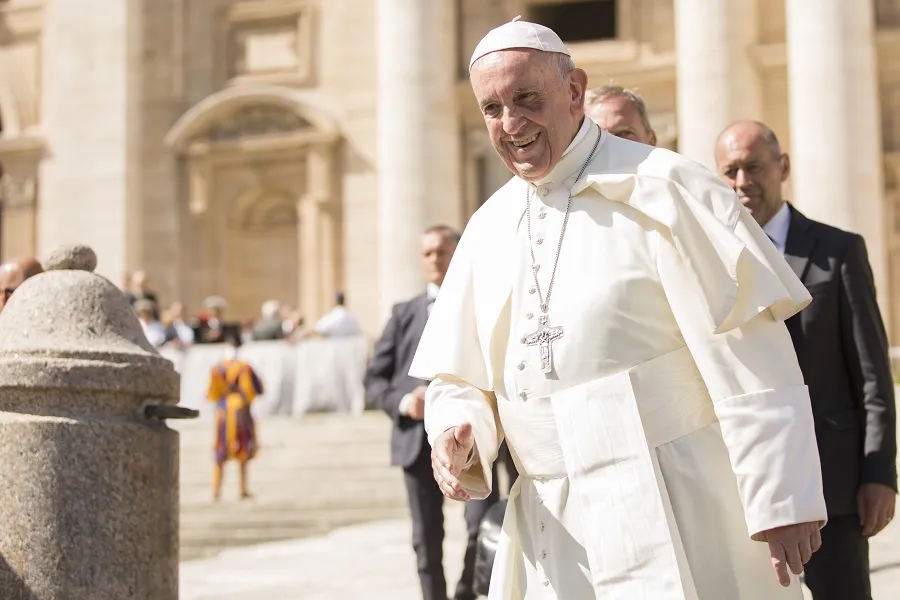
Vatican City, Sep 25, 2017 / 09:12 am (CNA/EWTN News).- Monday Pope Francis spoke to benefactors of the Vatican Swiss Guard about love of neighbor, which he said must first be steeped in love of Christ and drawn from prayer and frequent reception of the sacraments.

“Love to one’s neighbor corresponds to the mandate and the example of Christ if it is based on a true love of God. It is thus possible for the Christian, through his dedication, to make others feel the tenderness of the heavenly Father,” the Pope said Sept. 25.

“To give love to brothers, it is necessary to draw it from the furnace of divine charity, through prayer, listening to the Word of God, and nurturing the Holy Eucharist. With these spiritual references, it is possible to operate in the logic of gratuity and service.”

Pope Francis met Monday morning with 50 members of the Foundation of the Pontifical Swiss Guard, an organization which offers financial, material and technical support to the Vatican’s small military force.

He thanked them for their work in support of the young Swiss men who devote some years of their lives to “serving the Church and the Holy See.”

“This is an opportune occasion for me to reiterate that their discreet, professional and generous presence is so appreciated and useful for the good performance of Vatican activities.”

The business of the foundation expresses community spirit and solidarity, the Pope said, a typical feature of the Catholic presence in society and an attitude which is rooted in the appeal of the Gospel to love one’s neighbor.

“Therefore, through your work, you are concrete witnesses of evangelical ideals and, in the Swiss social fabric, you are an example of fraternity and sharing,” he said.

Concluding, Francis wished them joy as they continue their “fruitful commitment,” and bestowed the apostolic blessing.

He also prayed for protection for them and their families through the intercession of the Blessed Virgin Mary and St. Nicholas of Flüe, the patron of Switzerland, whose feast the Swiss celebrate on Sept. 25.

St. Nicholas of Flüe was born in 1417 near the Lake of Lucerne in Switzerland. He married at the age of 30 and had 10 children. In addition to his duties as a husband and a father, Nicholas donated his talents and time selflessly to the community and always strove to give an excellent moral example to all.

The saint was also able to devote much of his private life to developing a strong relationship with the Lord.  He had a strict regime of fasting and he spent a great deal of time in contemplative prayer.

Around the year 1467, when he was 50 years old, Nicholas felt called to retire from the world and become a hermit. His wife and children gave their approval, and he left home to live in a hermitage a few miles away.

While living as a hermit, Nicholas quickly gained a wide reputation for his personal sanctity, and many people sought him out to request his prayers and spiritual advice.

Nicholas lived the quiet life of a hermit for 13 years. However in 1481, a dispute arose between the delegates of the Swiss confederates at Stans and a civil war seemed imminent. The people called on Nicholas to settle the dispute, so he drafted several proposals which everyone eventually agreed upon.

Nicholas’ work prevented civil war and solidified the country of Switzerland. But, as a true hermit, he then returned to his hermitage after settling the dispute.

He died six years later on March 21, 1487 surrounded by his wife and children. The Church celebrates his feast day on March 21, though in Switzerland and Germany it is celebrated on Sept. 25.

[…]

No Picture
News Briefs

Inclusion, dialogue highlighted in new Vatican guidelines for educators

September 24, 2017 CNA Daily News 0

Vatican City, Sep 24, 2017 / 10:36 pm (CNA/EWTN News).- The Vatican has issued new guidelines for Catholic educators, developed to help them respond to the modern challenges of a globalized society, placing a heavy emphasis on inclusion, the need to dialogue and the importance of “humanizing” education so the person is at the center.

The guidelines were published Sept. 22 in a short document entitled “Educating to Fraternal Humanism: Building a Civilization of Love 50 years after Populorum Progressio.”

Populorum Progressio is an encyclical written by Pope Paul VI in 1967 on “the development of peoples” in wake of the Second Vatican Council.

Vatican officials said the guidelines represent a fresh perspective on what Christian education means in today’s globalized world, with a special emphasis on dialogue, inclusion and creating a “humanizing” approach to education.

It was published by the Gravissimum Educationis Foundation, which was established by Pope Francis in 2015 to mark the 50th anniversary of the Second Vatican Council’s declaration on Christian education.

One of three declarations of Vatican II, Gravissimum educationis recognized the Church’s role in education, ordered toward man’s salvation, and stated fundamental principles of Christian education.

The conciliar document, issued Oct. 28, 1965, stated that Catholic schools are meant “to help youth grow according to the new creatures they were made through baptism as they develop their own personalities, and finally to order the whole of human culture to the news of salvation so that the knowledge the students gradually acquire of the world, life and man is illumined by faith.”

Cardinal Giuseppe Versaldi, president of the Vatican’s Congregation for Catholic Education, told journalists that Populorum Progressio “marked a decisive watershed in the history of social issues, offering a new model of ethics that was able to embrace, with a wider gaze, all continents in the perspective of ever-increasing global interdependence.”

The document, which forms the basis for the guidelines, “underlines how urgent and necessary it is to humanize education, favoring a culture of encounter and dialogue,” he said.

And the first step in “humanizing” education, he said, is by “globalizing hope guided by the message of salvation and love from Christian revelation.”

“The solidarity and brotherhood that arise from this personal and social transformation,” he said, “will be the basis of an inclusive process capable of influencing lifestyles and economic and environmental paradigms.”

Alongside Cardinal Versaldi at the press conference were the congregation’s secretary, Archbishop Angelo Vincenzo Zani, and the Secretary General of the Gravissimum Educationis Foundation, Msgr. Guy-Réal Thivierge.

In comments to journalists, Archbishop Zani said there are three key points to the guidelinest, the first of which is “to humanize education.”

“This is very important because the Pope said at the end of the global congress in 2015 said no to proselytism, yes to humanization. So education is above all making it so the person is fully themselves.”

To do this, the person must use all the instruments available to them, but without forgetting “the dimension of transcendence” that the incarnation of Christ offers.

“For us this dimension of humanization is essential not only in an ideological or theoretical sense, but in concrete practice,” Zani said, explaining that it must be “translated into paths that go beyond the technicalities and ‘proceduralisms’ that often suffocate institutions.”

A second key aspect of the text is its emphasis on “the culture of dialogue,” which Archbishop Zani said involves “the need to pass from the throwaway culture to to the culture of dialogue.”

To this end, the text outlines the thought of French philosopher Paul Ricueur, who develops the concept of dialogue, “asking that this dialogue isn’t done on a superficial level, but on the level of the depth of the person who in order to dialogue, must enter into themselves and…put themselves into contact with the identity of the other.”

Zani then pointed to a third element of the guidelines he said is part of the core message, which is “the disposition of inclusion,” which Pope Francis himself speaks of often.

Inclusion means to encounter, rather than to exclude, Zani said, noting that “many times our institutions are exclusive more than inclusive,” and “the knowledge itself that we communicate in our institutions, is often a selective knowledge.”

“So this culture of inclusion would like to propose a knowledge that is rather understood as a good that isn’t positional, which guarantees a social position, but a relational good, which helps every person to further develop their relationships with other people,” he said.

Zani also outlined several projects the foundation is currently involved with, including research for a new models of education, a survey for youth ahead of the upcoming Synod of Bishops and a permanent observatory tasked with studying international changes and challenges to an integral education.

In comments to CNA, Cardinal Versaldi said the term “fraternal humanism” in the title of the guidelines means “to educate man, humanity, on how to be true men.”

“You cannot avoid relationships with others, which are relationships in the logic of love,” he said, and emphasized the importance of mutual sharing and enrichment, “because we aren’t all from the same place, there are inequalities, there are exclusions.”

 The cardinal said that the guidelines emphasize  “the duty on the part of everyone to see how to give their contribution to change a situation of inequality or of being discarded.” This, he said, is because “in a globalized world, where there inequality, a problem arises for everyone, not only for those who are discarded.”

Because of this, not only do people need to have the foresight to see and remedy situations of injustice, but institutions and governments must as well, Versaldi said. “Otherwise the world won’t be cured of its evils.”

What Catholic educational institutions can offer, he said, is the proper formation of youth in particular, so they can themselves become examples of “fraternal humanism” that others will follow.

Versaldi said the congregation won’t be asking educational institutions to change their curriculum per se, but rather, ask that educators themselves be formed in the contents of the guidelines and update their own approach based on the perspective the text offers.

“You can’t simply repeat the past, even from the point of view of content and curriculum, but you need to also be able to adapt to the new situations, always maintaining in a strong way the meaning of the Christian message, which doesn’t change through time,” he said.

According to the cardinal, there are currently more than 216,000 Catholic schools throughout the world with a student population of over 60 million from all faiths and ethnicities.

Africa boasts more than 24 million Catholic school students, and is followed by Asia, which has 13 million. The Americas have a Catholic school population of 12 million, followed by Europe with 8.6 million and Oceania with 1.2 million.

Cardinal Versaldi said that “despite falling in some western countries, in recent years there has been a steady increase in registrations on a global level.”

In addition to the number of Catholic schools and students, there are roughly 1,800 Catholic universities and 500 ecclesial faculties globally.


[…]

No Picture
News Briefs

Pope and Peruvian president discuss Venezuela, upcoming papal visit

September 24, 2017 CNA Daily News 1

Vatican City, Sep 24, 2017 / 06:54 pm (CNA/EWTN News).- Pope Francis met with Peruvian President Pedro Pablo Kuczynski Friday to discuss the country’s fight against poverty, the crisis in Venezuela and the Pope’s upcoming visit, among other topics.

President Kuczynski, described the meeting to journalists at a Sept. 23 news briefing, saying “what we spoke about is what is happening in Peru, how little by little we are eliminating poverty in Peru (and) what is happening in the Peruvian government.”

“We also spoke, naturally, about the visit of the Holy Father to Peru,” he said, drawing attention to the trip Pope Francis will make to Peru and Chile in January 2018.

The president said preparations for the visit are going well, and that “almost everything is ready.” Authorities are still deciding where the Pope’s final Mass on the last day of the visit will be held, but “everything else in the trip is already organized.”

The visit, announced in June, will take the Pope to Chile from January 15 to 18 and Peru from January 18 to 21, 2018. It will mark Francis’ fourth official tour of Latin America since his election, after Brazil in 2013; Bolivia, Paraguay and Ecuador in 2015 and his recent visit to Colombia earlier this month.

In Chile the Pope will visit the capital of Santiago, and the cities of Temuco and Iquique. In Peru, he will visit the capital city of Lima, as well as Puerto Maldonado and Trujillo.

In his comments to journalists, President Kuczynski described his conversation with the Pope as “very friendly.” The Pope offered several “proverbs” known in the Spanish language, he said, adding that “he is a man very knowledgeable in literature.”

He and Francis also discussed the situation of former presidents of Peru, some of whom are currently in prison. The latest ex-president to be put behind bars is Ollanta Humal, who was jailed in July amid a corruption scandal that continues to unfold in the country.

Corruption was also naturally a part of the discussion, specifically “how the fight against corruption is going,” Kuczynski said.

He explained that in his meeting with Vatican Secretary of State Cardinal Pietro Parolin that followed his conversation with the Pope, Peruvian leaders, after consulting with other governments, are planning to make a proposal to establish an “Inter-American Court against corruption” during the 2018 Summit of the Americas, set to take place in Lima.

The president also touched on Peru’s complicated past, in many was still shrouded by the violence of the guerrilla group “the Shining Path,” largely active in the 1980-90s, and the need for reconciliation.

“In Latin America, in all countries, we need reconciliation, and the visit of the Pope without doubt will immensely help this,” Kuczynski said, noting that Peru itself “has been successful enough in reconciliation after the period of terrorism and hyperinflation that we had.”

Another topic that has somewhat overshadowed the Church in Peru for the past two years is the scandal surrounding Luis Fernando Figari, a consecrated layman who founded the Sodalitium Christianae Vitae, a society of apostolic life, in 1971 in Peru. It was granted pontifical recognition in 1997, and is one of the most well-known communities in Peru.

It came into the international spotlight when in 2015 accusations of physical, sexual and psychological abuse were raised against Figari, which were proved to be true. Figari, who had been transferred to Rome, was then barred from any contact with the community as the result of an investigation carried out by Peruvian civil authorities.

Although the case is likely to come up at some point during the Pope’s visit, President Kuczynski said the issue was not raised in his discussion with the Pope, as it is being handled “through other channels.”

The president said his discussion with Cardinal Parolin also touched on the crisis in Venezuela, with both agreeing that “humanitarian aid must be allowed into Venezuela because there are many people who are sick, there are no medicines.”

“The current government, for reasons of pride, is opposed to this,” he said. Another mutual interest, then, is “to look for a dialogue so that there is a transitional system of government.”

“We are all worried, we want to help,” he said. “We think that a country that has the largest petroleum reserves in the world deserves a better destiny for their inhabitants.”

Miguel Perez, Rome correspondent for CNA’s Spanish-language sister agency ACI Prensa, contributed to this article.

[…]

No Picture
News Briefs

Paraguay’s government rejects gender ideology

September 24, 2017 CNA Daily News 1

Asunción, Paraguay, Sep 24, 2017 / 02:42 pm (ACI Prensa).- Paraguay Secretary of Education, Enrique Riera told reporters that the country’s constitution recognizes “the traditional family” consisting of “dad, mom, and children,” and stated that the government would remove from schools all material promoting false gender ideology, introduced by the previous administration.

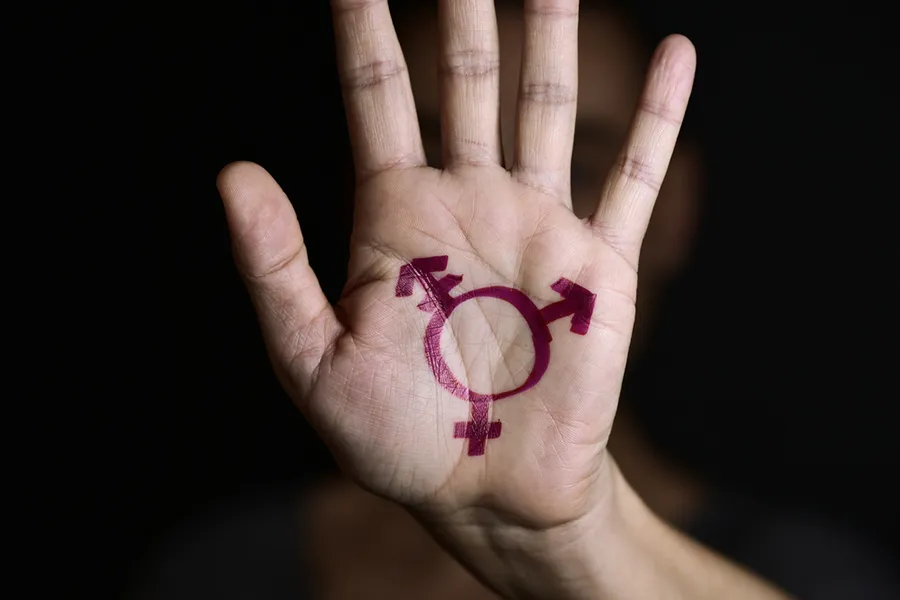
At a September 18 press conference, Riera lamented the “confusion” and criticism the government received after posts on social media stated that the country’s schools were teaching that gender is a social construct, that man and woman are not born as such, among other concepts related gender ideology.

The Secretary blamed this content on an agreement signed between the administration of former president Fernando Lugo, and a homosexual group called “We are Gay.”

The Lugo administration signed an agreement between We are Gay and the Directorate of Ongoing Education. That agreement generated some educational materials, and they remained in use and available on the government’s website, Riera said.

The Secretary explained that his office “ordered them to be taken down and revised because there is a phrase which created the whole problem,” which is “where it literally says that gender is a social construct.”

“I want to tell you that the Ministry of Education is basing itself on Article 52 of the National Constitution, on the traditional family, on traditional values, with dad, mom and children: It’s also my personal position and we naturally respect different options, but we’re not going to inculcate them in our public schools,” he assured.

Article 52 of the Paraguayan Constitution establishes that “the union in matrimony of man and woman is one of the fundamental components in the formation of the family.”

Riera indicated that he informed the President of Paraguay, Horacio Cartes “where this confusion came from. We all saw WhatsApp, there was some very severe criticism from some quarters.”

[…]

No Picture
News Briefs

Paraguay’s government rejects gender ideology

September 24, 2017 CNA Daily News 1

Asunción, Paraguay, Sep 24, 2017 / 02:42 pm (ACI Prensa).- Paraguay Secretary of Education, Enrique Riera told reporters that the country’s constitution recognizes “the traditional family” consisting of “dad, mom, and children,” and stated that the government would remove from schools all material promoting false gender ideology, introduced by the previous administration.

At a September 18 press conference, Riera lamented the “confusion” and criticism the government received after posts on social media stated that the country’s schools were teaching that gender is a social construct, that man and woman are not born as such, among other concepts related gender ideology.

The Secretary blamed this content on an agreement signed between the administration of former president Fernando Lugo, and a homosexual group called “We are Gay.”

The Lugo administration signed an agreement between We are Gay and the Directorate of Ongoing Education. That agreement generated some educational materials, and they remained in use and available on the government’s website, Riera said.

The Secretary explained that his office “ordered them to be taken down and revised because there is a phrase which created the whole problem,” which is “where it literally says that gender is a social construct.”

“I want to tell you that the Ministry of Education is basing itself on Article 52 of the National Constitution, on the traditional family, on traditional values, with dad, mom and children: It’s also my personal position and we naturally respect different options, but we’re not going to inculcate them in our public schools,” he assured.

Article 52 of the Paraguayan Constitution establishes that “the union in matrimony of man and woman is one of the fundamental components in the formation of the family.”

Riera indicated that he informed the President of Paraguay, Horacio Cartes “where this confusion came from. We all saw WhatsApp, there was some very severe criticism from some quarters.”

[…]

No Picture
News Briefs

Cardinal Burke: Church divisions show urgent need for clarity

September 24, 2017 CNA Daily News 4

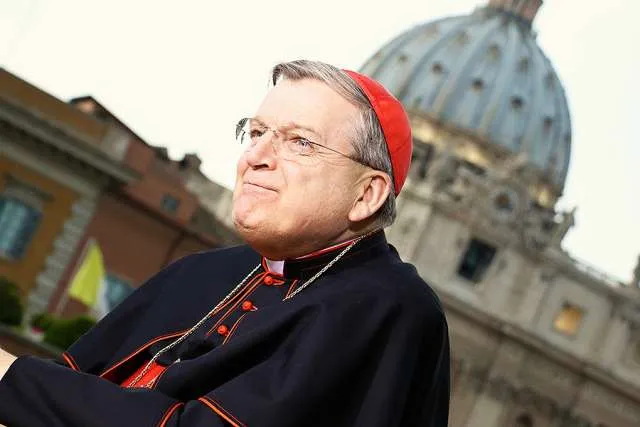
Sydney, Australia, Sep 24, 2017 / 12:38 pm (CNA).- Amid the ongoing debate surrounding “Amoris Laetitia,” dubia author Cardinal Raymond Burke said in a new interview that he’s wrongly depicted as the “enemy” of Pope Francis, but he stressed that current division in the Church demands an answer to requests for clarity.

“The urgency of a response to the dubia derives from the harm done to souls by the confusion and error, which result, as long as the fundamental questions raised are not answered in accord with the constant teaching and practice of the Church,” Cardinal Burke said.

“The urgency weighs very heavily on my heart,” he said. In his experience, the cardinal said he’s seen “a great deal of confusion, also people feeling that the Church is not a secure point of reference.”

“Some are feeling even a certain bewilderment…they are looking for a much stronger presentation of the Church’s doctrine.”

Cardinal Burke was one of four signatories of a letter submitted to Pope Francis last September outlining five dubia, or doubts, about the interpretation of his 2016 post-synodal apostolic exhortation “Amoris Laetitia.”

That letter had been submitted to the Pope privately, but released to the public two months later, prompting a firestorm of media commentary and debate.

However, the cardinal also addressed the purported “conflict” between him and Pope Francis, stressing that the media portrayal of he and the Pope is inaccurate, and frequently “overdone.”

“It’s all a caricature. They depict Pope Francis as a wonderful, open person and there’s nothing wrong with that, but they depict me as just the opposite,” he said, explaining that this is done “to advance their own agenda.”

However, Pope Francis “is actually not in favor of their agenda. They use this kind of technique to make it seem like he is and that’s fundamentally dishonest,” Cardinal Burke said.

Neither is there an intention to build up resistance against the Pope, he continued, explaining that the image of him being the “enemy” who is trying to undermine the Pope “isn’t the case at all.”

Cardinal Burke made his comments in a recent interview with Australian journalist Jordan Grantham, published Sept. 21 in Diocese of Parramatta’s online publicaton, “Catholic Outlook.”

The cardinal noted that as faithful Catholics, those who have expressed doubt or concern over the confusion surrounding “Amoris Laetitia” love the Pope “with complete obedience to the office of Peter.”

Yet at the same time, he said, “they don’t accept these questionable interpretations…of ‘Amoris Laetitia,’ interpretations, which in fact contradict what the Church has always taught and practiced.”

Without clarity on these issues, “people are in a very difficult state,” he said, explaining that this is demonstrated by the fact that bishops conferences have issued conflicting guidelines on how to interpret “Amoris Laetitia.”

In addition to Cardinal Burke, other signatories to the dubia letter were Cardinals Walter Brandmüller, president emeritus of the Pontifical Committee for Historical Sciences; Carlo Caffarra, Archbishop Emeritus of Bologna; and Joachim Meisner, Archbishop Emeritus of Cologne.

Cardinals Meisner and Caffarra passed away within two months of each other over the summer, leaving Cardinals Burke and Brandmüller to carry forward the ongoing debate over the dubia.

Cardinal Burke’s latest interview was not related to the release of a letter signed by 62 Catholic clergy and scholars, the most notable being superior general Bishop Bernard Fellay of the breakaway Society of St. Pius X. That letter presented itself as a “filial correction” to Pope Francis for reputed errors and heresies.

Among other things, the letter argues that the Pope has either directly or indirectly perpetrated seven heresies, most of which surround comments he has made about Martin Luther and ambiguities in “Amoris Laetitia,” specifically related to the question of the reception of Holy Communnion by divorced-and-remarried Catholics who cannot get an annulment.

The letter also objects to the Pope’s silence in the face of the “dubia” submitted to the Pope by the four cardinals.

Like the four cardinals’ original dubia letter, the 25-page letter of “filial correction” was also sent to the Pope privately, but the signatories decided to publish it after having received no response from the Pope.

Neither Cardinal Burke nor Cardinal Brandmüller signed the document. According to a Tweet sent out by the traditionalist blog “Rorate Caeli,” which has provided favorable coverage of the document’s release, cardinals were not asked to sign. The letter was “step one only.”

In his interview, Cardinal Burke said that many lay people argue over “Amoris Laetita,” and “many priests are suffering in particular because the faithful come to them, expecting certain things that are not possible because they’ve received one of the these erroneous interpretations of ‘Amoris Laetitia’.”

As a result, these people no longer understand Church teaching, the cardinal said. And in the Church, “we have only one guide, the Magisterium, the teaching of the Church, but we now seem to be divided into so-called political camps.”

The at times volatile “attacks” from parties who disagree is “a very mundane way of approaching things, it has no place in the Church,” Cardinal Burke continued. “But that’s where we’re at right now.”

The only way for the conversation to move forward on these matters, he said, “is to make the point of reference the doctrine of the Church. That’s what unifies us.”

Cardinal Burke also cleared up what he said are several misconceptions about him that are often promoted by the media, namely that he is “only interested in doctrine and law,” and that he is “out of touch with the times and living in the Middle Ages.”

“I am very pastoral and in fact, I don’t see any contradiction between being pastoral and being faithful in announcing the Church’s teaching and following the Church’s law,” he said.

The cardinal insisted that he is also “very conscious of the everyday culture in which we live, and I try to address it, but in a way that is full of compassion in the sense of addressing the Church’s teaching to the cultural situation and trying to lead the culture to a certain transformation.”

Referring to those who at times paint a picture of the Pope as a great revolutionary changing the tide of the Church in modern times, the cardinal said being the Successor of Peter “has nothing to do with revolutions.” Rather, it involves “maintaining the Church in unity with her long and constant tradition.”

Many people also claim the Pope is somehow going against the Church’s centuries-long tradition, he said. “And that isn’t possible either, because the Roman Pontiff is that principle of unity, unity which is not only present now, but unity with those who have gone before over the centuries.

“In fact, the two are one. When we are unified with the saints and especially with the great teachers of the faith along the centuries, then we also find unity with one another.”

Offering a word to all those currently worried about the state of the Church, Cardinal Burke stressed the need to remain confident in the fact that it is Jesus Christ whom they encounter in the Church, and who comes to meet us.

“Therefore, no matter what confusion or even divisions enter into the Church, we should never give up hope,” he said.

“We should cling all the more faithfully to what the Church has always taught and practiced. And that way we will really save our own souls, with the help of God’s grace, which, of course, we must always be about.”

[…]

No Picture
News Briefs

Vatican responds to allegations that ex-auditor was ousted

September 24, 2017 CNA Daily News 1

Vatican City, Sep 24, 2017 / 10:25 am (CNA/EWTN News).- The Vatican has issued a response to allegations made by former auditor general Libero Milone, who, three months after mysteriously stepping down in the middle of a five-year mandate, has said he was “threatened” into resignation by an “old guard” opposed to his work.

The Vatican’s Sept. 24 statement voiced “surprise and regret” at the allegations. It said that by speaking out, Milone “failed in the agreement to keep confidential the reasons for his resignation from office,” the Vatican said, noting that according to the statutes of his department, Milone’s task had been to “analyze the budgets and accounts” of the Holy See and its related administrations specifically.

“Unfortunately the office directed by Milone exceeded its powers and illegally commissioned an external firm to carry out investigative activities on the private lives of representatives of the Holy See,” the statement said.

“In addition to constituting a crime,” the act “irreparably crippled the trust placed in Mr. Milone, who, placed in front of his responsibilities, freely agreed to resign.”

Milone gave an interview to several media outlets Sept. 23, saying “I think the Pope is a great person, and he began with the best intentions.”

“But I’m afraid he was blocked by the old guard that’s still wholly there, which felt threatened when it understood that I could relate to the Pope and to Parolin what I had seen in the accounts. This is the logic,” he said.

According to his version of events, Milone, 69, said that in June he was falsely accused with “staged” allegations of a misuse of funds when he hired an outside firm to check security on computers in his office, and then “intimidated” into resigning from his position.

Milone said he wanted “to do good for the Church, to reform it like I was asked, but they wouldn’t let me.”
 
Speaking from his lawyer’s office, the former auditor made his comments to reporters from four different Italian and English language media outlets, including Italian paper Corriere della Sera, the Wall Street Journal, Reuters news agency and Italian TV channel SkyTg24.

He left his post in June without an explanation just two years into a five year mandate after being hired as the Vatican’s first Auditor General in a move to introduce more financial transparency in the Vatican City State.

Prior to coming to the Vatican, Milone had been chairman and CEO of the Deloitte global accounting firm in Italy, and had also worked for the United Nations and car enterprise Fiat.

At the time of his resignation, the Vatican said the act was done by “mutual agreement.” However, in his comments to media, Milone said this was not the case, but that he was intimidated into resigning when faced with threats of prosecution.

The Vatican statement in response to Milone’s comments made assurances that the investigations carried out were done “with every scruple and respect for the person.”

In his comments to media, Milone said he chose to speak out because in the past three months rumors have come out that are “offensive for my reputation and my professionalism.”

“I could no longer afford a small powerful group to expose my person for their shady games,” he said, explaining that he had always had a good relationship with the Pope, but for a year and a half prior to his resignation, he had been isolated and alienated from the Pope and other Vatican personnel.

Although he declined to give details due to non-disclosure agreements, Milone voiced his belief that he had been targeted after launching an investigation into a possible conflict of interest involving an Italian cardinal.

Describing his version of the chain of events that leading up to his resignation, Milone said he was called to the office of Archbishop Giovanni Becciu, the Vatican’s deputy Secretary of State, on June 19 and told that the Pope had lost faith in him and had requested his resignation.

When he asked why, Milone said he was given a series of explanations, “some of which seemed incredible.” When he asked to see the Pope, Milone said he was sent to Domenico Giani, head of the Gendarmeria, the Vatican’s police force, where he was interrogated for several hours.

After relocating to Milone’s office, the auditor said Giani yelled at him and demanded to have access to his computer and certain documents. Eventually Giani produced two receipts for payments he had made to the outside contractor that had checked security on the computers in his office.

The former auditor said one of the receipts was “a fake,” and voiced his belief that they had been fabricated as a result of a security check he had done after discovering unauthorized access to his computer and that spyware had been planted on his secretary’s computer in 2015.

After more questioning, Milone said he finally decided to sign a letter of resignation in order to “protect my family and my reputation.”

Milone said that when he offered to draft the letter, he was informed that one had already been written up, and was handed a letter dated for one month before his actual resignation took place, raising suspicious that the entire affair had been “staged.”

He also suggested that it might not be a coincidence that his own exit happened to coincide with the abuse charges recently raised against Cardinal George Pell, the architect of the Pope’s financial reform, the allegations of which started to come out around the same time that his efforts for reform were becoming increasingly controversial within the Vatican.

However, in comments to Reuters, Giani said there was “overwhelming evidence” against the former auditor, though he did not offer details.

Also in comments to Reuters, Archbishop Becciu said Milone had gone against “all the rules and was spying on the private lives of his superiors and staff, including me.” If he had not agreed to resign,” Becciu added, “we would have prosecuted him.”

Milone said he sent a letter to Pope Francis through a “secure channel” in July saying he was framed and “amazed” that his departure took place at the same time as that of Cardinal Pell, but has not received a response.

[…]