No Picture
News Briefs

How should the US react to human rights abuses in Ethiopia?

February 16, 2017 CNA Daily News 0

Washington D.C., Feb 16, 2017 / 10:44 am (CNA/EWTN News).- One member of Congress is hoping for a “serious policy review” by the Trump administration of the United States’ relationship with Ethiopia, citing human rights abuses by the government there.

“To truly stop violence abroad, Ethiopia must stop violence at home,” Rep. Chris Smith, chair of the House subcommittee on Africa and global human rights, stated at a press conference outside the U.S. Capitol building on Wednesday.

“Since 2005, untold thousands of students have been jailed, have been shot during demonstrations or have simply disappeared in the last 11 years,” Smith stated Feb. 15. “Ethiopia’s next generation is being taught that the rights that democracy normally bestows on a country’s citizens don’t apply in their country.”

Smith and Rep. Mike Coffman (R-Colo.) introduced a House resolution (H. Res. 128) Wednesday “highlighting the crisis in Ethiopia due to government violations of the human rights of its citizens,” Smith stated.

“With this resolution, we are showing that the United States remains committed to universal respect for human rights, and that we will not tolerate continued abuse of those human rights by Ethiopian security forces,” Coffman said.

There has been a “steady erosion” of democracy in Ethiopia since 2005, the congressmen maintained.

Government dissidents have been jailed, citizens have been tortured and killed by the government’s security forces, and freedom of the press has been infringed upon. Ethnic groups have been the victims of violence perpetrated by the government.

Peaceful protests in the Oromia and Amhara regions of the country were met with hundreds of killings and tens of thousands of arrests by security forces in 2016, Human Rights Watch said in its recent report on the country. Citizens released from jail claimed they were tortured while in custody.

“Instead of addressing the numerous calls for reform in 2016, the Ethiopian government used excessive and unnecessary lethal force to suppress largely peaceful protests,” Felix Horne, senior Africa researcher at Human Rights Watch, stated in the report released in January.

One protest in the Oromia region resulted in the police using tear gas, rubber bullets, and rounds fired into the air to break it up, claiming that the crowd was getting out of hand. An ensuing stampede killed 50. The Inter-religious Council of Ethiopia, on which Catholic leaders sit, called for prayer and peace amid the protests and asked government leaders to listen to the people.

The recent protests in the Amhara region of the country have showed a sense of “identity” on the part of embattled citizens, and their “need to survive,” Tewodrose Tirfe of the Amhara Association of America, a refugee who came to the U.S. in 1982, noted.

“The U.S. and the West cannot sympathize with a government that kills people,” Seenaa Jimjimo, a human rights advocate who was born and grew up in Ethiopia, insisted in her statement at Wednesday’s press conference.

Amidst protests, a state of emergency was declared by the state in October and is “being used as a method to crack down even further on basic human freedoms,” Coffman said.

Thus, the resolution is the “first step by our representatives to let the Ethiopian government know that the U.S. policy is changing, that their continued human rights violations on innocent civilians will not be tolerated,” Tirfe stated.

“We invoke the Global Magnitsky Act,” Gregory Simpkins, staff director of the House subcommittee on Africa, said on Wednesday of the law which enables sanctions against specific “entities and persons who violate the human rights of people.”

Ethiopia has acted as a key ally in fighting international terrorism, Smith noted, but if it fails to protect human rights at home then extremism could fester within its own borders.

“What Congressman Smith and I are asking is for the Congress of the United States to join together and pass this resolution condemning the Ethopian government for its human rights abuses,” Coffman stated.

“And I think it’s important for all Americans to care about human rights to encourage their member of Congress to co-sponsor this resolution so that we can pass it in the Congress.”

[…]

No Picture
News Briefs

What is the devil’s favorite sin? An exorcist responds

February 16, 2017 CNA Daily News 0

Madrid, Spain, Feb 16, 2017 / 03:17 am (CNA).- Is an exorcist afraid? What is the devil’s favorite sin? These and other questions were tackled in an interview with the Dominican priest, Father Juan José Gallego, an exorcist from the Archdiocese of Barcelona in Catalonia, Spain.

Almost a decade after Fr. Gallego was appointed as exorcist, he was interviewed by the Spanish daily El Mundo. The priest said that in his experience, pride is the sin the devil likes the most.

“Have you ever been afraid?” the interviewer asked.

“In the beginning I had a lot of fear,” Fr. Gallego replied. “All I had to do was look over my shoulder and I saw demons… the other day I was doing an exorcism, ‘I command you! I order you!’…and the Evil One, with a loud voice fires back at me: ‘Galleeeego, you’re over-doooing it.’ That shook me.”

Nevertheless, he knows that the devil is not more powerful than God. The exorcist recalled that “when they appointed me, a relative told me, ‘Whoa, Juan José, I’m really afraid, because in the movie ‘The Exorcist,’ one person died and the other threw himself through a window. I said to her ‘Don’t forget that the devil is (just a) creature of God.’”

When people are possessed, he added, “they lose consciousness, they speak strange languages, they have inordinate strength, they feel really bad, you see very well-mannered people vomiting and blaspheming.”

“There was a boy whom the demon would set his shirt on fire at night and things like that. He told me what the demons were proposing him to do: If you make a pact with us, you’ll never have to go through any more of what you’re going through now.”

Father Gallego also warned that “New Age” practices like reiki and some yoga can be points of entry for the demons. He also said that addictions are “a type of possession.”

“When people are going through a crisis they suffer more. They can feel hopeless. People feel like they’ve got the devil inside,” he said.


This article was originally published on CNA Aug. 25, 2015.
 

[…]

No Picture
News Briefs

Meet the priest who has helped rescue thousands on the Mediterranean Sea

February 16, 2017 CNA Daily News 0

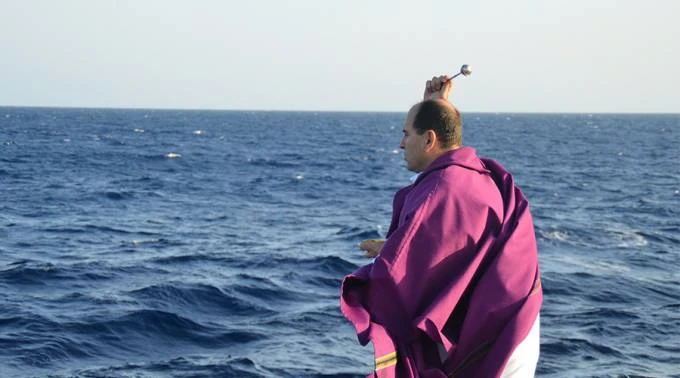
Madrid, Spain, Feb 16, 2017 / 01:56 am (CNA/EWTN News).- Father Alberto Gaton is the chaplain of a Spanish ship that combats human trafficking by rescuing people in the Mediterranean Sea. In the span of almost 5 months, his team has managed to rescue more than 3,000 people.

“Seventy percent of them are Christians fleeing from persecution in their countries,” he told CNA. “They’re fleeing persecution from Boko Haram in Nigeria, the terrorists groups, the situation in their countries.”

From September 2016 through January 2017, the priest was aboard the “Frigate Navarra” in Operation Sophia, the EU anti-migrant smuggling operation in the Mediterranean Sea. The ship had a crew of 208 sailors.

“We were also collaborating to rescue people that the mafias have abandoned to their fate in the sea – we on the Frigate Navarra, along with other NGOs and other European naval forces, collaborated to make rescues,” he said.

In precarious make-shift boats of rubber and wood, hundreds of people try to cross the Mediterranean every day, the chaplain said. “Heavy storms frequently come up, and if we’re not there, they would die.”

The main goal of Operation Sophia is to “combat the mafias which are trafficking in souls on the Mediterranean,” he said, and “always help to rescue those at sea, because they are the poor people of the land who embark from all points in Africa hoping to reach the coasts of Europe and who many times end up on the bottom of the sea.”

Sometimes, it happens that due to wind, rough seas or nightfall, the rescue is hindered, he said. “Thanks be to God, we were able to rescue all the boats we were responsible for, even though some of them were in very bad sea conditions.”

Fr. Gaton recalled his first rescue: “once inside the ship, they began to dance, it was a happy day because nobody died. It was marvelous to see those who were rescued safe and sound dancing.”

But the joy of days like that is offset by the profound sadness of seeing “what point this world has come to in wickedness of heart, which when God is forgotten, is capable of sending little children, pregnant mothers and babies in inflatable boats that are like shoe boxes, floating coffins with no other fate than to be rescued or lost.”

When they rescue refugees, he said, “the first thing is to recover from injuries, have something to eat, treat dehydration…But meanwhile I am always there with the families, with the sick.”

At one point, an old woman who had been rescued asked him to bless her and the girl she was carrying.

“The parents of the little girl had gone missing before the rescue and now it was the old woman who took care of her. She just asked me to bless them. We prayed together in the infirmary,” he recalled.

On another occasion, a Protestant pastor had fled his homeland due to persecution. “I helped him in everything I could,” the chaplain said, adding that most of the time, people don’t ask for anything material. “They just want a prayer, a smile.”

Fr. Gaton told CNA that his work as a chaplain has been difficult. “You are faced with death, with suffering, with violence. If you’re far from home and the priest introduces himself as another shipmate for the believers and non-believers with whom they can unburden themselves, they can talk and share like they can’t do with the naval officers.”

In addition to carrying out the same tasks as the other sailors, his unique task is “to be with the parishioners without forgetting that you are a soldier, but giving your all as a priest. “

The priest said that every day, Mass was celebrated on the ship. However, since there was no chapel, it was celebrated on the deck, or else inside if there was bad weather.

Another especially moving moment for the chaplain was evening prayer, offered each day “at the moment of sunset, to the Lord of the calm and the storm.” Even the atheists would join in when there was a bad storm or if they had a sick relative.

The priest said that in the months spent at sea on the Frigate Navarra, they celebrated a First Communion, and several sailors took marriage or Confirmation prep classes.

“I always say that at sea, the atheists become agnostics; the agnostics become non-practicing Catholics, and the non-practicing, at least for a while, they practice. That’s my experience.”

Fr. Gaton was ordained a priest at the age of 29, after exercising his ministry in Santander, Spain; Rome; and the United States, and at the advice of his bishop, he decided to join the army. When he began this service, he was already 45 years old.

Currently, he is Major Chaplain of the southern military region, a permanent major, and as such he belongs to the military archdiocese.


[…]

The Dispatch

Legos + Batman = “Awesome!”

February 16, 2017 Nick Olszyk 0

MPAA Rating: PG USCCB Rating: AII Reel Rating: (4 out of 5 reels) The Lego Batman Movie is impossible to dislike. It is also the best Batman movie since The Dark Knight and the best […]