

 When Pope Francis was first elected on March 13 of this year, some of the early media reports about the largely unknown Argentine cardinal painted a dire portrait of a man with shadowy connections to a military dictatorship, a man whom rumor described as conspicuously silent during the government-sponsored murder of priests preaching liberation theology. But in recent days, in the wake of the compelling interviews with America and La Reppublica, many of these same voices have discovered a new Pope Francis, one who is tolerant, open-minded, anti-establishment, and perhaps even supportive of some forms of the liberation theology he was once accused of persecuting.
Readers of papal encyclicals on politics and economics, broadly called Catholic social thought, often walk away with a similarly double image: commentators on John XXIII’s Mater et Magistra, John Paul II’s Centesimus Annus, and Benedict XVI’s Caritas in Veritate have claimed and counter-claimed each document as a certain and final victory for democratic capitalism or state-run socialism, depending on the commentator’s predilections.
Asking the Right Questions
All too often, questions about the Church’s politics end up like the trompe-l’oeil images that vex freshman philosophy students. Is it a duck or a rabbit? An old lady or a young girl? Is Pope Francis a fascist or a Marxist? Is Catholic social thought capitalist or socialist? Is it all in the eye of the beholder?
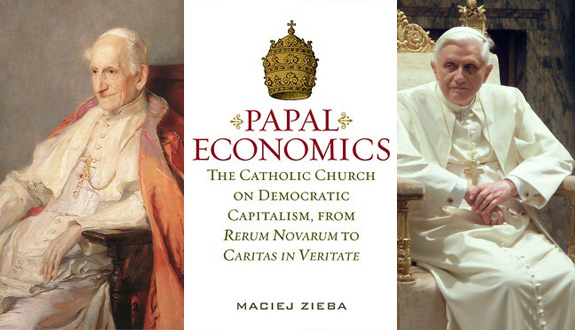
These questions do not have a satisfying answer because they are the wrong questions. In his new book Papal Economics: The Catholic Church on Democratic Capitalism, from Rerum Novarum to Caritas in Veritate, Maciej Zięba (pronounced Zhiemba) sets out to introduce the right questions to ask about the Church, man, economics, and the State.
Zięba’s personal background certainly influences his perspective: a physicist in Communist Poland whose career was ruined by helping to edit a paper for the Solidarity movement, he became a Dominican priest and a major thinker on the theological dynamics of politics and economics, closely tied to intellectuals like George Weigel, Michael Novak, and of course, John Paul II. From 1991 to the present day he has lectured at the Tertio Millenio Institute for the Free Society’s summer seminar, guiding students from Central Europe and America in a thorough, contextualized reading of John Paul II’s Centesimus Annus— a document he sees as the Church’s definitive statement on social thought.
With such a background, Zięba wisely does not attempt a pose of interpretive neutrality on political and economic issues; instead, he seeks to provide a consistent theological reading of papal writings on social thought, using Centesimus Annus as a lens through which to see the past, present, and future (Worth noting here is that the book’s subtitle is something of a stretch: Centesimus Annus is the clear focus of the book, with other documents serving as background to it). This is not the only possible option; others have chosen the more progressive document Populorum Progressio of Paul VI as the interpretive lens for these questions. Yet with these acknowledgements duly made, Zięba makes a persuasive case that Centesimus Annus is the essential lodestone for Catholic social thought.
Zięba’s concern about using other documents as a foundation for a perennial social thought is that they tend to be too particular, too focused on the conflict of the great economic systems of their day, and tend to address theoretical problems only on an ad hoc basis. As long as debate remains at the level of capitalism versus socialism or democracy versus statism, ecclesiastical pronouncements on economics and politics remain mired in the specific partisan problems of contemporary states, which is what leads to the perpetual double vision of their interpretation; for instance, socialists concerned about the legacy of fascism in Italy, Spain, and Latin America read Mater et Magistra as an anti-fascist embrace of socialism, where free-market economists concerned about communism in the USSR and Asia read it as an anti-communist embrace of capitalism.
Humanity, Society, and Culture
But John Paul II proposes a different starting point for thinking about problems of economics and politics in Centesimus Annus: man himself. He contends that before we consider specific ramifications of how man is to live in the world, we must first understand who he is and the dignity that is his. Two basic realities emerge: man is a person, who has a transcendent dignity that is his by nature, but that also requires human, moral, and spiritual formation to come to full flowering; and man is a social being, whose personhood is expressed most completely in giving himself to others. Man is thus never just an individual nor just part of a collective—his personhood and social nature must be realized in each other, not one at the expense of the other.
From this attention to the human person, John Paul II turns to the next-order concern, which is human culture. Zięmba describes the pope’s notion of culture as the
process by which individuals and groups—in particular the family and society—maintain and develop identity, a process driven by the subjectivity inherent in the dignity God bestows on man to pursue the true and the good in dialogue with others.
As a person, man strives to realize by his action who he is, in concert with others who discover the same by mutual work and involvement, in family structures, voluntary organizations, mores, art, study, religion, etc., not as totally undetermined endeavors but in their most meaningful expressions as a pursuit of the true and the good. Here the pope gives key ground for legitimate differences among human cultures while precluding a value-free relativism: the reality of truth and goodness, ultimately grounded in God’s unchanging nature, is the purifying fire of all man’s cultural practices.
The pope’s dynamic vision of culture as the efflorescence of man’s personal dignity realized on a social scale entails a high regard for human freedom. In fact, this process of human maturation and flourishing is precisely what we mean by freedom: that the person is able to develop the full potential of his nature, living out the dignity that is his as a creature made in the image of God. This vision of freedom is notably different from the contemporary Western conception of freedom as radical indeterminacy, a freedom from all norms of truth. The pope is clear that this false vision of freedom leads only to tyranny: “In a world without truth, freedom loses its foundation and man is exposed to the violence of passion and manipulation, both open and hidden.” A just social order, then, must enable man to pursue his free development as a search for the truth, protecting him from stunted notions of human life, whether externally constructed or self-imposed.
Only with these anthropological principles in place can we now move on to consider more precisely what sort of social order, in its economic and political dimensions, will enable man to live out his dignity most fully. In the economic order, man needs a system that recognizes the dignity of his work as a vital component of who he is, enabling him to flourish as a person and a member of a community, and that encourages his free, creative action. In the political order, he needs a structure that protects the rights inherent in his dignity, while ensuring that he lives up to their obligations, limiting fallen man’s tendency toward exploitation, manipulation, and excessive concentration of power.
The Church and Politics
So what does this look like, concretely? Zięba is at his most deft when he answers this question. Firstly, we must recognize that the Church will not and cannot ally herself fully with a single mode of economic or political life. As he puts it, “a conscious faith can never provide an exhaustive explanation of reality, and thus there is an immanent tendency to de-ideologize all systems and values.” Because “the Kingdom of God cannot be built on the Earth,” the Church must necessarily provide an “antimodel” in sociopolitical life, a term that means the Church does not propose a positive model of its own in these questions, either by allying itself with socialism, capitalism, or a hypothetical “third way;” while maintaining her commitment to the nature of man and the truth given by God, the Church is fundamentally pluralistic in its economic and political positions. The Church can “point where the discussion should lead,” but she will not “insist on an ultimate solution.”
The word “antimodel” is key here: the Church does not offer one single path as the way humans must walk to build a kingdom of justice on the Earth, but instead she must continually remind the world of man’s true dignity, offering criticisms and warnings about failings in contemporary practices and delineating boundaries within which economics and politics must function. She is to be a nobler version of Socrates in Athens, acting as a gadfly that provokes society to a continual re-examination of its principles and purification of its practices.
This, then, is John Paul II’s project in Centesimus Annus. Having established the true nature of man, with all it implies for human society, and faced with the gross abuses of economics and politics in the twentieth century, he outlines certain minimum boundaries in which a state must function. As Zięba puts it:
The border is constituted, on one hand, by the state’s aspirations to totalitarianism (to some extent even the welfare state abuses its prerogatives) and, on the other hand, by political and economic mechanisms acting on their own accord.
Neither the state nor the economy can be given free rein over man, for either of these options begins to depersonalize and dehumanize social life: a totalitarian state suppresses all intermediary institutions between the individual and the state and reduces the person to a mere servant of the state’s needs, while unbridled economism reduces man to a quantity of production and consumption, whether that is realized in communist or capitalist modes.
Reflecting on these conditions and boundaries of sociopolitical life, Zięba concludes his lengthy analysis of Centesimus Annus and its criticisms of twentieth-century economic and political systems by arguing that “the system that meets the demands of Catholic social teaching (which is not to say that it is the sole acceptable possibility) is a democratic state of law and a socially sensitive, free economy.” Throughout his work Zięba provides lengthy argumentation from Centesimus Annus and the rest of the Catholic social thought tradition to maintain that all forms of totalitarianism, communism, and socialism are absolutely precluded by papal teaching.
That being said, we should not caricature his conclusion as a simple endorsement of Western capitalist democracies: his claim is simply that the democratic state with its rule of law and the free economy provide the widest potential for man to develop in accord with his dignity, as long as the state and the economy are made subservient to that dignity and held in check by the legitimate demands of the human person.
Zięba’s book is not a how-to guide for state-builders, and does not provide concrete solutions to the serious problems that vex contemporary economic practice. He does not provide easy answers for sorting out the constructive and destructive aspects of globalization, credit structures, fiscal policy, health care, social services, or any of the other issues that confront us today. Nor should he. In explicating the teaching of Centesimus Annus and the legacy of Catholic social thought, Zięba gives citizens, businessmen, and politicians tools with which to analyze their practice and create concrete solutions out of their own free creativity.
Papal Economics is not the final word on Catholic social thought, but Fr. Zięba does the public a great service by overturning the double-vision problem that many commentators bring to the Church’s politics. Trying to squeeze Pope Francis into American political categories is doomed to fail, as are the eager attempts to claim social encyclicals for one ideology or another. Catholic social thought will always be an antimodel, a gadfly spurring men to more honest reflection about our economic and political life. The Church reminds us to begin not with a war of ideologies, but with the basic facts about man, his dignity, and his desire for God. This is the truth on which our society must be grounded. And it is only in the truth that we can be free.
Papal Economics: The Catholic Church on Democratic Capitalism, from Rerum Novarum to Caritas in Veritate
by Maciej Zięba
ISI Books, 2013
Hardcover; 239 pages
If you value the news and views Catholic World Report provides, please consider donating to support our efforts. Your contribution will help us continue to make CWR available to all readers worldwide for free, without a subscription. Thank you for your generosity!
Click here for more information on donating to CWR. Click here to sign up for our newsletter.
