

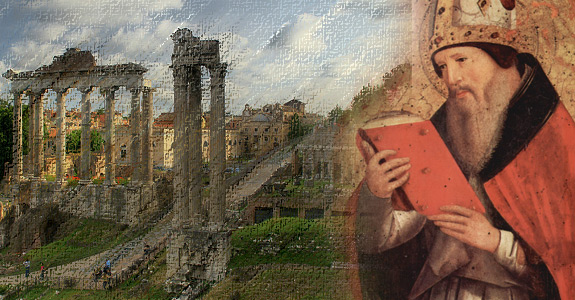

Perhaps Rome is not perishing; perhaps she is only scourged, not utterly destroyed; perhaps she is chastened, not brought to nought. It may be so; Rome will not perish, if the Romans do not perish. And perish they will not if they praise God; perish they will if they blaspheme Him.[1]
— St. Augustine
I was so stupefied and dismayed that day and night I could think of nothing but the welfare of the [Christian] community; it seemed as though I was sharing the captivity of the saints, and I could not open my lips until I knew something more definite; and all the while, full of anxiety, I was wavering between hope and despair, and was torturing myself with the misfortunes of other people. But when the bright light of all the world was put out, or, rather, when the Roman Empire was decapitated, and, to speak more correctly, the whole world perished in one city. ‘I became dumb and humbled myself, and kept silence from good words, but my grief broke out afresh, my heart glowed within me, and while I meditated the fire was kindled;’[2]
— St. Jerome
From his monastic cell in Bethlehem, the great Western Father and Doctor of the Church, St. Jerome bewailed Late Antiquity’s “9/11,” the Fall of Rome. Rome’s fall has been an object of fascination for western writers, not least because ever since the Founding Fathers, patriotic Americans have seen parallels between that shining city on seven hills and our own noble republic. Indeed, events of the last few years have called into question whether America herself is now likewise doomed to irreversible “decline and fall.”
On August 24, 410, Rome was sacked by the warlord Alaric and his army of rampaging Goths. When a starving populace admitted the barbarian horde on that fateful August day, it was the first time in an astounding 800 years that enemy soldiers had ever breached the imperial capital’s defenses. Although their attackers were actually Arian Christians (deniers of Christ’s divinity) who spared churches and practiced some measure of clemency, the psychological impact of such a blow for the greater Roman world (some thirty million souls or more) is hard to underestimate. Rome was, after all “the light,” according to Jerome, and that is also how general Maximus characterizes it to an elderly Emperor Marcus Aurelius in the Academy award winning “Gladiator.” The battle-tested legionary has seen much of the rest of the world, and it is “brutish and dark.”
Not just modern film-makers, however, but modern historians, as well, beginning with Edward Gibbon in 1776, have tended to agree with both Jerome and the general. They have seen, starting with the reign of Marcus’ megalomaniacal son Commodus, in AD 180, a steady and almost inevitable decline of the greatest civilization man had yet produced, with the disasters of the fifth century fully emblematic of its final, fitful death throes. For Gibbon, “Christianity and barbarism,” were ultimately to blame for bringing down the Empire, and ushering in the “Dark Ages.”
Now it must be said there is much evidence for a genuine “Decline” and “Fall” in the historical record (whether Christianity is to blame is another matter). As Bryan Ward-Perkins recently recorded of material existence in Roman Britain at the fortress of Vindolanda on Hadrian’s Wall:
…a plethora of objects, often dispatched from elsewhere, were in routine use by the soldiery and their families…socks, sandals, and underpants…bed boards…cart-axels. The shoes that have been recovered from the site range from standard but solid military boots…to a delicately shaped woman’s slipper…which is prominently stamped with its maker’s name—the equivalent, surely, in style and status to a modern Gucci shoe…In the post-Roman West, almost all this material sophistication disappeared.[3]
Ward-Perkins remarks that in defending the northern frontiers of empire, the Romans brought not only soldiers with money in their belts, but “a tempting display of southern consumer culture.” Indeed, such ostentation is often blamed in part for triggering the waves of barbarian invasions in the first place. According to this view, the Germanic invaders sought not so much the destruction of Rome, but “a piece of the action.” As a matter of fact, Roman scholarship of the past four decades has tended to focus not so much on the devastation the migrations brought, but the continuity and adaptation that ensued. Largely thanks to the manifold and magisterial works of scholar Peter Brown, today’s academy no longer speaks in Gibbonian terms of a sharp “Decline and Fall,” but rather of a long, graded, construct (almost like a Roman aqueduct) called “Late Antiquity.” This approach has not been without its benefits, especially for historians of Catholicism, who were largely brushed aside by the older economic and political historians. Christopher Dawson, for instance, could complain in the 1930s:
To the secular historian the early Middle Ages must inevitably still appear as the Dark Ages, as ages of barbarism, without secular culture or literature, given up to unintelligible disputes on incomprehensible dogmas…But to the Catholic they are not dark as much as ages of dawn, for they witnessed the conversion of the West, the foundation of Christian civilisation, and the creation of Christian art and Catholic liturgy. Above all, they were the Age of the Monks… [4]
While contemporary scholarship has, indeed, concentrated on the religious aspects of the late antique world, today’s intelligentsia are woefully lacking in Dawson’s devotion. More than this, Ward-Perkin’s recounts their startling neglect of the even indispensably secular. As he writes of Harvard University Press’, Guide to Late Antiquity:
If we seek the peoples of the late antique world, we have already found Visigoths, Franks, Britons, and Anglo-Saxons to be absent. But ‘Demons’ and ‘Angels’ both get entries; just as there is an entry for ‘Hell’, and separate ones for ‘Heaven’ and ‘Paradise’. Secular officials get short shrift, whereas a host of different heretics and ascetics get individual entries. I looked in vain for one of the most powerful figures in late Roman politics and administration, the ‘Praetorian Prefect’, but found nothing between the entries for ‘Pornography’ and ‘Prayer’.[5]
This has led historians like Perkins and Adrian Goldsworthy, for example, to re-invoke the “Decline and Fall” approach to the conclusion of the classical world. The title of his recent work, How Rome Fell, certainly broadcasts Goldsworthy’s belief in a collapse, and brought on more by innumerable usurpers, than on the Germanic migrations themselves:
[F]rom 217 down to the collapse of the Western Empire there were only a handful of periods as long as ten years when a civil war did not break out…It was normal for an emperor to abandon a war against a foreign enemy to deal with a Roman rival.
Usurpers did not act alone. They needed supporters and the most important of these expected rewards including promotion and riches if the rebellion was successful. If a usurper was suppressed, then many of his backers were likely to suffer with him. Punishment was often extended to their families, especially those holding any office whose wealth made them appealing targets for informers. In this way even a localised rebellion could mean life, death, imprisonment or ruin to people in distant provinces who had not been involved in it in any direct way. This was a world of patronage, where the powerful exerted themselves to secure benefits for relatives and friends. Such webs of favour and gratitude could become very dangerous for all concerned at times of internal conflict.[6]
Having briefly perused the present state of scholarship, what are we to make of the much disputed “Decline and Fall of Rome”? And what lessons does it hold for America, that other “shining city on a hill,” especially on days when she suffers incredible setbacks? I believe much “light” may be shed, if we use the writings of St. Augustine for our lens.
The son of a devout Christian mother (St. Monica) and a prodigal pagan father, Augustine was raised in Roman North Africa. In the impetuosity of his youth he both fathered a child out of wedlock and left Catholicism for the cult of Manichaeism. Teaching that all matter was evil, these gnostic “Christians”, among other things, rejected the Catholic Church, the bodily Crucifixion and Resurrection of Christ, as well as natural procreation, in favor of artificial contraception and homosexuality. But after a meeting with a high level “churchman” proved intellectually unsatisfactory, the precocious Augustine soon counted himself a Platonist, a follower of the ancient Greek philosopher according to the interpretations of Augustine’s near contemporary Plotinus. But in the climax of his Confessions, Augustine describes in vivid detail the day of his ultimate decision for Christ and the role that imperial politics (not to mention Christian monasticism) played in his regeneration. The catalyst for his own conversion was the arrival of an unexpected guest and the story the guest related to Augustine of his own—quite unexpected—conversion during a similar social visit to a monastic house in Milan:
[Ponticianus and a friend] found there a book in which was written the Life of Antony [the third-century saint who forsook riches, embracing instead the life of a desert hermit]. One of them began to read it. He was amazed and set on fire, and during his reading began to think of taking up this way of life and of leaving his secular post in the civil service to be your [God’s] servant. For they were [intelligence] agents in the special branch. Suddenly he was filled with holy love and sobering shame. Angry with himself, he turned his eyes on his friend and said to him: “Tell me, I beg of you, what do we hope to achieve with all our labours? What is our aim in life? What is the motive of our service to the state? Can we hope for any higher office in the palace than to be Friends of the Emperor? And in that position what is not fragile and full of dangers? How many hazards must one risk to attain to a position of even greater danger? And when will we arrive there? Whereas, if I wish to become God’s friend, in an instant I may become that now.” So he spoke, and in pain at the coming to birth of new life…he read on and experienced a conversion inwardly where you alone could see and, as was soon evident, his mind rid itself of the world.[7]
Clearly evinced in this tale from the Confessions is the cutthroat nature of the Roman court, previously characterized by Goldsworthy above, which inevitably led to the demise of the state. But more importantly for any analysis of the meaning of history, is Ponticianus’ self-revelatory question: “What is our aim in life?” The men of Late Antiquity, not unlike those of contemporary Modernity, were so wrapped-up in the intrigues and ambitions of this life that they had lost sight of themselves as “selves”: the “I” at the center of our being, who I am. It took the example of Antony, who had forsaken all, to “shock” Ponticianus and his companion out of complacency and into cognizance of the eternal. One could argue even further—as Augustine arguably does in the City of God— that God “permitted” the Sack of Rome in 410, to produce the same effect in an otherwise stagnate Roman culture. Put in other words, is it not sometimes providentially necessary for nations “to fall to lose it all,” to re-discover what truly “matters”[8]?
Our own age is one beset with corruption in high places—as well as a siege mentality. The arrival of “alien” races and/or the threat of the destruction of traditional living patterns/identities are dominant themes in pop-culture. This is obvious, not only from movies and network television shows (Independence Day, War of the Worlds, Signs, V), but even from cable’s more prosaic History Channel, which seems obsessed of late with various doomsday scenarios. The Sack of Rome provides a model for “metanarratives” of societal failure and/or identity construction as can be detected for example, in the following “parallel” passages from M. Night Shyamalan’s alien invasion movie Signs, and St. Augustine’s literary response to the barbarian capture of his capital, The City of God (of which I cannot think a better read these days, especially as we commemorate the 1,600th anniversary of Augustine’s commencing to write it):
Graham Hess – “People break down into two groups when they experience something lucky. Group #1 sees it as more than luck, more than coincidence, sees it as a sign. Evidence that there is someone up there, watching out for them. Group #2 sees it as just pure luck, happy turn of chance. Sure there are people in group #2 looking at these 14 lights in a very suspicious way. For them the situation is 50/50. Could be bad. Could be good. But deep down they feel that whatever happens they’re on their own and that fills them with fear. But there is a whole lot of people in group #1. They see those 14 lights they are looking at as a miracle and deep down they feel that whatever is going to happen there will be someone there to help them. That fills them with hope. So what you have to ask yourself is what kind of person are you? Are you the kind that sees signs, sees miracles or do you believe that people just get lucky. Or look at the question this way… it is possible that there are no coincidences?”
St. Augustine-“Accordingly, two cities have been formed by two loves: the earthly by the love of self, even to the contempt of God; the heavenly by the love of God, even to the contempt of self. The former, in a word, glories in itself, the latter in the Lord. For the one seeks glory from men; but the greatest glory of the other is God, the witness of conscience. The one lifts up its head in its own glory; the other says to its God, ‘Thou art my glory, and the lifter up of mine head.’ …The one delights in its own strength, represented in the persons of its rulers; the other says to its God, ‘I will love Thee, O Lord, my strength.’…But in the other city there is no human wisdom, but only godliness, which offers due worship to the true God, and looks for its reward in the society of the saints, of holy angels as well as holy men, ‘that God may be all in all.’
Every age of anxiety—especially our own— is a disguised opportunity for man to disabuse himself of the delusion that “paradise” may be constructed here on earth, by one’s own power, independently of grace and without absolute truth, solely upon the shifting sands of the “strength” of politics and the latest cultural norms. For the Romans of antiquity, the Age of the Caesars gave way to the medieval Ages of Faith. As Augustine understood only too personally, twenty-first century man, like the prodigal son in Jesus’ parable (Lk 15: 11-32) will likewise only “come to himself,” “After he had spent everything, [and] there was a severe famine in that whole country, and he began to be in need… feed[ing] pigs…He longed to fill his stomach with the pods that the pigs were eating.” There must, as Augustine reminds us, first be the “pain at the coming to birth of new life.” “For whoever desires to save his life shall lose it; but whoever loses his life for my sake shall find it” (Matt. 16:25). Where does he find himself, after he has abased himself? Where does he locate his dignity and purpose as man? As a son in the arms and kisses of his Father who has already run out to meet him in this life.
If America reaches a tipping point (or if she already has)—whether because of political events or foreign attacks—when she is no longer “the light,” Christians may take some comfort in Augustine’s remark: “If what God Himself has made, will one day come to an end, how much sooner the work of Romulus”…or Washington. They may also take solace in the words of Fr. Graham Hess in Signs: “whatever is going to happen there will be someone there to help them. That fills them with hope.” As Scripture has it: “The Lord is good to them that hope in Him, to the soul that seeketh Him” (Lam 3:25).
ENDNOTES:
[1] Sermon 81; as cited in Herbert Deane, The Political and Social Ideas of St. Augustine, (New York: Columbia University Press, 1963), 73.
[2] Commentary on Ezekiel; http://www.ccel.org/ccel/schaff/npnf206.vii.iv.x.html.
[3] Bryan Ward-Perkins, The Fall of Rome and the End of Civilization, (Oxford: Oxford University Press, 2005), 104.
[4] Christopher Dawson, The Making of Europe: An Introduction to the History of European Unity, (London, 1932), xvii-xviii, as cited in Ward-Perkins, 172.
[5] Ward-Perkins, 172.
[6] Adrian Goldsworthy, How Rome Fell, (New Haven and London: Yale University Press, 2009),408.
[7] Confessions, Bk VIII, vi (15,) ed and trans. H. Chadwick, (Oxford: Oxford University Press, 1991), 144.
[8] I am not a follower of their music, but I am rearranging Linkin Park’s pop-hit for my own purposes.
If you value the news and views Catholic World Report provides, please consider donating to support our efforts. Your contribution will help us continue to make CWR available to all readers worldwide for free, without a subscription. Thank you for your generosity!
Click here for more information on donating to CWR. Click here to sign up for our newsletter.
