

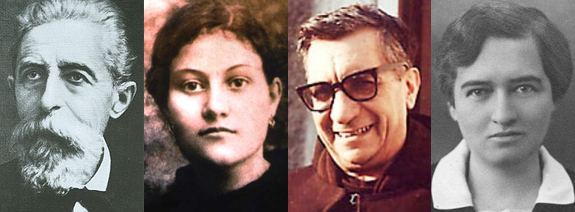

In September 2005, the Congregation for the Causes of Saints announced that Pope Benedict was instituting new procedures for the rite of beatification.
“Canonization is the supreme glorification by the Church of a Servant of God raised to the honors of the altar with a decree declared definitive and preceptive for the whole Church, involving the solemn Magisterium of the Roman Pontiff,” the Congregation stated. “Beatification, on the other hand, consists in the concession of a public cult in the form of an indult and limited to a Servant of God whose virtues to a heroic degree, or martyrdom, have been duly recognized.” The liturgical cult of blessed, according to the formula of beatification, is limited in locis ac modis iure statutis (“in places and modes established by law”).
Beginning in 1662, beatifications took place in Rome, with a curial official leading the ceremony in the morning and the pope venerating the blessed in the afternoon. In 1971, the popes began to preside personally at the beatification rites, which at times came to be celebrated outside Rome.
“Rites of beatification and canonization are already in themselves quite different; nonetheless, the fact that from 1971 onwards the Holy Father generally presided at them has almost blinded people to the substantial difference between the two institutions,” the Congregation noted. Pope Benedict blended aspects of the older and newer practices: beatifications would henceforth typically be presided over by the prefect of the Congregation for the Causes of Saints and would typically take place outside Rome.
In 2012, 28 venerable servants of God—including 15 martyrs, five founders of religious communities, and two converts—have been raised to the altars in 14 beatification ceremonies.
Hildegard Burjan
Blessed Hildegard Burjan (1883-1933), beatified in Vienna on January 29, “wanted to be present at the focal points of human suffering as the ‘charismatic messenger of social love,’” Blessed John Paul II said during his 1998 apostolic journey to Austria.
Born to a Jewish family and a student of German philology and philosophy, Burjan married at 24 and converted to Catholicism at 26, following her recovery from a serious illness. In 1910, she bore her only child, Lisa, whom doctors had advised her to abort during her difficult pregnancy; Burjan refused, and Lisa lived to be 95.
Influenced by Pope Leo XIII’s social encyclical Rerum Novarum, Burjan started the Verein christlicher Heimarbeiterinnen (the Association of Christian Domestic Workers) in 1912 and, in the wake of the devastation wrought by World War I, she founded the association Soziale Hilfe (Social Assistance) in 1918. From 1918 to 1920, she served on the Vienna city council and in the Austrian parliament, and in 1919 founded the Schwesterngemeinschaft Caritas Socialis (Sisters of Caritas Socialis), a women’s religious community still serving the needy today.
“It is not enough to help people with money or small gestures,” Blessed Hildegard said. “It is necessary to make them stand on their own feet and to give them the belief: I am a person who can achieve something.”
María Inés Teresa of the Blessed Sacrament
The life of Blessed María Inés Teresa of the Blessed Sacrament (1904-81), beatified in Mexico at the Basilica of Our Lady of Guadalupe on April 21, was changed after she attended a Eucharistic Congress and read St. Thérèse of Lisieux’s Story of a Soul. In 1929, during a time of great persecution in Mexico, she entered a community of cloistered Poor Clares that had moved to Los Angeles. After the community returned to Mexico, she rose to the position of novice mistress.
Called by God to a more active missionary life, Blessed María Inés Teresa founded the Poor Clare Missionary Sisters of the Blessed Sacrament in 1945. By the time she died, her order had spread to five continents.
“We must teach others about Christ,” she wrote in a 1977 letter to her community. “We missionaries should not, therefore, let a day go by without our talking of Christ to others. To know that only a small number of people know the true God (Love) should be a source of torment for us. It should urge us not to spare any suffering, any inconvenience. It should spur us to do everything, anything to make God known and loved by all the inhabitants of the world.”
Giuseppe Toniolo
Blessed Giuseppe Toniolo (1845-1918), an Italian economics professor, was beatified at the Basilica of St. Paul Outside the Walls on April 29. After his Regina Caeli address that day, Pope Benedict paid a lengthier tribute to Toniolo than to any of the other men and women beatified in 2012.
“He lived between the 19th and 20th centuries, he was a husband and the father of seven children, a university professor and educator of youth, an economist and sociologist and an enthusiastic servant of communion in the Church,” the Pope said.“He put the teachings of Pope Leo XIII’s encyclical Rerum Novarum into practice; he promoted Catholic Action, the Catholic University of the Sacred Heart, the Italian Catholic Social Weeks, and an international law institute for peace.”
“His message is very up to date, especially in these times: Blessed Toniolo points out the way of the primacy of the human person and of solidarity,” Pope Benedict continued. “He wrote: ‘Over and above even the legitimate goods and interests of individual nations and states, there is an inseparable note that coordinates and unites them all, that is to say, the duty of human solidarity.’”
Pierre-Adrien Toulorge
Blessed Pierre-Adrien Toulorge (1757-93), a martyr during the French Revolution, was beatified in Coutances, France, on April 29. In the turmoil of the day, the Premonstratensian (Norbertine) priest departed for England for five months but returned to France.
In the year before his execution, he secretly ministered in village after village and offered Mass using handwritten Mass texts. Discovered in a barn and arrested, he initially lied about his journey to England, but later repented and told the whole truth in court—even after a sympathetic judge offered him the chance to remain silent and be acquitted—leading him to become, in the words of Pope Benedict, a “martyr of truth.”
Upon being sentenced to death, he chided a weeping nun:
Madame, the tears you are shedding are unworthy of you and me. What would worldly people say if they knew that having renounced the world, we found it difficult to leave it? If we are loathe to die, we will give the children of this century a bad example, and perhaps your discouragement will close the door of salvation for many souls who might find themselves in the same situation. Let us teach them by our constancy what they must do. Let us show that faith is victorious over torture, and open a path to heaven amidst the final efforts of hell.
As he approached the guillotine, he cried out, “My God, I place my life in your hands! I pray for the restoration and preservation of your holy Church. Forgive my enemies.”
Mother Saint-Louis
Mother Saint-Louis (1763-1825), born Louise-Élisabeth Molé, was beatified in Vannes, France, on May 27. Born into the French nobility, she married at 15 and bore five children, only two of whom survived childhood. In 1794, her husband was guillotined on Easter Sunday.
After her two surviving children reached adulthood, she founded the Sisters of Charity of Saint-Louis in 1803 for the education of poor girls; later, the sisters opened orphanages. “I was driven by love from my early youth, but by a jealous love, crucified, who asked me to sacrifice everything to him,” Mother Saint-Louis recalled in a letter.
Marie Jean-Joseph Lataste
Blessed Marie Jean-Joseph Lataste (1832-69), described by Pope Benedict as an “apostle of prisons,” was beatified in Besançon, France on June 3. The son of a skeptic father and a devout mother, he entered the minor seminary but was steered by his father to become a tax administrator and accountant.
At 20, Lataste began to visit the poor regularly as a member of the Society of St. Vincent de Paul, and the following year, he fell in love with a devout 16-year-old young woman. She died two years later, and in 1857 he entered the Dominican order.
Ordained to the priesthood in 1863, he devoted himself to an apostolate of preaching, writing, and visiting prisons, founding the Dominican Sisters of Bethany in 1867 to work for the rehabilitation of women prisoners. Within a year, 12 women, including four former prisoners, joined the community. Ill and exhausted, Lataste died shortly thereafter; when his tomb was moved in 1937, his body was found to be incorrupt.
Cecilia Eusepi
Blessed Cecilia Eusepi (1910-28), beatified on June 17 in the small central Italian town of Nepi, was deeply influenced by St. Thérèse of Lisieux’s Story of a Soul as a young child. At the age of 13, Eusepi received permission from her bishop to enter the Order of the Servants of Mary.
“I would even go so far as to call her our own little Thérèse,” said Father Tito Sartori, postulator general of Eusepi’s beatification cause. “Of all the most recent figures of saintliness recognized by the Church, Cecilia is the one who most absorbed and followed the ‘little way’ indicated by the great French saint.”
Directed by her confessor to write an autobiography, which she called The Story of a Clown, Eusepi wrote that “if Jesus had granted the same grace to some other soul as he granted to me, the halo of holiness would not have been long in circling that head. But it pleases Jesus, who likes to joke with his creatures, to steep in grace the least probable, people who might not be worthy, the ones who seem to him to be the most wretched, in order to make his mercy shine forth all the more, and he takes pleasure in their confusion and wonder.”
Eusepi contracted tuberculosis and died before she could profess vows; her body remains incorrupt. “In dressing her, we had noticed that she had an open wound on her back, but imagine our amazement when we saw that there was no sign at all of the devastating effects of the tuberculosis,” the priest of her home parish said in 2009.
Mariano Arciero
Blessed Mariano Arciero (1707-88), beatified in the small southwestern Italian town of Contursi Terme on June 24, was ordained a priest in Naples at the age of 24. In his various assignments in Naples and Calabria, he devoted himself to catechesis and the confessional and, in time, was named spiritual director of the archdiocesan seminary. “Holding out the word of God to the small and the great, to seminarians, to priests, he was an itinerant apostle of the Gospel, admired by all for his charity, poverty, humility,” Cardinal Angelo Amato, the prefect of the Congregation for the Causes of Saints, preached at Arciero’s beatification Mass.
Louis Brisson
Beatified in Troyes, France on September 22, Blessed Louis Brisson (1817-1908) loved the sciences—he constructed an astronomical clock—and was ordained to the diocesan priesthood in 1840. Three years later, he was appointed chaplain of a convent of the Visitation Order, founded by St. Francis de Sales and St. Jane Frances de Chantal two centuries earlier. Influenced by Salesian spirituality, Blessed Brisson and St. Léonie Aviat founded the Oblate Sisters of St. Francis of Sales in 1868 to catechize female textile workers. Four years later, Brisson founded a men’s community, the Oblates of St. Francis de Sales, and by the time of his death a quarter century later, the Oblates had schools or missions in Uruguay, Brazil, Ecuador, Germany, Austria, Belgium, Greece, England, and the United States.
In his beatification homily, Cardinal Amato paid tribute to Blessed Brisson’s “apostolic spirit of faith,” “discreet and generous charity,” and “filial devotion to the pope, which he considered the ‘pivot’ of his faith.” As Blessed Brisson said, “We will always remain with regard to holy Church and the pope as children under the tutelage of their father and their mother. With us, there will be no fights or struggles of opinions; it is a waste of time.”
Gabriele Maria Allegra
On September 29, Blessed Gabriele Maria Allegra (1907-76) was beatified in the small city of Acireale, Sicily. Blessed Allegra entered the Franciscan order (Order of Friars Minor) and was ordained to the priesthood at the age of 22. Two years later, he was assigned to the missions in China, where he began the decades-long task of translating the whole Bible into Chinese, becoming the first person to do so in 1968. Devoted to the Blessed Virgin from youth, the “St. Jerome of China” also led retreats, translated sonnets, wrote a commentary on Dante’s Divine Comedy, and regularly spent Christmas and Easter with lepers.
Bedřich Bachstein and Companions
On October 13, Blessed Bedřich Bachstein and his 13 companions, all from the Order of Friars Minor, were beatified in Prague. Four of the martyrs hailed from what is now the Czech Republic, while the others were natives of France, Germany, Italy, the Netherlands, and Spain. “They are the first blesseds in the Year of Faith and are martyrs,” said Pope Benedict; “they remind us that believing in Christ also means being ready to suffer with him and for him.”
The 14 were slain in 1611 by a Protestant mob. Blessed Bachstein, about 50 years of age, was killed by a spear to the heart. Most of the Franciscans were stabbed or beaten to death; Blessed Klemens, a novice, had his head split open by an axe. Blessed Juan Martínez was attempting to protect a ciborium when his hand was cut off and he was stabbed in the back; the hosts were then trampled on.
Maria Luisa Prosperi
Blessed Maria Luisa Prosperi (1799-1847), a Benedictine nun and mystic, was beatified in Spoleto, Italy on November 10. Known from childhood for her devotion to the Eucharist and the Passion, she was elected abbess of her monastery. Blessed Prosperi, said Cardinal Amato, had “a firm faith, firm, unlimited; it rose to the heights of God’s mysteries, and it seemed as if she could see with her eyes what we believe to faith.”
She lived a hidden life—her mystical experiences were unknown to her fellow nuns—but her monastery today attracts many pilgrims. “We are still amazed by the enormous flow of pilgrims, priests, and the poor who come to us,” said the current abbess of the Monastery of Santa Lucia in Trevi before Blessed Prosperi’s beatification. “For today’s society, lacking secure points of reference, the nun is a ‘sister’ to whom to confide their troubles and their hardships, a ‘mother’ from whom is sought spiritual help, but also, without shame, material assistance.”
María Crescencia Pérez
On November 17, Blessed María Crescencia Pérez (1897-1932), a religious of the Daughters of Our Lady of the Garden, was beatified in the northeastern Argentine city of Pergamino. Influenced by the spirituality of St. Thérèse, she sought to “do what God wants, want what God wants, and be where God wants.” As she ministered to tuberculosis victims in Chile, she contracted the disease and died. Pope Benedict described her as “a model of evangelical gentleness enlivened by faith. Let us praise the Lord for her witness.” Her body remains incorrupt.
Maria Troncatti
Beatified in the small city of Macas in central Ecuador on November 24, Blessed Maria Troncatti (1883-1969) was an Italian missionary sister. She entered the Daughters of Mary, Help of Christians (Salesian Sisters of St. John Bosco) in 1908, served as a nurse during World War I, and was sent to Ecuador in 1922, never to return to her native land. “Every day I am happier with my missionary religious vocation,” she said, as she brought the Gospel to the indigenous Shuar people, earning their confidence through the medical treatment she offered them. Taking in abandoned babies who were slated to be killed, Blessed Troncatti became like a mother to many. She died in a plane crash at the age of 86.
Devasahayam Pillai
On December 2, Blessed Devasahayam Pillai (1712-52) was beatified in Kottar in the southeastern Indian state of Tamil Nadu. The first Indian layman to be beatified, Pillai was a Hindu court official who learned out about the Gospel through conversations with a captured Dutch sea captain. Following his conversion, he led others to the Catholic faith, including his wife and other family members. Accused of treason, he was arrested and publicly mocked and tortured over a three-year period before he died.
At the time of his wife’s last visit to his prison cell, he said:
My loving spouse, do not be disheartened that you have had no happiness but only suffering on account of being married to me. You have been a partner in my sufferings and humiliations. If you bear these sufferings with patience, you will be a sharer in the heavenly prize that God will offer.… If you remain in this country after my death the members of your community will bother you a lot. So you should flee to some other place. There the Lord will protect you from all harm. Do not be anxious that we will lose our relatives. The Lord is our relative and our helper. You should pray to God for me that, just as He has given me the grace I needed to patiently endure the sufferings that have been inflicted upon me till now, He might strengthen me so that at the time of my death, I may not waver out of fear.
“He was a faithful layman who lived in the 18th century and died a martyr,” Pope Benedict said on the day of his beatification. “Let us join in the joy of the Church in India and pray that the new blessed may sustain the faith of the Christians of that large and noble country.”
If you value the news and views Catholic World Report provides, please consider donating to support our efforts. Your contribution will help us continue to make CWR available to all readers worldwide for free, without a subscription. Thank you for your generosity!
Click here for more information on donating to CWR. Click here to sign up for our newsletter.
