

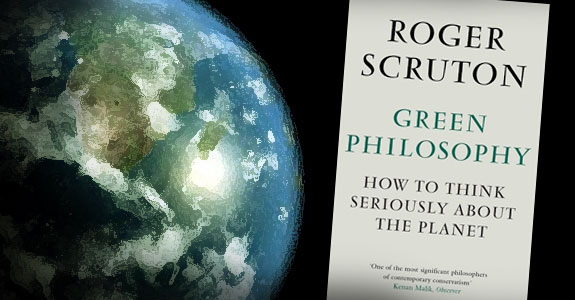

Nuance is often lacking in discussions about global environmental crises, which makes Roger Scruton’s Green Philosophy: How to Think Seriously About the Planet (Oxford University Press) a gift for those distraught by the doomsday scenarios or outright denial voiced by many today about life on Earth. Scruton’s examinations of agriculture, climate change, widespread plastic pollution, and much more offer sound, challenging food for thought—even if the necessary ingredients to achieve his proposals are left largely unstated, as people of faith will notice.
Scruton is an English writer and philosopher. He labels himself as conservative but his writings and observations can defy the commonly accepted meaning of that label. In How to Think Seriously About the Planet one finds solutions that would, and do, delight liberal ecological crusaders. This is but one example of Scruton’s willingness to seek answers along any path that will do.
In just over 400 pages, the book connects topics that should be connected when discussing ecology: politics, philosophy, aesthetics, economics, sociology, the natural sciences, history, and current events. What is hardly mentioned, however—and when it is, only with the lightest of touches—is faith, especially the Christian faith that Scruton has adopted and that formed the foundational narrative of much of the Western world that he examines. Perhaps Scruton assumes that his audience will be largely secular and so wishes to avoid any terminology—like sin, grace, or God—that may interfere with, or be diminished by, his political message.
Nevertheless, love and sacrifice play big roles in this book. The central proposal for thinking seriously about the planet is “old-fashioned oikophilia”—the love of the home. It is this love, Scruton argues, that provides the best means to counter human-induced ecological crises. Any changes in human practices that are meant for the good of the environment (and, thus, for people) must root themselves in our “individualist” instinct for communities to tend to their own. The opposing “egalitarian” reflex—to solve problems through the actions of strangers within centralized governments, international agencies, or non-government organizations, of which no one political authority is in control—will too often fail and in many cases already has.
Scruton writes that “[t]he conservative understanding of political action that I propose is formulated in terms of trusteeship rather than enterprise, of conversation rather than command, of friendship rather than the pursuit of some common cause. Those ideas lend themselves readily to the environmental project, and it always surprises me that so few environmentalists seem to see this. It is as obvious to a conservative that our reckless pursuit of individual gratification jeopardizes the social order as that it jeopardizes the planet. It is obvious too that the wisest policies are those that strive to protect and keep in place the customs and institutions that place a brake on our appetites, renew the sources of social contentment, and forbid us to pass on the costs of what we do to those who did not incur them.”
It is hard not to hear a dialogue with Christian ethics in Scruton’s definition of political action. Indeed, much of what Pope Benedict XVI has said about ecology and human consumption aligns with Scruton, when stripped of political adjectives. But Scruton’s musings about conservative political philosophies do not journey into faith, even if this is where the entire project seems headed.
As for the political, there is much in How to Think Seriously About the Planet that makes Scruton’s case against large-scale regulatory bureaucracies and a reliance on international treaties. There is also much to support local control—civic associations, local elected governments, and “small alliances of friends and neighbours…who are making space for themselves in the nooks and crannies on which the eye of officialdom seldom falls.”
This is not to say that Scruton won’t recognize the value of regulation. He likes government control of building and signage ordinances that encourage traditional architecture, such as in places like Salzburg. He acknowledges that these sorts of ordinances may be a disadvantage to individual businesses, but since the disadvantage “is imposed equally on all of them, none of them really suffers.” Scruton also admits that there are issues—like climate change—that do call for an international response, along with local and individual ones. Here and elsewhere, Scruton shows his gift of calm, nuanced analysis where others might offer loud, ideological shopping lists—and predictable ones at that.
In fact, in reviewing the charged topic of anthropogenic climate change, Scruton wisely avoids in-depth critiques of scientific details, for he is not a climatologist. Rather, he is willing to defer to experts providing empirical evidence that a growing restlessness in our atmosphere is (at least partly) the result of humanity’s input of greenhouse gases. Scruton stops short of joining climate-change “alarmists,” but he is willing to begin calling for answers.
One answer that Scruton supports is a tax on carbon emissions. He does so for much the same reason that he champions Salzburg’s signage ordinances: carbon taxes equitably share the pain of reducing the unwanted side effects of doing business. Here, Scruton the conservative is supporting a tax that is often championed by progressives and celebrities within the climate-change entertainment industry, such actress Cate Blanchett and Al Gore.
In fairness, the politics of carbon taxes versus other schemes—like market-based “cap-and-trade” approaches that allow industries to buy and sell carbon credits—are not always clearly positioned within ideological camps, nor are they topics on which Scruton wishes to focus. Still, his offering of oikophilia as the best fuel for one’s eco-policies aligns with his support of taxing carbon emissions because his argument is a communal one: they pass the cost of pollution to “those who contribute most to producing it—and that means everyone, since the cost is passed on at the end to the consumer, who is the one ultimately responsible.”
While this may make Scruton a friend of many on the left, he is a friend of traditional conservatives in other areas, such as in his critique of government regulations. He provides a number of examples to fault such top-down approaches, especially those rooted in a fear of risk, which he believes breaches the true purpose of government.
“Instead of creating the framework in which human beings can take risks and assume responsibility for doing so, law becomes a universal obstacle to risk-taking—a way of siphoning responsibility from society and transferring it to the impersonal state, where it can be safely dissolved and forgotten. As soon as there is the faintest suspicion of risk, the legislators will produce an edict designed to eliminate it.”
Scruton backs this up with many examples—and even I, a state environmental regulator, read his case studies while (mostly) nodding in agreement. Rules and regulations can grow out of bounds and it is sometimes forgotten that their implementation requires what might be called a pastoral approach—a remembrance that the point of it all is not necessarily the letter of the law but the spirit of building and protecting communities. Indeed, Scruton is on to something in his appreciation of aesthetic regulations, such as those that prevent McDonald’s arches in the hearts of ancient European cities. The purpose of such edicts exemplifies the oikophilia that Scruton champions. But if this is the case for one sort of regulations—and regulators—can it be true for others? If so, does this indicate that there is something more for Scruton to consider?
Here, a small detour will be helpful: In my world of regulating water-pollution control infrastructure, my team prefers to provide technical assistance and training, when possible, rather than levy fines and issue notices of enforcement. The former is easier and it ennobles the men and women that we oversee. Many of my counterparts in the federal Environmental Protection Agency also appreciate the “tech-assistance” approach. In fact, after 2010’s record-breaking floods inundated two wastewater treatment facilities in Rhode Island, regulators from EPA’s Boston office spent days helping municipal staffs operate and monitor their idled, muddy plants. The partnerships formed between the regulated municipalities, my state office, and the US EPA show that regulators can offer helping hands to the wounded.
Was this an example of Scruton’s oikophilia? Yes. But it goes deeper. Such regulatory cooperation is a sort of top-down love of neighbor. This is not to say that all governments or their agents are capable or willing to operate in such ways. Hardly. Nor does this imply that fines and legal actions are not a useful deterrent for those who do violence to the innocent.
For instance, one matter devoid of adequate regulations is the process of “fracking” for natural gas that is encased in shale deposits deep under the homes of millions. In America, a lack of local oversight has resulted in growing hostilities between homeowners with contaminated groundwater and the energy companies that were allowed to frack under their land.
Last month in the state of Ohio, the Dioceses of Cleveland and Youngstown held an educational forum to allow the gas association to present its case and to hear from aggrieved homeowners. All parties then listened as Catholic environmental ethicists spoke about how one can love thy neighbor even if government regulations do not require it.
My meaning in taking this detour is to reflect on Scruton’s silence on faith and to suggest that such silence is a danger when dealing with local and global ecological crises.
Scruton’s oikophilia is indeed an important factor in the equations of ecological (and social, and personal) health. But it is not enough. Love of one’s home implies an inwardness, a communal self-centeredness that Scruton has recognized requires sacrifice to overcome. Indeed, any such philos is an imperfect love that needs something other than itself to elevate it, and so bring it to the greater agapic love of utter selflessness. With a love thus perfected, one can spontaneously and deeply love not just one’s neighbors or tribe, but also distant strangers—whether they are a regulator’s regulated community, the people one wishes to sell to or buy from, the overseas workers one employs, or the generations not yet born that must attend to whatever wastes we leave behind.
At one point, Scruton rightly portrays oikophilia as the product of human evolution, which required communal assistance for individuals to survive and reproduce. It should be underscored that this also explains why tribes clash in times of want. In contrast, a radical, agapic love of other reaches beyond such tribal evolutionary forces—and this reaching beyond cannot be legislated or even willed into existence. It is not a political force. It is a religious one.
Moreover, the cultures that Scruton principally writes about are Western ones that were baptized long ago by Christian thought. Here, historian Christopher Dawson may make a worthy dialogue partner for Scruton’s project, if not Pope Benedict XVI. Either way, Scruton’s silence toward faith leaves one wanting more than his otherwise solid political observations can offer. What is needed to bring Scruton’s philosophies to life, then, is the authentic Christian, extra-evolutionary force of love of stranger, because only such graced, cruciform love can appropriately shape how one thinks of, and loves, each other and the planet.
Green Philosophy: How to Think Seriously About the Planet
By Roger Scruton
Oxford University Press (2012)
464 pages
If you value the news and views Catholic World Report provides, please consider donating to support our efforts. Your contribution will help us continue to make CWR available to all readers worldwide for free, without a subscription. Thank you for your generosity!
Click here for more information on donating to CWR. Click here to sign up for our newsletter.
