

 Courage in a Time of Uncertainty
Aristotle famously wrote that, “Hope is a waking dream.” Hope, to indeed be hope, must awake; it must be a dream that is made real. China’s dreams for religious freedom and tolerance have for nearly a century been slumbering under a strong anesthetic, but recent months have shown slow but tangible signs of waking. China’s Catholics have embraced the “new evangelization,” and have decided that, as J R. R. Tolkien once said, “There is some good in this world, and it’s worth fighting for.”
As I write this column I am aware of the recent arrests of Bishop Peter Shao Zhumin and his chancellor, Father Jiang Sunian; they are scheduled to undergo ideological classes: brainwashing. Only two months ago, Bishop John Ruowang was also arrested and forced to attend government classes. In fact, the bureau chief of the Communist Party’s United Front Work Department met with representatives of the Chinese Catholic Patriotic Association on March 2, and exhorted them to “convert the underground community.” What the media often fails to mention is that the two Catholic communities – sanctioned and unsanctioned – collaborate more often than they conflict. Despite official exhortations, “above ground” clergy are more interested in converting non-Christians than in the playing ideological games with their fellow Catholics. The state continues its old antics, and the world watches critically as it coerces and controls the Catholic Christians who desire little more than freedom to love and serve God, as well as love their country.
But I shall focus my remarks here on more optimistic news.
I am often struck by the irony that China’s Catholics, who have less access to papal encyclicals, are more interested in them than many American Catholics, some of whom it seems are unaware such encyclicals exist. The Holy Father’s 2005 encyclical, Deus Caritas Est, has had a weighty effect on the routine lives of Chinese Catholics, and its opening line, “天主是爱” (God is love), has inspired a renewal of charity and evangelization throughout the country, and the first few months of 2012 have seen a precipitous rise in Catholic outreach and catechumens. A Chinese priest in Rome has provided me with several reports of hope from within China’s long suffering Church. In typically euphemistic language, the Chinese nuns of Guangxi went to a small leper community in the rural mountains to, as they said, “bring spring to winter.” In order to “be the hands and feet of Christ” in their “winter” of suffering, these sisters brought “smiles and gifts” to the forgotten victims of leprosy.
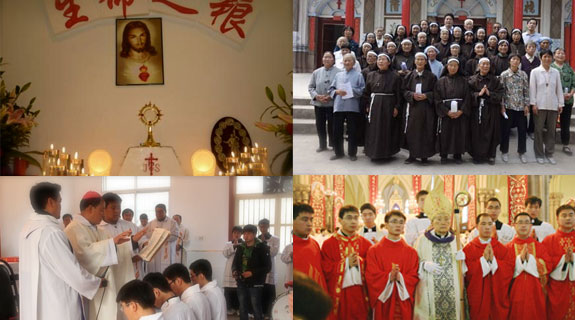
In the Wenzhou Diocese, Father Jiang initiated a new Lenten practice that he has called, “family Eucharistic adoration,” a movement that is swiftly sweeping across the area. Seeing China’s economic rise and its trend toward materialism, Jiang complains that, “secularization is threatening our faith life and we do not have enough strength to combat against it.” “However, the almighty God is the source of our strength,” he suggests, and “people who rely on God will find joy and peace.” To confront China’s materialism Wenzhou’s Catholics are signing up to have a Eucharistic altar installed in their home for twelve to twenty-four hours; the individual families spend that time reading Scripture, praying together, and in prolonged adoration of Jesus in the Blessed Sacrament. As one Catholic asserted, “耶稣的到来,不仅是贵宾、医生、而且还是家长” (When Jesus comes, He is not only a special guest, or even just a physician, but he is the head of our household). So far over fifty households have invited God into their homes during this Lent.
Not only is family Eucharistic adoration becoming popular, most dioceses are now organizing weekly adoration in major cities. Beijing, for example, now attracts large crowds of Catholic faithful to its four principal churches, wherein adoration of the Blessed Sacrament is held four days a week, and echoing the sentiments of the humble Saint Francis, China’s Christians exclaim, “What wonderful majesty! What stupendous condescension! O sublime humility! That the Lord of the whole universe, God and the Son of God, should humble Himself like this under the form of a little bread, for our salvation.” While traditional devotions have largely diminished in America, nearly all China’s Catholics pray a daily rosary and recite evening prayers to the Sacred Heart of Jesus, for as they say, the battle cannot be won without the supernatural aid of Christ in the Sacrament and constant prayer to his Sacred Heart.
China’s Catholics often remark, “Outsiders already know about our struggles, but do they know about how God has blessed us? There are victories, too.” Believing in the salutary results of prayer and adoration, China’s Church trusts that God will help it survive. Indeed, recent months have proven that God is more than assuring the Church’s survival, he has also facilitated its growth. Vocations are rising, as are ordinations, and as the government turns impatiently toward the lure of fiscal hegemony, more and more young Chinese are turning toward the waters of baptism. On March 17, seven deacons were ordained priests for the Diocese of Shanghai. Festooned with streaming red banners, the Cathedral of Saint Ignatius was filled beyond capacity as the faithful gathered to celebrate their new priests. Bishop Jin Luxian, currently in his late nineties, celebrated the Mass in Shanghai, while in distant Shaanxi four new priests were ordained. Already this year China is enjoying more vocations than it has in several decades.
After taking a group photograph in front of a large Christmas tree, still outside the cathedral long after Christmas, forty-five catechumens were recently baptized in the mother church of Taiyuan Diocese. As is the custom in northern China, the catechumens vowed to “follow Christ” and brought candles and salt during the solemn offertory, representing their promise to be the salt and light of the gospel in China and the world. And despite the fact that Catholic Orders are officially banned in Mainland China, forty Shaanxi Catholics joined the Franciscan Third Order in a ceremony officiated by Father Xia Changzhou, OFM. This growth of Franciscan spirituality is intentional, for as secular China venerates the altar of wealth, Shaanxi’s faithful honor the words of Saint Francis, who said, “Grant me the treasure of sublime poverty: permit the distinctive sign of our order to be that it does not possess anything of its own beneath the sun, for the glory of your name, and that it have no other patrimony than begging.”
Not all is promising however, as Bishop Ma Yinglin, who remains one of the few bishops in China who is unrecognized by the Vatican, recently ordained priests for the Kunming Diocese. The outspoken Hong Kong priest, Father Anthony Lam Sui-ki, responded to Ma’s disobedience to the Holy Father, stating, “It is very dangerous for the country and society to have a ‘son of corruption’ like Ma, as the mindset of conniving corruption is contagious, which would encourage more opportunists who disregard Church principles.” While some dioceses boast growing numbers of priests and converts, others like the one under Bishop Ma continue to foster division and suspicion among the faithful. Before the ordinations one Mainland blogger appealed to Ma to “repent and avoid making another mistake.” As Emerson once said, “Obedience alone gives the right to command,” and Bishop Ma has demonstrated little obedience to the pope he claims to follow.
Patience in a Time of Repression
During my last visit to Beijing, I spent time at two museums that are next door to each other, the Millennium Pavilion and the Museum of Military history; both are painstakingly crafted testaments of China’s cultural prominence in human history. The Millennium Pavilion featured a newly-installed exhibit dedicated to the 1911 Revolution, when imperial China was at last replaced by a modern Republican government, and the Military Museum featured exhibits on the Peoples’ resistance to imperialist and foreign powers through the nineteenth and twentieth centuries. I was most interested in the fact that both museums displayed historical images and descriptions of Catholic missions – photographs of churches, orphanages, and hospitals. Much has changed in China’s rhetoric regarding missionaries between 1960, when the Military Museum exhibit was installed, and late 2011, when the Millennium Pavilion exhibit was staged.
In the Military Museum photographs of Catholic churches seized by the Peoples’ Liberation Army are proudly displayed, touting the Party’s victory over “imperialist Catholic missionaries” who had done only harm to Chinese sovereignty and culture. The Millennium Pavilion, installed only a few months ago, featured a different narrative; in this new version of Catholic history in China foreign missionaries are shown caring for young orphans, treating sick villagers, and teaching Chinese women who had before then received little attention in China’s educational system. In short, for the first time since 1949, Christian missionaries were presented in a government-sponsored exhibit as “beneficial” to China’s people and its transition into modernity.
My objective in this month’s column is not to downplay the real conundrums facing religious liberty in China, but like everyone else who reads the daily news, I have grown weary of the incessant reports of oppression, repression, and rebellion. There is much happening in the world that is hopeful, and the Church in China, despite some major and minor glitches, is experiencing relative freedom and support. In his play, Les Misérables, Victor Hugo wrote that, “even the darkest night will end and the sun will rise.” This, after all, is the meaning of the Paschal mystery; Christ is the God of hope, and grace, and resurrection. For some reason lies have always been more popular than the truth; that is, unless the truth appears somehow unbelievable. Mark Twain once said that, “A lie can travel half way around the world while the truth is putting on its shoes.” China’s official line on Christian missionaries has been built more upon lies than truth, and it was refreshing indeed to see, for the first time, an official exhibit praising the works of missionaries who came to China in the name of Christ; and it is encouraging to see the Church, at least for now, awakening a dream of hope.
If you value the news and views Catholic World Report provides, please consider donating to support our efforts. Your contribution will help us continue to make CWR available to all readers worldwide for free, without a subscription. Thank you for your generosity!
Click here for more information on donating to CWR. Click here to sign up for our newsletter.
