


Hans Urs von Balthasar (1905-1988) was a major and influential figure in the Church in the 20th century. He was a prolific author, a theologian whose thought has been admired and commended by St. Pope John Paul II, Joseph Ratzinger (Pope Benedict XVI), Bishop Robert Barron, and many others.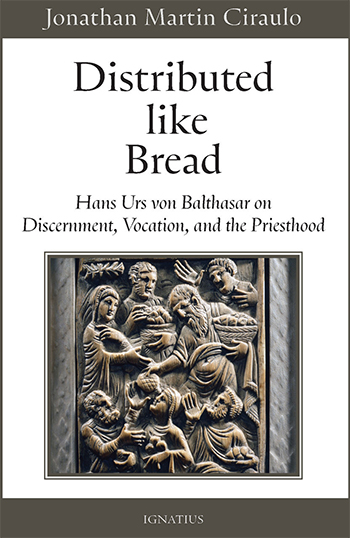
Jonathan Ciraulo is the editor of a new volume entitled Distributed like Bread: Hans Urs von Balthasar on Discernment, Vocation, and the Priesthood (Ignatius Press, 2026). This concise book presents some of von Balthasar’s reflections on discernment, which respond to current questions regarding the viability of priestly and religious vocations today. It aims to help readers understand how personal freedom and vocation are related, and how it is through the reception of a mission that we become truly ecclesial and open to God and others.
Dr. Ciraulo is Associate Professor of Systematic Theology at the Catholic University of America, and is the editor of the journal The New Ressourcement, and author of The Eucharistic Form of God: Hans Urs von Balthasar’s Sacramental Theology.
He recently spoke to Catholic World Report about his new book, the work of Hans Urs von Balthasar, and the importance of discernment for priests and laypeople.
Catholic World Report: How did the book come about?
Jonathan Ciraulo: Deacon Jim Keating, who was the editor of the Institute for Priestly Formation Publications, asked me to write a little book to introduce the thought of Hans Urs von Balthasar to seminarians in particular. As I was then teaching at a seminary, and in fact teaching an elective on Balthasar to the seminarians, I knew that Balthasar was a much-needed voice in the Church today, particularly for seminarians and priests.
Thus, the first edition of this book was written with seminarians and priests in mind as the intended audience. The newer Ignatius Press edition allowed me to broaden the focus. In general, I envisioned this book as a sort of introduction to Balthasar, who continues to fascinate and at times perplex many in the Church today.
This introduction to Balthasar occurs through the lens of those themes announced in the book’s subtitle: discernment, vocation, and the priesthood.
Catholic World Report: For those unfamiliar with him, can you give us an introduction to Hans Urs von Balthasar?
Ciraulo: Hans Urs von Balthasar (1905-1988) is now widely recognized as one of the most important theologians of the 20th century. On the one hand, he was somewhat of a theological outsider: his PhD was in Germanistik (German Studies), not in theology, he was never a professor of theology, he was not involved with the Second Vatican Council, as were many other theologians of his generation, and his interests were somewhat outside of the theological mainstream.
On the other hand, his work on the Church Fathers makes him representative of the ressourcement movement (a recovery of the insights of the Patristic period), he helped found the influential journal Communio, and he was a major influence on generations of theologians, priests, bishops, and even popes (particularly Benedict XVI).
Although he lived and studied in Austria, France, and Germany, Balthasar was born and spent most of his life in Switzerland. In addition to his writings (which, including his articles, books, and translation, are counted in the hundreds), his main work included his priestly ministry to students, his collaboration with the mystic Adrienne von Speyr, the creation and administration of his own publishing house (Johannes Verlag), and the founding, with von Speyr, of a secular institute with three branches (lay women, lay men, and priests), the Johannesgemeinschaft (the Community of Saint John).
Pope Paul VI appointed him to the International Theological Commission in 1969, and John Paul II named him a cardinal in 1988, although he died only a few days before the consistory.
CWR: What is most notable or unique about him and his work?
Ciraulo: Arguably, no other recent theologian provides as synthetic a vision of the breadth of the Catholic tradition. Without homogenizing the diversity of the Church’s tradition, in Balthasar one can hear the voice of the Church Fathers, the great medieval scholastics, the mystics, as well as the breadth of the philosophical and literary tradition. The metaphor he liked to use was that of a symphony of distinct voices.
Like Thomas Aquinas in the 13th century, Balthasar had an unswerving dedication, indeed reverence, for the Church’s tradition, while also recognizing the imperative of thinking with that tradition to address contemporary concerns. Balthasar shows the confidence with which Christianity can dialogue with modern philosophers (whether Hegel and Kant or Nietzsche and Heidegger) and address contemporary questions with confidence (whether moral, historical, or scientific). In Balthasar, one can see that the Church is equal to the task set before it in our time.
Balthasar is also well-known for his attempt to reunite theology and spirituality. If he proposed a “kneeling theology” and not only a “desk theology,” this is because he understood the damage done to both theology when it is divorced from the spiritual life and the spiritual life when unmoored from theology. To get a sense of his spiritual vision, I would recommend his book Heart of the World.
CWR: Balthasar can be intimidating to many readers because he was so educated and brilliant (he was once described as “the most cultured man in Europe). But is he accessible to the average reader?
Ciraulo: Indeed, Balthasar is principally known for his towering intellect, and the great majority of his writings demand of his readers a familiarity with philosophical, theological, and literary history that relatively few possess. This is true especially of his major trilogy, The Glory of the Lord (seven volumes), the Theo-Drama (five volumes), and the Theo-Logic (three volumes).
Nevertheless, he also wrote many smaller, more accessible books that will be of great aid to anyone. I would especially recommend In The Fullness of Faith, New Elucidations, and the collection of his homilies, You Crown the Year with Your Goodness, for anyone looking to read Balthasar for the first time.
What is remarkable about Balthasar, in fact, is that one can easily discern the same theological vision in both his dense theological tomes and in his shorter works of spirituality.
In this book, I am drawing on the entirety of his corpus in order to distill some of the more salient points that touch on perennial Christian questions of discerning the will of God. The first chapter in particular is intended to be a quick introduction to the life and thought of Balthasar.
Although he came from a patrician family (hence, the “von”) and was indeed an intellectual giant, in no way was Balthasar an “elitist,” at least as that term is commonly used. In fact, he had a lively concern for the poor, for the little ones, and knew quite well that the mysteries of God are often “hidden from the wise” and instead “revealed to the childlike” (Matthew 11:25).
The last book he wrote is very telling in this regard: Unless You Become Like This Child. He himself attempted to make his theology accessible, and I hope this small book will contribute something to that same end.
CWR: The book is in three sections, all of which are explicitly related to the priesthood. But there are many insights for laypeople as well.
Ciraulo: Materially, much of the book is indeed concerned with the priesthood and with issues that relate particularly to the priestly state. Formally, though, the goal of the book is to elucidate themes that are central to every Christian’s life. Balthasar’s own experience of experiencing a call to the priesthood and to religious life is instructive here. He was first struck by the need to be unreservedly available to God, to utter with Mary “fiat mihi.”
That is to say, prior to a calling for a particular vocation—for instance, to the priesthood or religious life—there is a shared Christian demand to present oneself as available to God. Saint Ignatius would call this indifference. This is true both before pursuing a definite state in life (whether priestly, religious, or lay) as well as after. Balthasar wanted to expand our sense of “discernment” to include the whole of Christian life. Discernment is thus part of the basic Christian disposition to God. This is, to be sure, just as relevant for the layperson as it is for the priest.
Many of the other themes, even if they are concerned directly with issues touching the priesthood (e.g., celibacy, the question of the holiness of the minister, the labor of a pastor), have resonances for similar issues facing all Christians, and I tried to indicate that throughout the book. But also, I do believe all Catholics, clerical or lay, have a major interest in understanding how Christ continues his work through his priests in a special way.
CWR: Vocational discernment can be approached in different ways, and there are some varied understandings of just what we mean when we talk about vocation. How does Balthasar help us in this?
Ciraulo: For Balthasar, vocation is tied to the idea of mission. You can see here his background in the Society of Jesus and St. Ignatius’ Exercises. And, importantly, Balthasar says very clearly that an individual becomes a person in the fullest sense insofar as he has taken on a definite mission. Simon is much more himself when Christ establishes him as Peter, and the same can be said for Abraham (Abram) and Israel (Jacob). In this sense, then, all people have a vocation, have a mission that God has entrusted to them uniquely.
CWR: What do you hope readers will take away from the book?
Ciraulo: I tried to communicate something of Balthasar’s insistence on an unswervingly theological sense of vocation. This is not to say that personal considerations (one’s own talents and dispositions) or even sociological ones are irrelevant. Nevertheless, if (consciously or not) the priesthood or another state in life is pursued without a lively sense of mission, without a disposition of utter availability to be used by God, then one may have missed what is most central, the “one thing necessary.”
If there is a crisis in the priesthood, it may be that we have exchanged a robustly theo-centric understanding of the priesthood for much thinner gruel. Balthasar reminds us that God can and does call us to great missions of self-sacrifice.
CWR: Is there anything else you would like to add?
Ciraulo: Writing the book was an act of gratitude to the many good priests I have known, and I hope readers will share that sense of gratitude for the gift of the priesthood.
If you value the news and views Catholic World Report provides, please consider donating to support our efforts. Your contribution will help us continue to make CWR available to all readers worldwide for free, without a subscription. Thank you for your generosity!
Click here for more information on donating to CWR. Click here to sign up for our newsletter.

Seeking background to dear Ass. Prof. Jonathon Ciraulo’s fine new book and this nice CWR review by beloved Paul Senz, I came across the following somewhat concerning published critiques of Balthasar’s offerings.
We might hope the formation of our clergy is free from such as this.
Some conservative Catholic thinkers have turned to Balthasar as a response to feminism, leading to a movement known as ‘new Catholic feminism’ that is deeply indebted to his theology. This has raised concerns about the
appropriateness of his writings as a Catholic Church’s answer to feminism,
as they may not align with the Church’s traditional stance on gender and
sexuality.
There are debates within the Catholic tradition regarding the unity of the
Catholic Church’s theology on the question of Christ’s descent into Hell.
Some theologians argue that Balthasar’s position is at odds with the
Church’s traditional view, suggesting that his work may fall into heresy.
Balthasar’s works have been criticized for fostering spiritual presumption
and complacency in readers, as well as dulling missionary zeal. Critics
argue that his writings may not be a reliable guide for effective and
credible Christian witness in a secular age.
Balthasar’s theology is often described as complex and idiosyncratic, which some critics believe is not suitable for serving as a standard bearer for
Catholic theology. This criticism is rooted in a neoscholastic perspective
that seeks a simple theology with clear answers.
Deeply informed criticism of Balthasar’s weird dualist spiritual life – the origin Balthasar said of all his theological propositions – is provided in this short youtube video clip interview with Professor Ralph Martin:
Balthasar, Speyr and hell w/ Ralph Martin (clip)
Prof Martin alsoexpressed concerns about von Balthasar’s theological views,
particularly his hope for universal salvation. Martin argues that von
Balthasar’s teachings have led many to presume that virtually everyone will be saved, despite the evidence of Scripture, tradition, and Church teaching.
Martin’s critique focuses on the implications of these views for Christian
hope and the Church’s mission. He emphasizes the need for careful
consideration of the theological implications of von Balthasar’s thought,
especially in light of the Church’s teachings on salvation.
Ever in the grace & mercy of King Jesus Christ; love & blessings from marty
Alright. With the mantle of a critic, first to acknowledge Ciraulo’s excellent work and the genius of von Balthasar, What else is new? Must we be convinced once again of the value of the Catholic priesthood?
Apparently so if bishops are incompetent, and Catholic Culture as a unique entity has become largely less distinguishable. Let’s be realistic. Who benefits from reading Balthasar besides well formed Catholic intellectuals, to name a few but I won’t because we know who they are? Although Ciraulo’s tutorial will help a few more intellectual candidates the remainder will likely pass through it with no gain. They’ll be formed by their instructors well if formed with those like Ciraulo but most likely by lesser kind.
Young men or older require an imagination spurred by fire. A recognition of the Holy Spirit voiced by Paul and the Apostles, Fathers, by the witness of the saints and martyr saints. Witness by that saintly fire has been dampened to virtual nonexistence. Been told many times I’m too emotional.
For myself, likely true although we need to be emotively virile sometimes and less intellectual like Christ and his devoted cadre of saintly priests.
“Who benefits from reading Balthasar besides well formed Catholic intellectuals…”
I read several of his books while I was a Protestant, and they helped me on my journey into the Church.
As Ciraulo notes, Balthasar wrote many (many!) shorter books (100-150 pages) that are very accessible and not academic at all.
Yes, his large theological works can be daunting. But it’s unfair to say or think that Balthasar is only for intellectuals or scholars.
Well Carl you like many Protestants who eventually took to the Catholic faith were avid readers moreso than most Catholics and intellectually competent to comprehend von Balthasar. An indication you gave of this is the vast number of books you have, presumably read for the most part, plus your eruditious response to commenters.
Although yes. My remark was wanting.
I am sorry Dr. Rice, but every single paragraph of your post is way, way, WAY off base. You might want to read some people who actually UNDERSTAND Balthasar before commenting or relying on critics who have, quite literally, no idea what they are talking about.
“Balthasar’s works have been criticized for fostering spiritual presumption and complacency in readers, as well as dulling missionary zeal.” Good heavens, and may God have mercy—- if anyone wrote about the NECESSITY and task of mission, it was Balthasar.
The “heresy” charge on hell was based on a radical misunderstanding of what Balthasar said, and has been debunked numerous times.
Please read some books by Tracey Rowland, who clearly explains in very simple language the divide between the old neo-scholastics and their two-tier theory of nature and grace, and those who understand that while distinct, nature and grace are not unrelated, or merely juxtaposed. I suggest starting with her beginner books, like “Doing Theology:Catholic Theology” or “Introducing Communio Theology.” Those more advanced in theological thinking can check out the Communio journal, or David C. Schindler’s book, “Hans Urs von Balthasar and the Dramatic Structure of the Truth”.
It is distressing to read such embarrassing critiques. Balthasar was 100% faithful and orthodox, and if Thomas Aquinas were alive today he would be facing the exact same philosophical questions. He already answered Aristotle and would certainly respond to Heidegger and Hegel with 100% Catholic fidelity. If you cannot see that, go back and look again.
I could write a book here but I will not. I just plead with anyone who read the above screed to look for themselves. If you find it too “complex and idiosyncratic” (??) then leave it aside, while remembering that many people even today find Aquinas himself “complex and idiosyncratic.”
Signed – a faithful orthodox Catholic who loves the TLM, the Rosary, Marian devotions and the whole nine yards. Balthasar changed my life. In fact, add “How Balthasar Changed My Mind: 15 Scholars Reflect on the Meaning of Balthasar for Their Own Work”, a book by 15 faithful Catholcis – not a modernist, liberal, or heretic among them.
Many thanks, dear Benay Berne, for this bold Balthasarophile response.
It’s well known that Balthasar impressed on many Catholic leaders of an intellectual bent that he was ‘the most cultured of men’.
For those who bow before elevated culture {such as Rowland & the ‘Communio’ mob} that seems to be enough to make them ignore Balthasar’s several frank heresies and his unwise [to say the least] spiritist sourcing, not from The Holy Spirit’s revelations in The Church’s Apostolic witness, but from a disturbed, sickly, thrice married woman who Balthasar became fatally infatuated with; even to the point of stalking her in her home at night.
He left his Jesuit order to move in with Adrienne von Speyr whose spiritist claims included her having entered the being of various saints and even entering Balthasar when he was in the confessional, where she claimed it was her [not GOD’s Holy Spirit] who directed his confessor’s ministry.
Balthasar’s heretical universalism (and the havoc it has caused & is causing in Rome & across the Catholic world) directly derives from his chosen spiritual director (von Speyr) claiming that she had visited Hell and it was empty! Balthasar himself stated that all his work derives from von Speyr!
In plain language: A controlling spiritist & her accolyte theologian pupil conspired to make King Jesus Christ and His Holy Apostles liars by saying no one goes to Hell! All in a very culturally elevated way, with crumbs of orthodoxy to disarm The Church establishment.
None deny that some of Balthasar’s work is orthodox & may even have helped some people (such as our beloved CWR editor).
That doesn’t explain the unwise fanaticism of today’s Balthasarophile faction who willing ignore the plain evidence of Spiritism (a sacrilege), errosion of Catholic orthodoxy, and outright heresies, such as universalism.
One must caution: “Persist in this at the hazard of your eternal soul.”
Saint Paul’s revelation in 1 Corinthians 1:18-25 is salutary.
Thank you for this, Dr. R.
Balthasar greatly admired Origen, an early theologian (185-253) of prolific writing and similar views; Origen argued the possibility of universal ‘restoration” to include Satan himself. Both the pope and emperor banned Prigen’s books, but controversy surrounds him to this day since some of his writings are questionably not his writings! I imagine something similar will be true for Balthasar too.
I do not think Balthasar’s HOPE adequately addresses Jesus’ definitive words on judgment. Jesus said He will judge some unworthy of His Kingdom and order them to depart into the eternal fire “prepared for the devil and his angels” (Matthew 25:41). That sounds like hell to me.
To hope against Jesus’ words to the contrary is to hope against Hope, from my POV.
Many folk think Balthasar is wonderful, full of brilliant insights of intellect, (similar to St. Aquinas), goodness, and wisdom, whose writing contains all sort of stupendous attributes: Fr. Fessio. Benedict XVI. Chappstick. Bishop Baron. The list goes on.
Discerning the truth of Balthasar’s leaving the Jesuit order is not easy. Was he ordered removed by his superior, or did he leave of his own accord? In any case, he was without means financial support when he left to found a SECULAR institute, and he lived (because of financial straits?) for some time with the ‘mystic’ you mention. Ignatius Press also published (at one time; do they still?) her ‘visions.’
“How Balthasar Changed My Mind: 15 Scholars Reflect on the Meaning of Balthasar for Their Own Work”, a book by 15 faithful Catholcis – not a modernist, liberal, or heretic among them.
Reasonable minds will disagree with your assertion here. I started to read our friend Dr. Chapp’s intro to the book you cite and its just par the course with what he says on CWR its all triumphalist handwaving of overcoming the big bad mean Neo-Scholastics. The whole New Theology’s conception of truth as the paradox of opposites is celebrated in that introduction and elsewhere. But as the other commentators note this has wrecked tremendous destruction in the Church and in the wider culture. The New Theology leads into a post truth nihilism where any good proposition is then negated by the opposite its supposedly tension with. No overly verbose poetical language can obscured this fact that has now been proved by logic and experience. Its effects are clearly demonstrated in the catastrophic decline in the Church since we have imbibed Von Balthasar and his friends. Chapp, Rowland Schindler et al. will never acknowledge this. For them, the New Theology didn’t fail we failed it. We just need a new generation not invested in their pet theology theories to pick up the ruins and move forward.
Dear Mortain, thankyou for the insightful comment.
We could do a close-up of: “pick up the ruins and move forward.”
It’s in the air! The Holy Spirit of GOD calling: “Pick up The New Testament & The Catechism of The Catholic Church & you’ll move forward.”
Ever in the love of King Jesus Christ; blessings from marty
“An individual becomes a person in the fullest sense insofar as he has taken on a definite mission.” A sense of irony for this reader, in that Balthasar’s statement would “fully” capture the acceptance of a “mission” as a participation in the divine nature (2 Pt 1:4) when viewed in the context of the Thomistic psychological analogy of the Trinity and the eternal processions as “mission”, to be “sent” in the Incarnation and at Pentecost (see Frs. Gilles Emory, O.P., Thomas Joseph White, O.P.). Alas, Balthasar’s modern Trinitarianism allowed German Idealism to set the terms.
I’ve always thought that Balthasar’s death a few days before he would have been made a cardinal may have been heaven’s way of cautioning us concerning some of his thought.
It was a ‘coincidental’ sign, that it was.
Von Balthasar’s Adrienne von Speyr dreamy mystic connection always signaled caution. Von Speyr had a strange dominance over him at times scolding and possessive.
Doubts related to eschatology, Man’s salvation is one that mars his excellent insights.
Yes, dear Fr Dr Peter Morello: “Von Speyr had a strange dominance over him at times scolding and possessive.” This is exposed more in the following:
A Review Essay of The Devil’s Redemption: A New History and Interpretation of Christian Universalism – Homiletic & Pastoral Review
Here’s just a tiny part of Professor Martin’s review of Professor Michael McClymond’s momentous & uniquely significant books:
Strange Spiritual Influences
Even more troubling, though, than Balthasar’s approach to scripture and tradition is his openness to suspect spiritual experiences and private revelations that came to him through his very close collaborator, Adrienne von Speyr.
Professor McClymond quite convincingly establishes in his study of universalism through the centuries and in all the churches the frequent influence of the occult, of spiritism, of “esoteric” knowledge, of secret societies, “white magic”, theosophy, alchemy, astrology, of private revelation in generating and supporting the views of those who teach universalism, automatic writing, séances, astral projection, “spirit guides,” etc. The evidence is overwhelming and shocking and is extensively documented in this very important book. (22-23, 96, 200-215, all of chapters 5, 8, etc.)
Unfortunately the evidence for occultic influence on Balthasar’s theories is rather clear. Professor McClymond while doing a masterful job in tracing the philosophical and theological influences on Balthasar — the church fathers inclined to universalism, the similar influence of Karl Barth with which he had frequent conversations, the universalism of prominent Russian thinkers, German idealism, etc. — also documents the troubling “esoteric” influences on his “hopeful universalism”, including even the little-known fact that Balthasar wrote an admiring afterword to Valentin Tomberg’s work of Christian esotericism, Meditations on the Tarot. (931)
The relationship between Balthasar and von Speyr was unusual. He moved in with her and her husband and had an intense spiritual relationship with her. He claimed grounding for his unusual doctrine of the Trinity that seems to imply conflict and darkness in the Trinity, and his unusual interpretation of Holy Saturday, on the revelations of von Speyr. He repeatedly claimed that the two of them can’t be separated and they are one in their theology. He even, in an interview with Cardinal Scola towards the end of his life, claimed that the Church would have to revise its doctrines in the light of her beautiful theories, and wondered why it hadn’t known these things sooner.
He actually wrote two books describing their relationship and the accounts he gives there of what transpired between them spiritually and theologically are quite troubling. Speyr claimed to be in constant communication with St. Ignatius and told Balthasar that St. Ignatius wanted him to leave the Jesuits, and he did. She sometimes spoke to him in a guttural voice that wasn’t hers, in extremely demeaning ways. His skepticism about anyone being in hell, even Judas, was based on his lifelong attraction in this direction and her specific revelations. He was thrilled that everything in his theory was coming together and being confirmed and deepened with her. Professor McClymond points out that Balthasar was very open in acknowledging these significant influences.
“I was tremendously and lastingly attracted by Barth’s doctrine of election, that brilliant overcoming of Calvin. It converged with Origen’s views and therefore with Adrienne’s Holy Saturday theology as well.”
There are also disturbing sexual innuendo in the images Speyr uses when talking about their relationship, even though no one has ever accused them of an illicit physical relationship. McClymond draws heavily upon Karen Kilby’s study on Balthasar’s relationship with Speyr. Besides the excellent work of Kilby and McClymond, I’ve also published an article on their relationship and the need for discernment of the source of her spiritual experiences in the Angelicum journal, which I think contributes to this important issue.
Here is a link to a recent, relevant video by Prof. McClymond –
Dangers of Universalism with Dr. Michael McClymond – YouTube
Von Balthasar’s enthusiastic preface for Valentin’s Tomberg’s “Meditations on the Tarot” (an egregious catechism of occultism and superstition) seems out of sync with his reputation for intellectualism.
Dear Miguel Cervantes: “Von Balthasar’s enthusiastic preface for Valentin’s Tomberg’s “Meditations on the Tarot” (an egregious catechism of occultism and superstition)”; spot on!
This is also mentioned in Michael McClymond’s definitive books on the spiritist origins of the heresy of universalism; viz –
A Review Essay of ‘The Devil’s Redemption: A New History and Interpretation of Christian Universalism’ – Homiletic & Pastoral Review.
Here’s just a small part of Professor Martin’s review of Professor Michael McClymond’s momentous & uniquely significant books:
Strange Spiritual Influences
Even more troubling, though, than Balthasar’s approach to scripture and tradition is his openness to suspect spiritual experiences and private revelations that came to him through his very close collaborator, Adrienne von Speyr. Dr. McClymond quite convincingly establishes in his study of universalism through the centuries and in all the churches the frequent influence of the occult, of spiritism of “esoteric “ knowledge, of secret societies, “white magic,” theosophy, alchemy, astrology, of private revelation in generating and supporting the views of those who teach universalism, automatic writing, séances, astral projection, “spirit guides,” etc. The evidence is overwhelming and shocking and is extensively documented in this very important book. (22-23, 96, 200-215, all of chapters 5, 8, etc.)
Unfortunately the evidence for occultic influence on Balthasar’s theories is rather clear. Dr. McClymond while doing a masterful job in tracing the philosophical and theological influences on Balthasar — the church fathers inclined to universalism, the similar influence of Karl Barth with which he had frequent conversations, the universalism of prominent Russian thinkers, German idealism, etc. — also documents the troubling “esoteric” influences on his “hopeful universalism,” including even the little-known fact that Balthasar wrote an admiring afterword to Valentin Tomberg’s work of Christian esotericism, ‘Meditations on the Tarot’. (931)
The relationship between Balthasar and von Speyr was unusual. He moved in with her and her husband and had an intense spiritual relationship with her. He claimed grounding for his unusual doctrine of the Trinity that seems to imply conflict and darkness in the Trinity, and his unusual interpretation of Holy Saturday, on the revelations of von Speyr. He repeatedly claimed that the two of them can’t be separated and they are one in their theology. He even, in an interview with Cardinal Scola towards the end of his life, claimed that the Church would have to revise its doctrines in the light of her beautiful theories, and wondered why it hadn’t known these things sooner.
He actually wrote two books describing their relationship and the accounts he gives there of what transpired between them spiritually and theologically are quite troubling. Speyr claimed to be in constant communication with St. Ignatius and told Balthasar that St. Ignatius wanted him to leave the Jesuits, and he did. She sometimes spoke to him in a guttural voice that wasn’t hers, in extremely demeaning ways. His skepticism about anyone being in hell, even Judas, was based on his lifelong attraction in this direction and her specific revelations. He was thrilled that everything in his theory was coming together and being confirmed and deepened with her. Dr. McClymond points out that Balthasar was very open in acknowledging these significant influences.
“I was tremendously and lastingly attracted by Barth’s doctrine of election, that brilliant overcoming of Calvin. It converged with Origen’s views and therefore with Adrienne’s Holy Saturday theology as well.”
There are also disturbing sexual innuendo in the images Speyr uses when talking about their relationship, even though no one has ever accused them of an illicit physical relationship. McClymond draws heavily upon Karen Kilby’s study on Balthasar’s relationship with Speyr. Besides the excellent work of Kilby and McClymond, I’ve also published an article on their relationship and the need for discernment of the source of her spiritual experiences in the ‘Angelicum’ journal, which I think contributes to this important issue.
Here is a link to a recent video by Prof. Michael McClymond –
Dangers of Universalism with Dr. Michael McClymond – YouTube