

 At the end of a Wednesday evening class last semester, one of my students approached me to ask a question. After hesitating somewhat, he proceeded in the following manner: “Professor, I really have enjoyed your class, but you always teach as though Catholicism is true. You rarely talk about other religions, of which I was actually hoping to learn more about.” I reminded the troubled young man that he should re-read the syllabus, since “Teachings of the Catholic Church” is actually the official course title. The humorous encounter reminded me of Walker Percy’s response to the question of why he became a Catholic: “What else is there?” How ironic, yet typical of most university students, that someone would be taking a course on Catholicism and simultaneously be disgruntled that this is precisely what he is getting.
The history of Catholicism has thankfully shown us that there is a tremendous pedagogical character regarding the nature of error: it helps us achieve greater clarity on a particular matter that may have, up to that point, been otherwise. Moreover, error also helps us to see whether or not the one committing it has willfully chosen it. It would be safe to say that the latter is a hallmark of many post-modern Catholics. The student mentioned in the beginning was, in my estimation, suffering from a high degree of excusable ignorance; he did not have a full grasp of what he was asking, and seemed more the result of a cultural that had groomed him to accept relativism a priori. Others, have fallen away from the faith, not by an excusable ignorance or happenstance, but by a mode of living that refuses to conform itself to the demands of the faith.
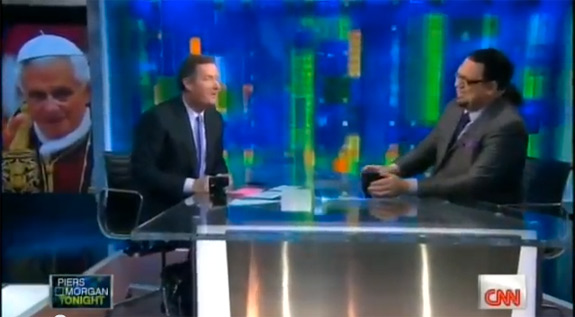
These preliminary points came to mind last week as I watched the brief exchange between Piers Morgan and Penn Jillette (easily accessible on YouTube). Morgan, a self-professed Catholic, was questioning Jillette, a professed atheist, on the significance of Pope Benedict XVI’s resignation. The exchange between the two is enlightening for the fact that not only is Morgan so blatantly distorting in presenting authentic Catholic teaching, but more so because of Jillette’s clearer foundational understanding of Catholicism’s essence. Notice why this is so essential: Jillette does not profess to be Catholic, or religious, in any manner whatsoever; he is simply attempting to give an account of what the Church actually expects of those who profess the Catholic faith. On the other hand, Morgan explicitly admits to being Catholic and, “like many young Catholics, is disgruntled by the Church’s unwillingness to get with the times and necessary societal changes.” The key line of the entire brief clip comes at the very end of where Jillette shoots back at Morgan’s concluding remarks: “That’s not the Catholic Church.”
There are a number of important points that can be drawn out from this exchange, each helpful to our understanding of what Catholicism truly is. I will present three points: the first two are more specific, and the last is general and overarching:
1) We must distinguish the preambles from the mysteries of the faith. The preambles of the faith are those truths that can be known by natural reason apart from the light of faith and Divine Revelation. Some of these truths would be the fact that God exists, is eternal, one, immutable, and pure act. These truths about God can be discovered by philosophical and/or scientific inquiry, but are rooted in our experience of the very order and reality of natural things. The mysteries of the faith are those which, in principle, transcend the very structure of human reason. They do not contradict reason, but exceed its scope and grasp. That God is a Trinity of Persons, that Jesus Christ is fully God and fully man, or that Christ is actually present in the Eucharist, are truths of the faith that cannot be reasoned to, but must be accepted on faith.
The distinction drawn here can also be seen as it relates to the Church’s moral teachings. Morgan lambasts Catholicism for not allowing the use of condoms in Africa, “Where it would saved tens, if not hundreds of thousands of lives. It can’t be Christian to allow so many people to die.” Catholicism does teach that condoms are morally wrong in light of Christian anthropology, but the immorality of using condoms is more like a preamble than a mystery of faith. According to Morgan, the Church’s teaching on condoms seems to be something that we are to accept on faith, like we would the Trinity or the Incarnation (while I like the first part of Jillette’s response that Catholicism is not a democracy, he seems to follow the same line of thinking as Morgan when he utters “even if we can’t understand exactly what God’s plan is”).
Yet this is erroneous, for it would then be claiming that Catholics alone, through the assent of faith, hold that condom use is immoral. Several studies have been produced in the last decade showing the harmful effects of condom use (see in particular the work of Dr. Edward Green, the director of Harvard’s HIV Prevention Research Project who defended Pope Benedict’s comments in 2009 that condoms were making the AIDS epidemic in Africa worse). While it is true that the ban of condom use is part of the Catholic faith, it is nevertheless clear that one can discover the harmful (physical and moral) effects of condom use through the natural light of reason.
Of course, we must not forget another important point that the Church calls to mind here: due to the limitation of our finite intellects, laziness, the daily demands of life, and moral disorders, it is not a guarantee that we will arrive at the preambles of faith (which are the moral truths referring to the natural law). Therefore, God has made it that the preambles have also been revealed and can be assented to in faith.
2) Theology is both speculative and practical, but primarily speculative. This point was at the core of Pope John Paul II’s first three papal encyclicals, and the theme of Benedict’s Regensburg Address. At one point during the interview, Morgan says, “I don’t remember Jesus saying no condoms, no marriage for priests, no remarriage for divorce, and no women priests. These never came from Jesus’ own mouth.” Don’t forget contraception, abortion, and same-sex unions on that list.
Aquinas tells us that theology is primarily speculative because it has God as its object, meaning that all moral theology and questions concerning authentic Catholic action must preserve the primacy of truth before it can be measured in terms of its usefulness for mankind. Morgan, like many “social justice” Catholics, intentionally places “orthopraxis” above and in opposition to “orthodoxy.” If truth can only be established according to right praxis or action, then ultimately there will be no standard upon which to judge whether or not these acts are in accord with Catholicism’s understanding of its own essence. Ratzinger pinpoints the destructive results of such a conception:
Theology becomes then no more than a guide to action, which, by reflecting on praxis, continually develops new modes of praxis. If not only redemption but truth as well is regarded as post hoc, then truth becomes the product of man. (Principles of Catholic Theology: Building Stories for a Fundamental Theology, 317)
The principles of Catholic theology are rooted in the very inner life of God, and must be given to us as a gift in revelation. Therefore, it is only in this light that we can understand the kinds of acts that can be truly imitative of Christ. Again, without this understanding, Catholicism would become a groundless ideology that would juxtapose the form and content of the faith with its authentic and fully lived expression.
3) “Falling Away” from the Faith is never by chance. Newman rightly pointed out that critically wondering about the teachings of the faith, why the Church teaches a particular doctrine, and how it relates to my own understanding of things, is not a sign of the faith’s absence. Even to be doubtful about a particular doctrine whose full connection we do not see, is not contradictory to the light of faith. Is this not precisely what is taking place the RCIA process? Rather, Newman says that if we were not critically thinking about our faith and its moral, spiritual, and intellectual ramifications, then this would be a sign of treading down the wrong path. We all know people who have “fallen away” from the faith, describing it as though similar to the wind moving them without consent, but nevertheless.
Morgan’s general attitude and intention is not that of someone seeking to understand the truths of the faith in humble obedience to the Church, in a spirit of fides quarens intellectus. It is not a result of ignorance or misinformation, and we can make this judgment based upon the responses that Jillette makes during the interview. To make the implicit and illusory claim that the Church is responsible for killing hundreds of thousands of people is not to be taken lightly. If that is the case, one wonders why Morgan would even be willing to call himself a Catholic; an institution capable of that kind of evil shouldn’t be tolerated, but destroyed. I think Fr. James Schall has stated well an important truth to take away from the exchange between Morgan and Jillette, explaining the reason that many Catholics don’t want to know what Catholicism is:
Though I think there can be genuine intellectual perplexities about the truth of faith, things that need to be worked out and usually have been in the history of Christian thought, I also think that most of what is called “falling away” from the faith stems from how we are living. Our minds are generally sharp enough, on reflection, to realize that reason and faith teach something other than what we are doing. If we are challenged to justify our living, what we must do is develop an “alternate” theory of Christianity or morality that justifies our way of living. This is the first and essential act in falling away. This initial step forces us by our own logic to justify what is contrary to the essential core of reason and revelation. Once this step is taken, like falling off the cliff, the rest is simply down hill and no longer free. (“On Losing the Faith”)
If you value the news and views Catholic World Report provides, please consider donating to support our efforts. Your contribution will help us continue to make CWR available to all readers worldwide for free, without a subscription. Thank you for your generosity!
Click here for more information on donating to CWR. Click here to sign up for our newsletter.
