
No Picture
News Briefs

Arthur Brooks at SEEK 2026: ‘Your job isn’t to win arguments, it’s to win a soul’

January 4, 2026 Catholic News Agency 0
Arthur Brooks gives a keynote address at SEEK 2026 on Jan. 4, 2026. | Credit: Madalaine Elhabbal/CNA

Jan 4, 2026 / 23:20 pm (CNA).

New York Times bestselling author and Harvard professor Arthur Brooks encouraged attendees at SEEK 2026 to resist the temptation as missionaries to “fight fire with fire.”

In his Jan. 4 keynote speech in Columbus, Ohio, Brooks said the world “is not just a cold world,” but “a world that attacks you.” In this context, he said, it can be challenging not to fight back.

However, he said, “your job isn’t to win arguments, it’s to win a soul.”

Brooks teaches at Harvard’s Kennedy School of Business and has written multiple books on finding happiness and meaning in life, including From Strength to Strength and Build the Life You Want, which he co-authored with Oprah Winfrey. He also writes a column in The Atlantic called “How to Build a Life.”

Some 26,000 attendees have gathered through Jan. 5 in Columbus, Denver and Fort Worth, Texas for the SEEK 2026 conference organized by FOCUS.

“The spirit of the missionary will take you into the heart of a culture war,” Brooks said. “And in that culture war, you won’t win with violence…as you can win with love.” Brooks recounted his experience giving a talk in Manchester, New Hampshire in 2014, for an audience he said was “a very ideologically oriented group.”

According to Brooks, he was the only speaker out of the 15 present who was not a presidential candidate. He said that during his address, he told his audience, “You’ve been hearing from political candidates who want your vote. And what they’re telling you is that you’re right and the people who disagree with you are stupid people and hate America, but I want you to remember something. Those people, they’re your neighbors, and they’re your family…It’s not that they hate America, it’s that they disagree with you.”

When acting as a missionary, he said, the goal is to persuade people. “If you want to persuade them, you can’t do that with hatred, because nobody has ever been insulted into agreement,” Brooks said.

‘entering mission territory’

Brooks concluded by telling about a retreat center that he and his wife, Esther, visit when they give marriage preparation. Inside the chapel of the retreat center, he said, there is a sign over the door to exit the chapel that reads, “You are now entering mission territory.”

“So as you leave this beautiful, beautiful gathering tomorrow, the signs on the door of your hotel or this conference facility, any place that you find yourself as you leave this city, and effectively for the last time tomorrow, is that you’re entering mission territory,” Brooks said. “Let’s set the world on fire together.”

Katie Tangeman, a sophomore at Northwest Missouri State University, said she came away from Brooks’ talk motivated to “just take a step back whenever I’m feeling frustrated or annoyed with somebody, or if they’re attacking me, to just see them as a beloved son or daughter of God and approach them with love instead of the contempt and hate that [Brooks] was talking about.”

“Because that’s not being a good Christian,” she added.

“I want to say the biggest thing I took away from Arthur Brooks’ talk tonight, his keynote speech, [is] that you can change the trajectory of how a conversation goes by battling it with kindness in a way,” said Andrew Stuart, an agricultural business major, also at Northwest Missouri State.
[…]

No Picture
News Briefs

Trump says U.S. will ‘run’ Venezuela until ‘transition’ to new president

January 3, 2026 Catholic News Agency 3
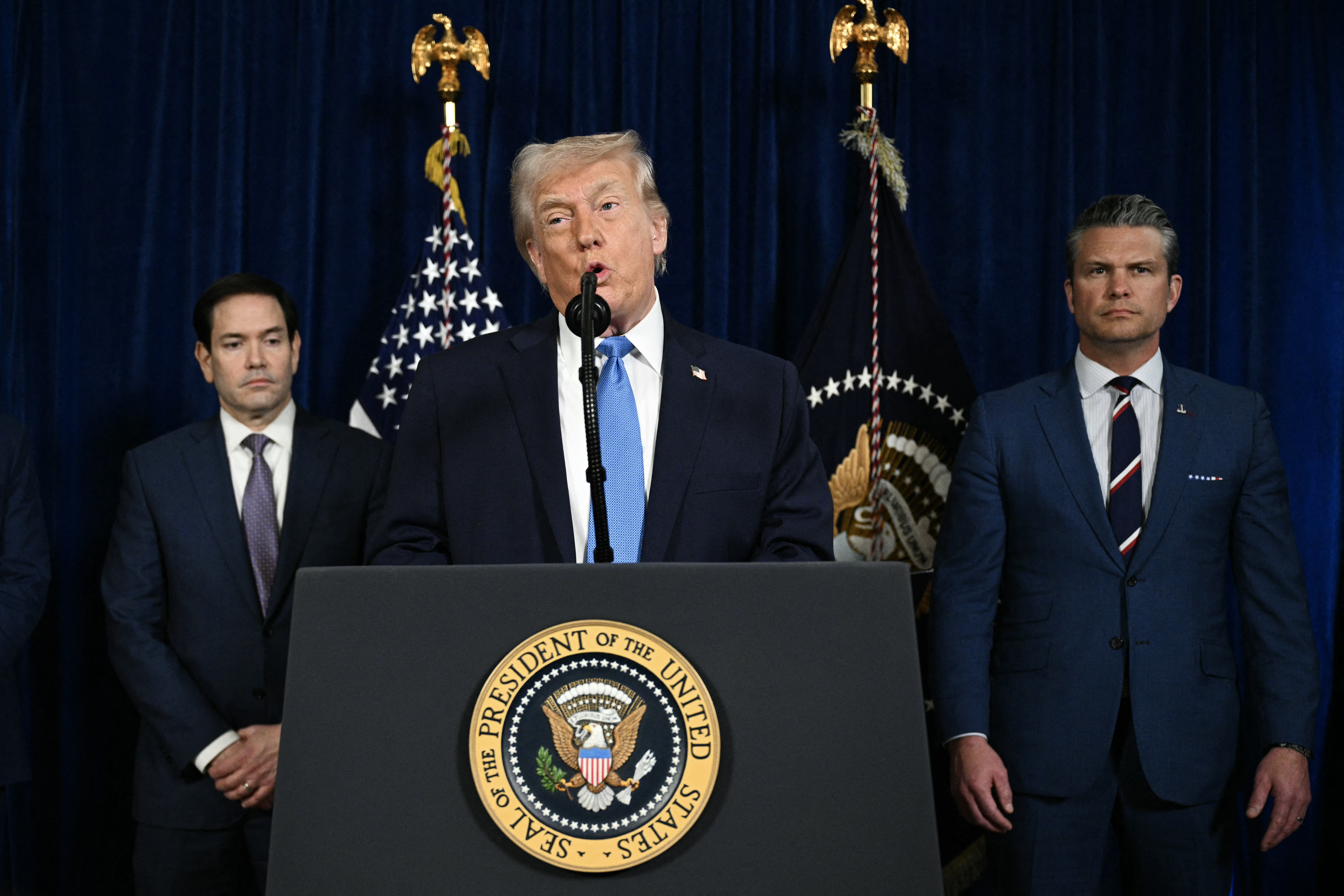
U.S. President Donald Trump delivers a press conference after the capture of Venezuela President Nicolás Maduro, Washington, D.C., Saturday, Jan. 3, 2026. Credit: JIM WATSON / Getty Images

Jan 3, 2026 / 12:56 pm (CNA).

U.S. President Donald Trump on Jan. 3 said the United States would “run” Venezuela until a replacement for President Nicolás Maduro can be found, with the U.S. leader vowing a “safe, proper, and judicious transition” after American forces arrested Maduro and brought him to New York State for indictment.

The U.S. launched strikes in the Venezuelan capital of Caracas on Jan. 3 before capturing Maduro and transporting him to the U.S., where he was indicted on drug and weapons charges in a New York district court.

In a press conference on Jan. 3, Trump revealed that the U.S. would “run the country until such time as we can do a safe, proper, and judicious transition.”

“We don’t want to be involved with having somebody else get in and [then] we have the same situation that we had for the last long period of years,” Trump said, emphasizing: “We are going to run the country.”

The president alleged that the Maduro regime in Venezuela “emptied out their prisons [and] sent their worst and most violent monsters into the United States.”

He referenced the June 2024 killing of Jocelyn Nungaray, who was raped and strangled in Texas allegedly by two Venezuelan immigrants in the country illegally.

Asked how long the U.S. would be in charge of Venezuela, Trump said: “I’d like to do it quickly.” He said such operations take “a lot of time.”

He described the country’s infrastructure as in poor shape. “We’re going to take a lot of money out so that we can take care of the country,” he said

U.S. Secretary of Defense Pete Hegseth at the press conference praised the soldiers who carried out the Venezuelan operation early on Jan. 3, describing them as the “elite of America.”

“Our adversaries remain on notice,” Hesgeth said. “America can project our will anywhere, anytime.”

National leaders in Latin America expressed condemnation of the U.S. operations in Venezuela on Jan. 3, with executives in Colombia, Brazil and elsewhere warning of U.S. aggression and regional instability after the strikes.

The bishops of Venezuela, meanwhile, said they are in prayer and communicating with each other amid the ongoing incident.

[…]

No Picture
News Briefs

Breaking: Explosions rock Caracas and other cities in Venezuela

January 2, 2026 Catholic News Agency 2
Breaking News – CNA

Jan 3, 2026 / 02:50 am (CNA).

Multiple explosions rocked Caracas and several other Venezuelan cities early Saturday, Jan. 3, accompanied by the sound of apparent military aircraft flyovers.

Residents reported shaking windows and columns of smoke rising from strategic locations, including military bases.

“The explosions were so strong they made the windows of my house shake. When we looked outside, numerous plumes of smoke were rising over Caracas,” said Andrés Henríquez, a correspondent for ACI Prensa, CNA’s Spanish-language news partner.

“There were many, countless. Then, videos and reports began to emerge of explosions in other cities.”

Regime calls on citizens to mobilize

In a furious response issued Saturday, the Maduro regime denounced the blasts as “extremely grave military aggression” by the United States, alleging an attempt to seize Venezuela’s strategic resources.

Foreign Minister Yván Gil Pinto announced that President Nicolás Maduro has signed a decree declaring a “State of External Commotion” — a constitutional emergency measure granting the regime sweeping wartime powers to mobilize the military and suspend civil guarantees.

Citing Article 51 of the U.N. Charter, the government vowed to “exercise self-defense” and called on citizens to mobilize against what it termed an “imperialist attack” intended to force regime change.

Shortly after the regime reaction, U.S. officials reportedly confirmed to CBS News that President Donald Trump had ordered the strikes.

The developments follow recent escalations, including the U.S. designation of Maduro as alleged leader of the “Cartel of the Suns” narco-terrorism ring.

Church warns of persecution

The violence validates grim warnings from the Venezuelan Bishops’ Conference (CEV). In their recent Christmas message, the bishops cautioned that the “joyful experience” of the season was “overshadowed” by the country’s “turbulent national reality” and “generalized impoverishment.”

Tensions between the Church and the regime have spiked since the disputed July 2024 elections. The episcopate has repeatedly demanded the release of political prisoners — including minors — while Maduro recently accused Cardinal Baltazar Porras of conspiracy during the October 2025 canonization of Venezuela’s first saints.

Analysts told CNA recently that the Church likely faces “more persecution” in 2026 as the regime becomes increasingly isolated.

This is a developing story. Latest update on Jan. 3 at 3:42 am ET with the first official reactions and statements from Venezuela and the U.S.

[…]