No Picture
News Briefs

Pope Francis prays for Iraq as number of civilian deaths rise

March 29, 2017 CNA Daily News 0

Vatican City, Mar 29, 2017 / 04:56 am (CNA/EWTN News).- With the battle for major ISIS strongholds heating up in Iraq, Pope Francis has voiced his closeness to the country, praying for the safety of people on the ground, particularly civilians caught in the crosshairs of the fighting.

“My thoughts go out to civilians trapped in the western districts of Mosul and displaced because of the war, to whom I feel united in suffering, through prayer and spiritual closeness,” he said during his March 29 general audience.

“While expressing deep sorrow for the victims of the bloody conflict, I renew to all the call to engage with every effort in the protection of civilians as an imperative and urgent requirement.”

During the audience, which took place in St. Peter’s Square, the Pope greeted a delegation of Iraqi Superintendents representing various religious groups accompanied by the President of the Pontifical Council for Interreligious Dialogue, Cardinal Jean-Louis Tauran.  

“The richness of the beloved Iraqi nation lies in this mosaic which is unity in diversity, strength in union, prosperity in harmony,” he said, encouraging them to go forward on this same path.

Francis also asked for prayers for Iraq that they might find reconciliation and harmony and “peace, unity and prosperity” among their different ethnic and religious groups.

His appeal followed a sharp rise this week in the number of reported civilian deaths in U.S.-led airstrikes in Iraq and Syria as ground forces backed by the strikes are closing in on two of the Islamic State’s main urban strongholds: Mosul in Iraq and Raqqa in Syria.

According to the Washington Post, the reports have fueled accusations that the U.S. and its partners may not be acting with sufficient regard for the safety of civilians.

During his main address to pilgrims, Pope Francis continued his catechesis on the theme of hope, drawing attention to the close connection that exists between the virtue of hope and the virtue of faith.

“Great hope is rooted in faith, and as such is able to go beyond all hope,” he said, “because it is not based on our word, but the Word of God…When God promises, he accomplishes what he promises.”

“I’d like to ask you a question,” the Pope said. “We, all of us, are we convinced of this? Do we believe that God loves us and that everything he has promised us will be brought to fruition?”

All we have to do is have an open heart, and God will teach us how to hope and will do “miraculous things.” The only price, he said, is to “open our hearts to faith and he will do the rest.”

To illustrate the point, Pope Francis drew on the Old Testament story of Abraham and his wife Sarah, quoting the words of St. Paul in the Letter to Romans, that Abraham “believed, hoping against hope.”

Despite the advanced age of he and his wife Sarah, Abraham, “did not weaken in faith when he considered his own body as dead (he was almost a hundred years old) and the dead womb of Sarah,” who was barren.

We are also called to live this experience and example of faith, Francis said, adding that Abraham, “who, even before the evidence of a reality that seems destined for death, trusts in God, ‘fully convinced that what he had promised he was also able to bring to completion.’”

Francis said this is a “paradox,” yet at the same time is the strongest element of our hope. A hope, he said, which is “founded on a promise which from the human point of view seems uncertain and unpredictable, but which does not fail even in the face of death.”

“The God who reveals himself to Abraham is the God who saves, the God who has come out of desperation and death, a God who calls to life,” he said. “In the story of Abraham all becomes a hymn to God who frees and regenerates.”

And we recognize and celebrate the fulfillment of God’s promises in the mystery of Christ’s Resurrection at Easter, he explained.

Hope, then, is not something we can possess based on “human reassurance,” but “it occurs where there is no hope, where there’s nothing left to hope for, just as it did for Abraham, in front of his imminent death and sterility of his wife Sarah.”

“Dear brothers and sisters, today we ask the Lord for the grace to remain founded not so much on our safety, on our own strength, but on the hope drawn by the promise of God, like true children of Abraham,” he concluded.

[…]

No Picture
News Briefs

Vatican official honors Mother Angelica with Mass at St. Peter’s

March 28, 2017 CNA Daily News 1

Vatican City, Mar 28, 2017 / 11:31 am (CNA/EWTN News).- Archbishop Rino Fisichella celebrated Mass in St. Peter’s Basilica to mark the one-year anniversary of the passing of Mother Angelica, saying the nun changed the face of the New Evangelization by riding the digital wave and using to communicate the Gospel in a fresh and appealing way.

“Before John Paul II spoke of the New Evangelization, (Mother Angelica) was able to do it concretely with television, the new way of communicating the Word of God,” Archbishop Fisichella told CNA March 27.

Because of this, he said Mother “was a New Evangelist, she concretely did the New Evangelization” alongside another major saintly personality in the U.S. at the time: Archbishop Fulton Sheen, whose cause for canonization has been opened.

“Fulton Sheen and Mother Angelica, for the whole Church they are the image, the icon of what the New Evangelization through the new media of communications means,” he said.

Head of the Vatican’s Council for the Promotion of the New Evangelization, Fisichella celebrated Mass March 27 at the altar of St. Joseph inside St. Peter’s Basilica to mark the one-year anniversary since Mother Angelica’s death.

Mother Mary Angelica of the Annunciation founded EWTN in 1981, and it has since become the largest religious media network in the world. She died March 27, 2016 – Easter Sunday – after a lengthy struggle with the aftereffects of a stroke. She was 92 years-old.

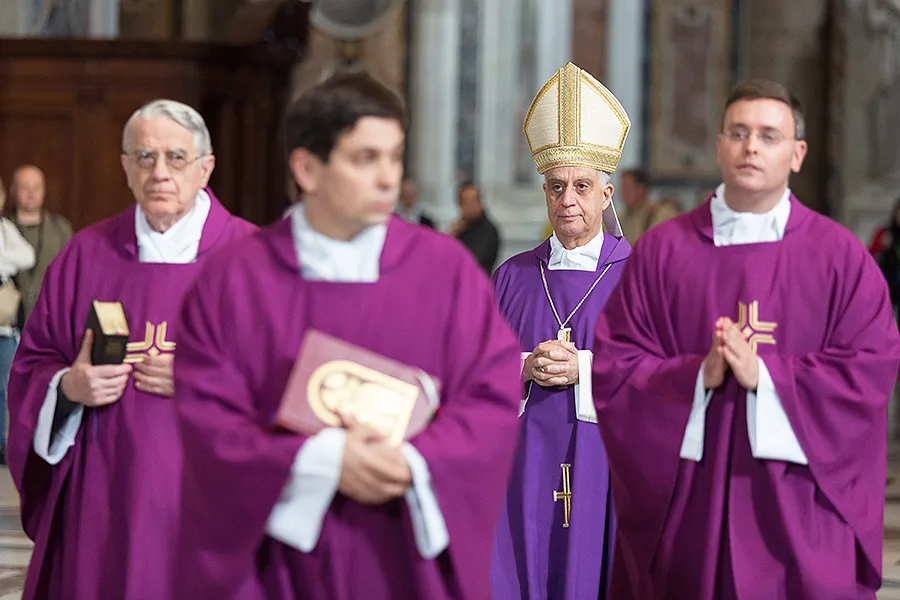
In his homily for the Mass, which was concelebrated by former Vatican spokesman Fr. Federico Lombardi and attended by journalists from various media outlets as well as Hungarian Ambassador to the Holy See Eduard Habsburg, Fisichella praised Mother as someone whose legacy would continue to last.

A year after her death, “we try to remember her words, her preaching – because it was (a type of) preaching – her witness and the work she did for the Church,” he said.

“The mystery of death raises questions in all of us, but it’s still a mystery,” he said. “We live and we are in front of a death to give sense to our lives.”

He pointed to the words of the Prophet Isaiah in the day’s first reading, who said that “no longer shall there be an old man who does not round out his full lifetime.”

“I think this word of the prophet can also be applied to Mother Angelica,” he said, explaining that “the sense of our lives, the sense of her life was determined by an encounter. She encountered Jesus Christ in her life, and for this reason she consecrated her whole life to Christ.”

Because of this Mother Angelica was above all “a woman of faith,” he said, and recalled an expression Mother herself frequently recited: “my dear friends, faith is what gets you started; hope is what keeps you going; love is what brings you to the end.”

Mother Angelica, he said, “was sustained by faith, she was a witness of hope, but love moved her entire life.”

Pointing to a passage from the day’s Gospel from John in which a nobleman, after learning that Jesus healed his son, “believed through the Word what Jesus had spoken to him, and he went his way.”

“I think that is beautiful to reflect on Mother Angelica’s life with this expression,” Fisichella said. “She believed through the Word that Jesus spoke to her, she believed and there is no other reason.”

“She believed and all that she created was a consequence of this faith, of this encounter of faith. And then she went her way, and her way is what today millions of people can watch, can listen to, can reflect on.”

EWTN, he said, is not just a television network, but “a work and consequence of this vocation, of this encounter of Mother Angelica with Christ.”

“This was her vocation, this she understood as the gift that Jesus himself gave to her. And she did it in a very strong way,” he said, noting how she was able to communicate the Gospel on TV “sine glossa,” meaning “without adding” or interpreting.

At times Mother even caused trouble with people, he said, explaining that “every time we announce the Gospel, we give trouble to someone.” But what Mother did was offer “a challenge.”

It was above all a challenge “to find the sense of your life, especially in a culture in which indifference and atheism is, it seems to be, in first place for many people,” he said.

Referencing another passage from Isaiah that says “‘they shall live in the houses they build, and eat the fruit of the vineyard they plant,” the archbishop said Mother Angelica continues to live through EWTN’s witness.

“Mother Angelica’s vocation continues to give witness to the world of today, with your ability, capacity, will, to announce the Gospel of the Lord,” he told employees of the organization attending the Mass.

Fisichella closed his homily with another quote from Mother, who said that “everything starts with one person. I don’t care if you are five or 105, God from all eternity, chose you to be where you are at this time in history, and he chose you to change the world.”

“We keep these words in our hearts and in our minds, like a new challenge one year after her death, to remember the task that everybody should have in this service to the Church,” he said. “It doesn’t matter if you are five or 105, what is important is that God, from all eternity, chose you.”

After the Mass veteran Vatican journalist Joan Lewis, Rome Bureau Chief for EWTN and former employee of the Holy See Press Office’s Vatican Information Service, recalled the moment when she was “commissioned” by Mother Angelica after accepting the job as bureau chief.

While Mother was already speechless after suffering a debilitating stroke, Lewis told CNA that she approached Mother, who was in a wheelchair, and knelt down so the two could look each other in the face.

“It was very moving for me because although she couldn’t talk, she blessed my ears, my mouth, my hands and my eyes, so that I would use all of those to do what she had done for so many years, which was to bring the Word of the Lord, the teachings of the Church to the world,” Lewis said.

“So it was her example, even when she couldn’t speak, that really infused in me the desire to go ahead and do her work,” she said, explaining that Mother Angelica was particularly inspiring for what she did as a woman.

“What a wonderful woman courage she was, of vision, of foresight, a person who just didn’t let obstacles get in her way,” Lewis said, noting that at the time, women in the United States often still hit “a glass ceiling.”

“If you were a woman, you couldn’t go any higher – you would hit this glass, but un-seen ceiling,” she said, but recalled that with Mother Angelica, “she never sensed that. There was never a barrier to whom or how she could tell the truth, and I try and remember that when I write.”

Referring to Archbishop Fisichella’s homily, Lewis said his decision to quote Mother’s phrase that “faith sets you out on the path, hope keeps you going, and love brings you to the end,” was particularly moving. “It just doesn’t get any better.”

[…]

No Picture
News Briefs

As abuse survivor leaves, Vatican group aims to listen better to victims

March 27, 2017 CNA Daily News 1

Vatican City, Mar 27, 2017 / 10:26 am (CNA/EWTN News).- After a victim who suffered past clerical abuse resigned from the Vatican’s anti-abuse commission, the group is aiming for more effective ways to communicate with survivors and include them in its work.

According to a March 26 press release from the commission, members “unanimously agreed to find new ways to ensure its work is shaped and informed with and by victims/survivors.”

The Pontifical Commission for the Protection of Minors (PCPM) met March 24-26 at the Vatican for their eighth Plenary Assembly since being formed by Pope Francis in Dec. 2013.

The session came less than one month after clerical abuse survivor Marie Collins resigned from her position on the commission, citing pushback from certain Vatican dicasteries, specifically from the Congregation for the Doctrine of the Faith, as one of the main reasons for stepping down.

In a March 1 communique announcing her decision, the commission praised Collins as someone who has “consistently and tirelessly championed for the voices of the victims/survivors to be heard, and for the healing of the victims/survivors to be a priority for the Church.”

In their latest meetings, commission members again voiced “strong support” for Collins and for “her continuing work to promote healing for victims of abuse and the prevention of all abuse of minors and vulnerable adults,” the press release stated.

Members also expressed gratitude that Collins has agreed to continue working with the commission in their educational programs for new bishops and with other offices of the Roman Curia.

With relation on how to best include survivors as they go forward, the commission’s statement said that they are carefully considering several ideas that have been successfully implemented in other places for recommendation to Pope Francis.

In addition, the commission discussed the response to communications from survivors/victims directly to their office and other offices of the Holy See, agreeing that “acknowledging correspondence and giving a timely and personal response is one part of furthering transparency and healing.”

They talked over the importance of responding “directly and compassionately,” while acknowledging that this is a major undertaking due to the volume of this type of correspondence the Holy See receives.

Each letter also requires a large amount of attention in order to give the specific resources and assistance necessary.

However, the commission agreed to send further recommendations on this matter to Pope Francis for consideration.

The latest plenary session of the PCPM immediately followed an educational seminar held March 23 at the Pontifical Gregorian University in Rome. The event was co-hosted by the PCPM and the Gregorian University’s Center for Child Protection.

The day-long educational seminar focused on what the local church and institutions are doing to combat abuse of minors specifically in schools and the home, and was attended by at least half a dozen heads of Vatican departments, with every Vatican department represented in some way.

[…]

No Picture
News Briefs

In Milan, Pope makes youth promise to never be a bully

March 25, 2017 CNA Daily News 0

Milan, Italy, Mar 25, 2017 / 01:27 pm (CNA/EWTN News).- In last meeting during his day trip to Milan, Pope Francis issued a harsh criticism of bullying in schools, asking youth to promise him and Jesus to never bully others, and telling teachers to be aware of the problem.

“There is an ugly phenomenon in education today: bullying. Please, be aware,” the Pope said during a March 25 encounter with youth in Milan.

He responded to a question posed by a catechist asking how to foster an open dialogue between educators, students and their parents. Among other points, he told teachers to watch out for bullying before addressing the youth about it themselves.

“I ask you, in silence: in your schools, in your neighborhoods, is there someone that you mock? That you make fun of because they look a little funny, because they are a little fat? That you like to embarrass and hit because of this?” the Pope asked.

“Think about this. This is called bullying,” he said, and asked the youth – many of whom will receive the sacrament of Confirmation this year – to use their Confirmation to “make the promise to the Lord to never do this” and to pray that it doesn’t happen in their schools, neighborhoods or parishes.

“Understood? Promise me: never, never make fun of, never mock a friend, a neighbor, etc. Do you promise this?” he said. Not satisfied with the strength of their answer, he again asked the youth the same question, which was then met with a roaring “yes”.

“Think in silence if you do this and if you are able to promise this to Jesus. Promise Jesus to never bully.”

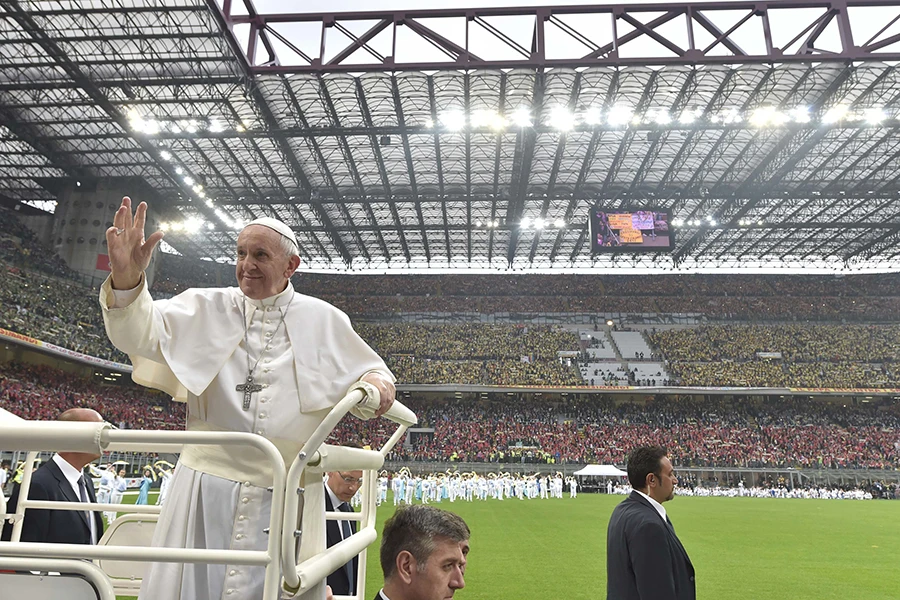
Pope Francis spoke to a stadium filled with youth at the end of his March 25 daytrip to Milan.

The pope started his trip visiting the city’s impoverished “White Houses” complex greeting several of the families who live there, including a Muslim family.

He then headed directly to Milan’s cathedral where he met with the priests and religious before praying the Angelus and eating lunch with inmates at the city’s Casa Circondariale di San Vittore prison.

After lunch, he celebrated Mass at Milan’s Parco di Monza for the Feast of the Annunciation, traveling by car after to the Meazza-San Siro Stadium where he met with some 78,000 people, including catechists, volunteers and many of the 45,000 youth who have either received the Sacrament of Confirmation in 2017 or will receive it, along with their parents and family members.

After scripture readings and a series of performances by the youth, Francis responded to three of their questions, one of which was posed by a boy named Davide, one by a couple with three children and one by the catechist.

In his response to Davide’s question about what helped him to grow in friendship with Jesus when he himself was young, the Pope said it came down to three main things: his grandparents, playing with his friends and participating in groups at this parish.

Francis recalled how one grandfather had told him to “never go to bed without saying something to Jesus; tell him goodnight.” This reinforcement combined with the prayers he learned from his grandmothers and his mother helped reinforce the faith, he said.

“Grandparents have the wisdom of life, and with that wisdom they teach us to grow closer to Jesus,” he said, urging the youth to talk to their grandparents, “ask them whatever questions you want. Listen to what they say.”

Playing with friends also helps, he said, because in knowing how to play well with others, “without insulting each other,” you learn “to respect others, you learn to make a team, to work together, and this unites us to Jesus. So play with your friends!”

Parish life is also crucial, he said, and jestingly encouraged the youth to have the same excitement about Mass as they do about their groups and activities.

When answering the couple’s question on how they can transmit the beauty of the faith to their children without sounding boring, annoying or authoritarian, Pope Francis advised them to think of who helped them to grow in the faith.

He asked the stadium to take a moment and ponder the answer in silence, explaining that an important figure for him was the priest who baptized him and who was then present throughout his life until he entered the novitiate with the Jesuits.

“I never, never forget that priest. He was an apostle of the confessional; merciful, good, a hard worker. And so he helped me to grow,” the Pope said, explaining that he asked for this reflection because “our children watch us constantly; even when we are not aware.”

On this point, as he often has in the past, Francis warned against the damage it can do to children when they see their parents fight.

“You don’t understand the suffering a child experiences when they see their parents fight, they suffer. And when their parents separate, they pay the price,” he said, explaining that when parents bring a child into the world, “you must be aware of this.”

“We take responsibility to help this child grow in the faith,” he said, and suggested that the couple reach Chapters 1 and 4 of his post-synodal apostolic exhortation Amoris Laetitia, a fruit of the 2014 and 2015 Synod of Bishops on the Family.

Dedicated to love in marriage and in the family, the Pope told them the chapters, particularly the first, would be helpful, and told them to never forget that “when you fight, children suffer and they don’t grow in the faith.”

He also stressed the importance of playing with their children and practicing the works of mercy together, which help nourish faith and family life.

Sunday’s are an especially good day to spend together as a family, he said, but noted that for some this is hard to do, since many have to work on weekends in order to provide for their families.

“Parents at this time can’t or have lost the virtue of playing with their children,” he said, explaining that whenever when he hears a parent complaining about their children’s behavior, he often asks if they take time to just sit and play with their children.

Many parents “don’t know how to respond,” he said, recalling how he once spoke with a father who only saw his children on the weekends, since he left for work while they were still asleep and came back after they were already in bed.

“It’s this life that takes your humanity,” he said, and told parents to “play with your children, and transmit the faith.”

[…]

No Picture
News Briefs

Don’t fret about numbers, but your mission, Pope tells Milan religious

March 25, 2017 CNA Daily News 0

Milan, Italy, Mar 25, 2017 / 06:31 am (CNA/EWTN News).- During his daytrip to Milan Saturday, Pope Francis told the diocese’s priests and religious not to fear the challenges that come with their ministry nor the increasing number of empty convents, urging them instead to focus on the core of their mission: bringing Christ to his people.

“Our congregations were not born to be the mass, but a bit of salt and yeast which would have given their own contribution so that the mass grows; so that the People of God have that ‘condiment’ they were missing,” the Pope said March 25.

He noted that for many years in the past, congregations moved forward with the idea that they needed to “occupy spaces” more than launching new processes and projects.

The perception then, he said, was that “ideas (or our impossibility to change) were more important than reality; or that the part (our small part or vision of the world) was superior to the whole Church.”

But today’s reality serves as a challenge, and “invites us to again be a bit of yeast and a bit of salt,” he said, asking “Can you imagine a meal with too much salt? Or a pasta that’s totally fermented? No one would eat it, no one could digest it.”

“I’ve never seen a pizzamaker use a kilo of yeast and a gram of flour” to make the dough, Francis said, and urged religious to “listen to reality, to open ourselves to the ‘mass,’ to the Holy People of God, to the entire Church.”

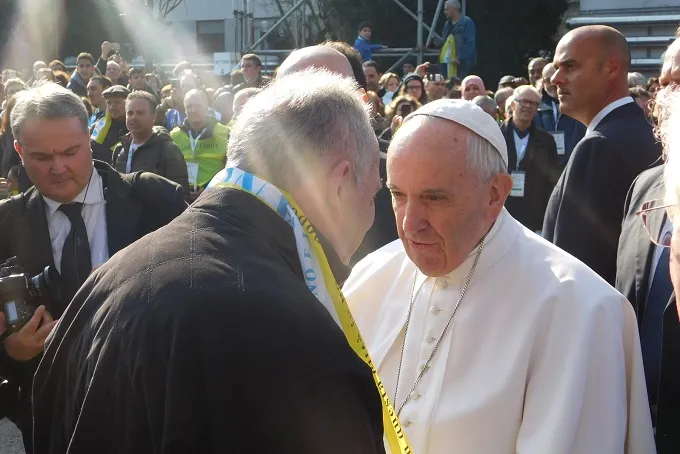
Pope Francis spoke to priests and religious inside Milan’s cathedral of St. Mary of the Nativity during his March 25 daytrip to the city.

He kicked off the visit by stopping by the “White Houses” high-rise complex in the eastern quarter of the city, an area marked by acute poverty where many migrants, including Muslim families, live. He then headed directly to Milan’s cathedral where he met with the priests and religious.

<blockquote class=”twitter-video” data-lang=”en”><p lang=”en” dir=”ltr”>Up-close view of a papal blessing to some small pilgrims in <a href=”https://twitter.com/hashtag/Milan?src=hash”>#Milan</a> via <a href=”https://twitter.com/andygag”>@andygag</a> <a href=”https://twitter.com/hashtag/PopeFrancis?src=hash”>#PopeFrancis</a> <a href=”https://t.co/lEiFe59PCE”>pic.twitter.com/lEiFe59PCE</a></p>&mdash; Catholic News Agency (@cnalive) <a href=”https://twitter.com/cnalive/status/845563394254082048″>March 25, 2017</a></blockquote>
<script async src=”//platform.twitter.com/widgets.js” charset=”utf-8″></script>

The Pope took questions from three members of the audience, including Ursuline sister Mother M. Paola Paganoni, parish priest Fr. Gabriele Gioia and Robert Crespi, one of the diocese’s 143 permanent deacons.

Instead of taking notes and giving an entirely off-the-cuff speech as usual during his Q&A sessions, this time Francis decided to follow a written text due to the day’s full schedule, deviating to add a few lines here and there.

The question on numbers was posed by Sr. Paganoni, who asked the Pope how to be a prophetic sign in modern society, and to which peripheries they should go, given that religious are small in number and constitute a “minority” in the Church.  

In response, the Pope not only told the nun to not fret about numbers, but he also cautioned against the feeling of “resignation,” which he said can frequently creep up when looking at how few they are.

“Without realizing it, each time that we think or see that we are few, or in many cases elderly, we experience the weight, the fragility more than the splendor, and our spirit begins to corrode from resignation,” he said.

In turn, resignation can lead to the spiritual sin – also called a “disease” – of acedia, about which the Fathers of the Church issued sharp warnings since it essentially leads a person into despair, indifference and apathy regarding the faith and one’s vocation.

“Few yes, a minority yes, elderly yes, but resigned no!” he said, explaining that the lines in this regard are fine, are can only be recognized by a process of self-reflection in front of the Lord.

“When resignation takes hold of us,” he said, “we live with the imagination of a glorious past which, far from awakening the original charism, increasingly surrounds us in a spiral of existential heaviness. Everything becomes heavier and difficult to lift up.”

He warned religious to stay away from this attitude, as well as the temptation to use the empty structures to get money by turning them into hotels or looking for other “human solutions” to the problem. Doing this, he said, “hinders or deprives us of joy.”

And while he said he can’t tell them which peripheries to go to, since that’s the job of the Holy Spirit, who inspired their original charism, Pope Francis urged religious to choose them well and reawaken “the hope spent and sapped by a society that has become insensitive to the pain of others.”

“Go and bring the ‘anointing’ of Christ,” he said, telling them never to forget “that when you put Jesus in the midst of your people, they find joy…only this will render our lives fruitful and will keep our hearts alive.”

In response to Crespi’s question on what contribution deacons can give to the Church, the Pope said they have “a lot to give,” specifically when it comes to managing the tensions and blessings of ministry and family life.

However, Francis also cautioned against viewing deacons as “half-priests and half-laity,” because in reality “they are neither here nor there.”

Looking at them in this way “does harm to us and does harm to them” and takes strength away from their vocation in the Church, he said, explaining that the deaconate “is a specific vocation, a family vocation that recalls service as one of the characteristic gifts of the people of God.”

“The deacon is – so to speak – the guardian of service in the Church,” Pope Francis said. Because of this, his specific mission consists of “reminding all of us that faith, in its various expressions – communitarian liturgy, personal prayer, different forms of charity – and in its various states of life – lay, clerical, familial – has an essential dimension of service.”

Speaking directly to the deacons, he said they are “a sacrament of service to God and to your brothers. A vocation which like all vocations is not only individual, but lived inside the family and with the family, inside the People of God and with the People of God.”

Francis also answered Fr. Gioia’s question on what can be done in order not lose the joy of evangelizing in the face of challenges such as secularism and ministering to a multi-cultural, multi-ethnic flock with different religions.

In his response, the Pope said we shouldn’t be afraid of challenges, because they are “a sign of a living faith, of a living community that seeks its Lord and has eyes and hearts opened.”

Rather, what we must fear instead is “a faith without challenges, a faith believed to be complete, as if everything has been said and realized,” because without challenges, there is a danger that our faith becomes “an ideology.”

The Pope also spoke of the importance of recognizing the richness of the differences in the Church throughout its history, explaining that “the Church is one in a multifarious experience.”
 
Although there can also be “horrors” and errors in the ways some interpret religion, he stressed the need to separate and distinguish between the “luminous aspects and the dark aspects” of each.

He also cautioned against confusing unity with uniformity and plurality with pluralism, saying that in both cases “what is being sought is to reduce the tension and remove the conflict or ambivalence to which we are subjected as human being.”

Finally, the Pope in his last point to the priest emphasized the need for pastors to offer better formation in discernment, particularly to youth.

“The culture of abundance to which we are subjected offers a horizon of many possibilities, presenting them as valid and good,” he said, noting that today’s youth are exposed to a constant “zapping” of information.

“Whether we like it or not, it’s a world in which they are inserted and it’s our duty as pastors to help them pass through this world,” he said, explaining that because of this, “it’s good to teach them to discern, so that they have the tools and elements which help them to walk the path of life without extinguishing the Holy Spirit which is in them.”

After his audience with priests and religious, Pope Francis led pilgrims gathered outside the cathedral in praying the Angelus before heading to the city’s Casa Circondariale di San Vittore prison, which in 2012 held 1,700 detainees.

At the prison, the Pope is slated to greet employees and police officers who work at the facility before greeting the inmates themselves. He is then expected to have lunch with 100 of prisoners before heading to Milan’s Parco di Monza to celebrate Mass and meet with youth after.

[…]