No Picture
News Briefs

Analysis: What guides Vatican diplomacy?

January 10, 2018 CNA Daily News 0

Vatican City, Jan 10, 2018 / 02:00 pm (CNA).- At a traditional new year’s meeting between Pope Francis and diplomats to the Vatican, the pope painted a picture of pontifical diplomacy around the globe: An international mission working to secure the common good, an always increasing network of relations, and the certainty of an impartial voice working for peace.

The Pope’s speech sets the basis and the guidelines for the Holy See’s diplomatic activities during the year. If the guidelines are based on concrete issues, then pontifical diplomacy has three main threads —three themes that include all the others.

The first is a commitment to peace; the second is a commitment to human dignity; and the third is a commitment to fight poverty.

In the mind of the Pope, all three seem linked to one another.

The Vatican’s commitment to peace is practiced via the art of mediation, and the Holy See has been a critical participant in the mediation of global conflict for decades. The Vatican’s commitment to human dignity is based on the principle that all people are equal and dignified in the sight of God. And the Church’s commitment to fight poverty is expressed in its diplomatic work for peace, international development, and support for marginalized. On that front, Pope Francis has asked who, in the end, is poorer than an unborn child, or than the forgotten or marginalized elderly.

These three commitments will shape the Holy See’s diplomatic activity for the upcoming year. Within that framework, there are two clear priorities for the diplomatic work of the Holy See in the upcoming year.

The first is advocating for migrants and refugees. The United Nations are finalizing a Global Compact on Migration, that follows the New York Declaration for Refugees and Migrants issued in September 2016. The Holy See participated in all of the meetings, and presented 20 points of actions on the issue gathered under the four keyworks “welcome, protect, promote and integrate.”

The Pope has made migration a core issue of his pontificate: he established a special section for Migrants and Refugee within the ranks of the Vatican dicastery for the Promotion of the Integral Human Development, and the Pope is personally chairing it. The theme for the World Day of Peace 2018 was “Migrants and Refugees: Seekers of Peace,” underscoring the importance the issue has for the Holy See.

The second diplomatic focus is on peacekeeping. The Holy See is aims to helping and assisting countries in achieving peace.

Archbishop Silvano Maria Tomasi, a former papal nuncio now counsellor at the Vatican Dicastery for the Integral Human Development, stressed to CNA that for at least the past 50 years, “peacekeeping and the search for peace have dominated the Holy See’s public interventions.”

The Holy See is working to create a path to peace, Tomasi said, by working on “the formation of a new mentality, thanks to the World Day of Peace; the Holy See’s involvement in discussions on disarmament; and the Holy See’s encouragement to develop effective international institutions.”

How does the Holy See carry on its commitment?

First of all, with its work into the multilateral institutions, namely the United Nations and other global institutions.

The Holy See Mission at the United Nations in New York provided data on the Holy See’s work at the UN during the last year.

The Holy See at the UN in New York delivered 82 interventions, and 10 of them were delivered by Archbishop Paul Richard Gallagher, Vatican “foreign ministry,” who led the Holy See’s delegation at the 72nd session of the UN General Assembly in September.

Archbishop Gallagher also signed the Treaty on the Prohibition of Nuclear Weapons for the Holy See and in the name of and behalf of the Holy See.  The Holy See’s  mission noted that “the Holy See was an active participant in negotiations, and was one of the 122 States that voted in favor of the treaty, adopted on July 7, 2017.  The signing took place during the High Level Ceremony for the opening of the signing of the Treaty, in which the Holy See joined more than 40 states in signing the treaty, and was joined by only Thailand in simultaneously ratifying the treaty.”

The Holy See Mission at the UN Office in Geneva, led by Archbishop Ivan Jurkovic, delivered 48 interventions, participating in many panels on the Global Compact on Migrations. The Holy See Mission in Geneva also represents the Holy See at the International Organization for Migration: the Holy See has been a member state of the IOM since 2012.

Those are only examples of the Holy See’s considerable involvement in multilateral international organizations. It is noteworthy to remember that there is also a Holy See Diplomatic Mission in Vienna, accredited to the Organization for Security and Cooperation in Europe, and to other special organizations like the International Atomic Energy Agency, to which the Holy See is a member state and founder.

No less important is the Holy See’s Mission at the Food and Agriculture Organization in Rome. Pope Francis has personally demonstrated that fighting world hunger is a priority to the Holy See. The Pope has visited the FAO headquarters two times, Nov. 20, 2014 and Oct. 16, 2017, and went to the World Food Program Headquarters June 13, 2016. In addition to that, the Pope symbolically donated $25,000 dollars to the FAO to support the Eastern African populations facing food insecurity and famine.

The Holy See’s diplomatic network of bilateral relations also continues to grow.In 1900, only about 20 countries had diplomatic relations with the Holy See. In 1978 the number was 84; in 2005 it was 174. During Benedict XVI’s pontificate, six new countries were added to the list, and, under the leadership of Pope Francis that number has climbed to 183, with Myanmar, also called Burma, joining the list of states with full diplomatic ties with the Holy See.

There are only 13 States who have no diplomatic ties with the Holy See.

Out of them, 8 have no Vatican envoy: Afghanistan, Saudi Arabia, Bhutan, the People’s Republic of China, North Korea, Maldives and Tuvalu. The Holy See has apostolic delegates, not fully recognized as ambassadors, in four countries: Comoros, Somalia, Brunei and Laos. The Holy See has started negotiations with Vietnam to reach full diplomatic ties, and in 2011 the Holy See appointed the first non-residential Vatican envoy to Hanoi.

The diplomatic efforts of the Holy See are considerable, and, as Pope Francis emphasized, committed to important and deeply Catholic international goals.


[…]

No Picture
News Briefs

Pope taps Colombian bishop to oversee Sodalitium amid ongoing crisis

January 10, 2018 CNA Daily News 0

Vatican City, Jan 10, 2018 / 09:00 am (CNA).- The Vatican announced Wednesday that Colombian Bishop Noel Antonio Londoño Buitrago C.Ss.R. has been appointed papal commissioner for the Sodalitium Christianae Vitae, a Catholic society of apostolic life.  

Londoño will oversee the community as they continue a process of reform, following revelations that their founder, Luis Fernando Figari, committed serial acts of abuse while leading the community. Several former leaders of the community have faced related allegations.
 
Londoño’s appointment was announced in a Jan. 10 communique from the Vatican, which stated that Londoño, the Bishop of Jericó, would carry out his role alongside Cardinal Joseph Tobin of Newark, who has served as papal delegate overseeing the SCV’s reform process since May 2016.

Tobin will continue to be the group’s liaison with the Vatican’s Congregation for Institutes of Consecrated Life and Societies of Apostolic Life, and will focus primarily on reforming economic matters. In his role as Commissioner, Londoño will serve oversee the leadership of order as they continue to reform their governing policies and formation procedures.

The Sodalitium Christianae Vitae was established by Figari in 1971 in Peru, and was granted pontifical recognition in 1997. Alejandro Bermúdez, executive director of CNA, is a member of the community.

In addition to founding the SCV, a community of men, Figari also founded the Marian Community of Reconciliation and the Servants of the Plan of God, a community of women and an order of women religious. In 2002, he was named a consultor to the Pontifical Council for the Laity, and served in subsequent consultative roles at the Vatican.  

Figari stepped down as superior general of the Sodalitium Christianae Vitae in 2010, after allegations of abuse surfaced in Peru. The current superior general is Alessandro Moroni Llabres.

The community was investigated after the publication of a book in 2015 by journalists Paola Ugaz and Pedro Salinas, chronicling years of alleged sexual, physical and psychological abuse by members of the SCV. In addition to Peru, the community operates in Argentina, Brazil, Colombia, Costa Rica, Chile, Ecuador, the United States, and Italy.

Figari and other former leaders of the community remain the subject of criminal investigations in Peru.

In May 2016 the Pope named Archbishop Tobin as the pontifical delegate charged with overseeing the community’s handling of the investigation and their process of reform.

In February of 2017, a team of independent investigators commissioned by the Sodalitium reported that “Figari sexually assaulted at least one child, manipulated, sexually abused, or harmed several other young people; and physically or psychologically abused dozens of others.”

As a result, the Vatican’s Congregation for Institutes of Consecrated Life issued a decree the same month forbidding Figari from any contact with the religious community, and banning him from returning to Peru without permission from the current superior of the Sodalitium. Figari was also forbidden to make any public statements.

The Vatican made a similar move in the case of the Legionaries of Christ after it was discovered that their founder, Fr. Marcial Maciel, had been living a double life.

In 2006, with the approval of the Pope, the Congregation of the Doctrine of the Faith imposed upon Maciel “a retired life of prayer and penance, renouncing any form of public ministry.” Due to his advanced age, Maciel was not the subject of a formal canonical trial.
 
From that point on, Benedict XVI carried out a process of reform for the Legionaries, and in 2010 named then-Archbishop Velasio de Paolis as papal delegate to serve in a role similar to what Londoño will have for the SVC.

After his appointment, De Paolis formed a commission charged with drafting new constitutions for the Legionaries. He completed his mandate in 2014 when the new constitutions were approved by Pope Francis. The cardinal died in September 2017.

No specific time frame was given for Londoño’s mandate as Commissioner and it is not yet known what steps he will take, however, he is likely to follow the model set by De Paolis, and step aside when the community has a clear path forward.


[…]

No Picture
News Briefs

Pope Francis gives 2,000 poor, prisoners a day at the circus

January 10, 2018 CNA Daily News 1

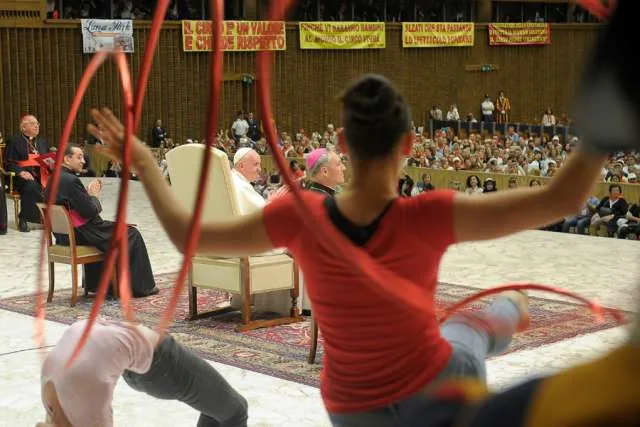
Vatican City, Jan 10, 2018 / 03:37 am (CNA/EWTN News).- Tomorrow afternoon some 2,100 of Rome’s poor, homeless, refugees, prisoners and volunteers will head to the circus courtesy of Pope Francis in yet another act of charity for those who are less fortunate.

Tickets to the performance were provided through the Papal Almoner’s office, which manages the Pope’s charities.

The show, announced by the Almoner’s office Jan. 10, will take place the afternoon of Thursday Jan. 11, at Rome’s Circo Medrano under a large tent put up specifically for the event, which has been dubbed the “Circus of Solidarity” by the organizers.

A makeshift medical station will also be set up with volunteer doctors and nurses available for attendees who want an exam or a check-up. Each participant will also be provided with a sack lunch at the end of the show.

Pope Francis made a similar gesture in January 2016, when he sent 2,000 poor, homeless and migrants to the Rony Roller Circus for a special show that opened with a song written and performed by a Spanish singer who had once been homeless himself.

The Pope frequently speaks of the importance of the performing arts, and has held several audiences for circus performers. During the Jubilee of Mercy, he welcomed some 6,000 of these performers to the Vatican for a special Jubilee weekend in their honor.

In a past general audience, Francis said those who are involved in circus life “create beauty, they are creators of beauty, and this does good for the soul. How much we need beauty!”

Since Pope Francis was elected, his almoner, Polish Archbishop Konrad Krajewski, has kept busy with several similar initiatives aimed at both helping and evangelizing Rome’s poor and needy through culture.

Showers and a barbershop were installed in the bathrooms of St. Peter’s Square in 2015 to help the homeless in the Vatican area to stay clean. They have also been invited to participate in several other initiatives, including concerts, a visit to the Vatican Museums, special lunches during papal events and beach days with a pizza lunch during the summer.

[…]

No Picture
News Briefs

Pope says he will bring message of peace and hope to Chile, Peru

January 9, 2018 CNA Daily News 1

Vatican City, Jan 9, 2018 / 11:25 am (CNA/EWTN News).- Ahead of his visit to Chile and Peru, Pope Francis has said he wants to bring a message of peace and hope to both countries, which he said have been successful in fighting a “culture of waste” through their care for the poor and needy.

<iframe src=”https://www.facebook.com/plugins/video.php?href=https%3A%2F%2Fwww.facebook.com%2Fvaticannews%2Fvideos%2F1802268879784708%2F&show_text=0&width=560″ width=”560″ height=”315″ style=”border:none;overflow:hidden” scrolling=”no” frameborder=”0″ allowTransparency=”true” allowFullScreen=”true”></iframe>

In a Jan. 9 videomessage to both Chile and Peru, Francis told people from each country that “I want to meet with you, to look you in the eyes, to see your faces and be able to experience the closeness of God, his closeness and mercy, which embraces and consoles us.”

Both countries were forged with “determination and commitment,” he said, adding that he thanks God for “the faith and the love for God and for the most needy brothers, especially for the love that you have for those who are discarded by society.”

“The culture of waste increasingly invades us,” he said, explaining that while there, he wants to participate “in your joys and sorrows, your difficulties and your hopes, and tell you that you are not alone, that the Pope is with you, that the entire Church welcomes you, that the Church is looking at you.”

Pope Francis sent his message just days ahead of his departure for Chile and Peru, where he will be Jan. 15-22.

In Chile Pope Francis will visit the capital of Santiago, as well as the cities of Temuco and Iquique. In Peru, he will visit the capital city of Lima, as well as Puerto Maldonado and Trujillo.

The theme of his time in Chile is “I Give You My Peace,” while that of Peru is “United by Hope.”

In his message Francis touched on both themes, saying he wants the countries to experience “the peace that comes from God, and which is so needed; only he can give it to us.”

The Pope said peace is a gift meant for everyone, and is “the foundation of our coexistence and of society.” This peace, he said, “is sustained in justice and allows us to encounter moments of harmony and communion.”

We must constantly ask for this peace, which comes from the Risen Lord, “drives us to be missionaries, reviving the gift of faith which leads us to encounter, to the communion shared by the same faith celebrated and committed.”

This encounter with the Risen Christ also confirms us in hope, Francis said, explaining that “we do not want to be anchored in the things of this world, our gaze goes far off.” Rather, our eyes should be fixed “on his mercy, which heals our miseries.”

“Only he can give us the thrust to get up and follow,” he said, adding that “we are brothers who go out to meet others in order to confirm each other in the same faith and hope.”

The Pope closed the video entrusting his visit to Mary’s intercession and, as usual, asked for prayer, adding that he will be praying for the people of Chile and Peru.

Pope Francis is scheduled to land in Santiago just after 8 p.m. Jan. 15, and has no official events apart from the welcoming ceremony, after which he will head directly the apostolic nunciature.

The next day he’ll meet with the country’s authorities and diplomatic corps, and will have a private audience with Chilean president Michelle Bachelet before saying Mass. He’ll then make a brief visit to a women’s prison before meeting with Chile’s priests, seminarians, religious, and bishops in the afternoon.

His last activity for the day will be a private visit to a shrine dedicated to St. Alberto Hurtado S.J., where he will meet with the country’s Jesuit priests.

On Jan. 17 the Pope will head to Temuco, where he will say Mass and have lunch with around 10 people at the mother house for the Sisters of the Holy Cross order. He’ll then head back to Santiago for a meeting with youth and a visit to the Pontifical Catholic University of Chile.

The next day, his final one in Chile, Francis will go to Iquique in the morning, where he will celebrate Mass and have lunch at the retreat house for the shrine of Our Lady of Lourdes. He’ll then head directly to the Iquique airport, where he’ll depart for Lima, Peru.

Francis will land in Lima the evening of Jan. 18, but has no official events scheduled. His first formal appointment will take place Jan. 19, when he travels to Puerto Maldonado to meet with people from the Amazon region.

After this audience, the Pope will meet with the civil population and make a brief visit to the “Little Prince Home,” which houses some 40 at-risk children and youth. He’ll then lunch with representatives of Amazon before returning to Lima, where he’s scheduled to meet with Peru’s authorities and diplomatic corps.

Though he typically meets with the country’s authorities and diplomats as his first official engagement during international trips, Pope Francis has on occasion made exceptions.

His decision to meet with people from the Amazon first, then, is a sign of how important the region is to him, both for environmental reasons related to his 2015 encyclical Laudato si’, as well as the fact that in 2019 he will be holding a Pan-Amazonian synod to address problems related to the area.

After his meeting with authorities, Pope Francis will hold a private meeting with Peruvian president Pedro Pablo Kuczynski, who recently survived an impeachment vote over corruption charges, and will meet with the country’s Jesuits.

On Jan. 20, the Pope will head to Trujillo, where he will celebrate Mass and ride through the city’s “Buenos Aires” neighborhood, one of the poorest areas in town. Francis will then visit the city’s cathedral and afterward will meet with the country’s priests, religious, and seminarians.

He will then head back to Lima, where he will start his final day in Peru, Jan. 21, praying the Liturgy of the Hours with a contemplative order before venerating the relics of several Peruvian saints in the city’s cathedral.

The Pope will then meet with the country’s bishops, pray the Angelus, and say Mass before heading back to Rome, where he is expected to arrive around 2:15 p.m. Jan. 22.

Francis, the Church’s first Latin American Pope, has visited several countries in South and Central America, including Brazil in 2013, Bolivia, Ecuador, and Paraguay in 2015, Cuba and Mexico in 2016, and Colombia in 2017.

The last Pope to visit Chile and Peru was St. John Paul II, who made pastoral trips to Peru in 1985 and 1988, and to Chile in 1987.

[…]

No Picture
News Briefs

Vatican releases Pope’s liturgical schedule for January, February

January 9, 2018 CNA Daily News 1

Vatican City, Jan 9, 2018 / 06:34 am (CNA/EWTN News).- Earlier this week the Vatican published Pope Francis’ liturgical schedule for the months of January and February, which include his lineup of celebrations for the start of Lent, which this year begins Feb. 14.

With his trip to Chile and Peru taking place Jan. 15-22, the Pope’s usual schedule of morning Masses at Santa Marta and his Wednesday general audience Jan. 17 will be suspended.

Following his return to Rome, Francis will celebrate Second Vespers at the Basilica of St. Paul Outside the Walls Thursday, Jan. 25. The prayer service will mark the Feast of the Conversion of St. Paul, as well as the 51st annual Week of Prayer for Christian Unity.

The following Sunday, Jan. 28, Pope Francis will celebrate a special Mass at the Basilica of St. Mary Major for the Feast of the transfer of the icon of Salus Populi Romani.

Salus Populi Romani (Protectress of the Roman People) is the title of an ancient Byzantine icon of Mary and the Child Jesus, traditionally held to be painted by St. Luke the Evangelist and to have arrived in Rome in the 6th century.

It was first canonically crowned in 1838 by Pope Gregory XVI and a second time in 1954 by Pope Pius XII. It has a long history of devotion by the Roman people, as well as by popes. It resides in the Pauline, also called Borghese, Chapel in St. Mary Major.

Francis has a special devotion to the image. His first visit as pontiff was to the Basilica of St. Mary Major to pray before the image following his election.

On Feb. 2, Pope Francis will celebrate Mass at St. Peter’s Basilica for the Feast of the Presentation of the Lord.

As it will also be the 22nd World Day of Consecrated Life, the Mass will be celebrated with the members of the Congregation for Institutes of Consecrated Life and Societies of Apostolic Life, the Vatican department which oversees religious orders and congregations and secular institutes.

As is tradition, on Ash Wednesday, which falls this year on Feb. 14, Pope Francis will pray the Stations of the Cross at St. Anselm Church on Rome’s Aventine Hill, before processing the short way to the Basilica of Santa Sabina for the celebration of Mass, benediction, and the imposition of ashes.

The following Sunday, Feb. 18, he will begin his annual Lenten retreat with members of the Roman Curia. The week of spiritual exercises will take place at the Casa Divin Maestro in Ariccia, a town just 16 miles outside of Rome.

Located on Lake Albano, the retreat house is just a short way from the papal summer residence in Castel Gandolfo. It will be the fifth consecutive year the Pope and members of the Curia have held their Lenten retreat at the house in Ariccia.

While the practice of the Roman Pontiff going on retreat with the heads of Vatican dicasteries each Lent began some 80 years ago under the pontificate of Pius XI, it was customary for them to follow the spiritual exercises on Vatican ground. Beginning in Lent 2014, Pope Francis chose to hold the retreat outside of Rome.

The retreat will conclude Friday, Feb. 23.

[…]

No Picture
News Briefs

Vatican communications see new growth after rebranding

January 9, 2018 CNA Daily News 0

Vatican City, Jan 9, 2018 / 04:51 am (CNA/EWTN News).- After the recent re-branding and consolidation of the Vatican’s various media outlets, their different platforms have now reached a total of more than 4 million followers, who receive their daily papal news with a fresh logo.

According to a Jan. 9 communique from the Secretariat for Communications, Vatican media now has an online community of more than 4 million followers between the Facebook, Twitter, YouTube and Instagram platforms.

The numbers, the secretariat said, are the result of the continuing reform of Vatican communications launched in 2014 by Pope Francis and his nine cardinal advisors who make up the Council of Cardinals, which meets every few months to discuss the ongoing reform of the Roman Curia.

In order map out what a possible reform of Vatican communications would look like, the Pope in 2014 established an international commission headed by British Lord Chris Patten to study the current process and provide suggestions.

Francis then established the Secretariat for Communications in June 2015, naming Italian Msgr. Dario Vigano as its first head, giving him a mandate to reform Vatican communications with a focus on consolidation and increasing their presence in the digital world.

The secretariat oversees all of the Vatican’s communications offices, including Vatican Radio, L’Osservatore Romano, the Vatican Television Center, the Holy See Press Office, the Pontifical Council for Social Communications, Vatican Internet Service, the Vatican Typography office, the Vatican’s Photography Service, and the Vatican publishing house.

During the Council of Cardinals’ most recent meeting in December, Vigano unveiled the new logo and design for the Vatican News website, which consolidated the Vatican’s former news and radio pages into a new multimedia hub, which features audio, text, video and graphics, available in multiple languages.

With the consolidation of their social media pages, the Vatican has seen a sharp increase in followers in recent months. On Facebook specifically, their page “Vatican News” – recognizable by the new insignia, which is a white Vatican logo with a red background – has more than 3 million followers.

The page is available in six languages, including English, Italian, French, German, Spanish and Portuguese.

On Twitter, the six different language editions for Vatican media have all been unified under the same Twitter handle “@vaticannews”, and a new account, “@radiovaticanaitalia”, has been created to promote and provide information on the activities of Vatican Radio and the multilingual Vatican News channel on Instagram.

The Vatican’s YouTube channel, which offers viewers live coverage of the Pope’s activities, has also been rebranded with the same new logo and given the “Vatican News” title.

Social media for Vatican News is managed by the Secretariat for Communications’ Editorial and Theological-Pastoral departments. The secretariat also manages the Pope’s social media accounts in collaboration with the Secretariat of State.

Pope Francis has a high number of followers on his various social media accounts, which include his “@Pontifex” account on Twitter, which has more than 44 million followers in 9 languages, and his “@Franciscus” Instagram account, with more than 5 million followers on its one multilingual channel.

According to Msgr. Vigano, the increased presence of Vatican media on social networks “is one of the effects of the great process of reform of the Vatican media currently under completion.”

The positive result, he said, is thanks in large part to the “great commitment” of their journalists and technical staff.
 
“As communications professionals, according to the logic of a Church that looks outwards, we are all
called to be among the people,” he said, explaining that in today’s context, “this means being present on social networks and the internet with conviction and responsibility.”

For the Vatican, their perspective must be clear, he said, and it must be one which “requires us to focus on the human person, on relationships, the culture of encounter and, only in the last instance, on technology.”

[…]