No Picture
News Briefs

Pope Francis: Christianity isn’t a ‘shortcut’; it takes faith, morals
March 11, 2018 CNA Daily News 1

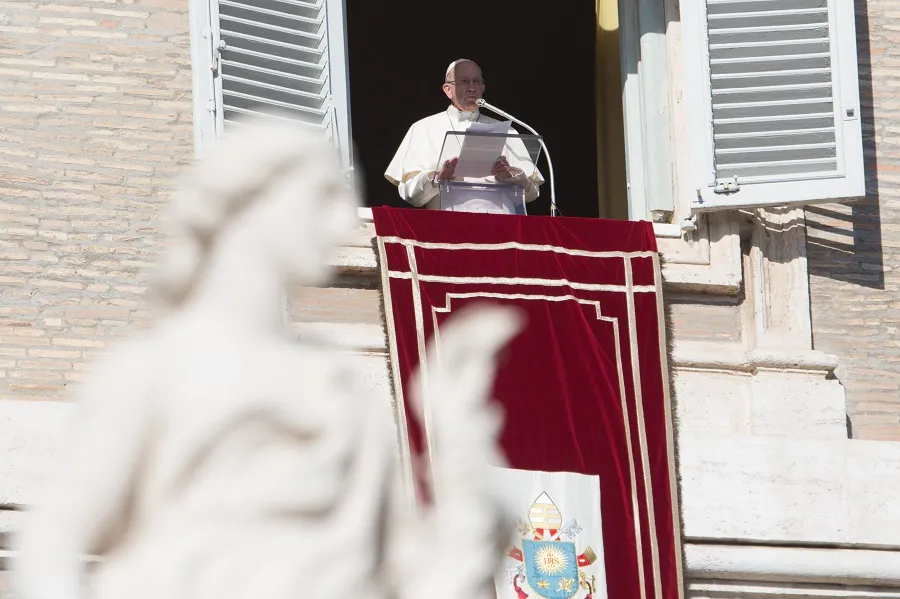
Vatican City, Mar 11, 2018 / 05:12 am (CNA/EWTN News).- On Sunday Pope Francis said that to be a Christian isn’t easy, but means having faith and striving to live a moral life even when it’s hard, trusting in God and his love during moments of weakness and anxiety.

“Christianity doesn’t offer easy consolations, it’s not a shortcut, but requires faith and a healthy moral life which rejects evil, selfishness and corruption,” the Pope said March 11.

A faithful and moral life, he said, “gives us the true and great hope in God the Father, rich in mercy, who has given us his only son, thus revealing to us his immense love.”

Pope Francis spoke to pilgrims in St. Peter’s Square for his Sunday Angelus address, which he focused on the day’s passage from John’s Gospel when Jesus speaks to Nicodemus, explaining what will happen to those who believe and walk in truth, and what will happen to those who don’t.

Jesus’ affirmation that “God did not send his Son into the world to condemn the world, but that the world might be saved through him,” synthesize the core of Christian message, Francis said.

Namely, this message is that “even when the situation seems desperate, God intervenes, offering man salvation and joy.” God, the Pope said, doesn’t stand aside, but “enters into the history of humanity to animate it with his grace and to save it.”

Christians, he said, are called to listen to this announcement and to reject the temptation to be too sure of themselves, wanting to “do without God,” and be “liberated” from him and his word.

“When we find the courage to consider ourselves for what we are, we realize that we are people called to deal with our fragility and our limits,” he said, noting that at times thinking about these weaknesses can lead people to be anxious for the future, or afraid of illness and death.

This, Francis said, is the reason many people look for “a way out,” turning to “dangerous shortcuts such as the tunnel of drugs, superstitions or ruinous magic rituals.”

However, Christianity offers a different path. Though it’s not easy, it leads to hope, he said, and pointed to the image of Jesus on the cross, which he said is the “greatest manifestation of God’s love.”

“It’s good to know our limits,” he said. Not to become discouraged, “but to offer them to God, and he helps us in the path of daily life. He takes us by the hand, but he never leaves us alone, never. Because of this we have joy.”

Turning again to the passage in the day’s Gospel where Jesus says that he didn’t come to condemn the world, but to save it, Pope Francis said if Christians root themselves in this affirmation, then “our trust is unshakable.”

To do this, he said, “is a matter of opening the heart.” And during Lent in particular, this means opening means increasingly opening oneself to God in a better way.

“Only in this way can we live a life animated by justice and charity, and become testimonies of this divine love; a love which is not only given to those who earn it, doesn’t ask for recompense, but is offered freely, without conditions.”

Jesus went to the cross “to heal us,” he said, and in off-the-cuff comments urged faithful to look to the crucifix and say: “God loves me. It’s true, there are sins, (but) God loves us in our weakness, in our infidelity, in our fragility…let’s look to the crucifix and go forward.”

Pope Francis closed his address asking that Mary would help obtain for each person this certainty that they are loved by God.

“(God) is close to us in moments when we feel alone, when we feel tempted to surrender to the difficulties of life,” he said, and prayed that those present would be able to communicate the message of Jesus, so that Lent would become “an experience of forgiveness, welcome and charity.”

After leading pilgrims in praying the Angelus, the Pope greeted pilgrims present from around the world, offering a special welcome the students, mentors and tech experts who participated in the March 8-11 first-ever Vatican “Hackathon.”

Speaking directly to the students, he told them “it’s beautiful to place intelligence, which is a gift from God, at the service of the truth and those most in need.”

[…]

No Picture
News Briefs

Syria is a new ‘massacre of the innocents,’ nuncio says

March 9, 2018 CNA Daily News 1

Vatican City, Mar 9, 2018 / 03:54 pm (CNA/EWTN News).- As the number of civilian victims in Syria’s bloody civil war continues to climb, Cardinal Mario Zenari, apostolic nuncio in Syria, said the situation is “hell on earth,” especially for vulnerable children.

Referring to a statement recently made by the regional director of the United Nations Children’s Fund (UNICEF), Zenari said Syria is currently “one of the most dangerous places for children.”

“It’s terrible. I always say, it’s a massacre of the innocents,” he said, and recalled how a few years ago near Damascus, where the nunciature is located, he met a 10-year-old girl who had both of her legs amputated after being hit by shrapnel from a mortar shell.

He recalled another story of a 15-year-old girl who was on her way back from school with a friend when a splinter from an explosion tore through her cheek and up through her head, killing her instantly.

There is “so much suffering,” Zenari said, adding that Pope Francis’ Christmas message for 2017 was “one of the most touching for me,” because it was entirely dedicated to the suffering of children.

From a humanitarian perspective, the situation is “out of control,” he said, and one could write “a book of lamentations” on the Syrian crisis alone.

Zenari, who has served as apostolic nuncio since 2008 and was named a cardinal by Pope Francis in 2016, spoke at a March 9 event for the “Open Hospitals” project, developed by the AVSI organization in 2016 in partnership with the Gemelli Foundation and the pontifical charity branch “Cor Unum.”

The project aims to provide medical care for those living in poverty and supports the activities of four non-profit hospitals in Syria.

Since the beginning of the country’s civil war in 2011, more than 13.5 million Syrians, including 6 million children, have been affected by a dire humanitarian crisis, with the majority of the population living in situations of food insecurity and without access to basic supplies.

According to U.N. estimates, some 11.5 million people, 40 percent of whom are children, do not have access to adequate medical care. Hospitals have routinely been targeted in the fighting, and since the beginning of the war, nearly two-thirds of Syria’s medical staff have fled the country.

With money needed to pay for staff, general management, monthly bills, and the renewal of old facilities, patients increasingly file into the few hospitals that are left with both routine healthcare needs and war injuries, making the financial strain near crippling.

As of November 2017, roughly one million euros (nearly $1.2 million) had already been raised by the Open Hospitals project to support the four hospitals with whom they partner.

In his speech for the March 9 event, Cardinal Zenari showed a 2-minute video portraying images of buildings destroyed by shelling and people injured in bombings, many of them small children with bloody face, covered in dust.

The social fabric of society is being “attacked,” he said, and “the deep wounds, above all in these children, are worse than what is seen.”

The number of civilian victims of the war has drastically increased in recent weeks, after Russian-backed Syrian forces on Feb. 18 launched a series of deadly airstrikes and artillery fire on besieged Easter Ghouta enclave, which sits just northeast of Damascus.

Home to some 400,000 people, Eastern Ghouta is the last rebel-held area east of Damascus and has been a target of Syrian President Bashar al-Assad’s forces since 2013 in a bid to drive the rebels out.

According to the Syrian Observatory for Human Rights, some 900 civilians have died so far in the fighting. Although the U.N. Security Council demanded a 30-day ceasefire go into effect Feb. 24, fighting has continued, and efforts to get humanitarian aid into areas where citizens are trapped were recently halted due to fear of chemical attacks.

Cardinal Zenari said that of all the world disasters he’s witnessed, “I have never seen so much violence as in Syria,” and likened the situation to the 1994 Rwandan genocide.

At times, Zenari said he asks himself, “Does the Lord not see this?” However, he said he is consoled when he thinks of the Jesus’ own suffering and death, because “Jesus in his passion sweat blood, from his whole body…(the) blood of the entire Church, the blood of the martyrs.”

“We are in the eighth year of the Passion” in Syria, he said.

He lamented the fact that no agreements have yet been reached to put an end to the violence, saying that so far the discussions either fail to yield a deal, or a deal is made but falls apart.

The cardinal also pointed to the millions who have fled Syria and are now living in other countries, including a high number of youth. Because of this, he said, Syria is rapidly becoming “a society without youth, a Church without youth.”

He closed his hour-long address with an appeal for prayer, asking attendees to pray for “our dear friends, brothers and sisters in Syria.”

[…]

No Picture
News Briefs

Students ‘hack’ away at global problems during Vatican hackathon

March 9, 2018 CNA Daily News 1

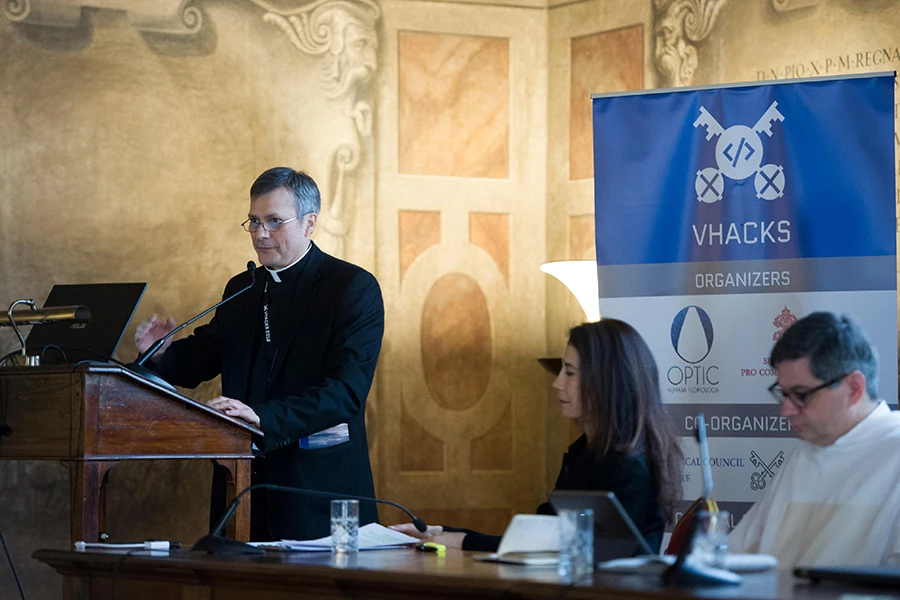
Vatican City, Mar 9, 2018 / 01:58 pm (CNA/EWTN News).- A March 8-11 “hacking marathon” at the Vatican is in full swing, with 120 students of different backgrounds, faiths, and disciplines working to “hack” into global social problems in 36 hours of innovative brainstorming.

“VHacks” is the first-ever Vatican hackathon, and the young participants and organizers have said that the location is an integral part of the event’s impact and appeal.

“It still sounds so strange: a hackathon at the Vatican,” said Cameron, a 21-year-old participant. “And that’s what makes it so amazing – the fact that you wouldn’t expect it.”

Cameron is an electrical engineering student at Harvard and on the organizing committee of VHacks. He told CNA that fact that VHacks is taking place at all says a lot “about how the Vatican, especially with Pope Francis’ style, is embracing technology a little bit more than it has before.”  

Hailing from 60 different countries, participants work in teams to tackle challenges related to the broader themes of social inclusion, interfaith dialogue, and refugees and migrants.

Each team chooses a challenge to “hack” during the conference, working nearly round-the-clock to come up with creative, technological solutions. At the end, all the teams will present their solutions to judges who choose the top projects and the final winners.

Ibrahim, 21, is from Pakistan and is studying industrial engineering and management at Jacobs University in Bremen, Germany.

He told CNA that the themes of VHacks are good in and of themselves, “but to have [the event] at such an important place just adds to it and adds to how serious we are in figuring out and solving these problems.”

A Muslim, he considers the Vatican a “landmark,” and a “sacred place,” which adds to the overall environment of the hackathon. “I think this is an extremely amazing initiative,” he said.

Hailing from Buenos Aires in Argentina, Sebastian, 24, told CNA that he has participated in hackathons before, but this one is “on another scale,” and that’s what first piqued his interest.

As a Catholic, he was also glad to see the Church getting involved in something like a hackathon, he said, noting that he has been invited to different hackathons before but decided against participating because compared to VHacks, “something was always missing.”

Lucy, 29, told CNA that she is really excited by “how invested this hackathon is in the human perspective and understanding what the user’s needs are.” She is a master’s student studying human-centered design thinking at Georgetown University.

Her team members, who all came from Georgetown, a partner in the event, chose the migrants and refugees challenge. “When you think about refugees in the big scope, it seems like there’s no point of entry that’s going to succeed,” she said.

“So how do we as individuals or as groups find an entry into that? I really think it is through this human-centered design” that VHacks is focused on.

The hackathon is also interspersed with educational opportunities, including panels and workshops on topics related to the themes. Participants can also avail themselves of advice and guidance from experienced “mentors” present to help throughout the conference.

“It’s not just a hackathon but a learning experience and a team-building experience,” Lucy said.

The event will conclude with Mass and sightseeing in St. Peter’s Basilica March 11, followed by attendance at the Pope’s Sunday Angelus and his papal blessing in St. Peter’s Square.

Dominican Fr. Eric Salobir, a co-chairman of VHacks and a consultor for the Secretariat of Communications, told CNA that having the hackathon at the Vatican is very symbolic, and allows big issues to be tackled from the global perspective offered by the Church.

Salobir is also the founder of the OPTIC network, a disruptive technology think-tank which frequently collaborates with the Holy See.

Explaining the term hackathon, Cameron clarified that while the words “hack” or “hacking” can have negative connotations, the phrase in this case is used to mean “hacking into a problem that has no clear start.”

“It just comes down to finding an entry point and saying, ‘This is where we’re going to start looking at it.’”

He acknowledged that it is unrealistic to think that solutions to these problems can possibly be found in just 24 or 36 hours. But what they want to do is “plant a seed” and create something to expand on in the future.

The environment of the hackathon, which lacks the usual pressures found in a career setting, makes it really “conducive to innovation,” he stated.  

In the end, it is hoped that some of the new ideas produced will be brought to fruition by the corporations, foundations and private donors sponsoring the hackathon.

A lofty goal, Salobir said they even hope to have some examples “of how technology can help to solve problems” in place by the time of the synod on the youth in October. “We hope to be able to show very practical, useful solutions,” he said.

“We saw from our experiences [putting on hackathons] in San Francisco and Paris that the students are incredibly creative in the way to use technology positively, in a way the older generations cannot imagine. They were born in this time of digital technology and sharing economy and they can provide a lot.”

“I have no clue what they will do practically, I have just the experience of other hackathons. But at other hackathons they really came with amazing ideas. I hope that this time it will be the same and they will really blow our minds with their creativity.”


[…]

No Picture
News Briefs

Pope Francis: We abandon God through sin, but he never abandons us

March 9, 2018 CNA Daily News 2

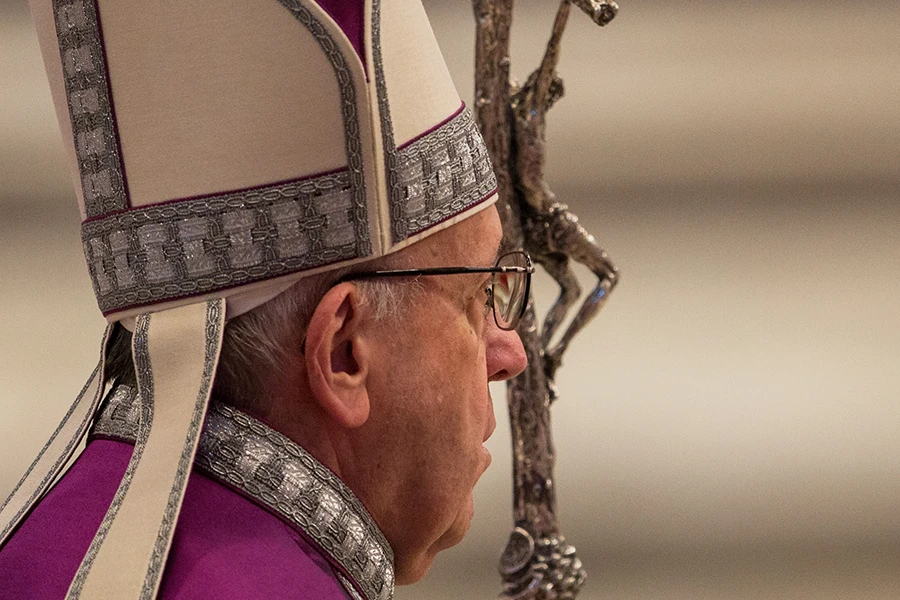
Vatican City, Mar 9, 2018 / 12:09 pm (CNA/EWTN News).- At his annual Lenten penitential service on Friday, Pope Francis said that it is not God who abandons us when we sin, but we who separate ourselves from him by choosing to sin, and that no matter what we do, God never stops loving us.

“We know that the state of sin distances us from God. But in fact, sin is the way that we distance ourselves from him. Yet that does not mean that God distances himself from us,” the Pope said March 9.

“The state of weakness and confusion that results from sin is one more reason for God to remain close to us,” he continued. “The certainty of this should accompany us throughout our lives.”

Pope Francis gave a brief homily during an annual Lenten penitential service in St. Peter’s Basilica. He reflected on a passage from the first letter of John, which speaks about God’s love for his children.

God’s love is greater than anything we can imagine, reaching beyond even the worst sins we find within us, he said.

“His is an infinite love, one that knows no bounds,” he reflected. “The words of the Apostle are a reassuring confirmation that our hearts should trust, always and unhesitatingly, in the Father’s love: ‘No matter what our hearts may charge us with, God is greater than our hearts’ (1 Jn. 3:20).”

Following the homily, Pope Francis led a silent examination of conscience. Then, as in other years, the Pope was the first to go and make his confession to a fellow priest before hearing the confessions of several others.

Other priests were also available throughout the basilica to hear individual confessions.

The penitential service also marked the beginning of the “24 Hours for the Lord” initiative held yearly on the fourth Friday and Saturday of Lent.

Led by Pope Francis, “24 Hours for the Lord” is a worldwide initiative that points to confession as a primary way to experience God’s merciful embrace. It was launched in 2014 under the auspices of the Pontifical Council for the Promotion of the New Evangelization.

The event gives Catholics an opportunity to go to confession and take part in Eucharistic adoration at participating churches. This year’s theme is “With you is forgiveness” taken from Psalm 130.

Earlier on March 9, Pope Francis spoke to participants in the Apostolic Penitentiary’s annual course on the internal forum, which is attended primarily by young priests, seminarians, and penitentiary priests specifically appointed to hear confessions and administer penance.

This year, ahead of the Synod of Bishops on youth, the course focused on the relationship between sacramental confession and vocational discernment.

In his speech, Francis noted how young priests have an “advantage – so-to-speak” when it comes to hearing the confessions of other young people, a proximity of age “favors even sacramental dialogue.”

On the other hand, there are limitations and challenges to being at the beginning of their ministry and therefore lacking in the experience of an older confessor, he said.

With these thoughts in mind, he asked, how do we go about listening to sacramental confessions, especially of the young, when it comes to vocational discernment?

“First of all, I would say that it is always necessary to rediscover, as St Thomas Aquinas says, the instrumental dimension of our ministry,” he said. “The priest confessor is not the source of Mercy or of Grace; he is certainly the indispensable tool, but always just an instrument!”

Being intentionally aware of this can help keep priests from becoming what Francis called “masters of consciences” instead of humbly listening to the Holy Spirit. He emphasized that seeing oneself as an instrument is not a lessening of the priest’s role in confession, but “the full realization of [the ministry].”

The Pope also stressed that confessors should listen carefully to any questions before offering answers, and when these two elements come together in sacramental dialogue, it can help to open up the journey of prayer and prudence that is vocational discernment.

Concluding, he encouraged the present and future confessors to be “witnesses of mercy, humble hearers of young people and God’s will for them, always respectful of the conscience and freedom of those who approach the confessional.”

He reminded them to entrust penitents to Mary, “who is the Refuge of sinners and Mother of mercy.”

[…]

No Picture
News Briefs

Dialogue must serve truth, Catholic leader says in response to women’s conference

March 9, 2018 CNA Daily News 1

Vatican City, Mar 9, 2018 / 09:55 am (CNA/EWTN News).- A women’s conference in Rome this week called for changes in Church teaching that organizers say would promote equality, but the head of a Catholic women’s organization cautioned that true equality must adhere to truth.

First held in 2014, the “Voices of Faith” conference has taken place annually on March 8 in honor of International Women’s Day. The title for this year’s event was “Why Women Matter.”

The event is known to annually include at least a few speakers who oppose Catholic teaching on key topics such as homosexuality and women’s ordination. This year, however, a dissenting tone was much more prominent among conference presenters.

Past events have featured also positive stories about women and the Church, such as a testimony last year from a Rwandan genocide refugee who received an education with the help of Salesian missionaries.

This year’s event, in contrast, focused heavily on a push to change Church teaching, with not a single speaker defending Church doctrine and practice.

Former president of Ireland Mary McAleese, herself a Catholic, delivered a keynote speech accusing the Church of maintaining a misogynistic attitude, saying Church leaders are trying to drown women out due to fear.

“We are here to shout, to bring down our Church’s walls of misogyny,” she said, and, referring to the Church hierarchy, added that “I hope that all the hearing aids are turned up today!”

McAleese, who has previously advocated publicly for same-sex marriage and women’s ordination to the priesthood, argued that “misogyny and homophobia” have been present since the Church’s establishment and have “kept Christ out and bigotry in.”

The Catholic Church “lags noticeably behind” other nations in the advancement of women and uprooting of discrimination, she said, calling this “a disgrace” for an organization “that claims to be created by God.”

Although new jobs and positions have opened up to members of the laity, both women and men, since the Second Vatican Council, McAleese said that “these have simply marginally increased the visibility of women in subordinate roles, including in the Curia,” and have “added nothing to their decision-making power or their voice.”

Ultimately, she said, not allowing women to be ordained to the priesthood, “has locked women out of any significant role in the Church’s leadership, doctrinal development and authority structure since these have historically been reserved to or filtered through ordained men.”

Other speakers took up similar topics, focusing on exclusion and calling the Church to change its teaching on homosexuality.

However Mary Rice Hasson, fellow at the Ethics and Public Policy Center in Washington D.C., warned that events such as the Voices of Faith conference do not effectively foster dialogue if they openly reject Church teaching.

“Dialogue and accompaniment have to be a walk towards the truth, in confidence that living in the truth is what brings happiness,” she told CNA.

Hasson, who was not affiliated with the conference, stressed that women should certainly discuss differences and try to understand points of conflict. But she cautioned that true constructive dialogue about women’s role in the Church “needs to take the Church’s teaching as its starting point.”

McAleese also complained that no cardinals or members of the curia were attending the event, despite a social media campaign by Voices of the Faith calling on them to do so.

“No Church leader bothers to turn up not just because we do not matter, but because their priestly formation prepares them to resist treating us as full equals,” she said.

In past years, a few Vatican officials have attending the Voices of Faith panel. This year’s event, however, drew controversy over some of the speakers.

The event has traditionally taken place inside the Vatican’s Casina Pio IV, headquarters of the Pontifical Academy for Sciences. This year, however, Cardinal Kevin Farrell, prefect of the Vatican dicastery for Laity, Family and Life, objected to two of the speakers: McAleese and Ssenfuka Juanita Warry, a LGBT advocate in Uganda.

The event required the cardinal’s approval in order to take place at Casina Pio V. Rather than adjusting their roster of speakers, Voices of Faith opted for a change of venue, and held the gathering at the headquarters of the Jesuit Curia in Rome rather than the Casina, which is located inside Vatican City State.

At the March 1 launch of the book “A Pope Francis Lexicon,” edited by Vatican journalists Cindy Wooden and Josh McElwee, Cardinal Farrell responded to a question about the dispute, saying events held within the Vatican are “presumed to be sponsored by the pope” and people assume that the pope “is in agreement with everything that is said.”

Farrell said that when he found out what the conference was about, “it was not appropriate for me to continue to sponsor such an event.”

In comments to CNA, Hasson said the Church is not just a human institution, but a supernatural gift, meaning its teachings “are true.”

“Unfortunately, the question of women’s ordination hijacked the conversation about women and the Church for decades,” she said. “It’s time to move past that.”

Similarly, Hasson said the Church’s teachings on marriage and sexuality will not change, “so agitation for change in those areas is counterproductive and is more likely to confuse people or give scandal.”

Hasson is also director of the Catholic Women’s Forum, an international network of women dedicated to amplifying the role women both in the Church and in society in support of Church teaching.

“Women are already contributing to the Church’s evangelical mission in significant ways – and have for centuries,” she said, but acknowledged that there is a need for women to be included in more high-level conversations, “because the Church needs our insights and gifts in order to accomplish its mission.”

In her opinion, Hasson said Voices of Faith “is, in part, a well-intentioned effort” to acknowledge both the gifts of women and the valuable role they play in the Church. She pointed to how previous events have drawn attention to the work women have done to assist the poor and marginalized.

Where Voices of Faith fails to serve the Church well, she said, “is in its support of advocacy agendas, proposed by women who dissent from the Church’s teaching.”

She pointed to the presence of McAlesse at this year’s conference as well as the inclusion of Sr. Simone Campbell, known for her involvement in the “Nuns on the Bus,” who works in legal advocacy for the poor yet supports the legalization of abortion, contraception and has pushed for women’s ordination.

Hasson said the organization’s demand for power is also problematic, since, as Pope Francis has emphasized, “participation is not a question of power but of service.”

She said she does not find it helpful “to measure women’s participation in the institutional Church by corporate measures,” such as keeping a tally of the number of women in leadership roles and how many of them have power and authority.

At the same time, Hasson said it is good “to open the Church’s consultative structure to make room for women,” but to do so in ways that recognize the unique needs of mothers.

Addressing the argument made by Voices of Faith conference participants that young women are leaving the Church in droves because they can’t find adequate leadership opportunities, Hasson said she doesn’t buy it.

“Women, especially young women, are leaving because they have not been brought into relationship with the Lord,” she said. “Their hearts are not converted, they don’t know the faith and don’t see the Church as a supernatural gift from God to help us live better and more fully human lives.”

“A woman who loves God doesn’t leave the Church because she doesn’t see a career path for herself in the Church.”

[…]

No Picture
News Briefs

Vatican confirms papal visit to Baltic nations in September

March 9, 2018 CNA Daily News 0

Vatican City, Mar 9, 2018 / 04:12 am (CNA/EWTN News).- Rumors of a papal visit to the Baltic states this year have been going around for months, however, the Vatican confirmed the news Friday, announcing that Pope Francis will visit Estonia, Latvia and Lithuania in September.

According to the March 9 communique, the Pope will travel to the three nations from Sept. 22-25, visiting the cities of Vilnius and Kaunas in Lithuania, Riga and Aglona in Latvia and Tallinn in Estonia.

The logo and motto for the visits were released along with the dates of the trip. Currently there is no official program for the visit, however, it is expected to be published shortly.

Francis’ September visit marks the first papal trip to the countries in a quarter of a century. He will be the second pope to travel to the Baltic states, exactly 25 years after St. Pope John Paul II, who visited the three countries in September 1993.

The theme for his visit to Lithuania is “Christ Jesus – Our Hope.” The motto for his visit to Lativia is “Show Thyself a Mother” in honor of the Virgin Mary, and the theme for Estonia is “Wake up, my heart!”

Each of the countries is predominantly Christian, with a mix of Catholic, Protestant and Orthodox populations, meaning that Francis’ visit, in keeping with his style, will likely have a strong ecumenical focus.

Both Estonia and Latvia have large Lutheran and Orthodox populations. Lithuania, on the other hand, is overwhelmingly Catholic, influenced largely by its historical connection to Poland.

More than 75 percent of the nearly 3 million people in Lithuania are Catholic, while Orthodox Christians make up about 4 percent of the population.

Latvia and Estonia, though historically Lutheran, have become increasingly non-religious. In Latvia, Lutheranism still accounts for about 34 percent of the population of just under 2 million and Catholics make up 25 percent, primarily in the eastern portion of the country. The third largest church in the nation is the Latvian Orthodox Church.

In Estonia, around 54 percent of the population of 1.3 million identify as non-religious. The Eastern Orthodox church accounts for about 16 percent and Lutheranism for almost 10 percent.

Francis’ visit also holds historical significance for the three countries, as the trip will take place during the centenary year of their establishment as independent states.

Until 1917, Estonia, Latvia and Lithuania formed part of the Russian empire. They gained independence in 1918, and remained independent until 1940, when they became part of the Soviet Union and endured Nazi domination from 1940-1944.

After their years under Nazi control, they were returned to the Soviet Union in 1945, and regained democratic independence in 1991. They have been members of the European Union since 2004.

St. John Paul II had a special fondness for Lithuania in particular, and shortly after his election famously declared that “half of my heart is in Lithuania.”

The Lithuanian capital of Vilnius is also linked to the image of Divine Mercy, as it was the city in which St. Faustina Kowalska received the visions of Jesus requesting the painting of the Divine Mercy image, and is where the original Divine Mercy image is located, to which John Paul II had a special devotion.

[…]

No Picture
News Briefs

Pope Francis: Let Catholic social teaching guide migration policy

March 8, 2018 CNA Daily News 0

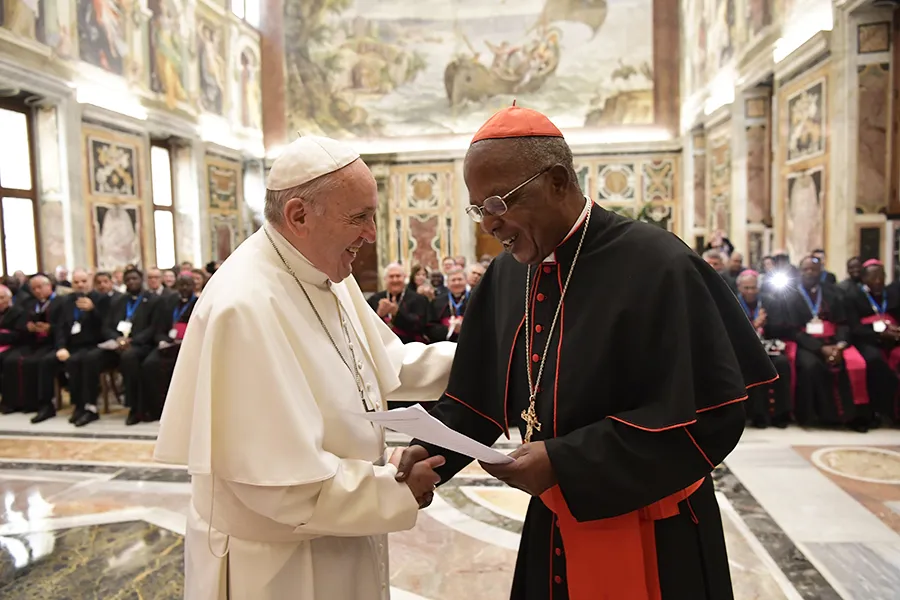
Vatican City, Mar 8, 2018 / 09:55 am (CNA/EWTN News).- The Church is responsible for encouraging civil leaders to respond to migration on the basis of Catholic social teaching, the Pope told the International Catholic Migration Commission Thursday.

“Together we must encourage countries to coordinate more suitable and effective responses to the challenges posed by issues of migration; and we can do this on the basis of the essential principles of the Church’s social teaching,” Pope Francis said March 8 in the Vatican’s Clementine Hall to the members of the comission’s plenary council.

“I ask the Holy Spirit to continue to enlighten all of you, as you carry out your vital mission of showing forth God’s merciful love to our migrant brothers and sisters.”

He commented that “your commitment has deepened in response to the inhumane living conditions experienced by millions of our migrant and refugee brothers and sisters in various parts of the world. Just as he did at the time of Israel’s enslavement in Egypt, so too the Lord hears their cry and sees their sufferings.”

The commission was founded in 1951, and the Pope said its works “represent exemplary instances of the four verbs – welcome, defend, promote and integrate – by which I wished to characterize the Church’s pastoral response in the face of migration.”

Francis also said he hopes the commission “will continue to inspire local Churches to do all they can for persons forced to leave their home countries and who, all too often, become victims of dishonesty, violence and abuse of every sort.”

He referred again to Moses’ commission from the Lord to free the Hebrews from Egypt, and said that “In order to set free those who today are oppressed, rejected and enslaved, it is essential to promote open and sincere dialogue with government leaders, a dialogue that takes into account people’s actual experiences, sufferings and aspirations, in order to remind everyone once more of his or her responsibilities.”

The Pope commended the compacts on refugees and migrants being drafted at the United Nations as “a privileged forum for implementing such dialogue.”

“We must … commit ourselves to ensuring that, as a sign of shared global responsibility, concrete engagement follows from the words already codified in the aforementioned two agreements,” Pope Francis stated.

[…]

No Picture
News Briefs

Vatican aims to ‘change the narrative’ on migrants, refugees

March 7, 2018 CNA Daily News 1

Vatican City, Mar 7, 2018 / 09:08 pm (CNA/EWTN News).- For the Vatican’s point man on migration, ever since the crisis reached a fever pitch in 2015, the mass movement of people has been painted in an overly negative, ominous and threatening light – a narrative he says needs to change.

When it comes to the perplexing question of migrants and refugees, “we need positive stories,” Fr. Michael Czerny, SJ, told members of the International Catholic Migration Commission March 7.

He said the migration crisis which has captured the public eye and dominated much of the world’s political discourse over the past few years has largely been painted in a negative light.

As one of two co-secretaries for the Dicastery for Integral Human Development’s section for migrants and refugees, Czerny said part of their job is “to help change the narrative” on the issue, because “the public view is negative.”

Fr. Czerny was one of three panelists addressing the 2018 U.N. global compacts on migrants and refugees during the ICMC’s March 6-8 plenary assembly in Rome. Speaking alongside him were Fr. Fabio Baggio, who serves as the second secretary for the dicastery and helps Czerny to oversee the section for migrants and refugees, and Stephane Jaquemet, the ICMC’s head of policy.

In comments to CNA, Czerny said a simple answer for the negative reaction is globalization and the fact that it was first viewed “as the great leap forward for the whole world, it was supposed to benefit everybody … the bitter, bitter, bitter disappointment of people all over the world and the way in which they’ve been betrayed by their economic and political leaders, is easy to scapegoat on people who are different from us, and who need and deserve our help but who are caught up in this pattern.”

Czerny said that in his view, the prevalent negative narrative on migration issue has nothing to do with migrants and refugees, but is rather “a misplaced disappointment with our leaders.”

Migrants and refugees, he said, “are being scapegoated. So I think by telling the truth and by telling positive stories, that’s how I hope we can reverse that narrative.”

Especially where the Church is concerned, migrants, refugees, asylum seekers, and victims of human trafficking “should feel that they are part of the life of the Church,” he said. “They should feel that they are welcomed and accompanied.”

Part of dicastery’s task, he said, is to ensure that “migration is a matter of choice,” and that no one is forced to leave their home country, especially not as a result of poverty or violence.

However, since migration is and always will be a reality the world has to face, another part of their mission means supporting the Church “in her mission to accompany migrants.”

“It’s no lie” that societies have been “enormously enriched” by migration and will continue to do so, he said, and pointed to the global compacts as a means of both helping migrants throughout their journey and making the process more bearable when they arrive.

The UN is drafting compacts aimed at improving the international community’s response to large movements of refugees and migrants, ensuring safe and orderly passage for migrants, and as well as to protracted refugee situations.

According to Czerny, issues of pastoral interest for the Church are ensuring that migrants, refugees, displaced persons, asylum seekers, and victims of trafficking have the adequate resources and support needed to arrive safely and integrate into their new societies.

To this end, he pointed to the four-point “action plan” outlined by Pope Francis in his message for this year’s World Day for Peace, titled “Migrants and Refugees: men and women in search of peace.”

The four points – to welcome, protect, promote, and integrate – have been adopted by the Holy See as a response to the migration issue and have been widely promoted in the diplomatic scene.

By promoting and advancing the integral development of migrants and refugees, the Church is putting into action “what social doctrine has taught all along,” he said, adding that by helping migrants and refugees integrate, the communities where they live become enriched.

In his comments to CNA, Czerny noted how many western governments in particular, not wanting to take in their share of the influx of migrants and refugees, try to solve the problem by providing financial support to countries of origin so citizens don’t have to leave in the first place.

“We have been trying to promote – we the west, the well-developed countries, have in some ways been trying to promote development in the third world practically since World War Two,” Czerny said. However, “the results are not very impressive.”

“So if there is going to be a real effort to promote real integral sustainable development, God bless us, let’s do it,” he said, but cautioned that if this promise of “development” is in reality “a way of trying to trick and bribe people to stay home because we don’t want them here, I think we should denounce it.”

In his comments during the panel, Jaquemet outlined the process of drafting and discussing the compacts.

One of the biggest stumbling blocks for the compact on refugees, Jaquemet said, is the issue of “solidarity,” because there are many states who have taken in refugees for years, but who are now seeing a decrease in financial support.

“Those countries are not happy,” he said, noting that western countries tend to be “quite reluctant to go into formal commitments in terms of burden sharing and solidarity.”

[…]